



Executive Summary
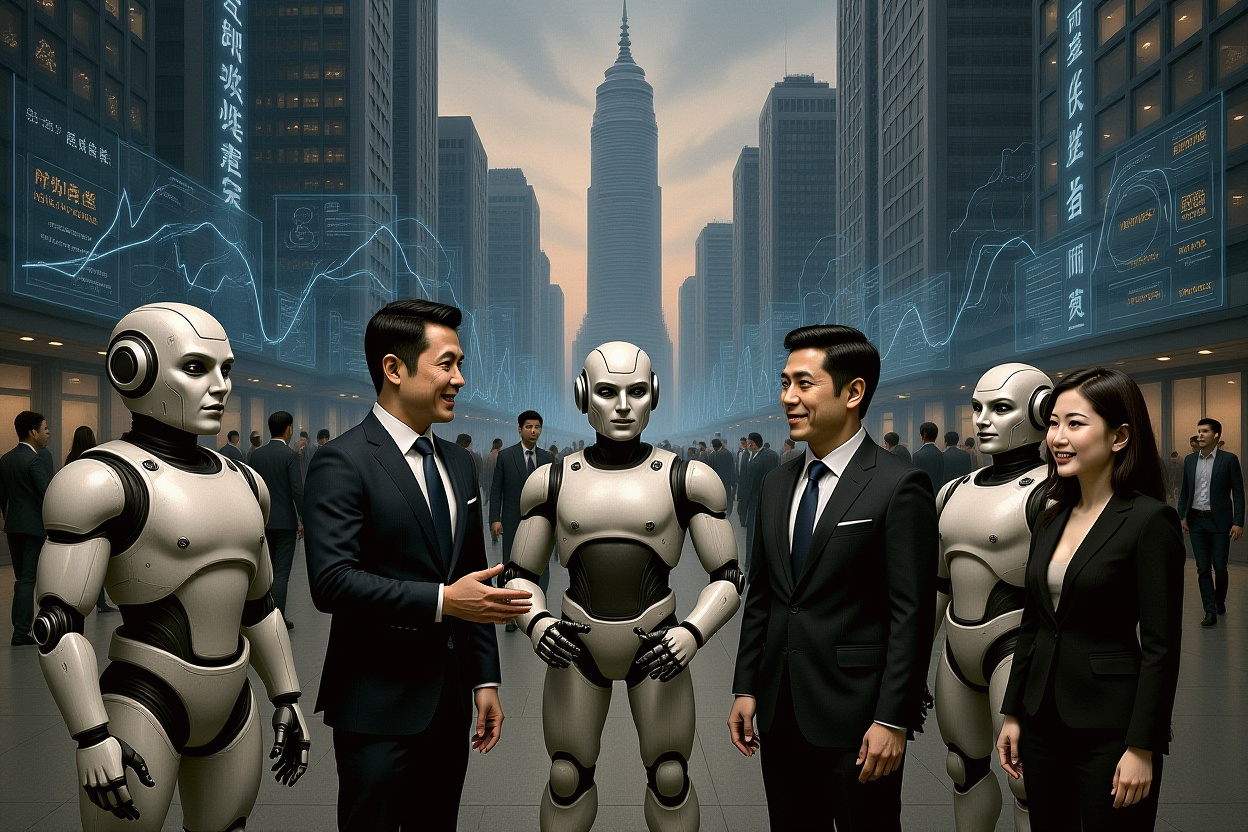
As global investors seek exposure to China’s technological frontiers, the 2026 CCTV Spring Festival Gala (央视春晚) emerged as a critical barometer for the embodied intelligence (具身智能) industry. This annual spectacle, watched by hundreds of millions, transformed into a high-stakes proving ground for domestic robotics leaders, offering profound insights into market readiness and investment viability.
– The Gala featured a coordinated debut of four major Chinese embodied intelligence firms—Magic Atom (魔法原子), Galaxy Universal (银河通用), Unitree Robotics (宇树科技), and Songyan Dynamics (松延动力)—marking the sector’s transition from lab curiosity to national showcase.
– IDC projects China’s embodied intelligence robot user spending to surge to $770 billion by 2030, with a compound annual growth rate of 94%, highlighting immense economic potential.
– Success on stage is merely the first hurdle; the real challenge lies in conquering industrial, commercial, and home environments, where reliability and scalability determine survival.
– For investors, the post-Gala phase demands a focus on firms with tangible orders, repeat customers, and robust application pipelines, moving beyond hype-driven valuations.
– Regulatory tailwinds from initiatives like “Made in China 2025” and AI development plans provide a supportive backdrop, but market forces will ultimately separate winners from losers.
The National Spotlight: A Catalyst for Technological Legitimacy
The CCTV Spring Festival Gala has long served as China’s premier cultural and technological stage, but the 2026 edition will be remembered as the moment embodied intelligence stepped into the mainstream. For the first time, humanoid robots were not peripheral novelties but central performers, engaging in complex choreography, martial arts, and interactive sketches. This strategic placement underscores a concerted push by industry and government to position China as a global leader in next-generation robotics. The Gala’s role as the ultimate testing ground for embodied intelligence is clear: it validates technological maturity while accelerating public and commercial acceptance.
Decoding the Four Contenders: Strategies Behind the Performances
The participation of Magic Atom (魔法原子), Galaxy Universal (银河通用), Unitree Robotics (宇树科技), and Songyan Dynamics (松延动力) revealed nuanced competitive dynamics. Each firm’s official designation—from “春晚机器人合作伙伴” (Spring Festival Gala Robot Partner) to “春晚指定具身大模型机器人” (Spring Festival Gala Designated Embodied Large Model Robot)—reflected distinct technical pathways and market positioning. Unitree Robotics, building on its 2025 Gala breakout, performed a martial arts routine with the Henan Tagou Martial Arts School, emphasizing dynamic mobility and precision. Songyan Dynamics appeared in a comedy sketch with veterans Cai Ming (蔡明) and Wang Tianfang (王天放), targeting emotional resonance and human-robot interaction. Magic Atom supported a song themed on intelligent manufacturing, while Galaxy Universal featured in a microfilm with popular actors Shen Teng (沈腾) and Ma Li (马丽), blending entertainment with narrative-driven promotion. This variety demonstrates how the Gala serves as a multifaceted platform for testing consumer engagement and functional versatility.
The Gala’s Dual Mandate: Public Education and Commercial Validation
Beyond spectacle, the Spring Festival Gala fulfills two critical missions for the embodied intelligence sector. First, it demystifies robotics for a mass audience, normalizing the idea of machines as cohabitants in daily life. Second, it provides a credibility boost for domestic technology, reassuring industrial buyers, supply chain partners, and international investors of China’s innovation capabilities. As Pan Gongsheng (潘功胜), Governor of the People’s Bank of China (中国人民银行), has emphasized in speeches on technological self-reliance, such showcases align with broader economic strategies. The Gala effectively functions as a live due diligence event, where performance under pressure signals operational readiness for the ultimate testing ground of real-world applications.
Market Explosion: Projections and Investment Implications
The embodied intelligence sector is poised for hypergrowth, with implications for equity markets, venture capital, and corporate strategy. IDC’s forecast of $770 billion in user spending by 2030 translates to a market expanding at nearly double each year, driven by labor shortages, automation demand, and policy support. For investors, this represents a golden opportunity, but one requiring careful navigation beyond the glow of stage performances.
Capital Flows and Valuation Realities
In recent years, Chinese robotics firms have attracted significant funding, with Unitree Robotics reportedly securing over $100 million in its latest round. However, the post-Gala environment demands a shift from potential to proof. As Maggie Wu (武卫), former CFO of Alibaba Group (阿里巴巴集团), noted in discussions on tech investment, “Sustainable value is built on recurring revenue, not one-off demonstrations.” The Gala’s spotlight has intensified scrutiny on business models, pushing companies to demonstrate path to profitability. Key metrics now include order backlogs from manufacturing clients, partnerships with logistics giants like SF Express (顺丰速运), and pilot programs in healthcare or retail. The ultimate testing ground for embodied intelligence is no longer the春晚 stage but the balance sheet and customer testimonials.
Regulatory and Economic Tailwinds
China’s regulatory framework actively supports embodied intelligence development through initiatives like the “Robotics Industry Development Plan (2021-2025)” issued by the Ministry of Industry and Information Technology (工业和信息化部). These policies encourage R&D investment, standardization, and cross-industry integration, reducing barriers to adoption. Additionally, the China Securities Regulatory Commission (中国证券监督管理委员会) has facilitated listings for tech firms, providing exit avenues for early backers. For global investors, understanding these dynamics is crucial, as they mitigate some risks while emphasizing the need for compliance in data security and safety standards, which are part of the ultimate testing ground for market entry.
The Real-World Crucible: Three Gates to Commercial Viability
When the Gala’s lights dim, embodied intelligence companies face a grueling transition from表演 to application. Industry insiders succinctly capture this challenge: “Robots can’t dance on stage forever.” To achieve scalable success, firms must conquer three sequential environments, each more demanding than the last.
Gate One: Industrial Adoption and Reliability
Factories represent the most immediate and lucrative market, with applications in assembly, quality inspection, and material handling. Here, the ultimate testing ground is defined by uptime, precision, and cost-efficiency. A robot that flawlessly executes a dance routine may falter in a dusty, vibration-prone assembly line where milliseconds matter. Companies like Siasun Robot & Automation (新松机器人自动化), a long-time industrial player, set high benchmarks for durability. For newer entrants, partnerships with automotive or electronics manufacturers serve as critical validations. Failure rates, mean time between failures (MTBF), and return on investment calculations become the true metrics, far removed from春晚 applause.
Gate Two: Commercial Integration and Adaptability
Retail stores, warehouses, and hospitality venues introduce complexity through human interaction, dynamic obstacles, and varied tasks. Success here requires advanced perception, decision-making, and natural language processing—capabilities only hinted at in scripted Gala skits. For instance, a robot guiding customers in a mall must handle unpredictable behaviors, a test of embodied AI’s real-time responsiveness. Companies are deploying pilots in chains like Hema Fresh (盒马鲜生) to gather data and refine algorithms. This phase is the ultimate testing ground for integrated systems, where software and hardware must coalesce seamlessly under unpredictable conditions.
Gate Three: Home Penetration and Mass Market Appeal
The final frontier is the household, a chaotic, unstructured environment posing supreme challenges for safety, affordability, and usability. While years away from ubiquity, early forays include educational companions and elderly assistance devices. The Gala’s portrayal of robots as friendly and capable is a first step, but real homes demand robustness against pets, children, and clutter. Cost reduction is equally critical; current premium models must become accessible to average consumers. This longest-term gate represents the ultimate testing ground for societal impact, where consumer trust and regulatory approval will determine winners.
Strategic Insights for Investors and Industry Stakeholders
As the embodied intelligence landscape evolves, stakeholders must adopt a disciplined, evidence-based approach. The Gala has illuminated potential, but the road ahead is paved with technical and commercial hurdles that will reshape investment theses.
Key Performance Indicators Beyond the Hype
Sophisticated investors should prioritize metrics that reflect genuine traction:
– Recurring Revenue Streams: Look for subscription models or service contracts, not just hardware sales.
– Patent Portfolios and R&D Investment: Firms with robust intellectual property, especially in AI vision and motor control, will have competitive moats.
– Strategic Alliances: Partnerships with giants like Tencent (腾讯) or Huawei (华为) for cloud AI or with local governments for smart city projects indicate scalability.
– Safety Certifications: Compliance with standards set by the National Institute of Standards and Technology (NIST) and Chinese equivalents reduces liability risks.
– Management Expertise: Leaders with backgrounds in both technology and operations, such as those with experience at DJI (大疆创新) or Xiaomi (小米), can navigate the ultimate testing ground of commercialization more effectively.
Global Context and Competitive Positioning
China’s embodied intelligence push occurs amid intense international rivalry with firms like Boston Dynamics and Tesla Optimus. However, domestic advantages include a vast manufacturing ecosystem, rapid iteration cycles, and strong government backing. For global fund managers, exposure to Chinese robotics offers diversification and growth potential, but requires monitoring of trade policies and technology transfer restrictions. The ultimate testing ground for global competitiveness will be export performance, with Southeast Asia and Europe as key battlegrounds for cost-effective automation solutions.
Forward Trajectory: Navigating the Post-Gala Landscape
The 2026 Spring Festival Gala has set a new benchmark for embodied intelligence visibility, but it is merely the opening act in a protracted drama of innovation and commercialization. The coming years will witness consolidation, with firms that translate stage success into industrial contracts rising to the top.
For corporate executives and institutional investors, the imperative is to focus on application depth over marketing breadth. Attend industry expos like the World Artificial Intelligence Conference (世界人工智能大会) to see hands-on demonstrations, scrutinize quarterly reports for recurring revenue growth, and engage with management on long-term roadmaps. The People’s Bank of China (中国人民银行) may further influence capital allocation through targeted lending programs for advanced manufacturing, as hinted in recent policy statements.
The ultimate testing ground for embodied intelligence is now unequivocally the market itself—where reliability, cost, and utility determine survival. As the Gala fades from memory, the real performance metrics will be written in factory logs, commercial pilot data, and ultimately, household adoption rates. Stakeholders who embrace this reality will be best positioned to capitalize on one of the century’s most transformative technological shifts, turning Chinese innovation into global investment success.