



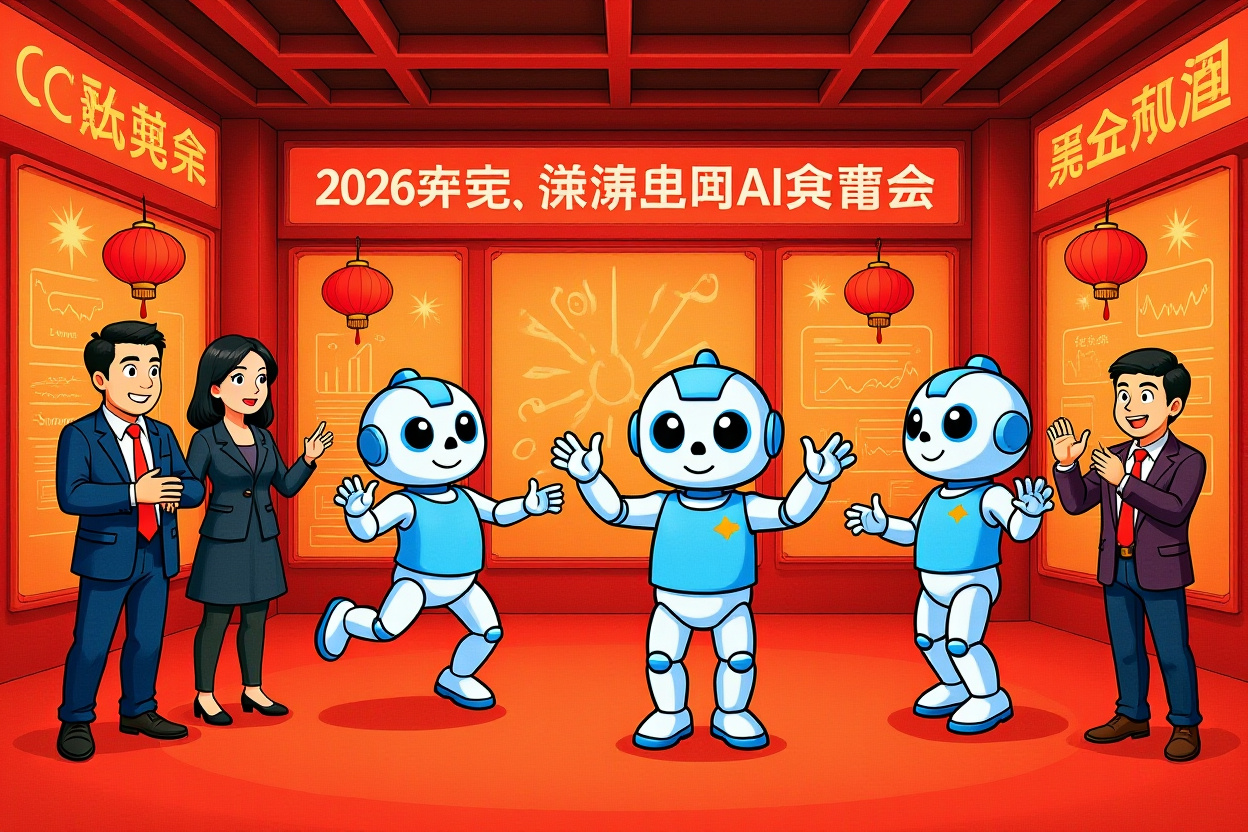
– The 2026 CCTV Spring Festival Gala featured humanoid robots from four leading Chinese embodied AI companies, moving the sector from laboratory curiosity to national spotlight.
– This showcase underscores a pivotal industry transition, with IDC predicting a 94% CAGR in user spending on embodied intelligent robots in China, reaching $770 billion by 2030.
– Companies must now overcome three commercialization hurdles: industrial reliability, commercial adaptability, and home environment integration, to achieve sustainable growth.
– The event highlights the importance of real-world applications over stage performances, with 2026 marking an inflection point for market validation and investor scrutiny.
– For global investors, the gala offers insights into China’s tech innovation pipeline, regulatory support, and potential equity opportunities in the robotics and AI sectors.
As the confetti settled on the 2026 CCTV Spring Festival Gala, a billion viewers witnessed more than festive entertainment; they observed a defining moment for China’s embodied artificial intelligence industry. The gala has emerged as the ultimate test for embodied AI, a high-stakes platform where companies like Yushu Technology (宇树科技) and Magic Atom (魔法原子) demonstrated their technological maturity. This annual spectacle, traditionally a cultural touchstone, now serves as a critical barometer for commercial viability, investor confidence, and regulatory endorsement in one of the world’s fastest-growing tech markets. For sophisticated professionals tracking Chinese equities, the performance signals a shift from speculative hype to tangible application, with profound implications for portfolio strategies in robotics and automation sectors.
The Spring Festival Gala: A National Stage for Technological Ambition
The CCTV Spring Festival Gala has long transcended its role as mere entertainment, evolving into a strategic showcase for China’s technological ambitions. In 2026, this tradition reached a new zenith with the debut of humanoid robots from four domestic embodied AI firms: Magic Atom (魔法原子), Galaxy General (银河通用), Yushu Technology (宇树科技), and Songyan Power (松延动力). Their synchronized dances and interactive skits were not just novelties but a deliberate statement of industrial capability, positioning the gala as the ultimate test for embodied AI in terms of public perception and technical robustness.
From Laboratory to Limelight: The 2026 Robot Lineup
The 2026 gala marked the first time Chinese embodied AI companies presented as a cohesive “corps,” moving beyond fragmented tech demos. Yushu Technology, building on its 2025 breakout, partnered with the Henan Tagou Martial Arts School for a wushu performance titled “武 BOT,” showcasing agility and precision. Songyan Power appeared in a comedy sketch with veterans Cai Ming (蔡明) and Wang Tianfang (王天放), while Magic Atom supported a song about intelligent manufacturing. Galaxy General featured in a micro-film with popular actors Shen Teng (沈腾) and Ma Li (马丽). This diverse participation underscores the sector’s push for mainstream integration, with each company leveraging the gala’s unparalleled reach to validate its unique value proposition.
Decoding the Titles: Strategic Positioning in a Competitive Field
A subtle but telling detail was the varied official designations for each company: Yushu Technology as “Spring Festival Gala Robot Partner,” Songyan Power as “Spring Festival Gala Humanoid Robot Partner,” Magic Atom as “Spring Festival Gala Intelligent Robot Strategic Partner,” and Galaxy General as “Spring Festival Gala Designated Embodied Large Model Robot.” These distinctions reflect deliberate market positioning—Yushu emphasizes broad robotics, Songyan focuses on humanoid forms, Magic Atom aligns with strategic AI integration, and Galaxy General highlights its large-model capabilities. For investors, such nuances reveal competitive differentiation in a crowded field, where branding can influence partnerships and funding rounds.
Beyond the Spotlight: The Commercial Imperative for Embodied AI
While the gala provides immense visibility, its true significance lies in catalyzing commercial traction. According to IDC data, China’s user spending on embodied intelligent robots is projected to hit $770 billion by 2030, with a staggering 94% compound annual growth rate. This projection transforms the gala from a publicity stunt into a vital credibility engine, offering the ultimate test for embodied AI by demonstrating real-time performance under intense scrutiny. The event serves dual purposes: educating the public on robot integration and assuring stakeholders—from supply-chain vendors to institutional investors—of Chinese technological parity with global leaders.
IDC Projections and Market Realities
The IDC forecast, cited in industry reports, highlights a gold-rush mentality in embodied AI. However, sustained growth depends on moving beyond stagecraft. The gala acts as a springboard, but companies must quickly translate applause into contracts. For instance, Yushu Technology’s post-2025 gala success led to over 12 major event appearances and 7 dedicated robot competitions, indicating initial market validation. Yet, as analysts note, the real metric is recurring revenue from industrial or commercial clients, not one-off performances. Investors should monitor quarterly filings from listed peers or venture-backed firms for signs of scalable business models.
The Gala as a Catalyst for Public and Investor Confidence
The gala’s role in building confidence cannot be overstated. By featuring robots in culturally resonant contexts, it normalizes human-robot interaction, easing adoption barriers in sectors like healthcare and logistics. Moreover, it provides a tangible proof point for capital allocation. As a fund manager specializing in Asian tech equities remarked, “The Spring Festival Gala offers a rare, real-time stress test for robotics firms—any glitch is magnified, but success can unlock Series B funding or IPO prospects.” This sentiment echoes across investment circles, where the gala is increasingly viewed as a due-diligence checkpoint for embodied AI investments.
Navigating the Three Critical Hurdles to Commercialization
As the gala’s lights dim, the embodied AI industry faces a sobering reality: robots cannot survive on dance alone. The ultimate test for embodied AI now shifts to overcoming three sequential hurdles that determine long-term viability. These challenges mirror the evolution of other tech sectors in China, where government support and market demand intersect, but profitability remains the final arbiter.
Hurdle One: Conquering the Industrial Environment
Hurdle Two: Mastering Complex Commercial SpacesThe next frontier includes warehouses, hospitals, and retail stores, where environments are dynamic and unstructured. Here, robots need advanced perception and decision-making skills to navigate crowds, avoid obstacles, and interact with humans. Magic Atom’s gala appearance in a song about smart manufacturing hints at its focus on this segment, but real-world deployment is tougher. For example, a robot serving customers in a mall must process vague requests and sudden movements—a leap from choreographed routines. This hurdle tests integrated systems, combining computer vision, natural language processing, and mobility. Venture capitalists are keenly watching pilots in logistics firms like JD.com (京东) or SF Express (顺丰速运) for scalability signals.
Hurdle Three: The Elusive Dream of the Home Robot
The final and most challenging hurdle is the home, a chaotic setting with pets, children, and variable layouts. Safety, affordability, and simplicity are paramount. Galaxy General’s micro-film role, depicting domestic scenarios, suggests aspirations in this direction, but mass adoption is years away. As an industry report from Xiaofanzhuo (小饭桌) notes, “The home robot market is a marathon, not a sprint, requiring incremental innovation in cost reduction and user experience.” For investors, this represents long-term potential but near-term risk; companies leading in industrial or commercial applications may have better cash flows to fund home-focused R&D.
The 2026 Inflection Point: From Stagecraft to Sustainable Business
The 2026 gala coincides with a broader industry pivot, where metrics of success are shifting from fundraising and media buzz to tangible orders and client retention. This inflection point serves as the ultimate test for embodied AI, separating contenders from pretenders in a market poised for consolidation. As capital flows into Chinese tech sectors, embodied AI firms must demonstrate path-to-profitability to justify valuations and attract further investment.
Shifting Metrics: Orders Over Optics
Investment Implications for the Chinese Equity MarketThe Curtain Rises on a New Era for Embodied AIThe 2026 CCTV Spring Festival Gala has set the stage for a transformative period in China’s embodied AI landscape. While the performances captivated audiences, the real drama unfolds in boardrooms and factory floors, where companies must prove their worth beyond the spotlight. The ultimate test for embodied AI is no longer about dazzling on national television but about delivering reliable, cost-effective solutions that address genuine market needs. As the industry marches toward 2030, investors should prioritize firms with clear commercialization roadmaps, strong partnerships, and resilient technology stacks. The gala’s legacy will be measured not in viral moments but in sustainable innovations that redefine China’s role in the global robotics race. For actionable insights, monitor regulatory updates from Chinese authorities and engage with equity research on emerging tech leaders, as the journey from stage to scalability is just beginning.