



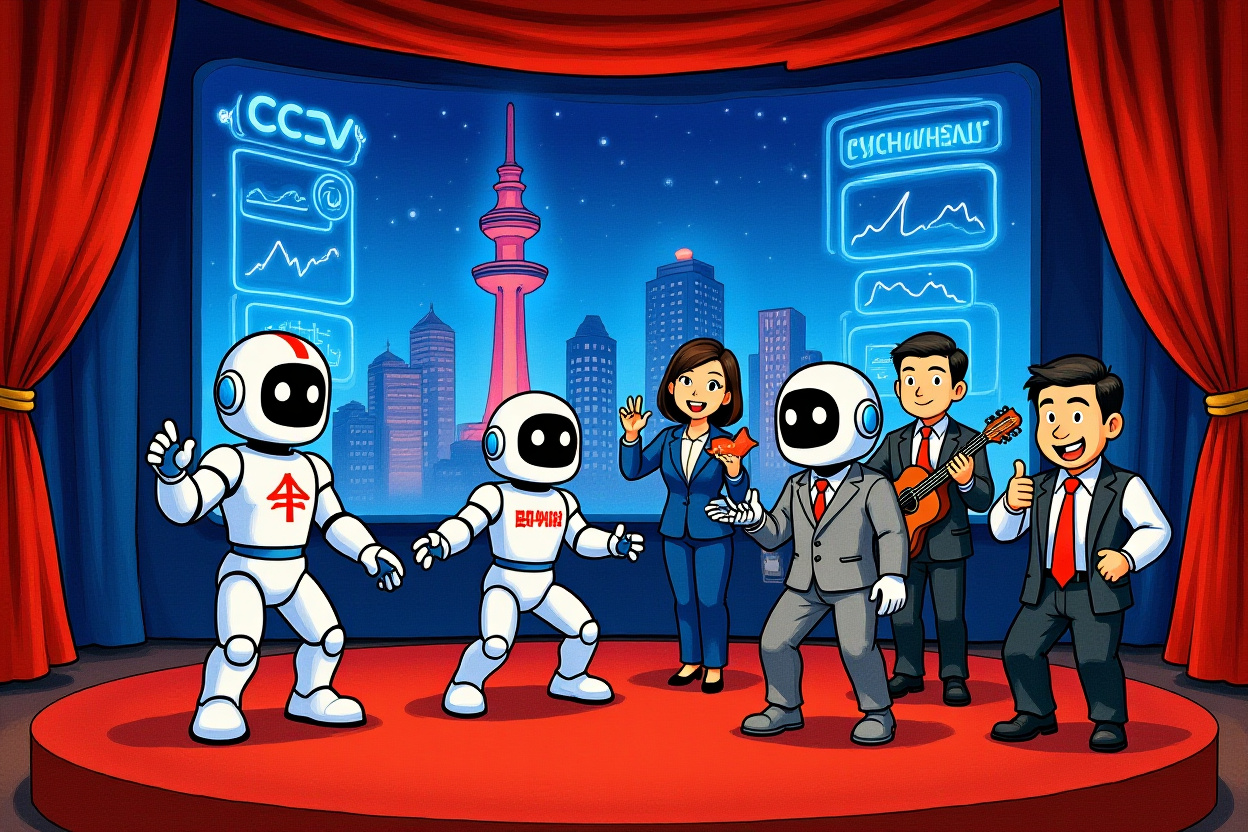
– The 2026 CCTV Spring Festival Gala served as a national platform for four Chinese embodied AI companies to demonstrate their humanoid robots, highlighting a shift from lab experiments to real-world applications.
– Behind the performances, subtle differences in official titles reveal distinct technical routes and strategic positioning among the firms, emphasizing the competitive landscape.
– Post-Gala challenges include three critical hurdles: industrial reliability, commercial adaptability, and home environment integration, which will determine true market success.
– Market forecasts project explosive growth, with China’s embodied AI user spending expected to reach $77 billion by 2030, driving a transition from hype to revenue-driven models.
– The Gala marks a watershed moment for the industry, signaling a move beyond stage spectacles to tangible orders and scalable solutions in global robotics markets.
In a stunning display of technological prowess, the 2026 CCTV Spring Festival Gala transformed from a cultural celebration into a high-stakes proving ground for China’s embodied artificial intelligence sector. As millions tuned in worldwide, the stage hosted not just traditional performers but cutting-edge humanoid robots from four domestic leaders, turning the event into what industry insiders now call the ultimate test for embodied AI. This unprecedented showcase underscores a pivotal shift: after years of research and development, Chinese robotics firms are stepping into the limelight, leveraging the Gala’s massive audience to validate their capabilities and accelerate commercialization. With the global spotlight fixed on their every move, these robots must now prove they can transcend entertainment and deliver real-world value, making the CCTV Spring Festival Gala as the ultimate test for embodied AI a defining moment for the industry’s future.
The Gala as a National Stage for Embodied AI’s Debut
The CCTV Spring Festival Gala has long been a barometer for China’s tech trends, but the 2026 edition elevated this role by featuring embodied AI robots as central performers. This marked the first time that multiple domestic firms presented their humanoid robots collectively on such a prestigious platform, signaling a strategic push to mainstream robotics. The inclusion of Magic Atom (魔法原子), Galaxy General (银河通用), Yushu Technology (宇树科技), and Songyan Dynamics (松延动力) highlighted the government’s endorsement of homegrown innovation, aiming to boost public acceptance and investor confidence in China’s robotics ecosystem. By treating the Gala as the ultimate test for embodied AI, these companies faced intense scrutiny, not just for their choreography but for their underlying technology’s readiness for mass adoption.
A Close Look at the Four Contenders and Their Performances
Each company brought unique strengths to the stage, reflecting diverse approaches to embodied AI. Yushu Technology, building on its 2025 Gala breakthrough, partnered with Henan Tagou Martial Arts School for a martial arts routine titled ‘Wu BOT,’ showcasing agility and precision in dynamic movements. Songyan Dynamics appeared in a comedy sketch ‘Grandma’s Favorite’ with actors Cai Ming (蔡明) and Wang Tianfang (王天放), emphasizing interactive capabilities. Magic Atom supported the song ‘Intelligent Future,’ while Galaxy General featured in a micro-film ‘My Most Unforgettable Tonight’ with Shen Teng (沈腾) and Ma Li (马丽). Their official titles—varying from ‘Gala Robot Partner’ to ‘Gala Specified Embodied Large Model Robot’—hint at underlying technical nuances, such as focus on hardware, software integration, or AI model sophistication. This diversity underscores how the CCTV Spring Festival Gala as the ultimate test for embodied AI evaluates not just performance but strategic positioning in a crowded market.
Decoding the Strategic Implications of the Gala Showcase
The Gala serves as more than a publicity stunt; it’s a critical milestone for industry validation. According to IDC data, China’s embodied AI robot user spending is projected to hit $77 billion by 2030, with a compound annual growth rate of 94%, indicating a gold-rush scenario. By securing a spot on the Gala, these firms gain credibility with stakeholders, from supply chain partners to corporate clients. For instance, Yushu Technology’s post-2025 surge—with robots featured in 12 major events and 7 dedicated competitions—demonstrates how Gala exposure can catalyze commercial opportunities. The event acts as a springboard, turning conceptual tech into tangible products that investors and customers can trust, thereby reinforcing the notion of the CCTV Spring Festival Gala as the ultimate test for embodied AI.
Beyond the Spotlight: The Three Critical Hurdles for Real-World Adoption
Once the Gala’s lights dim, embodied AI companies confront the harsh realities of market viability. Industry veterans often quip that robots can’t dance on stage forever, emphasizing the need for practical applications. The journey from spectacle to solution involves overcoming three daunting challenges, each representing a make-or-break phase for the industry. These hurdles test the core promise of embodied AI: to function reliably in unstructured environments, moving beyond scripted performances to autonomous problem-solving. As firms navigate this transition, the CCTV Spring Festival Gala as the ultimate test for embodied AI becomes a precursor to even tougher evaluations in factories, commercial spaces, and homes.
Hurdle One: Mastering Industrial Reliability and Efficiency
The first and most immediate barrier is penetrating industrial settings, where robots can address labor shortages in tasks like sorting, assembly, and logistics. However, factories demand near-perfect reliability, low operational costs, and minimal downtime—standards far stricter than a Gala stage. A misstep in a performance might be overlooked, but a malfunction on a production line can incur significant financial losses. Companies must prove their robots can handle extreme conditions, such as high temperatures or repetitive motions, without failure. For example, early adopters in automotive manufacturing have reported that robots often struggle with real-time adjustments, highlighting the gap between lab demos and factory-floor resilience. Success here requires robust hardware and adaptive AI algorithms, turning the CCTV Spring Festival Gala as the ultimate test for embodied AI into a baseline for industrial readiness.