



Summary
– The 2026 CCTV Spring Festival Gala served as a national platform for four embodied AI companies, highlighting China’s advancements in humanoid robotics.
– While the performance garnered attention, the industry faces significant challenges in transitioning from demonstrations to real-world applications in industrial, commercial, and domestic settings.
– Market research firm IDC forecasts explosive growth, with China’s embodied AI robot user spending projected to hit $770 billion by 2030, driven by a 94% compound annual growth rate.
– The year 2026 marks a critical turning point, shifting the industry’s focus from capital raising and publicity to securing tangible orders and achieving operational scalability.
– Long-term success depends on overcoming technical hurdles related to reliability, environmental adaptability, and cost-effectiveness to enable mass adoption.
The Spring Festival Gala as the Ultimate Test for Embodied AI
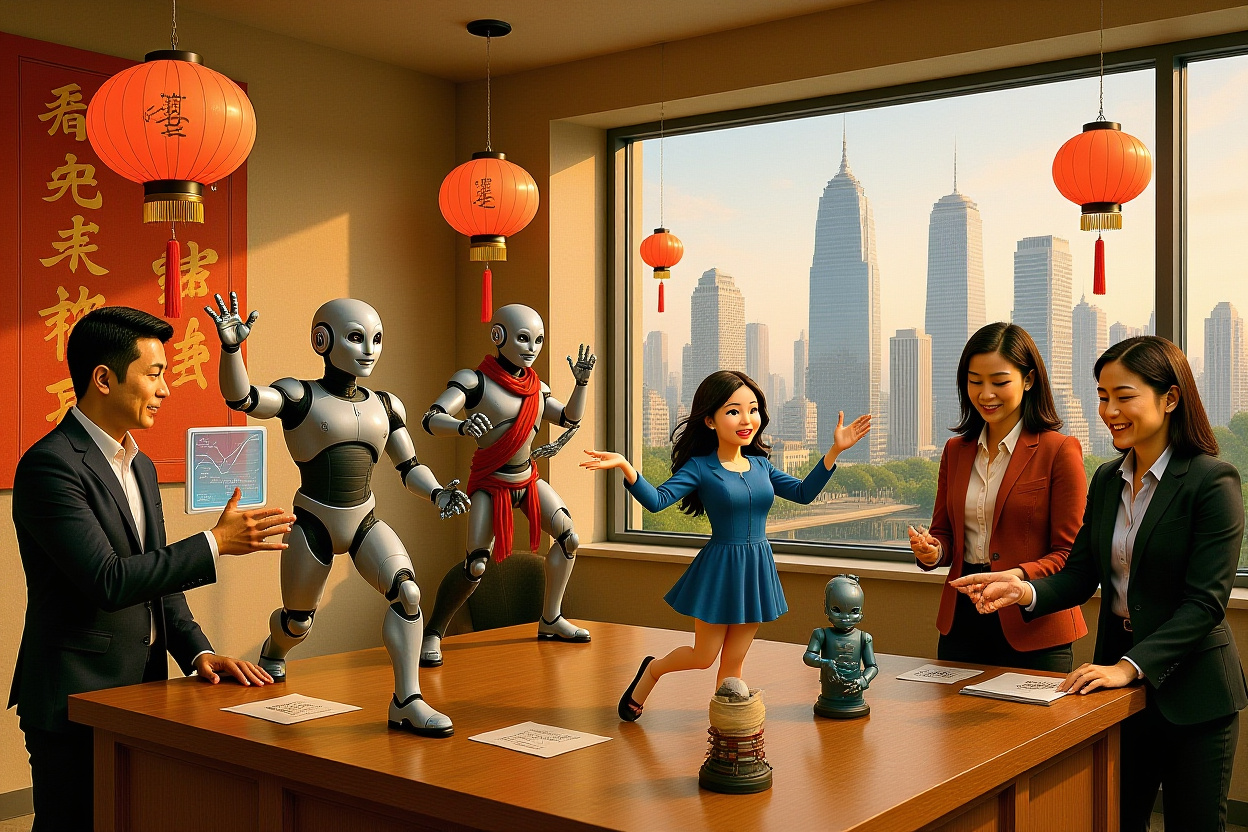
The CCTV Spring Festival Gala, an annual televised event watched by hundreds of millions, has evolved into a definitive showcase for China’s technological prowess. In 2026, it became the ultimate test for the nation’s embodied artificial intelligence (AI) robotics sector, as four domestic firms—魔法原子 (Magic Atom), 银河通用 (Galaxy Universal), 宇树科技 (Yushu Technology), and 松延动力 (Songyan Dynamics)—paraded their humanoid robots on stage. These robots danced, performed martial arts, and engaged in sketches, captivating a global audience. However, this glamorous debut is merely the prelude to a more daunting challenge: proving that these machines can move beyond the stage and into practical, revenue-generating roles. The Spring Festival Gala as the ultimate test underscores the industry’s journey from concept to commercialization, setting the stage for a rigorous evaluation of viability in harsh real-world environments.
A Robotic Arena of National Spotlight
The 2026 Gala featured humanoid robots as central performers, marking a shift from sporadic tech displays to a coordinated industry presentation. 宇树科技 (Yushu Technology), which gained fame after the 2025 Gala, collaborated with the Henan Tagou Martial Arts School for a wushu performance titled “武 BOT.” 松延动力 (Songyan Dynamics) appeared in a skit with veterans Cai Ming (蔡明) and Wang Tianfang (王天放), while 魔法原子 (Magic Atom) supported a song performance, and 银河通用 (Galaxy Universal) joined comedians Shen Teng (沈腾) and Ma Li (马丽) in a micro-film. This collective showcase, as reported by Phoenix Net Finance’s Company Research Institute (凤凰网财经《公司研究院》), signals the maturation of China’s embodied AI ecosystem, moving from isolated experiments to a competitive arena.
Decoding Strategic Positioning Through Official Titles
Beyond the Limelight: The Three Critical Hurdles for Embodied AIAfter the Gala’s lights dim, the embodied AI industry confronts a sobering reality: robots cannot forever dance on stages. The ultimate test extends into three grueling phases of commercialization, each posing unique challenges that will determine which companies survive and thrive.
Industrial Applications: The First and Most Viable Frontier
Factory settings represent the nearest-term opportunity, with robots tasked to handle repetitive, dangerous, or precision-demanding jobs like sorting, assembly, and logistics. However, industrial environments tolerate zero error—a minute of downtime can cost thousands in lost productivity. According to industry insiders, many robots falter here due to insufficient reliability under extreme conditions. For instance, a robot that performs flawlessly in a controlled lab may struggle with humidity, temperature variations, or continuous operation in a plant. Success in this arena requires robust engineering, predictive maintenance capabilities, and seamless integration with existing manufacturing systems, as seen in pilot projects by firms like 松延动力 (Songyan Dynamics) in automotive workshops.
Commercial Environments: Navigating Complexity and Interaction
Moving into spaces like retail stores, warehouses, hotels, and hospitals introduces dynamic variables: unpredictable human behavior, cluttered layouts, and diverse tasks. Here, robots must excel not just in mobility but in perception, decision-making, and natural interaction. The Gala’s scripted interactions, such as those with Shen Teng (沈腾) and Ma Li (马丽), do not guarantee an ability to navigate a crowded supermarket or assist a hospital patient. Technologies like computer vision, sensor fusion, and adaptive algorithms become critical. Companies like 魔法原子 (Magic Atom) are testing robots for inventory management, where they must avoid obstacles and respond to voice commands, but scalability remains a hurdle due to high costs and technical limitations.
The Home Front: The Ultimate but Distant Goal
Household adoption represents the pinnacle of embodied AI’s potential, yet it is fraught with difficulties. Homes are unstructured: floors are uneven, objects are scattered, and interactions are informal. Robots must be safe around children and pets, intuitive for non-tech users, and affordable for mass consumption. While 银河通用 (Galaxy Universal) explores educational companions and 宇树科技 (Yushu Technology) trials elderly care assistants, widespread home use is years away. The ultimate test here involves balancing advanced AI with simplicity and cost-effectiveness, a challenge echoed by analysts who note that current models, priced at tens of thousands of dollars, are prohibitive for average consumers.
Market Projections and Growth Trajectory
The embodied AI sector is poised for explosive expansion, driven by technological advances and societal needs. IDC data predicts that China’s embodied AI robot user spending will reach $770 billion by 2030, with a staggering 94% compound annual growth rate (CAGR). This projection, accessible via IDC’s website, underscores the gold-rush mentality among investors and entrepreneurs. However, this growth hinges on overcoming the commercialization hurdles highlighted by the Spring Festival Gala as the ultimate test.
Capital Influx and Investor Sentiment
The Industry’s Pivot: From Performance to PracticalityThe 2026 Spring Festival Gala as the ultimate test marks an inflection point, compelling companies to prioritize real-world utility over theatrical appeal. This shift is evident in changing industry narratives, where success is increasingly measured by deployment scale rather than stage presence.
The 2026 Inflection Point: Shifting Metrics of Success
Case Studies: Early Adopters and Pilot ProjectsExpert Perspectives and Regulatory LandscapeQuotes from Industry LeadersGovernment Policies Supporting Robotics DevelopmentFuture Outlook: What Lies Ahead for China’s Embodied AIAs the dust settles from the Gala, the embodied AI sector stands at a crossroads, with technological breakthroughs and market dynamics shaping its path forward.
Technological Advancements on the Horizon
Global Competitiveness and Export PotentialSynthesis and Forward GuidanceThe 2026 CCTV Spring Festival Gala as the ultimate test has illuminated both the promise and perils of China’s embodied AI robotics industry. While the stage provided unparalleled visibility, the real battleground is in factories, commercial spaces, and eventually homes, where reliability, adaptability, and cost-effectiveness reign supreme. Investors should monitor companies based on their order pipelines and pilot project outcomes, rather than media hype. For industry participants, collaboration across the value chain—from component suppliers to end-users—is essential to overcome technical and market barriers. As the sector evolves, those who pass this ultimate test will not only dominate China’s market but also shape the global future of robotics. Now is the time to act: engage with detailed due diligence, support innovation through strategic partnerships, and prepare for a transformative decade in AI-driven automation.