



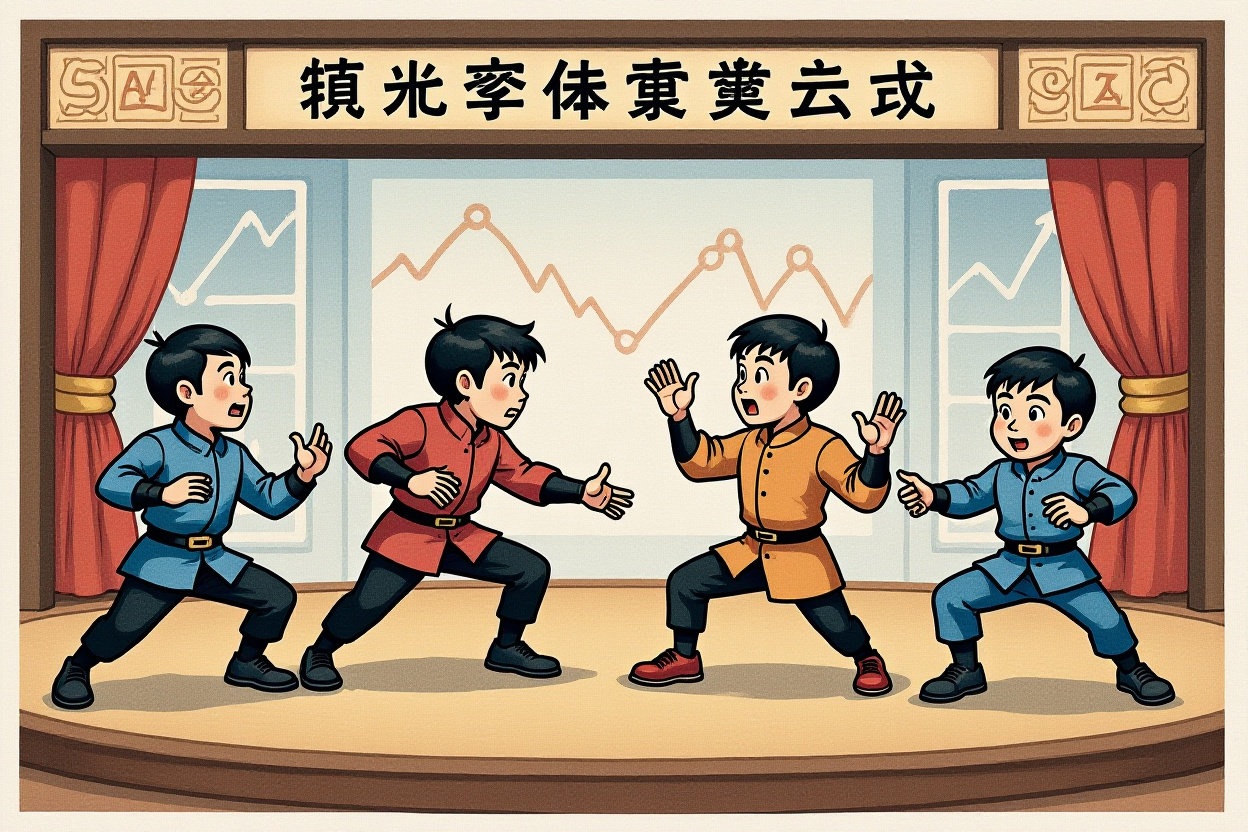
The Spectacle and the Signal: Spring Festival Gala 2026
The annual CCTV Spring Festival Gala is more than a cultural touchstone; it is a meticulously curated showcase of national technological prowess. For China’s fast-evolving tech sectors, securing a spot on its stage is akin to receiving a coveted seal of approval from the highest echelons of state media. In 2026, the spotlight shifted decisively from virtual algorithms to physical entities. The gala became the ‘ultimate test’ for China’s embodied intelligence sector, serving as a grand, live-fire demonstration for the world’s most sophisticated investors and corporate strategists.
Four domestic humanoid robotics contenders—Magic Atom (魔法原子), Galaxy General (银河通用), Unitree Robotics (宇树科技), and Songyan Dynamics (松延动力)—shared the national stage. Their performances, ranging from coordinated dance routines to kung fu demonstrations alongside human counterparts, represented a strategic inflection point. The event signaled a collective push to transition embodied intelligence—the integration of artificial intelligence with a physical form capable of interacting with the real world—from laboratory prototypes and niche demonstrations into the mainstream public consciousness and, more critically, toward viable commercial pathways.
This high-visibility debut, however, is merely the opening act. The real narrative for investors lies in what happens after the stage lights dim. The gala functions as a powerful catalyst, but the subsequent journey—navigating factory floors, commercial spaces, and ultimately, the complexities of the home—will separate market leaders from also-rans. The ‘ultimate test’ for embodied intelligence is no longer about executing a flawless choreographed routine, but about achieving reliability, scalability, and economic viability in the unforgiving arena of global commerce.
Deconstructing the Gala’s Robotic Lineup
The 2026 gala’s significance is amplified by the ‘ensemble cast’ approach. Unlike previous years featuring isolated tech demos, the coordinated appearance of four major players underscores the sector’s collective maturity and the state’s endorsement of its strategic importance. Each company’s integration into the programming revealed subtle, yet telling, distinctions in their market positioning and technological focus.
A Strategic Showcase of Diverse Applications
The specific roles assigned to each robot were not arbitrary; they were microcosms of intended use cases. Unitree Robotics (宇树科技), building on its breakout success from the 2025 gala, performed a martial arts routine, ‘Wu BOT,’ with the renowned Henan Tagou Martial Arts School. This highlighted dynamic mobility, balance, and precise, powerful movements—attributes critical for industrial manipulation and logistics.
Songyan Dynamics (松延动力) appeared in a comedy skit, ‘Grandma’s Favorite,’ requiring interaction with veteran actors Cai Ming (蔡明) and Wang Tianfang (王天放). This placement tested and demonstrated social robotics capabilities: gesture recognition, basic situational awareness, and comedic timing within a human-centric narrative. Magic Atom (魔法原子) supported a song titled ‘Intelligent Creation of the Future,’ while Galaxy General (银河通用) was featured in a New Year micro-movie, suggesting a focus on narrative integration and ambient, assistive presence.
The Nuance in Naming: A Blueprint for Differentiation
Perhaps the most revealing detail for market analysts was the variance in official partner titles, as reported by Phoenix Net Finance’s Corporate Research Institute (凤凰网财经《公司研究院》):
- Unitree Robotics: ‘Spring Festival Gala Robot Partner’
- Songyan Dynamics: ‘Spring Festival Gala Humanoid Robot Partner’
- Magic Atom: ‘Spring Festival Gala Intelligent Robot Strategic Partner’
- Galaxy General: ‘Spring Festival Gala Designated Embodied Large Model Robot’
This ‘difference of a single character’ is a masterclass in strategic branding within a regulated showcase. It reflects deliberate positioning across a spectrum: from general-purpose robotics (Unitree) to a specific focus on the humanoid form (Songyan), strategic intelligence integration (Magic Atom), and the cutting-edge convergence of embodied AI with large language models (Galaxy General). For institutional investors, these distinctions are crucial for mapping the competitive landscape and identifying which technological stack—mechanical agility, AI interaction, or model-based cognition—holds the greatest commercial promise.
The Dual Mandate of a National Showcase
The Spring Festival Gala’s value extends far beyond a one-night advertising blitz. For the embodied intelligence sector, it serves two critical, market-shaping functions that directly impact investor confidence and industry trajectory.
Mass Adoption Catalyst and Technological Validation
First, it acts as a unparalleled catalyst for mass adoption. Presenting robots as entertaining, capable, and non-threatening co-performers to an audience of hundreds of millions normalizes their presence. It shifts public perception from science fiction to tangible reality, softening the market for future consumer and commercial products. This top-down social endorsement is a powerful force in a market like China, reducing friction for downstream adoption in enterprises and public services.
Second, and more importantly for the investment community, the gala provides a high-stakes validation platform for domestic technology. It is a statement of capability to the global supply chain, potential enterprise clients, and capital markets. Performing live on national television, with zero tolerance for major failure, demonstrates a baseline level of reliability and technical maturity that no corporate white paper or controlled lab demo can match. It answers the skeptic’s first question: ‘Does it actually work?’ This public vetting reduces perceived technology risk for early-adopting corporate clients and provides a credible milestone for VCs and public market investors evaluating the sector.
The data underpinning this opportunity is staggering. According to IDC forecasts, user spending on embodied intelligent robots in China is projected to reach $77 billion by 2030, representing a compound annual growth rate (CAGR) of 94%. The gala is the opening salvo in capturing this ‘golden track’ growing at a near-doubling pace.
Beyond the Stage: The Three Commercialization Gateways
As the industry adage goes, ‘Robots cannot dance on stage forever.’ The applause from the gala fades quickly; sustainable revenue does not. The path from spectacular performance to profitable product requires successfully navigating three sequential, and increasingly difficult, commercial gateways. This framework is essential for investors assessing a company’s long-term viability.
Gateway 1: Conquering the Industrial Workspace
The first and most immediate gateway is the industrial environment. Factories and warehouses represent the most logical, structured, and financially compelling entry point. Tasks like sorting, assembly, palletizing, quality inspection, and material handling are repetitive, often hazardous, and plagued by labor shortages and rising wage costs.
However, the factory floor is a merciless judge. The metrics are stark: uptime, mean time between failures (MTBF), precision, and total cost of ownership (TCO). A misstep on stage can be edited or laughed off; a minute of downtime on a production line translates directly into lost revenue. The transition from a climate-controlled lab or scripted stage to a gritty, variable factory environment is a profound engineering challenge. It demands robustness, extreme reliability, and seamless integration with industrial IoT systems. Success here generates the recurring, high-volume orders that build financial stability and manufacturing scale.
Gateway 2: Navigating Dynamic Commercial Spaces
The second gateway leads into commercial spaces such as retail stores, hotels, hospitals, and logistics hubs. These environments are less structured than factories, introducing a new layer of complexity. Robots must operate safely amid unpredictable human traffic, adapt to dynamic layouts, and perform a wider variety of service-oriented tasks—from guiding customers and delivering items to disinfecting rooms.
This requires a significant upgrade in ’embodied intelligence.’ The system must integrate advanced computer vision for obstacle avoidance, natural language processing for basic interaction, and sophisticated path-planning algorithms. The capability to perform a pre-scripted interaction on a gala set does not guarantee the robot can handle a child running across its path, a sudden question from a customer, or a cluttered aisle in a warehouse. Crossing this gateway proves a robot’s utility beyond cage-like industrial settings, opening larger, though more fragmented, market segments.
Gateway 3: The Elusive Home Frontier
The third and final gateway—the home—remains the most distant yet potentially most lucrative frontier. The domestic environment is the ultimate test of embodied intelligence: it is highly unstructured, cluttered, safety-critical, and demands intuitive human-machine interaction. Challenges include navigating uneven floors, avoiding pets and toys, understanding vague voice commands (‘clean up around here’), and performing delicate tasks without causing damage.
To succeed here, robots must be exceptionally safe, perceptive, easy to use, and, crucially, affordable. This gateway requires breakthroughs not just in AI and mechanics, but in cost-reduction through mass manufacturing and supply chain optimization. While the unit economics for consumer robots are not yet favorable, the company that cracks this code will tap into a market of unprecedented scale. This represents the ‘final examination’ for the sector’s ambition of creating truly general-purpose embodied intelligence.
2026: The Pivot from Hype to Hard Metrics
The 2026 Spring Festival Gala is likely to be remembered as a demarcation line for China’s embodied intelligence industry. It marks the point where the sector’s primary metrics for success begin to pivot decisively.
From Funding Rounds to Purchase Orders
The previous phase was characterized by competition over venture capital funding, the scale of R&D teams, and the spectacle of technology demonstrations. Success was measured by valuation and media buzz. Post-2026, the focus intensifies on commercial traction. Key performance indicators (KPIs) are now shifting to:
- Pilot project conversions with Fortune 500 manufacturers.
- Volume of multi-unit deployment orders.
- Customer retention and repeat purchase rates.
- Gross margin profiles and paths to profitability.
- Demonstrated reductions in total cost of ownership for clients.
The ‘ultimate test’ is no longer about securing the next round of funding but about securing the next major enterprise contract. The glamour of the stage must be translated into the grit of reliable daily operation. Companies that fail to make this transition will find that their gala-induced valuation bump is fleeting, as investor patience for commercialization timelines wears thin.
Investment Implications and Forward Outlook
For global investors monitoring Chinese equity markets, particularly in technology and advanced manufacturing, the gala’s robotic showcase provides a tangible lens through which to evaluate a high-risk, high-reward sector. The journey of embodied intelligence presents a classic case of technological promise colliding with commercial reality.
The critical takeaway is that stagecraft is not a proxy for business acumen. Investors must look beyond the performance videos and dissect each company’s go-to-market strategy, partnership ecosystem, and technological roadmap for tackling the three commercialization gateways. Due diligence should focus on:
- Industrial Partnerships: Has the firm announced serious pilots or contracts with major industrial or logistics conglomerates like Foxconn (富士康), JD Logistics (京东物流), or SAIC Motor (上汽集团)?
- Technical Stack Breadth: Does the company control its core actuator, sensor, and AI software stack, or is it overly reliant on integrating third-party components? Vertical integration often correlates with better margins and reliability.
- Regulatory Foresight: How is the company engaging with Chinese regulators on safety standards, data privacy, and ethical guidelines for robotics? Proactive engagement can prevent future roadblocks.
The sector’s growth, as highlighted by IDC’s projections, is undeniable. However, the winners will be those who master the arduous transition from the gala’s ‘ultimate test’ of public performance to the market’s ultimate test of profitability and scale. The race is no longer about who can build the most mesmerizing robot, but about who can build the most indispensable one. The spotlight has moved from the center stage to the factory floor, the retail aisle, and, eventually, the living room. The companies that navigate this shift with operational discipline and clear commercial focus will define the next chapter of China’s technological ascent and generate substantial value for discerning investors.