



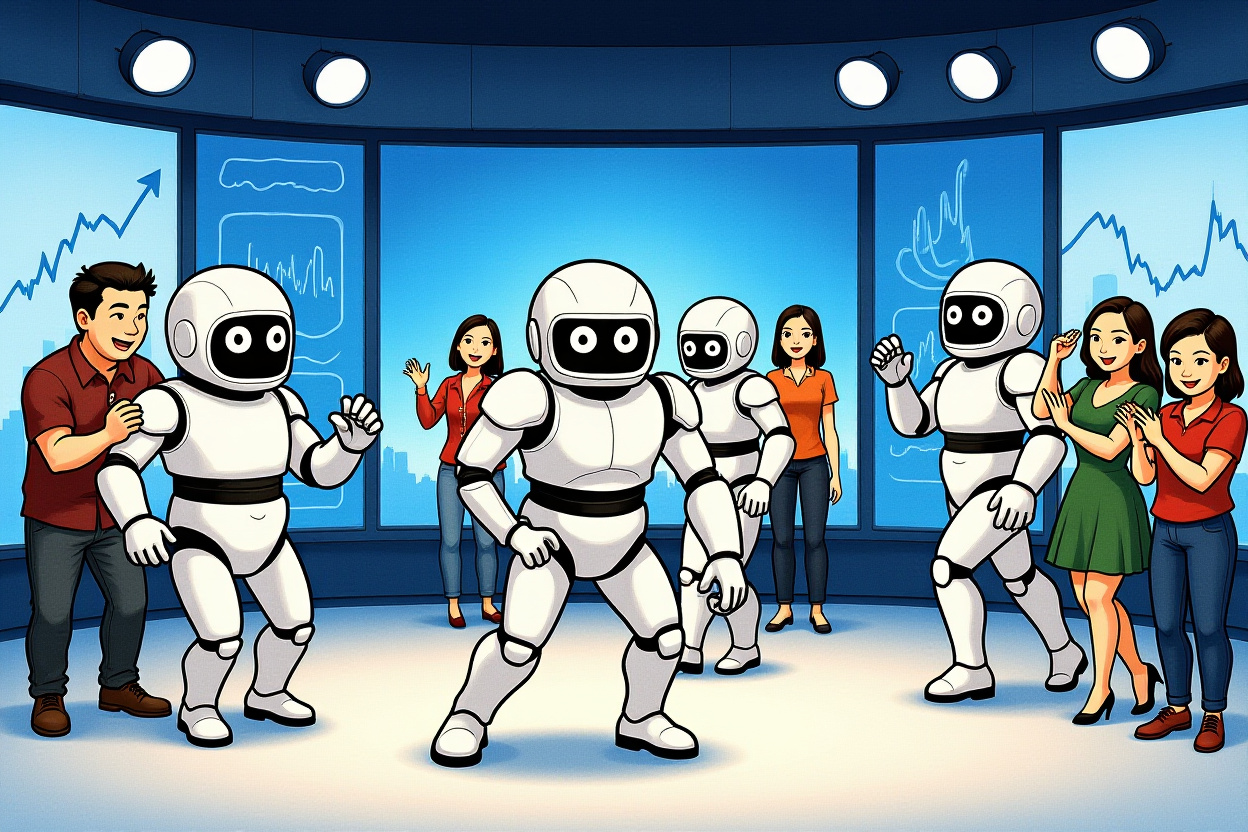
– The 2026 CCTV Spring Festival Gala showcased four leading embodied AI companies, marking a pivotal moment for China’s robotics industry as it transitions from lab concepts to national spotlight.
– This event serves as the ultimate test for embodied AI, validating technology readiness and public acceptance while highlighting diverse commercialization strategies.
– Post-Gala, the industry faces critical challenges in industrial integration, commercial deployment, and home adoption, with IDC projecting a 94% CAGR to $770 billion by 2030.
– Investors should focus on companies moving beyond performance demonstrations to secure real-world orders and scalable business models in this high-growth sector.
The Spring Festival Gala Illuminates China’s Embodied AI Ambitions
The CCTV Spring Festival Gala (央视春晚), a cultural institution watched by billions, has evolved into a strategic platform for technological validation, particularly for China’s burgeoning embodied AI sector. In 2026, this annual extravaganza transformed into the ultimate test for embodied AI, featuring humanoid robots from four domestic pioneers: Magic Atom (魔法原子), Galaxy Universal (银河通用), Unitree Robotics (宇树科技), and Songyan Power (松延动力). Their synchronized dances, martial arts displays, and interactive performances did more than entertain; they signaled a seismic shift in China’s tech landscape, where embodied intelligence is no longer a futuristic concept but a tangible market force. For global investors and business professionals, this showcase underscores the rapid maturation of Chinese robotics, offering a lens into commercialization trends and investment opportunities in one of the world’s fastest-growing tech domains.
A Historical Turning Point for National Tech Showcases
Traditionally, the Spring Festival Gala has highlighted incremental innovations, but the 2026 edition represented a paradigm shift. Unlike previous years with scattered tech demos, this marked the first time embodied AI companies formed a “collective force” on a national stage, reflecting coordinated industry growth. The participation of Magic Atom, Galaxy Universal, Unitree Robotics, and Songyan Power—each with distinct roles—demonstrates how the Gala acts as the ultimate test for embodied AI, pressuring firms to prove reliability, scalability, and public appeal. According to industry analysts, this move aligns with China’s national strategies, such as the “Made in China 2025” initiative, which prioritizes advanced manufacturing and AI integration. By leveraging the Gala’s massive reach, these companies aim to accelerate consumer adoption and attract capital, setting the stage for a competitive race toward real-world applications.
Decoding the Significance for Market Validation
The Gala’s role extends beyond mere exposure; it serves as a critical validation mechanism for embodied AI technologies. In China’s equity markets, where sentiment often drives valuations, a successful Gala performance can enhance investor confidence and spur follow-on funding. For instance, Unitree Robotics’ repeat appearance after its 2025 debut boosted its market profile, leading to increased venture capital interest and partnership deals. This phenomenon highlights how the Spring Festival Gala as the ultimate test for embodied AI bridges the gap between R&D and commercialization, forcing companies to demonstrate not just technical prowess but also market readiness. As one industry expert noted, “The Gala is where concepts meet reality—any flaw in performance can reverberate through supply chains and investor briefings.” Thus, for institutional investors, monitoring these showcases provides early indicators of which firms might lead the next wave of robotics innovation.
Analyzing the Key Players: Diverse Paths in Embodied AI Commercialization
The four companies featured at the 2026 Gala exemplify the fragmented yet dynamic nature of China’s embodied AI ecosystem, each pursuing unique technical routes and business models. Their official titles—varying from “Spring Festival Gala Robot Partner” to “Strategic Partner”—reveal nuanced positioning strategies, underscoring how the ultimate test for embodied AI is not one-size-fits-all but a tailored challenge based on core competencies.
Unitree Robotics: From Breakout Star to Industry Benchmark
Unitree Robotics (宇树科技), designated as the “Spring Festival Gala Robot Partner,” has emerged as a frontrunner, leveraging its Gala exposure to secure over 12 major event appearances and 7 dedicated robot competitions in 2025 alone. Its 2026 performance, a martial arts routine titled “武 BOT” in collaboration with the Henan Tagou Martial Arts School, showcased advanced mobility and coordination algorithms. This success stems from a focus on robust hardware and open-source platforms, enabling rapid iteration and cost reduction. For investors, Unitree’s trajectory illustrates how the Spring Festival Gala as the ultimate test for embodied AI can catalyze brand recognition and B2B contracts, particularly in entertainment and education sectors. However, the real challenge lies in translating stage success into industrial orders, a transition that will define its long-term viability.
Magic Atom, Galaxy Universal, and Songyan Power: Varied Approaches to Market Entry
The other players reveal complementary strategies. Magic Atom (魔法原子), a “Strategic Partner,” contributed to the song “智造未来” (Intelligent Creation of the Future), emphasizing AI-driven creativity and soft robotics for consumer interactions. Galaxy Universal (银河通用), the “Designated Embodied Large Model Robot,” partnered in a microfilm with comedians Shen Teng and Ma Li, highlighting its strength in natural language processing and contextual understanding. Songyan Power (松延动力), the “Humanoid Robot Partner,” appeared in a comedy sketch, focusing on durable mechanics for repetitive tasks. These distinctions show that the ultimate test for embodied AI encompasses multiple dimensions—from artistic expression to functional reliability. Investors should note that while all four passed the Gala’s performance test, their post-Gala journeys will diverge based on application focus, with Magic Atom targeting creative industries, Galaxy Universal aiming for service robotics, and Songyan Power eyeing logistics and manufacturing.
Beyond the Spotlight: The Threefold Challenge of Commercialization
Once the Gala’s lights dim, embodied AI companies confront a harsh reality: the ultimate test for embodied AI is not on stage but in unforgiving real-world environments. Industry insiders often quip, “Robots can’t dance forever,” emphasizing that sustainable growth hinges on solving practical problems. Post-2026, firms must navigate three sequential barriers to achieve scalable commercialization.
Industrial Integration: The Reliability Imperative
The first hurdle is penetrating factory floors, where embodied AI can address labor shortages in sorting, assembly, and quality control. However, industrial settings demand extreme reliability—7×24 operation with near-zero error rates. Unlike a Gala performance, a factory mishap can halt production lines, costing millions. For example, early adopters in automotive manufacturing have reported that robots perfect in labs often falter under variable temperatures or dust exposure. To pass this phase of the ultimate test for embodied AI, companies must enhance sensor fusion and fail-safe mechanisms, as seen in Unitree’s collaborations with Foxconn (富士康) for assembly line trials. Investors should track order volumes from manufacturing clients as a key metric for industrial readiness.
Commercial Deployment: Navigating Complex Environments
The second challenge involves deploying robots in dynamic commercial spaces like malls, warehouses, and hospitals. Here, the ultimate test for embodied AI expands to include perception, decision-making, and human interaction. A robot that dazzled on stage might struggle with sudden obstacles or customer inquiries in a crowded store. Galaxy Universal’s focus on large language models aims to tackle this via adaptive communication, but real-world validation is pending. Case studies from Alibaba’s (阿里巴巴集团) logistics arms show that success requires robust SLAM (Simultaneous Localization and Mapping)技术和 cost-effective maintenance. For fund managers, monitoring pilot projects in retail or healthcare can reveal which companies are advancing beyond gimmicks to genuine utility.
Home Adoption: The Long-Term Vision
The final and most daunting barrier is entering households, where unstructured environments pose unparalleled challenges—from cluttered floors to unpredictable pets. This represents the ultimate test for embodied AI in its purest form, demanding affordability, safety, and intuitive usability. While still nascent, companies like Magic Atom are exploring companion robots for elderly care, but high costs and safety concerns linger. Regulatory frameworks from the Ministry of Industry and Information Technology (MIIT) (工业和信息化部) will shape this transition, with standards for consumer robotics expected by 2027. For corporate executives, the home market offers vast potential but requires patience; early movers may gain brand loyalty, but profitability hinges on mass production and ecosystem partnerships, such as those with smart home giants like Xiaomi (小米).
Market Implications: Growth Projections and Investment Dynamics
The Spring Festival Gala showcase coincides with explosive growth forecasts for China’s embodied AI sector, making the ultimate test for embodied AI a critical gauge for capital allocation. IDC data predicts that user spending on embodied intelligent robots in China will reach $770 billion by 2030, with a compound annual growth rate (CAGR) of 94%. This trajectory positions the industry as a cornerstone of China’s tech-led economic transformation, attracting both domestic and international investors.
Economic and Regulatory Drivers
Several factors fuel this optimism. Demographically, China’s aging population and rising labor costs create urgency for automation, aligning with government policies like the “Robotics Plus” action plan. Financially, venture capital inflows into embodied AI have surged, with 2025 seeing over $2 billion in funding, per PitchBook reports. However, the ultimate test for embodied AI will be profitability; companies must shift from burning cash on R&D to generating recurring revenue. Regulatory support from bodies like the China Securities Regulatory Commission (CSRC) (中国证券监督管理委员会) could spur IPO activity, as seen with recent listings on the STAR Market. Investors should watch for regulatory announcements and subsidy programs that might de-risk early-stage investments.
Sector Analysis and Competitive Landscape
The embodied AI value chain spans hardware, software, and service layers, offering diverse entry points. Hardware specialists like Unitree Robotics focus on motor and actuator innovation, while software-centric firms like Galaxy Universal compete in AI algorithms. The ultimate test for embodied AI will differentiate winners based on integration capabilities—those offering full-stack solutions may capture more market share. For instance, collaborations between robotics firms and cloud providers such as Tencent Cloud (腾讯云) are enhancing data processing for swarm robotics. Institutional investors can leverage tools like the CSI Robotics Index (中证机器人指数) to track sector performance, but direct engagements with companies post-Gala will reveal execution prowess. Key metrics to monitor include patent filings, client retention rates, and average selling prices, which indicate scalability and competitive moats.
Strategic Pathways: From Performance to Sustainable Business Models
As the embodied AI industry matures, the focus must evolve from passing the Spring Festival Gala as the ultimate test for embodied AI to building durable enterprises. The post-2026 era will be a watershed, separating firms that thrive on practical applications from those reliant on hype.
Technological Innovations and Partnerships
To succeed, companies should prioritize modular designs that allow for rapid customization across industries. For example, Songyan Power’s partnership with JD.com (京东) for warehouse automation demonstrates how leveraging e-commerce logistics can drive initial scale. Additionally, advancements in embodied AI chips, led by firms like Horizon Robotics (地平线), will reduce costs and improve efficiency. The ultimate test for embodied AI now extends to supply chain resilience; disruptions in semiconductor imports could hinder progress, making domestic sourcing a strategic imperative. Investors should assess companies’ supplier networks and R&D alliances with academic institutions like Tsinghua University (清华大学).Actionable Insights for Stakeholders
For business professionals, the key takeaway is that embodied AI is transitioning from a speculative bet to a tangible asset class. To capitalize:
– Conduct due diligence on companies with proven post-Gala contracts, not just stage presence.
– Diversify across application verticals—industrial robotics may offer faster returns, while service and home segments promise long-term growth.
– Monitor policy shifts, such as China’s “Dual Circulation” strategy, which emphasizes domestic innovation and could boost local robotics firms.
– Engage with industry events like the World Artificial Intelligence Conference (WAIC) for networking and trend spotting.
Ultimately, the Spring Festival Gala as the ultimate test for embodied AI is just the beginning; the real marathon is in market execution.
Navigating the Future of Embodied AI in China
The 2026 CCTV Spring Festival Gala has unequivocally established itself as the ultimate test for embodied AI, propelling Chinese robotics into the global limelight. However, the journey from stage spectacle to sustainable business is fraught with challenges—industrial reliability, commercial adaptability, and home affordability. As IDC’s growth projections highlight, the sector’s potential is immense, but success will depend on translating technological feats into real-world value. For investors and executives, this moment offers a unique opportunity to engage with a high-growth industry at its inflection point. By focusing on companies that prioritize application over表演, and by staying attuned to regulatory and economic trends, stakeholders can navigate this dynamic landscape effectively. The ultimate test for embodied AI is now in your hands: will you watch from the sidelines, or actively shape the future of automation?