



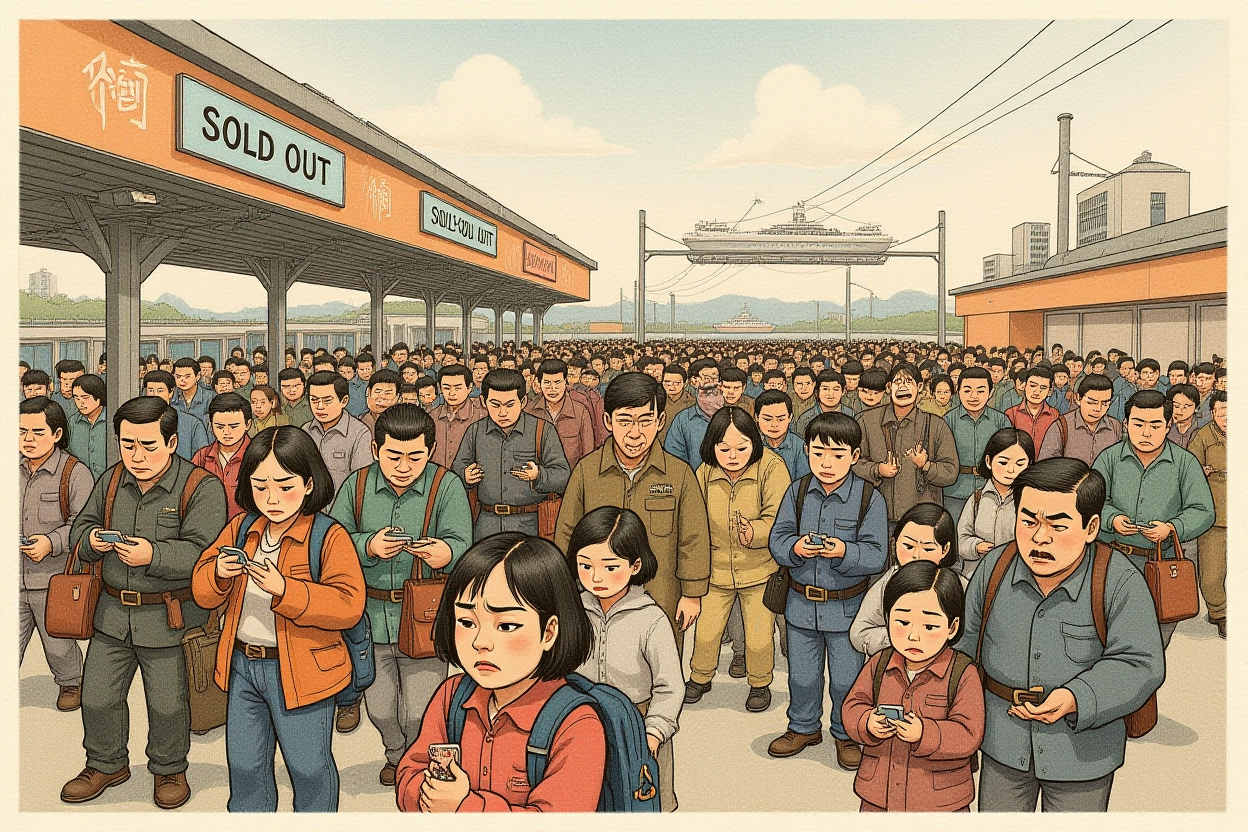
– The first Spring Festival travel rush following the Hainan Free Trade Port customs closure has overwhelmed the Qiongzhou Strait ferry system, with all vehicle tickets sold out days in advance, signaling intense demand. – Scalpers (黄牛, Huang Niu) are capitalizing on the shortage, charging up to 800 yuan premiums per ticket, highlighting market vulnerabilities and consumer risks despite official countermeasures. – Customs closure policy benefits are driving a surge in tourism and duty-free shopping, with data showing passenger traffic up 14% and duty-free sales jumping 46.8% year-on-year. – This transportation crunch acts as a real-time stress test for Hainan’s logistics infrastructure, revealing both challenges and opportunities for sectors like retail, tourism, and transportation services. – Investors should monitor related equities and infrastructure projects as Hainan’s economic transformation under customs closure accelerates, impacting supply chains and consumer behavior. For Mr. Li, a migrant worker in Guangdong for nearly a decade, the annual drive home to Hainan for Lunar New Year reunions has always been a manageable journey. This year, however, the first Spring Festival since the Hainan Free Trade Port customs closure turned his routine trip into a logistical ordeal. ‘All the cross-sea vehicle tickets are sold out,’ he told Yicai reporters, a sentiment echoed by countless travelers. His experience—abandoning his car in Zhanjiang’s Xuwen county and switching to passenger ferry tickets—highlights the unprecedented strain on transportation networks. This surge is not merely a seasonal spike; it is a direct consequence of Hainan’s historic policy shift, drawing attention from global investors assessing the island’s economic integration and market potential. The Hainan Free Trade Port customs closure has reshaped travel patterns, making this Spring Festival a critical case study in infrastructure resilience and consumer demand.
The Unprecedented Surge in Spring Festival Travel Demand
Personal anecdotes from travelers like Mr. Li vividly illustrate the scale of the crisis. Upon arriving in Xuwen on February 11, he encountered vehicle queues stretching over ten kilometers, a tangible sign of the bottleneck at the Qiongzhou Strait. This strait, the primary maritime link between mainland China and Hainan Island, has seen demand skyrocket, forcing families to resort to alternative routes or last-minute changes. The official data corroborates these stories, revealing a system pushed to its limits.
Official Statistics and Transportation Metrics
According to the Hainan Provincial Government’s news conference on February 11, as reported by the official WeChat account ‘海南发布 (Hainan Release)’, the first nine days of the Spring Festival travel period (February 2-10) saw 486.39 million passenger trips across Hainan, a 6.34% increase year-on-year. For Qiongzhou Strait crossings specifically, cumulative figures reached 1.012 million passengers and 257,900 vehicles, including 42,000 new energy vehicles—year-on-year growth of 14.0%, 8.2%, and 74%, respectively. On February 9 alone, a record 355 ferry sailings transported 133,200 passengers and 32,100 vehicles, demonstrating operational intensity. The ‘琼州海峡轮渡管家 (Qiongzhou Strait Ferry Butler)’ platform, the primary ticketing channel, has extended预售期 (advance booking periods) to 15 days for inbound and 30 days for outbound trips, yet tickets remain scarce, with nearly all slots from February 13-22 sold out. This demand surge is intrinsically linked to the Hainan Free Trade Port customs closure, which has heightened the island’s appeal for tourism and commerce.
Scalpers and Market Distortions in Ticket Sales
The ticket shortage has created a fertile ground for scalpers, known as 黄牛 (Huang Niu), who exploit desperate travelers. On social media platforms like Xiaohongshu and Xianyu, these operators offer代抢 (proxy ticket purchasing) services, charging around 800 yuan per vehicle ticket on top of the base fare of 390 yuan, totaling over 1,190 yuan. Some travelers have reported being scammed after upfront payments, with scalpers disappearing post-transaction. This black-market activity underscores the inefficiencies in the current distribution system and poses risks to consumers.
Official Warnings and Platform Responses
In response, the ‘琼州海峡轮渡管家 (Qiongzhou Strait Ferry Butler)’ platform has issued public reminders urging travelers to purchase tickets only through official channels and to avoid ‘代抢 (proxy purchases)’ or ‘包过 (guaranteed passage)’ schemes. The Hainan Provincial Department of Transportation has stated it is monitoring ticket reservations and候补 (waitlist) statuses, dynamically optimizing capacity and adding extra sailings. However, the persistence of scalping indicates underlying supply-demand imbalances exacerbated by the Hainan Free Trade Port customs closure, which has amplified travel intent. For investors, this highlights potential opportunities in digital ticketing solutions and anti-fraud technologies within China’s transportation sector.
Economic Implications of Hainan’s Customs Closure
The transportation crunch is a symptom of a larger economic shift. Since the Hainan Free Trade Port customs closure was implemented on December 18, 2025, the island has experienced a notable influx of visitors drawn by policy benefits like duty-free shopping and trade facilitation. This has direct implications for retail, tourism, and related equities, offering a window into consumer behavior changes.
Boost in Tourism and Duty-Free Shopping Data
Official statistics reveal that in the first month post-closure, Hainan’s air ports handled 311,000 inbound and outbound passengers, a 48.8% year-on-year increase.离岛免税购物 (Duty-free shopping for departures) surged, with sales reaching 4.86 billion yuan, up 46.8%, while购物人数 (shopper count) rose 30.2% to 745,000. For instance, at the Haikou Meilan Airport免税店 (duty-free shop), an Omega Constellation watch priced at 81,300 yuan domestically sold for 67,900 yuan—a saving of 13,400 yuan. Similarly, a 1TB Apple 17 Air phone was available for 9,940 yuan versus 11,999 yuan officially, though stock shortages followed high demand. These figures illustrate how the Hainan Free Trade Port customs closure is stimulating消费 (consumption), benefiting companies like中国中免 (China Duty Free Group) and tourism operators, which are key components of the Consumer Discretionary sector in Chinese equity markets.
Infrastructure and Logistics Challenges
The current strain on the Qiongzhou Strait crossings points to broader infrastructure limitations that could hinder Hainan’s growth ambitions. With vehicle transport up 8.2% and新能源车 (new energy vehicle) shipments soaring 74%, the system faces capacity constraints that require immediate and long-term solutions. This is critical for maintaining the economic momentum generated by the Hainan Free Trade Port customs closure.
Capacity Constraints and Emergency Measures
The ‘琼州海峡轮渡管家 (Qiongzhou Strait Ferry Butler)’客服 (customer service) noted that运力 (transport capacity) is operating at historically high levels, with应急疏运预案 (emergency evacuation plans) activated to增加航班班次 (increase sailing frequency). However, as of mid-February, tickets remain scarce, indicating that demand continues to outpace supply. The Hainan Provincial Department of Transportation is prioritizing安全 (safety) and有序 (orderly) transport, but analysts suggest that investments in additional vessels, port expansions, and integrated multi-modal transport networks are needed. For investors, this underscores potential in infrastructure bonds, port operators, and logistics firms listed on exchanges like the上海证券交易所 (Shanghai Stock Exchange) and深圳证券交易所 (Shenzhen Stock Exchange).
Broader Market and Investment Perspectives
From a financial standpoint, the Spring Festival travel rush offers real-time data on the economic impacts of the Hainan Free Trade Port customs closure. This event serves as a barometer for sectors exposed to Hainan’s development, providing actionable insights for institutional investors and fund managers monitoring Chinese equities.
Analyzing Data for Equity Market Signals
The surge in duty-free shopping and tourism traffic can positively affect companies in the retail and hospitality sectors. For example, stocks like中国旅游集团 (China Tourism Group) and regional airlines may see uplifts. Conversely, transportation bottlenecks could temporarily dampen efficiency, affecting supply chains for consumer goods. Investors should track official releases from bodies like the海南省交通运输厅 (Hainan Provincial Department of Transportation) and the国家发展和改革委员会 (National Development and Reform Commission) for policy cues. The Hainan Free Trade Port customs closure is a long-term structural change, and early indicators from this travel period suggest robust demand that could drive revenue growth for related listed entities.
Regulatory Environment and Future Projections
The Chinese government’s commitment to the Hainan Free Trade Port is evident in its customs closure initiative, which aims to transform the island into a global trade hub. Regulatory support includes incentives for infrastructure projects and retail expansions. Forward-looking guidance suggests that capacity enhancements will be prioritized, with potential public-private partnerships. Investors should consider exchange-traded funds (ETFs) focused on regional development or sectors like transportation and consumer discretionary, while also monitoring risks such as overcrowding or logistical delays. The Hainan Free Trade Port customs closure is set to catalyze further economic integration, making this a pivotal moment for market analysis. The Spring Festival travel rush following the Hainan Free Trade Port customs closure has laid bare both the opportunities and challenges in Hainan’s economic ascent. Key takeaways include the dramatic rise in consumer demand, evidenced by sold-out tickets and booming retail sales, and the pressing need for infrastructure upgrades to sustain growth. For market participants, this event underscores the importance of monitoring transportation logistics, duty-free retail trends, and policy implementations as leading indicators for investment decisions in Chinese equities. As Hainan continues to evolve under its new trade status, proactive analysis of such real-world stress tests will be crucial for capitalizing on emerging opportunities. Investors are advised to review quarterly reports from related companies, engage with market analyses from firms like中金公司 (China International Capital Corporation Limited), and stay attuned to regulatory updates to navigate this dynamic landscape effectively.