



Executive Summary: Key Takeaways from the Hainan Travel Rush
- The first Spring Festival travel period following the Hainan Free Trade Port (海南自由贸易港) closure has resulted in unprecedented demand, with all vehicle ferry tickets across the Qiongzhou Strait (琼州海峡) sold out for key dates, highlighting acute infrastructure pressures.
- Surging passenger and vehicle volumes—up 14.0% and 8.2% year-on-year, respectively—coupled with a 74% spike in new energy vehicle transport, signal robust domestic consumption and tourism growth directly tied to the Hainan Free Trade Port closure policy incentives.
- A booming duty-free shopping sector, with sales up 46.8% post-closure, is drawing significant consumer spending, presenting tangible investment opportunities in retail, logistics, and related Chinese equity sectors.
- Secondary market distortions, including scalper (‘黄牛’) activity charging over 1,000 yuan per ticket, underscore systemic vulnerabilities in transportation logistics that regulators must address to sustain economic benefits.
- This event serves as a critical stress test for Hainan’s integration into global trade networks, with implications for infrastructure investment, regulatory frameworks, and sectoral performance in Chinese markets.
Unprecedented Demand Meets Limited Capacity
The annual Chunyun (春运), or Spring Festival travel rush, has taken on new dimensions in the wake of the Hainan Free Trade Port closure. For years, the Qiongzhou Strait ferry service has been a vital artery connecting mainland China to Hainan Island, but this season, it has become a bottleneck emblematic of broader economic shifts. The Hainan Free Trade Port closure, officially launched on December 18, has catalyzed a surge in travel, with every vehicle ferry ticket sold out for days during peak periods, leaving thousands stranded and resorting to alternative plans.
Record-Breaking Ferry Traffic and Operational Strain
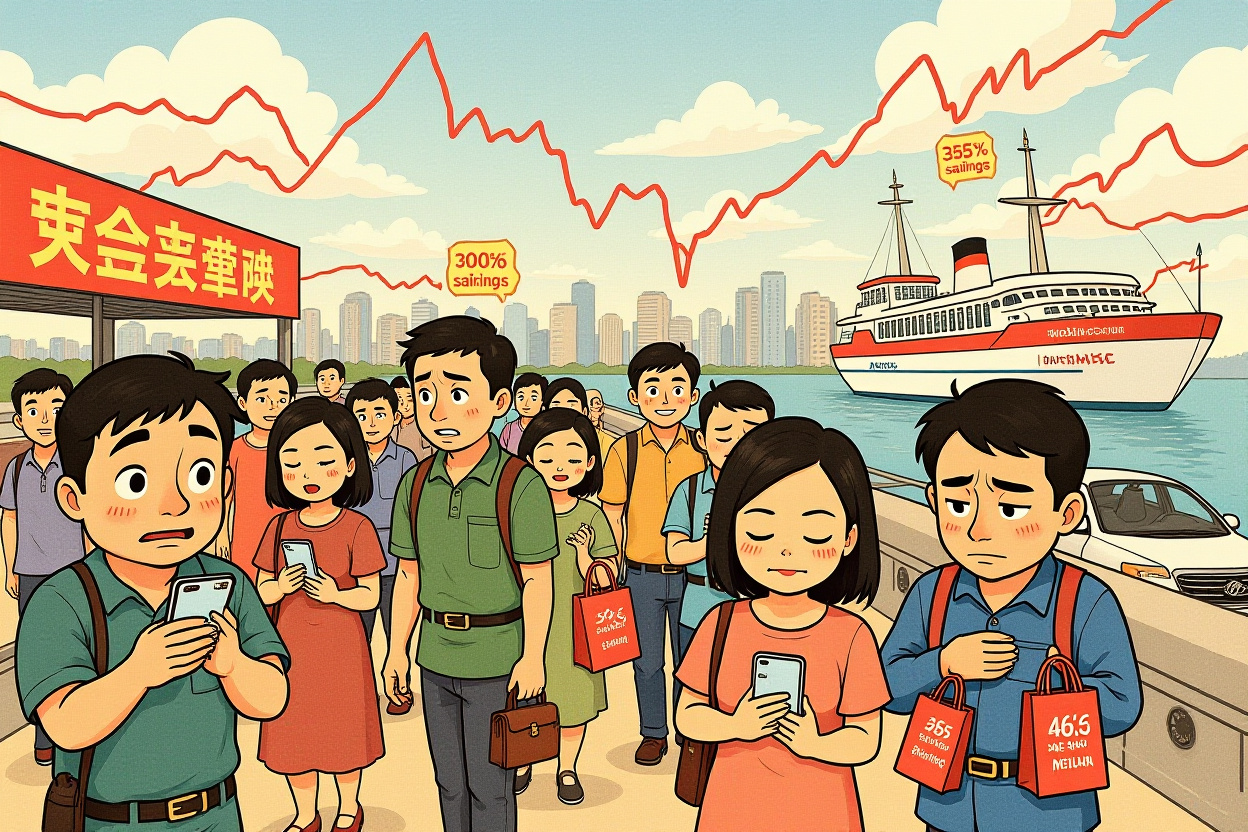
Data from Hainan provincial authorities reveals the scale of the challenge. In the first nine days of the travel rush (February 2-10), comprehensive transport passenger volume in Hainan reached 4.8639 million人次, a 6.34% increase year-on-year. Specifically, Qiongzhou Strait transport handled 1.012 million passengers and 257,900 vehicles, with new energy vehicles accounting for 42,000 units—a staggering 74% rise from last year. On February 9 alone, 355 sailings were conducted, a historic high, moving 133,200 passengers and 32,100 vehicles. This operational peak, while impressive, has exposed capacity limits, forcing operators like the Qiongzhou Strait Ferry Butler (琼州海峡轮渡管家) to extend ticket预售期 to 15 days for entry and 30 days for exit and implement应急疏运预案 (emergency transport plans).
The logistical strain is palpable on the ground. Mr. Li (李先生), a Guangdong-based worker, shared his experience with Yicai (第一财经): ‘I’ve driven back to Hainan for years, but this time, all car ferry tickets were gone.’ He estimated queues stretching over ten kilometers at Xuwen Port in Guangdong, ultimately parking his car and buying passenger tickets for his family. This scenario repeats across the region, as the Hainan Free Trade Port closure attracts not only returning residents but also tourists seeking duty-free bargains and a glimpse of policy-driven change.
The Scalper Economy and Market Inefficiencies
Where official supply falls short, secondary markets thrive. On social platforms like Xiaohongshu (小红书) and Xianyu (闲鱼), scalpers have capitalized on desperation, offering ‘代抢’ (proxy purchasing) services for vehicle ferry tickets at inflated prices. Reports indicate fees of 800 yuan per ticket on top of the standard 390-yuan fare, totaling over 1,190 yuan. Some travelers have fallen victim to scams, paying upfront only to be ghosted. The Qiongzhou Strait Ferry Butler has issued warnings against such practices, urging purchases through official channels, but the persistence of scalping points to deeper issues in ticket distribution and监管 (regulation).
This phenomenon isn’t merely a nuisance; it reflects market distortions that can deter genuine economic activity. For investors, it signals potential inefficiencies in China’s transportation and tourism sectors that may require policy interventions or private-sector solutions. The Hainan Free Trade Port closure aims to streamline trade, yet these travel bottlenecks could hinder seamless mobility, affecting consumer sentiment and spending patterns.
Economic Windfalls from Duty-Free and Retail Expansion
Beyond the travel chaos lies a compelling economic narrative. The Hainan Free Trade Port closure has unlocked significant policy红利 (dividends), particularly in离岛免税 (off-island duty-free) shopping. In the first month post-closure, Hainan’s空港口岸 (airport ports) saw 311,000 entry-exit personnel, a 48.8% increase, while duty-free sales hit 4.86 billion yuan, up 46.8% year-on-year. The number of shoppers rose 30.2% to 745,000, with 3.494 million items purchased, a 14.6% gain. These figures underscore a direct link between the Hainan Free Trade Port closure and stimulated consumer demand, offering a microcosm of China’s domestic consumption engine in action.
Consumer Savings and Retail Sector Implications
The appeal is rooted in tangible savings. At the Haikou Meilan Airport免税店 (duty-free shop), an Omega Constellation watch priced at 81,300 yuan官方售价 (official price) sells for 67,900 yuan—a 13,400-yuan discount. Similarly, a 1TB Apple iPhone 17 Air retails at 11,999 yuan但 (but) is available for 9,940 yuan, though high demand has led to stockouts. One consumer told Yicai they saved over 10,000 yuan on 100,000 yuan of purchases compared to mainland prices. This spending surge benefits listed entities like China Tourism Group Duty Free Corp (中国旅游集团中免股份有限公司) and Hainan-based retailers, potentially boosting their equity performance as investors eye growth in consumer discretionary stocks.
For institutional investors, these trends validate bullish outlooks on Hainan’s retail and tourism sectors. The Hainan Free Trade Port closure is designed to position the island as a global shopping hub, and early data suggests strong execution. However, sustaining this momentum requires addressing infrastructure gaps, as seen in the ferry crisis, to ensure a smooth customer experience that translates into repeat visits and higher lifetime value.
Infrastructure and Regulatory Crossroads
The transportation crunch highlights critical infrastructure challenges that could shape investment decisions. The Qiongzhou Strait, a narrow channel separating Guangdong and Hainan, relies on ferry services that are now operating at full capacity. While authorities have increased sailings and预售期 (pre-sale periods), the systemic limitations pose risks to Hainan’s economic ambitions. The Hainan Free Trade Port closure envisions seamless connectivity for goods and people, but current bottlenecks suggest need for accelerated investment in ports, vessels, and possibly even固定链接 (fixed links) like bridges or tunnels—projects that could attract capital from both state and private investors.
Government Response and Policy Adjustments
In response, the Hainan Provincial Department of Transport (海南省交通运输厅) has pledged to dynamically optimize运力配置 (capacity allocation) and add extra flights. This proactive stance aligns with broader national goals under China’s dual circulation strategy, which emphasizes domestic demand. For market participants, monitoring regulatory announcements from bodies like the Ministry of Transport of the People’s Republic of China (中华人民共和国交通运输部) is crucial, as policy shifts could impact sectors from shipping to construction. The Hainan Free Trade Port closure serves as a test case for how China balances rapid growth with logistical sustainability, offering lessons for other special economic zones.
Moreover, the surge in new energy vehicle transport—up 74%—ties into China’s green transition priorities, suggesting alignment with environmental, social, and governance (ESG) investing themes. Companies involved in EV manufacturing, charging infrastructure, and related logistics may see tailwinds from Hainan’s growth, making them attractive for ESG-focused funds.
Investment Implications for Chinese Equity Markets
This travel surge transcends mere transportation news; it offers a lens into sectoral opportunities and risks within Chinese equities. The Hainan Free Trade Port closure is a cornerstone of China’s economic policy, aiming to boost trade, tourism, and investment. For sophisticated investors, the current dynamics present several actionable insights.
Sectors Poised for Growth
- Transportation and Logistics: Companies operating ferries, ports, and related services, such as Hainan Strait Shipping Co., Ltd. (海南海峡航运股份有限公司), may benefit from increased traffic, though capacity constraints could limit short-term gains. Longer-term, infrastructure builders could see project pipelines expand.
- Retail and Consumer Discretionary: Duty-free operators and retailers in Hainan are direct beneficiaries of the spending boom. Stocks in this sector may offer growth potential, especially as the Hainan Free Trade Port closure matures and attracts international brands.
- Tourism and Hospitality: Hotels, airlines, and travel services stand to gain from sustained visitor influx. For example, China Southern Airlines (中国南方航空) has seen sold-out flights to Haikou, with premium fares exceeding 5,000 yuan, indicating pricing power.
- New Energy and Technology: The spike in EV transport aligns with national incentives, benefiting automakers like BYD (比亚迪) and charging network providers, potentially driving equity upside in these segments.
Risk Factors and Strategic Considerations
However, investors must weigh risks. The scalping issue and ticket shortages point to potential regulatory crackdowns that could affect market sentiment. Additionally, over-reliance on tourism makes Hainan vulnerable to economic cycles or external shocks, such as pandemic resurgence. Diversification across sectors and careful monitoring of policy changes from the National Development and Reform Commission (国家发展和改革委员会) is advised. The Hainan Free Trade Port closure is a long-term play, but short-term volatility may arise from operational hiccups like the current transport strain.
For global fund managers, this event underscores the importance of on-the-ground intelligence and adapting to rapid policy-driven shifts. The Hainan Free Trade Port closure is not an isolated incident but part of China’s broader economic restructuring, making it essential to integrate such developments into investment theses.
Looking Ahead: Strategic Guidance for Market Participants
The post-closure travel rush in Hainan is more than a seasonal anomaly; it’s a precursor to deeper economic transformations. As the Hainan Free Trade Port closure progresses, we can expect continued growth in passenger and freight flows, necessitating upgrades in infrastructure and regulatory frameworks. For investors, this translates into opportunities in equities tied to Hainan’s development, but also cautions about timing and sector selection.
Forward-Looking Projections and Recommendations
Analysts project that Hainan’s duty-free sales could exceed 100 billion yuan annually within the next few years, driven by policy tailwinds. To capitalize, investors should consider:
- Monitoring official data releases from Hainan Release (海南发布) and the General Administration of Customs of China (中华人民共和国海关总署) for trends in tourism and trade.
- Engaging with companies directly involved in Hainan’s ecosystem, through equity investments or partnerships, to gain exposure to growth narratives.
- Advocating for sustainable infrastructure solutions that address current bottlenecks, aligning with ESG principles and long-term value creation.
The Hainan Free Trade Port closure has set the stage for a new era of economic activity, and the sold-out ferry tickets are a stark reminder of both the demand and the challenges ahead. By staying informed and agile, investors can navigate this landscape to uncover alpha in Chinese markets.
Synthesis and Call to Action
The Hainan Free Trade Port closure has ignited a travel and consumption boom, with ferry ticket sellouts highlighting robust demand and infrastructure gaps. Key takeaways include surging duty-free sales, record transport volumes, and emerging investment themes in retail, logistics, and green technology. However, risks like scalping and capacity constraints warrant caution.
For institutional investors and corporate executives, the imperative is clear: dive deeper into Hainan’s evolving market dynamics. Conduct due diligence on sectoral plays, leverage real-time data from sources like Yicai and official WeChat accounts, and engage with policy developments to anticipate shifts. The Hainan Free Trade Port closure is a pivotal moment in China’s economic story—those who understand its implications will be best positioned to seize opportunities in the equity markets. Start by reviewing your portfolios for Hainan exposure and consider strategic allocations to capitalize on this growth frontier.