



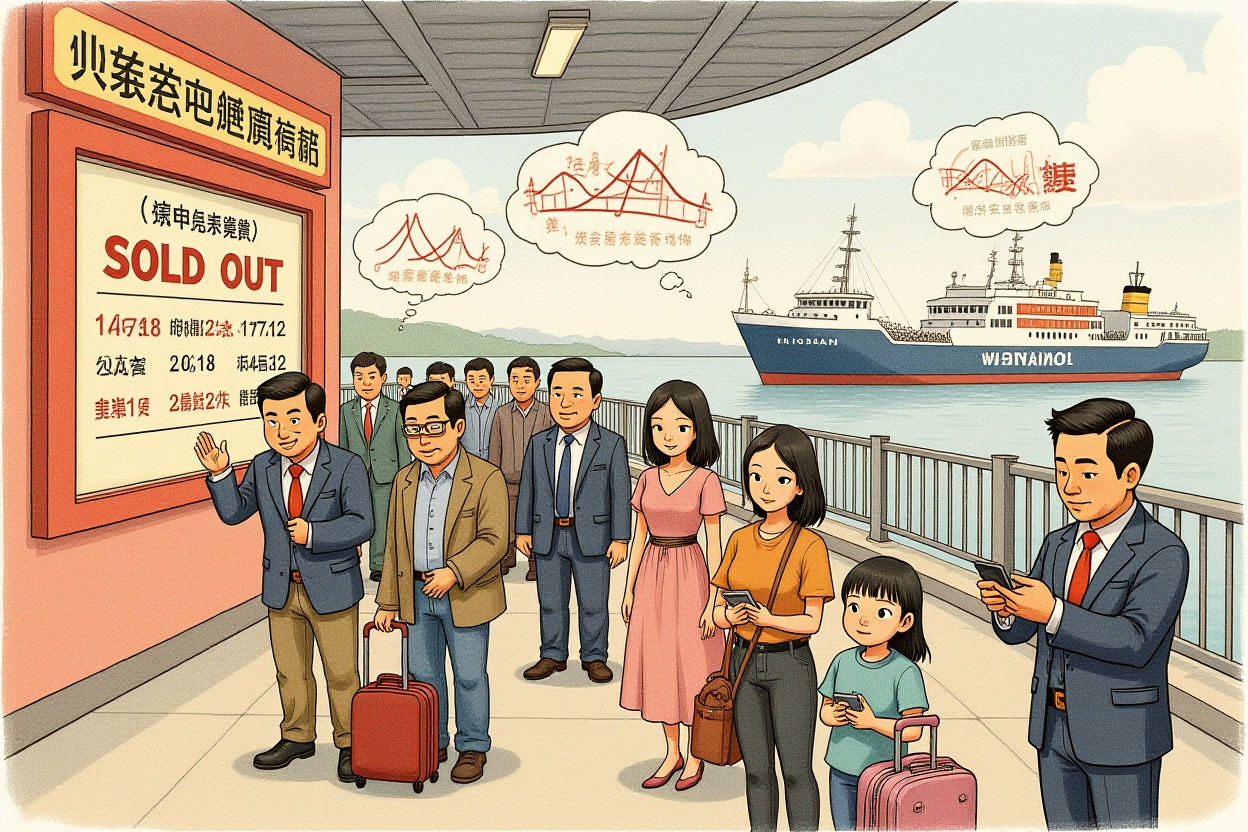
The first Spring Festival travel rush following Hainan’s historic closure operation has unleashed an unprecedented wave of demand, with every vehicle ticket across the Qiongzhou Strait sold out for days. This Hainan’s post-closure Spring Festival travel surge is not merely a logistical challenge; it is a powerful economic indicator with profound implications for investors in Chinese tourism, retail, and logistics sectors. The scenes of miles-long queues and scalpers charging exorbitant fees underscore a consumption revival driven by policy红利 (dividends), offering a critical lens through which to assess market dynamics.
Executive Summary: Key Market Takeaways
- The first Spring Festival after Hainan’s full-island closure operation has triggered record-breaking travel demand, with Qiongzhou Strait vehicle tickets completely sold out for over a week, signaling robust consumer mobility and confidence.
- Duty-free shopping data shows a dramatic uptick, with sales up 46.8% year-on-year, highlighting the direct economic impact of the closure policy and presenting a bullish case for retail and consumer staples stocks.
- The emergence of scalpers (‘黄牛’) exploiting ticket shortages reveals vulnerabilities in digital ticketing systems and underscores the need for enhanced regulatory oversight in high-demand transport corridors.
- Logistics and infrastructure are under severe strain, with ferry operators like 琼州海峡轮渡管家 (Qiongzhou Strait Ferry Steward) setting historical records for daily voyages, pointing to potential revenue boosts for related publicly-listed companies.
- This Hainan’s post-closure Spring Festival travel surge provides institutional investors with a real-time stress test of the island’s economic integration and a preview of long-term investment themes in the 海南自由贸易港 (Hainan Free Trade Port).
The Unprecedented Scale of the Travel Crunch
Mr. Li (李先生), who has worked in Guangdong for seven or eight years, represents thousands of travelers whose annual homecoming ritual was upended this year. For the first time, he could not secure a vehicle ferry ticket to cross the Qiongzhou Strait to his Hainan hometown. The official ticketing platform, 琼州海峡轮渡管家 (Qiongzhou Strait Ferry Steward) WeChat public account, showed every slot from February 9th to 12th sold out days in advance. This scenario illustrates the sheer volume of this Hainan’s post-closure Spring Festival travel surge.
Record-Breaking Passenger and Vehicle Numbers
Data from 海南发布 (Hainan Release) confirms the explosive growth. In the first nine days of the Spring Festival travel period (February 2-10), comprehensive passenger traffic in Hainan reached 4.8639 million person-times, a 6.34% year-on-year increase. Specifically for the Qiongzhou Strait, transport volumes hit 1.012 million passengers and 257,900 vehicles, with new energy vehicle transport soaring 74% to 42,000 units. On February 9th alone, a historic 355 ferry voyages were conducted, moving 133,200 passengers and 32,100 vehicles. These figures are not just statistics; they are a testament to the pent-up demand unleashed by Hainan’s new status.
Operational Response and Capacity Limits
In response, 琼州海峡轮渡管家 (Qiongzhou Strait Ferry Steward) activated emergency transport plans, increasing flight frequency and extending the ticket预售期 (pre-sale period) to 15 days for entry and 30 days for exit. Despite these measures, tickets remained scarce. A check on February 13th showed that for the period from the 13th to the 22nd, only one of eight vehicle ferry slots from Xuwen Port to Haikou Port had any tickets left—just 17 remaining for a 00:05 departure. The operational strain highlights both the success of the closure policy in attracting人流 (human flow) and the immediate infrastructure challenges it presents.
Economic Ripples: From Duty-Free Booms to Infrastructure Strain
The travel surge is directly fueling a consumption boom, particularly in the离岛免税 (off-island duty-free) shopping sector. For investors, this Hainan’s post-closure Spring Festival travel surge translates into tangible revenue streams for listed entities within the retail and tourism ecosystem.
Duty-Free Shopping: A Lucrative Indicator
One month after the closure operation began on December 18th, off-island duty-free shopping in Hainan reached 4.86 billion yuan, a staggering 46.8% increase year-on-year. The number of shoppers rose 30.2% to 745,000 person-times. A consumer interviewed by Yicai reported saving over 10,000 yuan on 100,000 yuan worth of luxury goods compared to mainland prices. Specific examples abound: an Omega Constellation watch priced at 81,300 yuan officially sold for 67,900 yuan at the Haikou Meilan Airport免税店 (duty-free shop), while a 1TB Apple MacBook Air was available for 9,940 yuan versus an official 11,999 yuan—though such hot items quickly sold out. This data point is a direct read on consumer discretionary spending power and the attractiveness of Hainan’s tax incentives.
Logistics and Transportation: Bottlenecks and Opportunities
The strain extends beyond ferries. Air travel saw similar constraints, with China Southern Airlines (南方航空) flights from Guangzhou to Haikou on February 13th-14th largely sold out, leaving only premium cabins priced above 5,000 yuan. This congestion underscores investment opportunities in aviation, port logistics, and supporting infrastructure companies that are essential to facilitating this Hainan’s post-closure Spring Festival travel surge. The need for capacity expansion is acute, and public companies involved in these sectors may see upward pressure on their valuations as demand persists.
The Shadow Market: Scalpers and Systemic Vulnerabilities
Where official supply falls short, illicit markets emerge. This Hainan’s post-closure Spring Festival travel surge has created a fertile ground for scalpers, who have been offering to ‘代抢’ (procure on behalf) vehicle tickets for fees as high as 800 yuan on top of the 390-yuan base fare, bringing the total cost to nearly 1,200 yuan. Platforms like 小红书 (Xiaohongshu) and 闲鱼 (Xianyu) have seen covert advertisements for such services.
Mechanics of the Scam and Official Warnings
When probed, these scalpers refuse to disclose their methods, often requesting身份证号 (ID numbers) and车牌号 (license plate numbers). Some travelers have reported being defrauded after payment. In response, 琼州海峡轮渡管家 (Qiongzhou Strait Ferry Steward) has issued public reminders to purchase tickets only through official channels and to beware of ‘黄牛’ (scalper) traps. This phenomenon highlights cybersecurity and fraud risks in high-stakes digital ticketing, a concern for regulators and a potential area for fintech solutions.
Regulatory Implications for Market Integrity
The prevalence of scalping during this Hainan’s post-closure Spring Festival travel surge points to a need for stronger market oversight. For investors, it signals potential regulatory tightening on digital platforms and ticketing systems, which could impact companies in the tech and e-commerce spaces. Ensuring fair access is crucial for maintaining consumer confidence and the sustainable growth of Hainan’s tourism economy.
Investment Lens: Sectors Poised for Growth
For institutional investors and fund managers, this event is a microcosm of broader trends. The Hainan’s post-closure Spring Festival travel surge offers actionable insights into which equity sectors may outperform.
Tourism, Hospitality, and Retail Conglomerates
Companies like 中国中免 (China Duty-Free Group), the operator of many island免税店 (duty-free shops), are direct beneficiaries of the shopping boom. Hotel chains, resort operators, and travel agencies with exposure to Hainan should see elevated revenues. The sustained high occupancy rates and consumer footfall validate long-term investment theses around Hainan’s transformation into a shopping and leisure hub.
Transportation and Infrastructure Plays
Ferry operators, airlines such as 中国南方航空 (China Southern Airlines), and port logistics firms are experiencing unprecedented demand. While short-term bottlenecks exist, companies that can scale capacity efficiently are well-positioned. Additionally, infrastructure builders involved in port expansions or new transportation projects under the 海南自由贸易港 (Hainan Free Trade Port) master plan warrant close attention from growth-focused portfolios.
Forward Outlook: Policy Trajectory and Strategic Positioning
The closure operation is not a one-off event but the start of a new economic era. This Hainan’s post-closure Spring Festival travel surge is likely a precursor to sustained high traffic, shaping policy and market trends for years to come.
Long-Term Effects of the Closure Operation
The 海南自由贸易港全岛封关运作 (Hainan Free Trade Port whole-island closure operation) aims to create a separate customs territory, boosting trade and tourism. The initial travel rush confirms strong public interest. Policymakers from the 海南省交通运输厅 (Hainan Provincial Department of Transport) have pledged to dynamically optimize transport capacity, indicating ongoing government support. For investors, this suggests a stable policy environment conducive to long-term capital allocation in Hainan-centric assets.
Actionable Guidance for the Sophisticated Investor
Monitor quarterly earnings of duty-free retailers and transport companies for confirmation of this demand surge translating into profits. Pay attention to official announcements from bodies like 海南发布 (Hainan Release) for clues on infrastructure spending. Consider diversified exposure through ETFs focused on Chinese consumption or the Greater Bay Area, which may include Hainan-related equities. Finally, use this Hainan’s post-closure Spring Festival travel surge as a case study to evaluate management effectiveness in companies facing sudden demand spikes.
Synthesizing the Market Signals
The sold-out tickets and bustling ports of Hainan tell a story of economic vitality fueled by strategic policy. This Hainan’s post-closure Spring Festival travel surge demonstrates the successful attraction of consumption and capital, with clear winners in retail and logistics. However, it also exposes friction points in digital infrastructure and market regulation that require attention. For the global investor, the event reinforces Hainan’s growing importance in China’s economic landscape and underscores the need to incorporate travel and consumption data into equity valuation models. As the island continues its transformation, those who accurately interpret these early signals will be best positioned to capitalize on the coming wave of growth. Review your portfolio’s exposure to Chinese travel and consumer sectors today, and consider increasing weightings in companies demonstrating robust operational execution amidst this demand tsunami.