



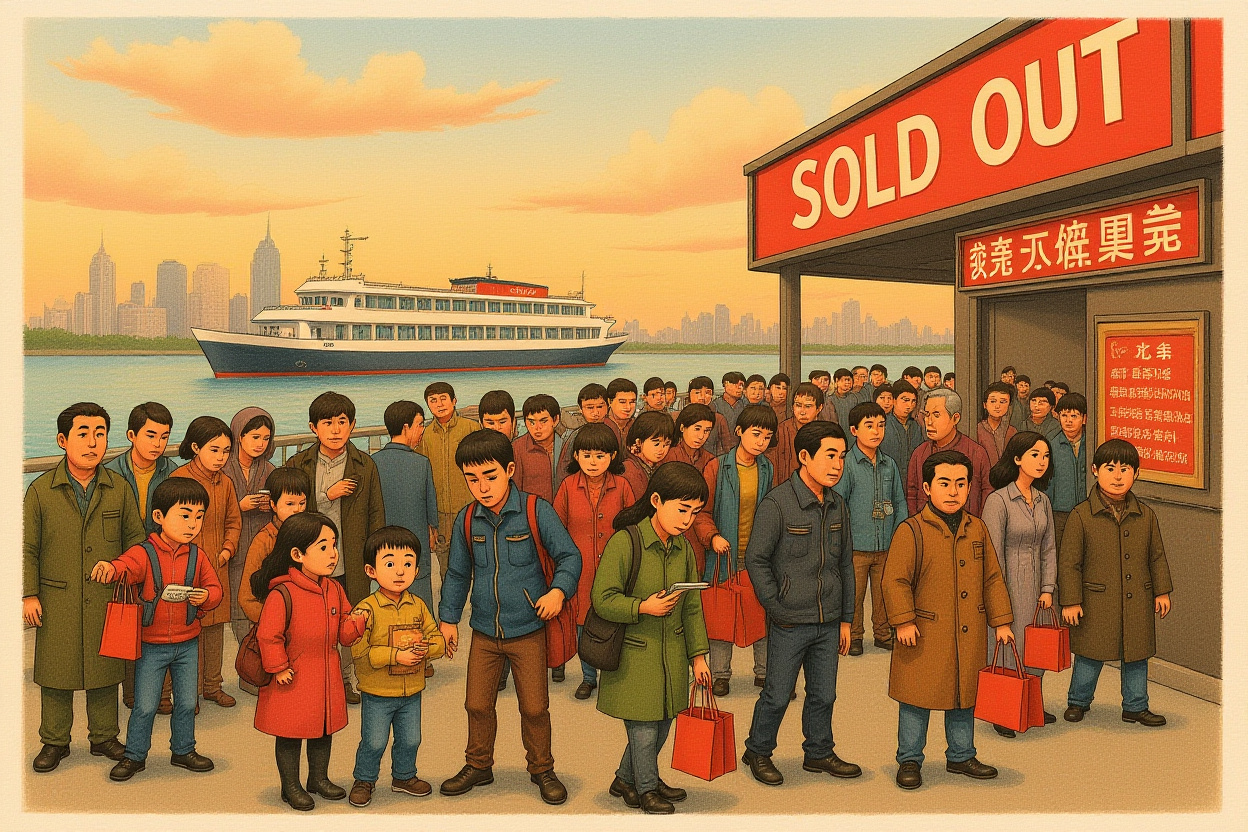
The Unprecedented Spring Festival Travel Crunch
The first Spring Festival travel season since Hainan封关运作 (Hainan’s customs closure operation) has unleashed a tidal wave of demand, exposing the fragile seams of the island’s transportation network. For millions of Chinese, the Lunar New Year represents the most important annual migration, a time to reunite with family. This year, that journey to Hainan has become an epic test of patience and planning, as all vehicle ferry tickets across the琼州海峡 (Qiongzhou Strait) have been sold out days in advance. The situation underscores how Hainan封关运作 is reshaping travel patterns and consumer behavior, with profound implications for investors eyeing the island’s economic transformation.
Record-Breaking Passenger and Vehicle Volumes
Data from海南省交通运输厅 (Hainan Provincial Department of Transport) paints a vivid picture of the surge. In the first nine days of the春运 (Spring Festival travel rush) from February 2 to February 10, comprehensive passenger traffic across Hainan reached 4.8639 million人次, a year-on-year increase of 6.34%. The琼州海峡 (Qiongzhou Strait) corridor, the vital maritime link between mainland China and the island, has borne the brunt of this growth. By February 10, it had transported 1.012 million passengers and 257,900 vehicles, representing increases of 14.0% and 8.2% respectively compared to the same period last year.
- Notably,新能源车 (new energy vehicle) transport saw a staggering 74% year-on-year jump to 42,000 units, reflecting broader national trends towards electric mobility.
- On February 9 alone, the strait operated a record 355 sailings, moving 133,200 passengers and 32,100 vehicles in a single day.
This operational peak, while impressive, has been insufficient to meet demand, leading to the complete sell-out of advance tickets and kilometers-long queues of idling vehicles.
Personal Anecdotes Highlight Systemic Strain
The human impact of this logistical squeeze is stark. Mr. Li, who has worked in Guangdong for seven or eight years, represents countless travelers. In previous years, he drove home to Hainan for the holidays without issue. This year, for the first time, he found all vehicle ferry tickets completely sold out. Forced to improvise, he parked his car in湛江徐闻 (Zhanjiang Xuwen) on the mainland side and bought passenger-only tickets for his family of four. Upon arrival, he witnessed a traffic backlog stretching an estimated十几公里 (over ten kilometers). His family ultimately had to take a local vehicle via a small path and walk about a kilometer to reach the port—a chaotic and exhausting prelude to the holiday.
His experience, echoed on social media platforms like小红书 (Xiaohongshu), highlights the acute pressure on the琼州海峡轮渡管家 (Qiongzhou Strait Ferry Butler) booking system. This official WeChat public account is the primary channel for ticket sales, and its pages for the critical travel days of February 9-12 showed a uniform ‘sold out’ status for vehicle transport.
Hainan封关运作 (Customs Closure Operation): A Catalyst for Change
The dramatic spike in travel interest is not a coincidence; it is directly linked to the official launch of Hainan封关运作 on December 18. This milestone in the海南自由贸易港 (Hainan Free Trade Port)建设 (construction) represents a shift to a fully integrated customs territory, where goods can move freely within the island while being subject to customs control when entering or leaving. The policy红利 (dividends) are already attracting a new wave of visitors, blending traditional holiday travel with shopping tourism and curiosity about the new economic regime.
Policy Overview and Economic Implications
Hainan封关运作 is designed to transform the island into a globally influential free trade port by 2025. The closure simplifies customs procedures within Hainan, creating a more business-friendly environment and enhancing the appeal of离岛免税 (off-island duty-free) shopping. For international investors, this represents a significant test case for China’s economic opening and a potential blueprint for other special economic zones. The immediate travel rush is a tangible, if stressful, indicator of strong consumer interest and confidence in Hainan’s new status.
Surge in Duty-Free Shopping and Tourist Arrivals
The economic data following封关运作 is compelling. In the first month alone,海南空港口岸 (Hainan air ports) recorded 311,000 inbound and outbound passengers, a 48.8% year-on-year increase. More strikingly, off-island duty-free shopping soared to 4.86 billion yuan in value, up 46.8%, with 745,000 shoppers (up 30.2%) purchasing 3.494 million items (up 14.6%).
- Consumers report significant savings. One shopper told第一财经 (Yicai) that buying 100,000 yuan worth of免税商品 (duty-free goods) in Hainan saved him over 10,000 yuan compared to mainland prices.
- At the海口美兰机场免税店 (Haikou Meilan Airport Duty-Free Shop), an Omega Constellation watch with an official price of 81,300 yuan was selling for 67,900 yuan—a discount of 13,400 yuan. An Apple 1TB 17Air phone priced at 11,999 yuan on the mainland was available for 9,940 yuan, though high demand has already led to sell-outs for certain models.
This消费 (consumption) boom, fueled by Hainan封关运作, is a key driver behind the travel surge, as visitors combine holiday visits with lucrative shopping trips.
Logistics and Infrastructure Under Pressure
The overwhelming demand has pushed the琼州海峡 (Qiongzhou Strait) transport system to its limits, revealing both operational flexibilities and vulnerabilities. The客服人员 (customer service personnel) for琼州海峡轮渡管家 directly attributed the strain to increased passenger numbers following Hainan封关运作. In response, authorities have activated应急疏运预案 (emergency疏散plans),增加航班班次 (increasing sailing frequency), and extended ticket预售期 (advance booking periods) to 15 days for entry and 30 days for exit, along with introducing round-trip ticket packages.
Qiongzhou Strait Capacity and Operational Challenges
Despite these measures, tickets remain scarce. A check on February 13 showed that for the period from February 13 to 22, only 8 vehicle ferry slots from徐闻港 (Xuwen Port) to海口港 (Haikou Port) were listed, with 7 already sold out. A single sailing in the early hours of February 13 had just 17 tickets left. This scarcity underscores the physical limitations of the ferry fleet and port infrastructure, which cannot be expanded overnight. The situation presents a critical case study in managing peak demand in a key transport corridor, a concern for logistics investors and policymakers alike.
The Rise of “Huangniu” (Scalpers) and Security Concerns
Where official supply fails, unofficial markets thrive. On platforms like小红书 (Xiaohongshu) and闲鱼 (Xianyu), individuals known as黄牛 (huangniu, or scalpers) have emerged, offering to ‘help’ purchase ferry tickets for exorbitant fees. Reports indicate these operators charge around 800 yuan per ticket on top of the official 390-yuan fare, bringing the total cost to nearly 1,200 yuan. Their methods are opaque, requesting身份证号 (ID numbers) and车牌号 (license plate numbers) from customers but refusing to disclose how they secure tickets.
- Several travelers have reported being defrauded after paying upfront, with the scalpers disappearing without delivering tickets.
- In response,琼州海峡轮渡管家 has issued warnings urging the public to purchase tickets only through official channels and to be wary of any ‘代抢’ (proxy grabbing) or ‘包过’ (guaranteed passage) schemes.
This black-market activity not only exploits consumers but also poses data security risks and undermines the公平性 (fairness) of the ticketing system, calling for stronger regulatory oversight.
Broader Market and Investment Implications
The travel chaos following Hainan封关运作 is more than a seasonal inconvenience; it is a信号 (signal) with deep implications for multiple sectors. For sophisticated investors and business professionals monitoring Chinese equity markets, these developments offer crucial insights into consumer trends, infrastructure gaps, and regional economic vitality.
Consumer Sector Opportunities in Hainan
The explosive growth in duty-free shopping validates the commercial appeal of Hainan封关运作. Companies in the retail, luxury goods, and tourism sectors stand to benefit significantly. The sustained high demand, even amid travel difficulties, suggests strong underlying consumer purchasing power and a willingness to travel for value. Investors should monitor listed companies with major exposure to Hainan’s duty-free market, such as中国中免 (China Duty Free Group), as well as hospitality and service providers on the island. The success of Hainan封关运作 could herald a long-term shift in domestic consumption patterns, with more spending retained within China’s borders.
Infrastructure and Logistics Investment Needs
The current bottlenecks highlight a pressing need for upgraded and expanded transportation infrastructure. This presents opportunities in several areas:
- Maritime Transport: Investment in new, larger, or more efficient ferries for the琼州海峡 (Qiongzhou Strait) route.
- Port Modernization: Enhancements to徐闻港 (Xuwen Port) and海口港 (Haikou Port) to improve vehicle processing and passenger flow.
- Digital Systems: Development of more robust, scalper-resistant online booking platforms and real-time traffic management systems.
- Alternative Transport: Increased capacity for航空 (aviation) links. For instance, on February 13-14, many China Southern Airlines flights from Guangzhou to Haikou were sold out, with only premium cabins available at prices exceeding 5,000 yuan.
These needs align with national strategies for integrated regional development and offer a potential pipeline for companies in construction, engineering, and technology.
Regulatory Responses and Future Outlook
Chinese authorities are actively managing the situation, balancing immediate crisis response with long-term planning for Hainan’s growth. The海南省交通运输厅 (Hainan Provincial Department of Transport) has stated it will closely monitor ticket reservations and候补 (waitlist) situations, dynamically optimize运力配置 (capacity allocation), and add extra sailings as needed to ensure safe and orderly crossings. These steps are essential for maintaining public confidence and ensuring the smooth functioning of Hainan封关运作 during its critical early phase.
Long-term Strategies for Sustainable Growth
The lessons from this first post-封关运作春运 (Spring Festival travel rush) will likely inform future policy. Sustainable growth for the海南自由贸易港 (Hainan Free Trade Port) requires a holistic approach that goes beyond tourism and shopping. Key considerations include:
- Diversifying Transportation Links: While the琼州海峡 (Qiongzhou Strait) ferry is crucial, enhancing air connectivity and exploring fixed-link possibilities (like a bridge or tunnel) could provide relief and resilience.
- Demand Management: Implementing smarter, data-driven ticketing systems that can better predict and manage peak flows, potentially incorporating dynamic pricing or staggered travel incentives.
- Integrated Development: Ensuring that transport upgrades are coordinated with urban planning, hotel capacity, and retail expansion to create a seamless visitor experience.
For the global investment community, Hainan封关运作 remains a compelling narrative of China’s economic evolution. The current travel snarls are growing pains that highlight the scale of the opportunity. As infrastructure catches up to ambition, Hainan is poised to solidify its role as a major consumption and trade hub.
Synthesizing the Surge: Key Takeaways for Stakeholders
The historic sell-out of Qiongzhou Strait ferry tickets during the first Spring Festival after Hainan封关运作 is a multifaceted event with clear lessons. It demonstrates the powerful magnetic effect of the free trade port’s policy incentives, driving record numbers of tourists and shoppers to the island. Simultaneously, it exposes critical vulnerabilities in transportation infrastructure and digital marketplaces that must be addressed to support long-term growth. The rise of scalpers exploiting ticket scarcity is a reminder of the need for robust regulatory frameworks in rapidly evolving economic zones.
For business professionals and investors, this episode reinforces the importance of monitoring on-the-ground implementation of major policies like Hainan封关运作. The consumer demand is undeniable, but the ability to capture its full value depends on supporting systems. The coming months will be telling as to how quickly authorities and the private sector can adapt. Stakeholders should watch for announcements regarding new transport projects, retail sales data from Hainan, and further regulatory tweaks to the duty-free shopping regime. The journey for Hainan’s transformation is just beginning, and navigating its initial challenges offers valuable insights for capital allocation in China’s dynamic market landscape.