



Executive Summary
This article delves into the recent phenomenon surrounding Chinese烤鱼 brand Kaozhi (烤匠), whose Shanghai debut generated queues up to 13 hours, sparking debates on marketing efficacy and long-term viability. Key takeaways include:
– Kaozhi’s launch strategy exemplifies a potent hunger marketing strategy, leveraging scarcity and social buzz to drive immediate traffic.
– Operational strain from excessive demand has led to touts, system vulnerabilities, and polarized customer reviews, risking brand reputation.
– The brand’s sustainability depends on transitioning from viral网红 status to building product loyalty amid fierce competition.
– For investors, this case underscores the need to scrutinize fundamentals over hype in China’s consumer equities, where fleeting trends can impact valuations.
– Historical parallels with brands like Tai Er酸菜鱼 (太二酸菜鱼) highlight the cyclical nature of food and beverage (F&B) frenzies and the importance of operational resilience.
The Viral Launch: Kaozhi’s Queue Economy and Marketing Masterstroke
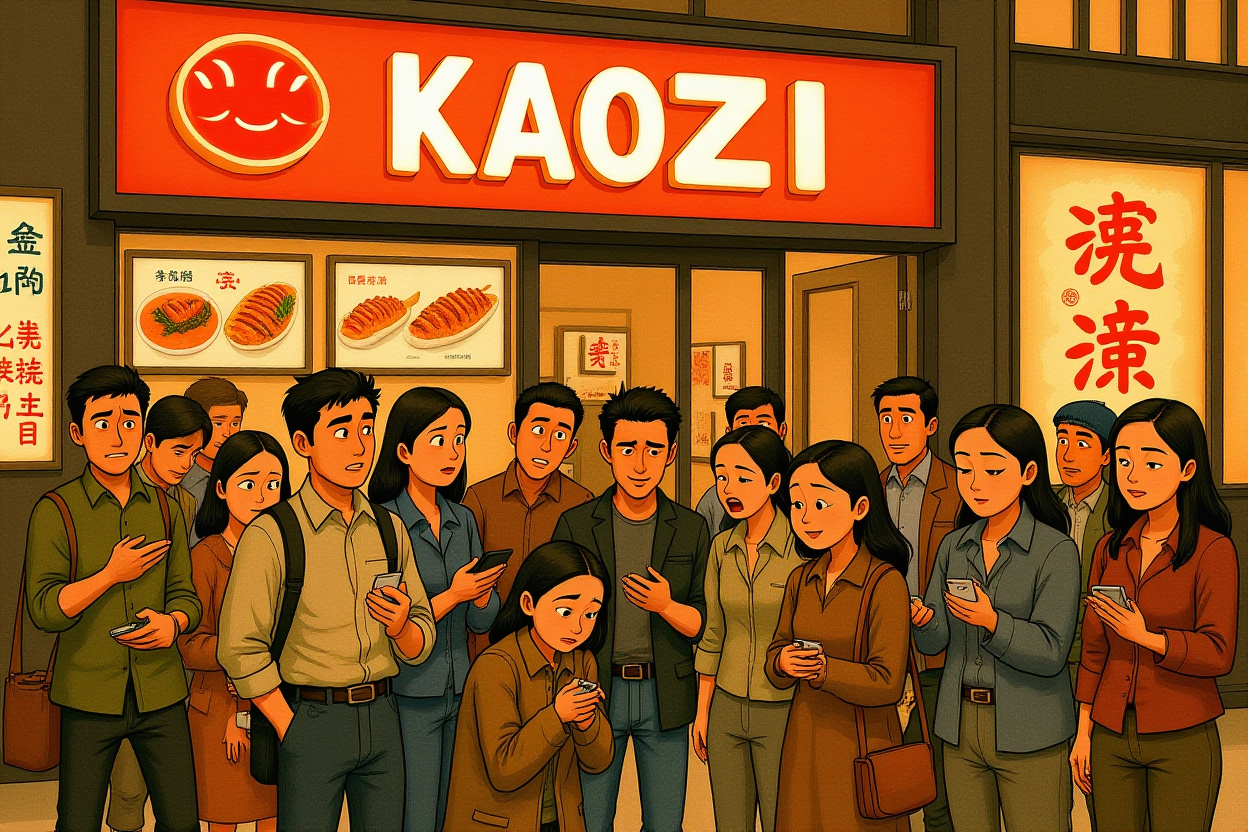
The recent opening of Kaozhi’s first Shanghai outlet sent shockwaves through China’s culinary and investment circles, with reported wait times peaking at 13 hours and over 6,300 tables queued in a single day. This spectacle isn’t merely about food; it’s a calculated hunger marketing strategy designed to generate unprecedented buzz. For global investors monitoring Chinese consumer trends, such phenomena offer critical insights into market sentiment, brand valuation drivers, and the risks of traffic-dependent business models.
Kaozhi’s approach mirrors tactics seen in other Asian retail sectors, where controlled scarcity—through limited releases or exclusive launches—creates a frenzy. However, the scale here is staggering: by midnight on opening day, over 4,000 tables remained waiting, with some patrons dining as late as 5 a.m. This data point alone underscores the brand’s ability to captivate urban consumers, particularly younger demographics in cities like Shanghai who crave novel experiences and social media-worthy moments.
Data-Driven Hype: The Numbers Behind the Queues
Kaozhi’s expansion from its Chengdu roots has been punctuated by queue metrics that fuel its narrative. In Beijing, the first store reportedly saw continuous customer flow from 10 a.m. to midnight without discounts, while the second location claimed 450 tables booked within an hour and an average wait of 6.5 hours. The Shanghai debut shattered these records, with real-time social media posts from consumers detailing seven-hour plus waits. This hunger marketing strategy relies on amplifying such statistics through coordinated campaigns, including pre-launch social media teasers, celebrity endorsements like川渝品鉴官张颜齐 (Zhang Yanqi), and influencer试吃 events.
The brand’s slogan, “不吃火锅,就吃烤匠” (If not hotpot, then Kaozhi), has gained traction, but the true engine is the排队 itself. As noted in coverage by Jiemian News (界面新闻), the queue even spawned a secondary market where touts resold numbered tickets for up to 300 yuan, earning over 1,000 yuan daily—a sign of both high demand and potential system exploitation. For financial analysts, these figures highlight the短期 traffic红利 (short-term traffic dividend) that can inflate early sales but may not correlate with sustainable revenue streams.
The Role of Social Media and Celebrity Endorsements
Kaozhi’s founder, Leng Yanjun (冷艳君), hails from a television advertising background, which explains the brand’s marketing-centric DNA. After a rocky start in 2013, Kaozhi revamped its店面装修 (store decor) and品牌营销 (brand marketing), leading to its current prominence. The Shanghai launch leveraged platforms like Xiaohongshu (小红书) and Weibo, where user-generated content about long waits went viral, reinforcing the hunger marketing strategy. However, this also opens the brand to scrutiny, as online discussions reveal a split between those enthralled by the hype and skeptics questioning its authenticity.
Outbound link: For deeper insights into China’s social media-driven consumption, refer to analyses from Caixin Global on consumer behavior trends.
Operational Realities: When Hype Meets Hard Constraints
While Kaozhi’s queues symbolize marketing success, they also expose critical operational vulnerabilities that could undermine long-term prospects. The hunger marketing strategy, if not managed with robust infrastructure, risks alienating the very customers it attracts. Reports from Beijing and Shanghai indicate that the overwhelming demand has strained取号 (number-taking) systems, allowed touts to flourish, and led to inconsistencies in service quality, prompting complaints on third-party platforms.
For institutional investors evaluating F&B stocks in the沪深交易所 (Shanghai and Shenzhen Stock Exchanges), such operational red flags warrant close attention. A brand’s ability to scale while maintaining standards directly impacts its profitability and margin sustainability. In Kaozhi’s case, the queue phenomenon has doubled as a stress test, revealing gaps that could affect franchise viability or expansion plans in other tier-1 cities.
Touts, System Vulnerabilities, and Customer Dissatisfaction
The emergence of黄牛 (touts) and跑腿员 (errand runners) charging for代取号 (proxy queuing) illustrates how Kaozhi’s hunger marketing strategy can be gamed. Despite brand efforts to combat this, vulnerabilities persist; for example, consumers have noted flaws in the “黑金匠” (Black Gold Member) priority system, where verification processes are lax. This not only frustrates genuine customers but also distorts demand metrics, potentially misleading investors about true organic growth.
On review platforms, mixed feedback abounds: some patrons praise the ambiance but criticize dishes as “又咸又油” (too salty and oily), while others deem the experience not worth the wait. A Xiaohongshu user summarized, “这是一家味道一般的精致网红餐厅” (This is a taste-average,精致网红 restaurant), highlighting the disconnect between hype and culinary delivery. Such sentiment echoes past网红 brands that faded after initial curiosity waned, serving as a cautionary tale for those betting on queue-driven valuations.
Impact on Brand Equity and Financial Performance
The hunger marketing strategy, while boosting short-term visibility, can dilute brand equity if perceived as gimmicky. Kaozhi’s reliance on排队数据 (queue data) in promotions may backfire as consumers grow weary of excessive waits. Financially, this could translate into volatile same-store sales post-launch, a metric closely watched by fund managers in the消费板块 (consumer sector). Moreover, operational inefficiencies from managing crowds can increase labor and logistics costs, squeezing margins that might otherwise attract equity investments.
Outbound link: For regulatory perspectives, the State Administration for Market Regulation (SAMR) guidelines on fair consumer practices offer context on touting issues.
Sustainability in China’s F&B Arena: Beyond the网红 Cycle
Kaozhi’s trajectory raises broader questions about the sustainability of hunger marketing strategy in China’s cutthroat F&B industry. The term网红 (internet-famous) often carries a connotation of ephemerality, with brands like Tai Er酸菜鱼 (太二酸菜鱼) illustrating how initial queues can give way to门店净减少 (net store reductions)—Tai Er reportedly closed 135 outlets in 2025. For corporate executives and private equity firms eyeing China’s consumer market, understanding this cycle is key to discerning durable investments from passing fads.
The hunger marketing strategy typically follows a three-phase pattern: rapid ascent via viral marketing, a backlash from unmet expectations, and either decline or evolution into a classic brand. Kaozhi is currently navigating the transition, where its success hinges on moving beyond gimmicks to solidify product quality, innovate menus, and foster loyalty. This challenge is compounded by同质化 (homogenization) in the烤鱼 (grilled fish) segment, where numerous competitors vie for attention in urban centers.
Case Studies: Lessons from Flash-in-the-Pan Brands
Historical examples abound. Brands that once commanded hours-long queues, from bubble tea chains to hotpot venues, have often struggled to maintain momentum after the novelty wears off. Tai Er酸菜鱼, for instance, initially captivated consumers with its漫画风装潢 (comic-style decor) and strict店规 (store rules), but eventually faced saturation and had to diversify its menu. Similarly, other餐饮 ventures have faltered when marketing overshadows core offerings, leading to a “流量反噬” (traffic backlash) where negative reviews accumulate.
For Kaozhi, avoiding this fate requires investing in supply chain resilience and customer relationship management. As noted in Xinjing Bao (新京报) reports, some consumers were “架了上去” (trapped) by sunk costs after joining queues casually, a dynamic that underscores the psychological pull of hunger marketing strategy but also its fragility. In financial terms, this translates to a high customer acquisition cost that may not yield proportional lifetime value if复购率 (repurchase rates) stagnate.
Product vs. Marketing: The Core Dilemma for Long-Term Growth
At its heart, Kaozhi’s sustainability depends on balancing marketing flair with substantive product development. Founder Leng Yanjun (冷艳君) has acknowledged the importance of both店面装修 and品牌营销, but the true test lies in whether the烤鱼 itself—and ancillary items like烤黑椒猪颈肉 (grilled black pepper pork neck)—can consistently delight palates. Industry experts suggest that enduring F&B brands in China, such as Haidilao (海底捞), have succeeded by coupling innovation with operational excellence, rather than relying solely on queue-induced scarcity.
This hunger marketing strategy, while effective for launch buzz, must evolve into a holistic brand-building approach. For investors, this means scrutinizing KPIs like customer satisfaction scores, menu expansion rates, and geographic diversification plans. In the context of China’s post-pandemic consumption recovery, brands that master this balance may offer more stable equity returns amid market volatility.
Investment Implications: Navigating Hype in Chinese Consumer Equities
For sophisticated investors and fund managers, Kaozhi’s phenomenon serves as a microcosm of larger trends in China’s consumer markets, where sentiment-driven rallies can obscure fundamental weaknesses. The hunger marketing strategy employed here reflects a broader shift towards experience-driven consumption, but it also highlights risks such as regulatory scrutiny over fair competition and consumer protection. As the People’s Bank of China (中国人民银行) monitors economic indicators, F&B sector活力 (vitality) can influence broader market confidence, making this analysis relevant beyond niche餐饮 stocks.
When evaluating companies like Kaozhi or its listed peers, investors should differentiate between traffic metrics and sustainable financial health. Queue lengths may spike initial revenue, but long-term value derives from factors like brand loyalty, operational efficiency, and adaptability to shifting tastes—especially among China’s discerning Gen Z demographic. This hunger marketing strategy, if overplayed, could lead to valuation bubbles that pop when consumer fatigue sets in, impacting portfolios heavy on consumer discretionary names.
Valuing Hype vs. Fundamentals in Equity Analysis
In equity research, analysts often grapple with quantifying intangible assets like brand heat. For Kaozhi, while its queues suggest strong demand, financial models must account for potential declines in footfall post-hype. Comparative analysis with listed F&B firms on the香港交易所 (Hong Kong Stock Exchange) or上海证券交易所 (Shanghai Stock Exchange) can provide benchmarks for revenue sustainability and margin profiles. For instance, brands that have transitioned from网红 to mainstream often show steadier growth curves, supported by repeat business rather than one-off curiosity.
Moreover, the hunger marketing strategy can attract regulatory attention if it leads to consumer harm or market distortion. China’s regulatory authorities, including the SAMR, have cracked down on unfair practices in the past, which could pose compliance risks for aggressively marketed brands. Investors should monitor such developments, as they can affect stock performance and sector sentiment. Outbound link: For regulatory updates, the SAMR’s official announcements offer timely insights.
Strategic Takeaways for Portfolio Allocation
Given these dynamics, a prudent investment approach in China’s F&B sector involves diversifying across brands with proven operational track records and clear paths to scalability. While hunger marketing strategy can signal innovation, it should not be the sole basis for investment decisions. Instead, focus on metrics like same-store sales growth over multiple quarters, cost control measures, and management’s long-term vision—factors that Kaozhi’s leadership, including founder Leng Yanjun (冷艳君), must demonstrate to attract institutional capital.
For global investors, this case underscores the importance of on-the-ground research and local partnerships to discern genuine opportunities from fleeting trends. As China’s consumption upgrade continues, brands that blend marketing savvy with substantive value creation will likely outperform, offering alpha potential in a crowded market.
Forward-Looking Insights: The Path Ahead for Kaozhi and the Industry
Kaozhi’s hunger marketing strategy has undeniably captured attention, but its future will be shaped by how it addresses the dual challenges of sustaining quality and managing growth. The brand’s ability to “长红” (remain popular long-term) hinges on evolving from a queue-dependent novelty to a trusted culinary destination. This requires continuous innovation in menu offerings, enhanced customer service protocols, and transparent communication to rebuild trust where gaps exist.
From a market perspective, China’s F&B landscape is ripe for consolidation, with savvy players leveraging digital tools and data analytics to optimize operations. Kaozhi could explore partnerships or franchise models to scale efficiently, but must avoid the pitfalls of overexpansion that have plagued other网红 brands. Investors should watch for announcements regarding new store openings, same-store sales data, and consumer sentiment indices to gauge progress.
Call to Action for Market Participants
For business professionals and investors engaged with Chinese equities, this analysis offers actionable insights: prioritize due diligence on consumer brands beyond surface-level hype. Monitor Kaozhi’s upcoming financial disclosures, if applicable, and compare its trajectory with industry benchmarks. Engage with management teams to understand their strategic priorities—whether they emphasize product development or marketing spend. Ultimately, the hunger marketing strategy is a tool, not a substitute for enduring value; those who recognize this distinction will be better positioned to capitalize on China’s dynamic consumer story.
As the market digests lessons from Kaozhi’s queues, the broader takeaway is clear: in China’s fast-paced capital markets, sustainable success comes from balancing innovation with integrity. Whether you’re a fund manager allocating assets or a corporate executive planning expansions, let this case remind you to look beyond the queue and into the kitchen—where real value is cooked up, one dish at a time.