



Executive Summary
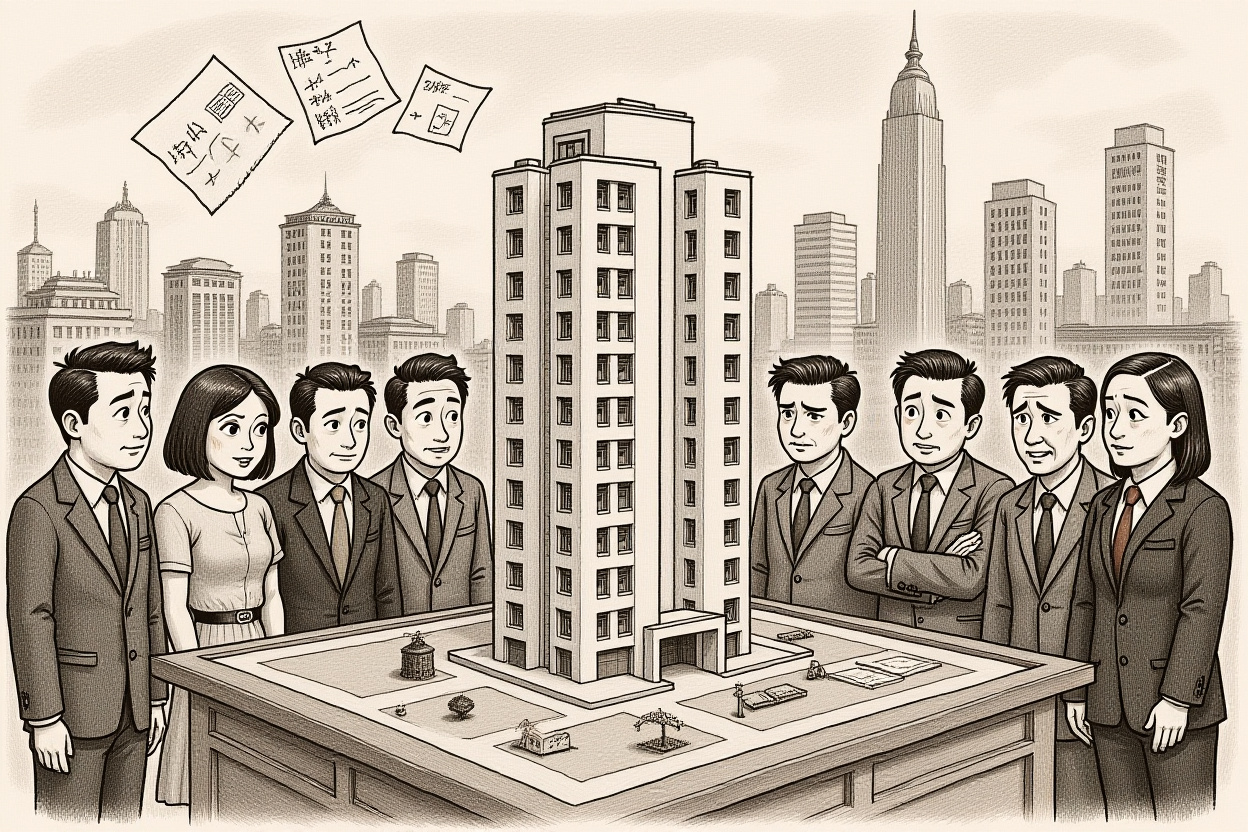
– Shenzhen’s Bai Shi Zhou urban renewal project, developed by Lvjing China Real Estate (绿景中国地产), has officially begun delivering residential units in its first phase, featuring towers up to 74 stories high, marking a pivotal moment for China’s urban redevelopment landscape.
– The delivery proceeds despite significant buyer backlash over delayed timelines, unmet promises on key amenities like a prestigious school, and quality concerns regarding public areas such as underground parking, highlighting ongoing challenges in large-scale real estate projects.
– Financial data reveals severe liquidity pressures for Lvjing Group, with liabilities dwarfing cash reserves, raising questions about the completion of future phases and potential involvement of state-owned enterprises or城投 platforms as rescue partners.
– This case underscores critical lessons for international investors regarding risk assessment in China’s real estate sector, emphasizing the importance of regulatory scrutiny, developer credibility, and the evolving dynamics of urban renewal initiatives.
– Expert analyses suggest that the future of Shenzhen’s Bai Shi Zhou urban renewal project may hinge on strategic partnerships and government support, serving as a bellwether for similar mega-projects across the country.
A Watershed Moment in Urban Redevelopment
After years of anticipation and amidst a cloud of skepticism, Shenzhen’s Bai Shi Zhou urban renewal project has reached a critical juncture with the initial delivery of its residential units. This milestone marks a significant moment for one of China’s most ambitious urban redevelopment initiatives, but it also brings to light the multifaceted challenges facing large-scale real estate projects in the country’s dynamic market. For global investors and professionals focused on Chinese equities, the unfolding story of Shenzhen’s Bai Shi Zhou urban renewal project offers valuable insights into the interplay between development ambitions, regulatory frameworks, and market realities. The project’s delivery, announced by Lvjing China Real Estate via the Hong Kong Stock Exchange, signals progress yet is tempered by controversies that could influence investor confidence and future urban renewal strategies nationwide.
The Milestone Delivery Amid Skepticism
On February 4, Lvjing China Real Estate (绿景中国地产) announced that the main construction of the first phase of its key urban renewal project in Shenzhen’s Nanshan District, known as Bai Shi Zhou (白石洲), had been completed with government approvals, initiating the handover process for residential units. This move represents a long-awaited step forward for Shenzhen’s Bai Shi Zhou urban renewal project, which has been a focal point of industry attention since its inception in 2014. However, the delivery has been shadowed by persistent doubts from buyers and market observers, reflecting broader tensions in China’s real estate sector.
Delayed Timelines and Contractual Nuances
According to purchase contracts provided by homeowners, the delivery date for the first-phase residential units was explicitly set for January 15, 2026. However, delays pushed this timeline, with project representatives citing a one-month grace period stipulated in the contracts, allowing delivery by February 14 without breaching terms. This contractual nuance, while legally sound, has fueled discontent among buyers who expected prompt completion. The situation underscores the importance of scrutinizing contract details in high-stakes real estate investments, particularly in urban renewal projects where complexities often lead to schedule slippages.
Developer’s Financial Pressures
The delivery comes against a backdrop of financial strain for Lvjing Group. Data from the company’s 2025 interim report reveals stark numbers: current liabilities stood at 60.57 billion yuan, with new borrowings of 7.703 billion yuan added in the first half of the year. Short-term debts due within one year amounted to approximately 2.914 billion yuan, while bank balances and cash were merely 342.5 million yuan, supplemented by around 1.449 billion yuan in restricted and pledged deposits. This liquidity crunch raises red flags about the developer’s ability to fund ongoing and future phases of Shenzhen’s Bai Shi Zhou urban renewal project, potentially necessitating external intervention.
Unfulfilled Promises: The School Controversy
One of the most contentious issues surrounding the delivery is the unfulfilled promise of a prestigious school, which was a key selling point during the marketing phase. Buyers, many of whom invested based on this amenity, have expressed frustration over the lack of progress, turning what should be a celebratory moment into a source of conflict.
Marketing Claims vs. Reality
Owner representative Mr. Wu (吴先生) articulated a common sentiment among buyers: ‘We大量业主都是冲着这个学校才来买的.’ He explained that sales materials from the developer explicitly promoted ‘优质教育家门口即上南山外国语学校’ (quality education at home with Nanshan Foreign Language School) and ‘九年一贯制学校,预计2026年9月即可就读’ (a nine-year一贯制 school expected to be operational by September 2026). These claims, disseminated through brochures and posters, played a pivotal role in attracting purchases. However, recent information indicates that the school site has not yet commenced construction, with estimates pointing to a 2027 start and 2029 completion. This disparity between promise and reality has eroded trust, with Mr. Wu noting, ‘学校的土地都还没拆迁完,连动工的迹象都没有,这真的是无法接受.’Government Role and Accountability
In response, project officials clarified that while the school was initially planned for developer-led construction, government fiscal adjustments later shifted responsibility to public authorities. By 2025, the land was transferred, and in October, the government appointed a general contractor for the school’s construction, now managed entirely by the education bureau and public works department. The developer stated that since mid-2024, all school-related promotions have ceased, with materials reviewed by market regulators to avoid违规宣传. This transition highlights the fluid nature of public-private partnerships in China’s urban renewal projects, where regulatory changes can significantly impact deliverables.Quality Concerns and Buyer Backlash
Beyond delays and broken promises, the physical quality of the project has sparked widespread concern among homeowners. Issues range from cosmetic finishes to structural elements, reflecting a broader trend of buyer activism in China’s real estate market.
Underground Parking and Public Areas
A primary point of contention is the underground parking facility, which some buyers found lacking basic finishes like epoxy flooring. Mr. Wu recounted that during visits, ‘部分业主去参观的时候,发现地库连地坪漆都没有,’ leading to perceptions that the project fell short of expectations for a luxury development with units priced in the tens of millions of yuan. After months of negotiations, the developer released an official garage rendering with a company seal, but buyers remain wary of potential corner-cutting under tight deadlines. Project representatives countered that parking upgrades were额外投入 (additional investments) beyond contractual obligations, with schemes agreed upon with homeowners in early 2024 and ongoing evaluations for优化调整 (optimization adjustments).Developer’s Response and Commitments
The developer has emphasized its efforts to address concerns, noting that车库升级本就是开发商在合同外额外投入的提升项,并非合同约定交付标准. They have engaged with homeowner representatives to reassess改造方案 (renovation plans), aiming to align with buyer expectations. This dialogue is crucial for maintaining project credibility, especially as Shenzhen’s Bai Shi Zhou urban renewal project moves forward. The situation illustrates the balancing act developers face between cost control and quality assurance in high-profile urban renewal initiatives.The Scale and Ambition of Bai Shi Zhou
Shenzhen’s Bai Shi Zhou urban renewal project is not just another development; it’s a behemoth that has captured industry imagination for years. With a total floor area of 3.58 million square meters and an estimated value of approximately 220 billion yuan, it represents one of Shenzhen’s most significant urban transformations.
Project Specifications and Market Positioning
The first phase, branded as ‘璟庭’ (Jing Ting), includes 1,257 presold residential units in towers reaching up to 74 stories, making it among the tallest residential projects in China and a landmark for Shenzhen’s skyline. In 2023, units were priced at an average备案均价 of 113,500 yuan per square meter, with total prices ranging from 10.12 million to 52.84 million yuan. This positioning targets高端居住 (high-end residential) segments, combining住宅 (residential),公寓 (apartments), and commercial components to create a mixed-use hub. The scale underscores why Shenzhen’s Bai Shi Zhou urban renewal project is closely watched by investors seeking exposure to China’s urban growth narratives.Financial Implications for Lvjing Group
For Lvjing Group, the stakes are extraordinarily high. The company has invested heavily in this venture over the past decade,几乎押上了全部家当 (virtually betting its entire fortune). The financial data mentioned earlier paints a precarious picture, with liabilities far exceeding liquid assets. This imbalance could affect not only the completion of subsequent phases but also the group’s overall stability, potentially influencing stock performance for Lvjing China Real Estate on the Hong Kong exchange. Investors must monitor these metrics closely, as they reflect the systemic risks associated with large-scale urban renewal projects in China’s current economic climate.Future Prospects and Potential Rescuers
With financial pressures mounting, the future of Shenzhen’s Bai Shi Zhou urban renewal project may depend on external partnerships or government intervention. Expert opinions suggest several plausible scenarios for rescuing or advancing the development.
Involvement of State-Owned Enterprises
Zhi Peiyuan (支培元), Vice Chairman of the China Investment Association上市公司投资专业委员会, analyzed that央国企接盘的概率更大 (state-owned enterprises are more likely to take over), citing their lower capital costs and expertise in navigating complex government relations. Additionally,地方城投平台 (local城投 platforms) could介入 (intervene), leveraging public credibility and resources. This aligns with broader trends in China’s real estate sector, where distressed projects often see state-backed entities stepping in to ensure completion and social stability.Market Analysis and Expert Opinions
Lu Kelin (卢克林), International Registered Innovation Manager and CEO of鹿客岛科技, offered a blunt assessment:深圳的大型旧改江湖只认‘有钱+有政府信用背书’两张门票 (Shenzhen’s large-scale旧改 circle only recognizes two tickets: ‘money’ and ‘government credit endorsement’). He outlined four criteria for potential rescuers: substantial cash reserves,默契 (rapport) with local governments on拆迁 (demolition and compensation), product iteration能力 to recalibrate庞大规划 (massive plans), and金融拆解术 (financial拆解 skills) to分期出货 (phase out the 220 billion yuan value). These insights emphasize that saving Shenzhen’s Bai Shi Zhou urban renewal project requires more than just capital; it demands strategic finesse and political acumen.Broader Implications for China’s Urban Renewal
The delivery and controversies surrounding Shenzhen’s Bai Shi Zhou urban renewal project serve as a microcosm of larger trends in China’s real estate and urban development sectors. For international investors and professionals, this case offers critical lessons on risk management and opportunity assessment.
Regulatory Environment and Investor Confidence
The project highlights the evolving regulatory landscape in China, where government policies on urban renewal, financing, and consumer protection are in flux. Recent measures by authorities like the住房和城乡建设部 (Ministry of Housing and Urban-Rural Development) aim to stabilize markets, but implementation varies. Investors should track announcements from bodies such as the深圳市规划和自然资源局 (Shenzhen Planning and Natural Resources Bureau) for signals on future directions. The school controversy, for instance, shows how shifts in public planning can disrupt private projects, underscoring the need for due diligence on governmental commitments.Lessons for International Stakeholders
– Scrutinize developer financials: As seen with Lvjing Group, liquidity ratios and debt levels are crucial indicators of project viability.– Verify amenity promises: Marketing claims should be cross-checked with official government plans and contracts to avoid reliance on unsecured benefits.
– Monitor partnership dynamics: Potential involvement of state-owned enterprises can alter risk profiles, offering stability but possibly reducing returns.
– Understand local contexts: Urban renewal in cities like Shenzhen involves intricate拆迁 negotiations and regulatory approvals, requiring localized expertise.
– These takeaways are essential for making informed decisions in Chinese equity markets, particularly for funds and institutions eyeing real estate assets.
Synthesizing Key Insights and Moving Forward
The delivery of Shenzhen’s Bai Shi Zhou urban renewal project is a landmark event with far-reaching implications. While it demonstrates progress in urban redevelopment, the accompanying controversies reveal persistent challenges in execution, financing, and stakeholder management. For the real estate sector, this case reinforces the importance of transparent communication, robust financial planning, and adaptive strategies in the face of regulatory changes. International investors should view this as a learning opportunity, emphasizing thorough risk assessment and diversification when engaging with China’s urban renewal projects.
Looking ahead, the trajectory of Shenzhen’s Bai Shi Zhou urban renewal project will likely influence broader market sentiment and policy approaches. Stakeholders are advised to stay informed through reliable sources, such as stock exchange filings and official government announcements, and to consult with experts on ground realities. As China continues to urbanize, projects like Bai Shi Zhou will remain bellwethers for investment trends—monitoring their evolution can provide actionable insights for navigating this dynamic landscape. Consider engaging with specialized financial analysts or subscribing to market updates to stay ahead in the rapidly changing world of Chinese equities.