



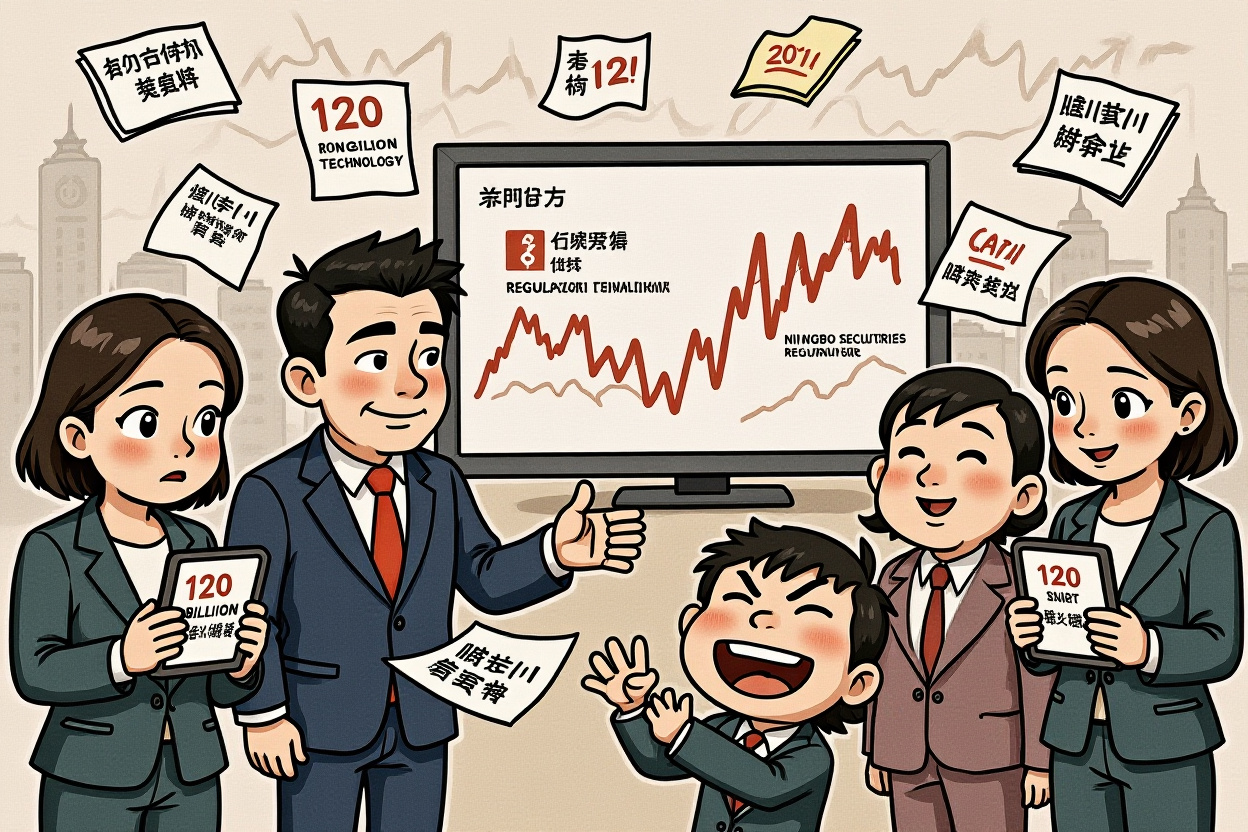
Rongbai Technology (容百科技), a leading cathode material supplier listed on China’s STAR Market, faces proposed fines totaling 9.5 million yuan from the Ningbo Securities Regulatory Bureau (宁波证监局) for alleged misleading disclosures regarding a purported 120 billion yuan contract with battery giant CATL (宁德时代). The swift regulatory action, concluded within 15 working days of investigation initiation by the China Securities Regulatory Commission (中国证监会), underscores heightened scrutiny on corporate governance and transparency in Chinese capital markets. Key discrepancies in the announcement include unconfirmed sales amounts, conditional procurement terms, and undisclosed preconditions, leading to a stock price drop of nearly 20% since the probe began. This incident serves as a critical case study for investors navigating the risks and opportunities in China’s dynamic equity landscape, emphasizing the importance of due diligence and regulatory awareness.
Deconstructing the 120 Billion Yuan CATL Contract Announcement
On January 13, Rongbai Technology (容百科技) issued an announcement titled “关于与宁德时代签署日常经营重大合同的公告” (Announcement on Signing a Significant Daily Operating Contract with CATL), which claimed a monumental agreement with CATL (宁德时代). The company stated that from the first quarter of 2026 to 2031, it would supply approximately 3.05 million tons of lithium iron phosphate (LFP) cathode materials for the domestic market, with an estimated total sales value exceeding 120 billion yuan. This 120 billion yuan CATL contract immediately captivated market attention, but regulatory scrutiny quickly revealed several inconsistencies that undermined its credibility.
What Rongbai Technology Claimed vs. Regulatory Reality
According to the investigation by the Ningbo Securities Regulatory Bureau (宁波证监局), the announcement failed to accurately reflect the terms of the underlying cooperation agreement. The regulator identified four key elements where the disclosure was lacking:
– The cooperation agreement did not stipulate a total sales amount; the 120 billion yuan figure was an estimate by Rongbai Technology, with the company later admitting in a January 19回复公告 (reply announcement) to the Shanghai Stock Exchange (上海证券交易所) that the sales金额具有不确定性 (amount was uncertain).
– The procurement volume was conditional, requiring CATL (宁德时代) to purchase at least 70% of the 3.05 million ton forecast, with final terms subject to future框架性 (framework),年度性 (annual), or单笔采购合同 (single procurement contracts).
– The announcement stated供货 (supply) from 2026 Q1 to 2031, but the agreement was valid only until December 31, 2030, creating a temporal mismatch.
– A critical precondition was omitted: CATL’s (宁德时代) obligation was contingent on Rongbai Technology meeting “综合竞争力” (comprehensive competitiveness) requirements, encompassing policy compliance, commercial terms, product quality, performance metrics, and delivery schedules.
These findings led the regulator to conclude that the 120 billion yuan CATL contract announcement was misleading, violating the证券法 (Securities Law) principles of truthfulness, accuracy, and completeness. For more details on regulatory filings, investors can refer to the Shanghai Stock Exchange inquiry letters.
Swift Investigation and Proposed Penalties
The regulatory response was rapid. The Shanghai Stock Exchange (上海证券交易所) issued a问询函 (inquiry letter) on the same day as the announcement, leading to a three-day trading halt for Rongbai Technology’s stock (688005). By January 18, the China Securities Regulatory Commission (中国证监会) had formally立案调查 (initiated an investigation), and on January 19, trading resumed with the stock price plummeting. The Ningbo Securities Regulatory Bureau (宁波证监局), acting on behalf of the CSRC, completed its probe swiftly, proposing warnings and fines totaling 9.5 million yuan: 4.5 million yuan for Rongbai Technology, 3 million yuan for Chairman Bai Houshan (白厚善), and 2 million yuan for Board Secretary Yu Jiyun (俞济芸). This拟决定 (proposed decision) allows the company to present defenses or request a hearing, but it signals firm regulatory intent in policing disclosure standards.
Immediate Market Fallout and Investor Sentiment
The revelation of the misleading contract announcement has had a tangible impact on Rongbai Technology’s market performance and broader investor confidence in China’s new energy sector.
Stock Price Volatility and Trading Halts
Following the January 13 announcement, Rongbai Technology’s stock was suspended from trading for three days. Upon resumption on January 19, the share price opened significantly lower and has累计下跌 (cumulatively fallen) nearly 20% to date, erasing billions of yuan in market capitalization. This decline reflects investor disillusionment and the repricing of risk associated with the company’s governance and the credibility of the 120 billion yuan CATL contract. The volatility underscores how sensitive Chinese equities, especially on the STAR Market (科创板), are to regulatory news and disclosure integrity, with similar patterns observed in past cases like康美药业 (Kangmei Pharmaceutical).
Broader Implications for the New Energy Battery Sector
The incident has cast a shadow over the lithium-ion battery supply chain, where cathode material suppliers like Rongbai Technology are pivotal. CATL (宁德时代), as a global battery leader, often enters into long-term agreements, but this case highlights the need for skepticism in evaluating such deals. Other firms in the sector, such as当升科技 (Easpring) and杉杉股份 (Shanshan), may face increased scrutiny from investors wary of inflated announcements. Industry analysts note that the focus on the 120 billion yuan CATL contract could lead to tighter internal controls across the industry, as companies seek to avoid regulatory backlash and maintain investor trust in a competitive market.
The Regulatory Lens: China’s Crackdown on Misleading Disclosures
China’s capital markets have seen a concerted effort to enhance transparency and protect investors, particularly after the establishment of the STAR Market (科创板) in 2019, which targets technology and innovation firms. The Rongbai Technology case exemplifies this trend, with regulators taking a zero-tolerance approach to misinformation.
Recent Precedents and Enforcement Trends
In recent years, regulators have taken action against several companies for虚假陈述 (false statements) or误导性陈述 (misleading statements). For instance, in 2022, the CSRC penalized康美药业 (Kangmei Pharmaceutical) for financial fraud, resulting in severe sanctions and delisting. The rapid response in Rongbai Technology’s case—just 15 working days from立案 (filing) to拟处罚 (proposed penalty)—demonstrates an accelerated enforcement mechanism aimed at deterring similar behavior. This aligns with the CSRC’s broader agenda, under leadership such as Chairman Yi Huiman (易会满), to foster a healthy market environment and maintain the credibility of China’s equity markets globally.
Compliance Requirements for STAR Market Listed Companies
Listed on the STAR Market (科创板), Rongbai Technology is subject to stringent disclosure rules under the上海证券交易所科创板股票上市规则 (Shanghai Stock Exchange STAR Market Listing Rules). These rules emphasize timely and accurate information on重大合同 (significant contracts),技术进展 (technological progress), and财务数据 (financial data). The 120 billion yuan CATL contract episode illustrates the consequences of non-compliance, including reputational damage, financial penalties, and potential delisting risks if violations are severe. Investors should monitor regulatory updates from bodies like the CSRC to stay informed on evolving standards.
Corporate Governance and Leadership Accountability
The penalties imposed on Rongbai Technology’s executives highlight the personal liability faced by corporate leaders in China’s regulatory framework, reinforcing the importance of robust governance.
Penalties for Executives Bai Houshan (白厚善) and Yu Jiyun (俞济芸)
Bai Houshan (白厚善), as the Chairman of Rongbai Technology, and Yu Jiyun (俞济芸), as the Board Secretary, are directly accountable for the accuracy of disclosures. The proposed fines of 3 million yuan and 2 million yuan, respectively, are substantial, reflecting their roles in overseeing the announcement process. This personal financial hit, coupled with reputational harm, serves as a deterrent for other executives and underscores the need for internal controls and verification procedures before public releases. In response, Rongbai Technology has stated that the信息披露违法违规行为 (information disclosure violation) does not trigger其他风险警示情形 (other risk warning scenarios) or重大违法强制退市情形 (major illegal强制 delisting scenarios), but investor trust remains fragile.
Rongbai Technology’s Response and Future Plans
The company asserts that its production and operations remain normal despite the controversy. To meet anticipated demand, Rongbai Technology plans to expand capacity through acquisitions and self-build projects, such as the 342 million yuan investment in贵州新仁 (Guizhou Xinren) for a 60,000-ton LFP production line. However, the credibility of future contract announcements, including any related to the 120 billion yuan CATL contract, will be under microscope. The company must enhance its disclosure processes, possibly by involving legal and compliance teams more rigorously, to avoid similar issues and rebuild investor confidence.
Strategic Insights for Global Investors
For international investors navigating Chinese equities, this case offers valuable lessons in risk assessment and due diligence, particularly when evaluating high-stakes announcements like the 120 billion yuan CATL contract.
How to Assess Contract Announcements in Chinese Equities
When evaluating such announcements, investors should:
– Scrutinize the specificity of terms: Are sales amounts fixed or estimated? Are there conditions or preconditions, as seen in Rongbai Technology’s case?
– Cross-reference with regulatory filings and exchange inquiries, such as those from the Shanghai Stock Exchange (上海证券交易所).
– Consider the company’s historical accuracy in disclosures and any past regulatory issues.
– Monitor industry peer reactions and analyst reports for consistency checks. For example, analysts from中国国际金融有限公司 (China International Capital Corporation Limited) often provide insights on sector trends.
– Use tools like ESG (Environmental, Social, and Governance) scores to evaluate corporate governance practices, which can signal disclosure reliability.
Risk Management Strategies in Light of Regulatory Actions
To mitigate risks, investors can:
– Diversify holdings across sectors and companies to reduce exposure to single-event shocks, such as the fallout from the 120 billion yuan CATL contract debacle.
– Stay informed on regulatory updates from bodies like the China Securities Regulatory Commission (中国证监会) and stock exchanges.
– Engage with company management during earnings calls or investor meetings to seek clarifications on major announcements.
– Leverage data from market research firms to validate claims, such as global demand projections for LFP cathodes, which are driven by electric vehicle adoption.
The Road Ahead for Rongbai Technology and the Industry
Despite the setback, Rongbai Technology remains a key player in the battery materials space, but its path forward requires careful navigation amid regulatory and market pressures.
Operational Adjustments and Capacity Expansion
The company’s expansion plans, including the Guizhou Xinren acquisition, are aligned with growing demand for LFP cathodes in electric vehicles. However, the credibility of future contract announcements will be critical. Rongbai Technology must enhance its disclosure processes, possibly by adopting third-party audits or independent reviews for major deals, to avoid similar issues. The 120 billion yuan CATL contract should serve as an internal benchmark for improvement, with lessons applied to upcoming agreements with other clients like比亚迪 (BYD) or特斯拉 (Tesla).
Long-term Viability in the Competitive Battery Materials Market
The global shift towards electrification ensures sustained demand for battery materials, but competition is fierce from players like浦项制铁 (POSCO) and巴斯夫 (BASF). Rongbai Technology’s ability to secure genuine, transparent agreements with customers like CATL (宁德时代) will be crucial for long-term growth. Investors should watch for signs of regained trust, such as successful contract executions without regulatory hiccups, and monitor financial performance indicators like revenue growth and margin stability. The People’s Bank of China (中国人民银行) policies on green finance may also influence sector dynamics, adding another layer for consideration.
The Rongbai Technology case epitomizes the dynamic interplay between corporate ambition and regulatory vigilance in China’s equity markets. The misleading 120 billion yuan CATL contract announcement has not only resulted in significant penalties but also eroded investor confidence, highlighting the critical importance of disclosure integrity. As regulators continue to tighten enforcement under frameworks like the新证券法 (New Securities Law), listed companies must prioritize transparency, while investors should arm themselves with thorough due diligence. For those engaged in Chinese equities, staying abreast of such developments is not optional—it’s essential for informed decision-making in a rapidly evolving landscape. Take this as a call to action: enhance your research frameworks, leverage regulatory resources, and approach high-stakes announcements with a skeptical eye to safeguard your investments and capitalize on genuine opportunities in markets like the STAR Market.