



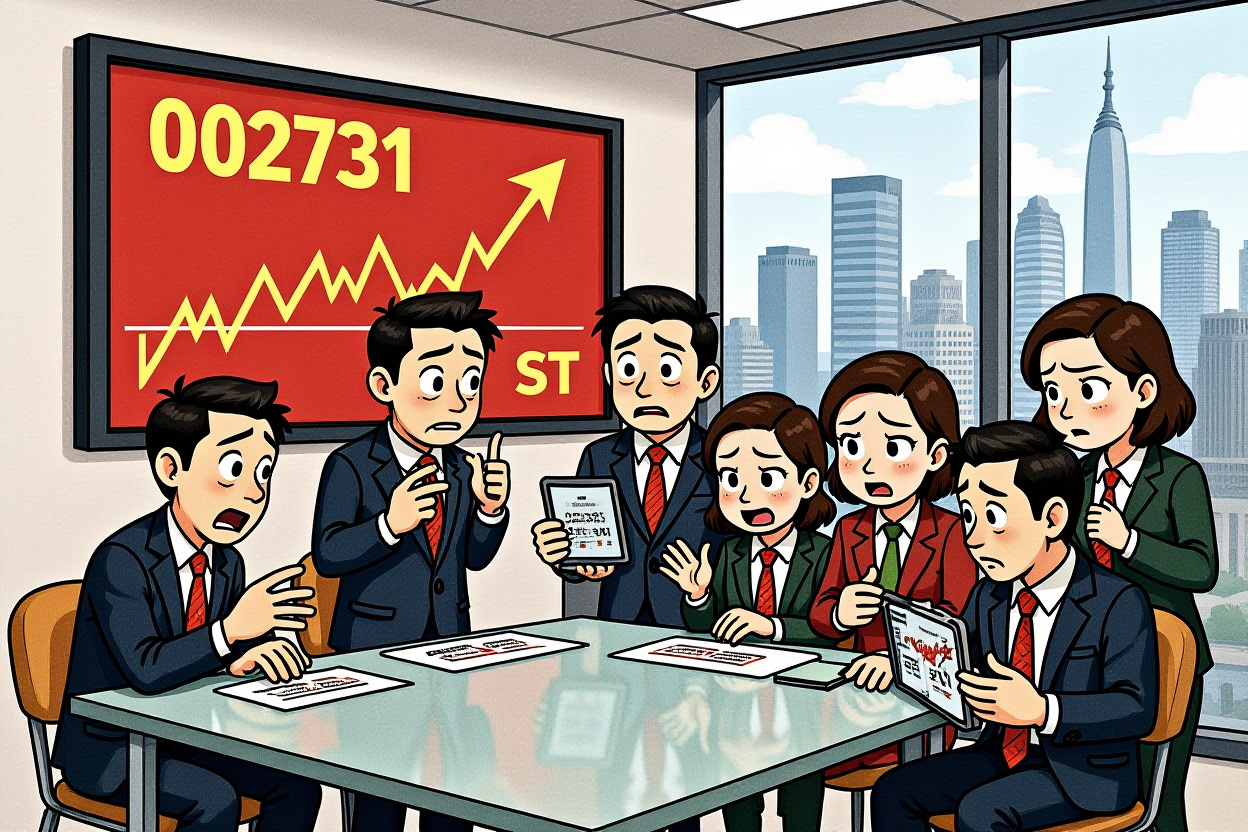
Executive Summary
– The listed company associated with Stock Code 002731 has had its primary bank accounts unexpectedly frozen by judicial authorities, triggering a major liquidity crisis.
– This event almost certainly necessitates a “Special Treatment” (ST) designation by the 深圳证券交易所 (Shenzhen Stock Exchange), which carries significant trading restrictions and stigma.
– The case highlights critical risks in the Chinese A-share market, including corporate governance failures, opaque financial disclosures, and the severe consequences of regulatory non-compliance.
– Investors must recalibrate risk models for mid-to-small cap stocks, as such events can precipitate rapid value erosion and complicate exit strategies.
– Proactive monitoring of 中国证券监督管理委员会 (China Securities Regulatory Commission, CSRC) announcements and exchange filings is now paramount for portfolio managers exposed to similar equities.
A Sudden Freeze Rocks the Market: The 002731 Precipice
In the high-stakes arena of Chinese equities, where liquidity is king and confidence is fragile, few announcements strike more fear than the sudden freezing of a company’s core banking lifelines. The unfolding crisis around Stock Code 002731, whose major operating accounts have been judicially frozen, represents a textbook case of operational risk morphing into an existential threat. This development directly precipitates its impending designation as an ST stock, a label that signals deep financial distress to the global investment community. For institutional investors tracking the Shenzhen market, this event is a stark reminder of the latent vulnerabilities that can lurk beneath seemingly stable balance sheets. The immediate suspension of daily financial operations cripples a company’s ability to pay suppliers, meet payroll, and service debt, instantly translating into a precipitous drop in shareholder value.
Decoding the Account Freeze: Legal and Financial Triggers
A judicial freeze on bank accounts is never an arbitrary action. It typically stems from a company’s failure to comply with a court order, often related to unpaid debts, legal disputes, or担保 (guarantee) liabilities. In the context of Stock Code 002731, this action suggests the company, or entities closely related to it, have defaulted on significant obligations, prompting creditors to seek asset preservation through the courts. The 中华人民共和国最高人民法院 (Supreme People’s Court of China) maintains strict protocols for such enforcement actions, which are becoming increasingly common as credit conditions tighten. The freezing of major accounts is a definitive red flag, indicating that internal cash flow has failed and external financing channels have likely dried up. For investors, this is the first domino to fall in a chain that inevitably leads to exchange-mandated special treatment.
The Immediate Aftermath and Market Ripple Effects
News of the freeze catalyzed a sharp sell-off in 002731’s shares, with trading volume spiking as panic set in. The broader sector of small and mid-cap stocks on the 深圳证券交易所 (Shenzhen Stock Exchange) also experienced heightened volatility, as fund managers conducted swift reviews of holdings with similar risk profiles. This event underscores the interconnected nature of China’s corporate debt ecosystem and the speed at which contagion can spread. The focus phrase, Stock Code 002731’s bank account freeze and ST designation, is now a central topic in risk committee meetings worldwide, prompting urgent reassessments of exposure to companies with high leverage or weak corporate governance structures.
Understanding the “ST” Designation: More Than Just a Label
The impending ST status for Stock Code 002731 is not a minor administrative footnote; it is a severe regulatory intervention with profound implications. ST, or 特别处理 (Special Treatment), is a mechanism used by Chinese stock exchanges to flag companies in financial peril or those that have violated listing rules. The designation serves as a critical warning system for the market, but it also imposes punitive restrictions that can trap unwary investors.
Criteria and Consequences of the ST Stamp
According to the listing rules of the 深圳证券交易所 (Shenzhen Stock Exchange), a company may be designated ST if its audited net profit is negative for two consecutive years, if its net assets fall below the registered capital, or if its financial reports receive a disclaimer or adverse opinion from auditors. Crucially, a major disruption like the freezing of principal bank accounts, which severely impacts normal operations, can also trigger this classification. The consequences are severe: daily price movement limits are reduced from 10% to 5%, the stock ticker is prefixed with “ST” to warn investors, and the company faces heightened scrutiny and reporting requirements. This effectively places the stock in a penalty box, drastically reducing its liquidity and attractiveness to most institutional funds.
The Path to Delisting and Shareholder Implications
An ST designation is often the first step on a path that can lead to 退市 (delisting). If the company fails to rectify its situation—for example, by resuming normal operations, reporting profitable quarters, or resolving the legal issues that caused the account freeze—it may face *ST (delisting risk warning) and eventual removal from the exchange. For shareholders of Stock Code 002731, this scenario represents a potential total loss. Recovery becomes exponentially harder as financing options vanish and reputational damage scares off strategic investors or white knights. The situation around Stock Code 002731’s bank account freeze and ST designation thus becomes a case study in capital preservation versus capital destruction.
Regulatory Scrutiny and the Role of Chinese Authorities
The response from China’s financial regulators will be closely watched as a barometer of enforcement rigor and investor protection. The 中国证券监督管理委员会 (China Securities Regulatory Commission, CSRC) has consistently emphasized market stability and the prevention of systemic risk, making cases like 002731 a priority for oversight.
CSRC’s Evolving Stance on Financial Transparency
In recent years, the CSRC has tightened disclosure requirements, particularly concerning major asset freezes, litigation risks, and internal control deficiencies. Companies are mandated to disclose such material events immediately. The fact that Stock Code 002731 is facing an ST designation suggests regulators have determined the company’s issues are severe and publicly material. This aligns with the CSRC’s broader campaign to weed out “zombie” listed companies and improve the overall quality of the A-share market. Investors should monitor the CSRC’s official website for any enforcement actions or guidance related to this case.
Exchange Enforcement and the Delisting Mechanism
The 深圳证券交易所 (Shenzhen Stock Exchange) plays a direct role in administering the ST regime. Its listing committee will review the circumstances of the bank account freeze and the company’s subsequent remediation plans. The exchange’s rules are designed to be automatic and formulaic in many respects; once certain triggers are met, the ST designation is applied with limited discretion. This mechanistic approach aims to provide market clarity but can also lead to abrupt re-ratings. The ongoing saga of Stock Code 002731’s bank account freeze and ST designation will test the consistency and transparency of this process.
Historical Precedents: Lessons from Past ST Scenarios
Chinese equity markets have witnessed numerous ST cases, providing a valuable roadmap for potential outcomes. Analyzing these precedents can help investors gauge the probability of recovery or failure for Stock Code 002731.
Case Studies: Recovery vs. Collapse
Some companies, like 沈阳机床 (Shenyang Machine Tool Co., Ltd.), underwent ST designation due to losses but managed to restructure debt, introduce strategic investors, and eventually shed the ST label. Others, such as 乐视网 (LeEco), saw their situations deteriorate from ST to delisting. The key differentiator often lies in the nature of the crisis: a cyclical downturn is more survivable than a fundamental fraud or a complete operational meltdown like a total bank account freeze. The latter, which appears to be the case with 002731, suggests a deeper, more systemic failure that is harder to reverse.
Common Threads and Investor Blind Spots
Historical analysis reveals common threads preceding ST designations: aggressive expansion fueled by debt, frequent changes in auditors, and a history of related-party transactions. For Stock Code 002731, investors are now scrutinizing past financial statements for similar red flags they may have overlooked. This event reinforces the necessity of deep fundamental analysis beyond headline earnings, paying close attention to cash flow statements, contingent liabilities, and the quality of a company’s 内部控制 (internal controls).
Strategic Implications for Global Investors and Fund Managers
For the sophisticated international investors who are the core audience of this analysis, the 002731 incident is a actionable data point for refining China-specific investment strategies. It underscores the non-negotiable importance of robust due diligence and dynamic risk management.
Revising Due Diligence and Risk Assessment Frameworks
– Enhanced Liquidity Analysis: Scrutinize the diversity and security of a company’s bank accounts and payment systems. Over-reliance on a single banking partner or region is a risk.
– Legal and Litigation Checks: Regular monitoring of court databases for lawsuits involving the company or its major shareholders is now essential. Tools that track 被执行人 (judgment debtor) status can provide early warnings.
– Stress Testing for ST Triggers: Portfolio models should explicitly factor in the probability and impact of an ST designation, especially for small-cap holdings. This includes modeling the liquidity drag from a 5% daily price limit.
The focus phrase, Stock Code 002731’s bank account freeze and ST designation, should serve as a permanent addition to the checklist for assessing operational risk in Chinese equities.
Portfolio Actions and Hedging Strategies
In the immediate term, investors holding 002731 or similar stocks face limited options due to trading halts and reduced limits. For broader portfolio protection, strategies may include:
– Reducing exposure to sectors with high leverage and weak cash conversion cycles.
– Increasing allocations to large-cap, state-owned enterprises with implicit government support and stronger compliance records.
– Utilizing derivatives or ETFs that allow short exposure to broad small-cap indices as a hedge against sector-wide distress signals amplified by cases like 002731.
Navigating the Aftermath: A Roadmap for Stakeholders
The final chapter for Stock Code 002731 is yet to be written, but the available paths are narrow. The company’s management must now engage in a high-wire act to restore confidence and avoid delisting.
The Company’s Uphill Battle for Survival
The immediate priorities for the company behind Stock Code 002731 will be to unfreeze the accounts through settlement with creditors, secure emergency financing to meet ongoing obligations, and present a credible survival plan to the exchange and regulators. This often involves asset sales, equity injections from major shareholders, or seeking mediation from local governments. Success is uncertain and typically results in massive dilution for existing shareholders. The market will be watching for any announcements regarding 重组 (restructuring) plans.
A Call to Action for the Investment Community
This incident is a powerful reminder that in China’s dynamic equity markets, vigilance is the ultimate currency. The saga of Stock Code 002731’s bank account freeze and ST designation concludes with several unambiguous lessons. First, operational risks can materialize with devastating speed, making continuous monitoring as important as initial valuation. Second, the Chinese regulatory framework for distressed companies, while structured, offers little mercy to those who fail its tests. Finally, diversification remains the cornerstone of risk management, not just across sectors but across market capitalizations and governance quality tiers.
Moving forward, astute investors should use this event as a catalyst to audit their Chinese equity holdings for similar vulnerabilities. Engage directly with company investor relations teams on questions of account security and litigation exposure. Subscribe to real-time alerts from the 深圳证券交易所 (Shenzhen Stock Exchange) and CSRC for all portfolio companies. In the complex tapestry of Chinese equities, the story of 002731 is a stark thread—one that warns of peril but also guides the attentive toward more resilient investment practices. The next step is to apply these insights before the next freeze, not after.