



Executive Summary
The cryptocurrency markets have been rocked by a severe sell-off, with profound implications for traders, institutional investors, and related financial ecosystems. Here are the critical takeaways:
- Bitcoin led a broad-based crypto plunge, briefly falling below $60,000 before a partial recovery, erasing gains from recent speculative rallies.
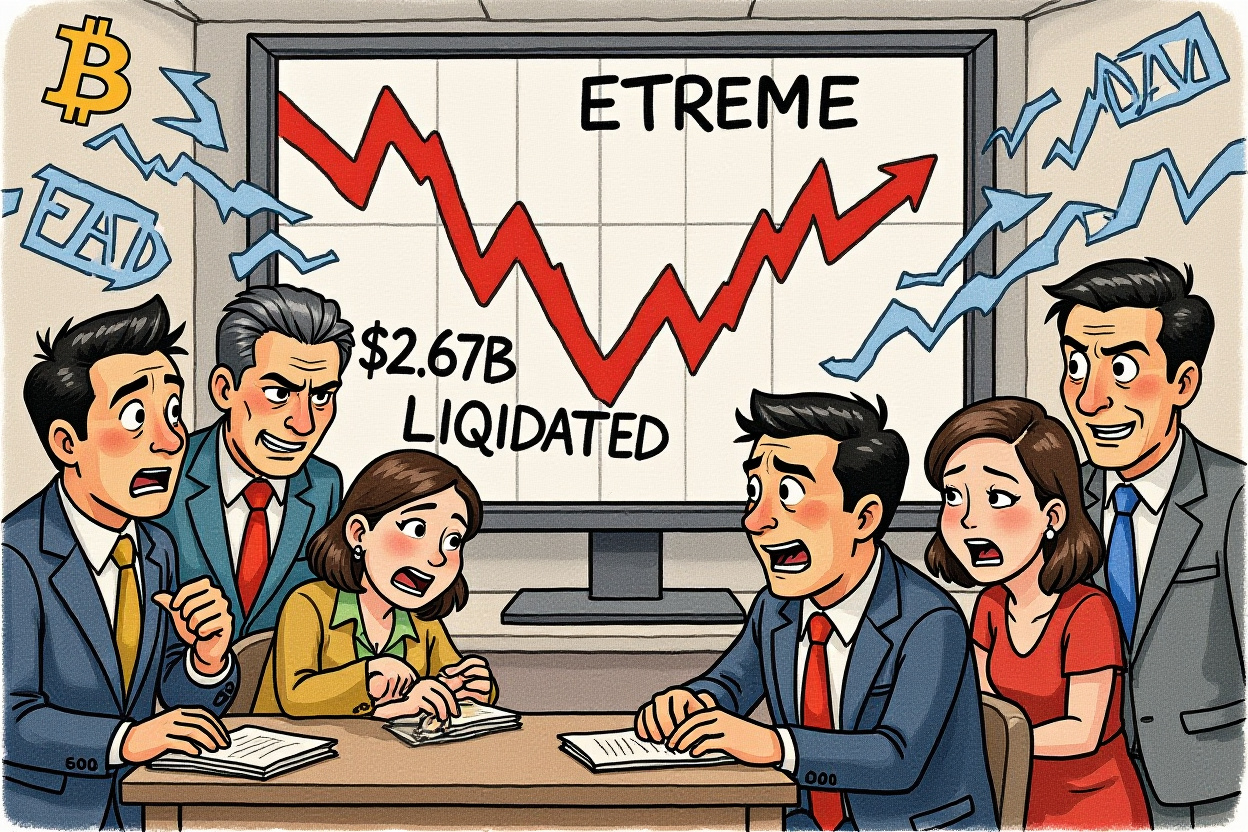
- Leverage unwinding triggered a liquidation cascade, with over 580,000 traders seeing positions forcibly closed, amounting to approximately $2.67 billion in losses within 24 hours.
- Market sentiment, as measured by the Crypto Fear & Greed Index, has plummeted to a level of 10, indicating a state of ‘extreme fear’ among participants.
- The sell-off has spilled over into cryptocurrency Exchange-Traded Funds (ETFs) and corporate balance sheets, notably impacting firms like Strategy Inc. with significant Bitcoin holdings.
- Prominent market figures, including Michael Novogratz and Michael Burry, have issued warnings, with analysts predicting potential further downside, raising questions about Bitcoin’s perceived role as a hedge.
A Sudden Storm in Digital Asset Markets
The digital asset landscape convulsed on February 6th, as what began as a sharp decline in Bitcoin prices rapidly escalated into a full-blown cryptocurrency bloodbath. In early trading, Bitcoin (比特币) price action resembled a cliff dive, plummeting towards the psychologically significant $60,000 level—a threshold not tested in months—before staging a volatile ‘V-shaped’ recovery to hover around $64,000. This dramatic move was not an isolated event but the catalyst for a market-wide rout. The initial tremor quickly amplified into a seismic shift, wiping out billions in market capitalization and signaling a profound shift in investor psychology. This cryptocurrency bloodbath serves as a stark reminder of the asset class’s inherent volatility and its interconnectedness with global risk sentiment, factors that sophisticated investors in Chinese equities and beyond must carefully monitor.
The scale of the sell-off was breathtaking in its speed and breadth. Within the same 24-hour window, other major digital currencies, often referred to as ‘altcoins’, experienced even steeper declines. Ethereum (以太坊), Dogecoin (狗狗币), and Cardano (艾达币) each recorded losses exceeding 10%, demonstrating that the panic was not confined to the flagship cryptocurrency. This synchronous downturn suggests a systemic deleveraging event rather than a issue specific to any single blockchain network. The trigger for this cryptocurrency bloodbath appears multifaceted, rooted in the unwinding of excessive leverage, a lack of fresh bullish catalysts, and a broader reassessment of risk across financial markets following recent geopolitical and macroeconomic developments.
The Liquidation Cascade: By the Numbers
Data from derivatives tracking platforms like CoinGlass paints a vivid picture of the human and financial cost of the downturn. The staggering figure of 586,219 liquidated traders represents one of the largest single-day casualty counts in recent memory. The total value liquidated reached $2.665 billion, with long positions (bets on rising prices) accounting for the overwhelming majority—$2.314 billion—compared to $351 million in short positions. This lopsided ratio indicates that the recent rally had encouraged a significant buildup of bullish leverage, which acted as fuel for the sell-off when prices reversed. Each forced closure adds selling pressure, creating a self-reinforcing cycle that can accelerate declines. For global portfolio managers, especially those with exposure to crypto-correlated assets or firms, understanding these mechanics is crucial for risk assessment.
Decoding the “Extreme Fear” Sentiment
Beyond the price charts and liquidation data, the psychological state of the market offers critical insight. The widely referenced Crypto Fear & Greed Index, which aggregates various market signals like volatility, momentum, and social media sentiment, collapsed to a reading of 10. This places the market squarely in the ‘extreme fear’ zone, a level often associated with capitulation events and potential market bottoms in traditional finance. However, in the nascent and sentiment-driven crypto markets, such extreme readings can also precede further volatility. The current cryptocurrency bloodbath has effectively vaporized the ‘fear of missing out’ (FOMO) that drove prices higher in prior months, replacing it with a ‘fear of losing everything’ mentality.
This shift in sentiment is not merely academic. It has real-world consequences for capital flows and investment behavior. Michael Novogratz, CEO of Galaxy Digital, encapsulated this change, stating, ‘There used to be an almost religious belief in ‘hodling’ bitcoin no matter what. But somehow, that faith or mania has worn off, and selling has begun to emerge.’ His observation points to a potential paradigm shift where the narrative of Bitcoin as a ‘digital gold’ or must-hold asset is being stress-tested. For international investors, particularly those navigating markets like China where regulatory sentiment can shift rapidly, gauging these psychological undercurrents is as important as analyzing balance sheets.
The Role of Narrative and Catalysts
The erosion of bullish narratives has been a key driver of the fear. Earlier speculative fervor, partly tied to political developments such as the potential for a Trump administration, has completely dissipated. Furthermore, the absence of a new, compelling catalyst—such as a regulatory breakthrough for spot ETFs in a major market or a wave of institutional adoption—has left the market vulnerable. Alex Thorn, Head of Research at Galaxy Digital, highlighted this, predicting further downside risk with Bitcoin potentially falling below $60,000. He noted Bitcoin’s failure to act as an inflation hedge during recent surges in gold prices as a particular point of concern for its investment thesis. This lack of a near-term positive catalyst exacerbates the sense of extreme fear.
Contagion: From Crypto to Corporations and ETFs
The fallout from this cryptocurrency bloodbath extends far beyond individual traders and exchange order books. A significant transmission channel has been through publicly listed companies that hold substantial Bitcoin treasuries on their balance sheets. Strategy Inc., a notable example, recently confirmed a staggering fourth-quarter net loss of $12.4 billion, primarily due to mark-to-market losses on its massive Bitcoin portfolio. The new market turmoil pushed Bitcoin’s price below the company’s cumulative cost basis for the first time since 2023, leading to a more than 17% drop in Strategy Inc.’s stock price on February 5th. This illustrates how cryptocurrency volatility can directly impact equity valuations, a linkage that global fund managers must factor into their analysis of tech and finance sectors.
Similarly, the nascent market for U.S. spot Bitcoin ETFs, once hailed as a gateway for mainstream capital, has felt the brunt of the sell-off. Data from Bloomberg indicated a single-day outflow of over $740 million from more than 140 crypto-themed ETFs on a recent Wednesday, contributing to a three-month net outflow approaching $4 billion. This represents a dramatic reversal from the inflows seen upon their launch. Research from Glassnode adds another layer of concern, indicating that the average cost basis for U.S. spot Bitcoin ETF holders is approximately $84,100 per coin. With Bitcoin trading significantly below that level, a large cohort of these new investors is sitting on substantial unrealized losses, which could pressure further redemptions and selling. This creates a feedback loop where ETF outflows force underlying Bitcoin sales, reinforcing the downward price pressure.
Implications for Asian and Chinese Investment Vehicles
While the direct impact might be most visible in U.S.-listed instruments, the reverberations are global. In Hong Kong, several crypto-focused ETFs and investment products have also launched, catering to regional demand. A sustained cryptocurrency bloodbath in core markets like the U.S. inevitably affects sentiment and pricing for these Asian products. Furthermore, Chinese investors, despite domestic bans on cryptocurrency trading, often access these markets through overseas channels or related equities. The performance of companies like Strategy Inc. or mining firms listed on the Nasdaq or Hong Kong exchanges can serve as a proxy for crypto market health, influencing broader tech sector sentiment in regional portfolios.
Regulatory Landscape and the Chinese Context
For investors with a focus on China, understanding the regulatory environment is paramount. The 中国人民银行 (People’s Bank of China) has maintained a strict prohibition on cryptocurrency trading and initial coin offerings (ICOs) within its jurisdiction, citing financial stability risks and capital flow concerns. This stance has largely insulated the mainland financial system from the direct shocks of events like the current cryptocurrency bloodbath. However, it does not mean Chinese capital is absent. Historical data shows significant involvement through offshore exchanges and investment vehicles. Moreover, Hong Kong’s positioning as a regulated crypto hub means developments there are closely watched. A severe market downturn could influence the pace and nature of regulatory experimentation in the special administrative region.
The current market turmoil may reinforce the cautious stance of Chinese regulators. Observers will be watching for any official commentary from bodies like the 中国证监会 (China Securities Regulatory Commission) regarding the risks demonstrated by the volatility, particularly for cross-border investments. For corporate executives and institutional investors operating in or tied to China, this episode underscores the importance of rigorous due diligence on any crypto-related exposure, whether direct or through supply chains and partner companies. The narrative of cryptocurrencies as a speculative bubble, often highlighted by Chinese state media, gains empirical support during such events, potentially hardening regulatory attitudes.
Historical Parallels and Policy Lessons
Chinese regulators have consistently prioritized systemic stability over speculative innovation in the financial sector. The 2017 ICO crackdown and the 2021 mining ban were decisive actions taken to mitigate perceived risks. The current global cryptocurrency bloodbath, with its associated liquidations and corporate losses, provides a real-time case study that likely validates the preemptive measures taken by authorities in Beijing. This regulatory philosophy extends to related areas like fintech and digital assets, suggesting that any future integration of blockchain technology in China’s financial infrastructure will be heavily controlled and state-sanctioned, rather than open and permissionless.
Expert Prognostications: Navigating the Uncertainty
The voice of industry experts provides crucial, though often divergent, guidance during periods of extreme market stress. The warnings have grown notably dire. Michael Burry, the investor famous for predicting the 2008 financial crisis, publicly cautioned that Bitcoin’s price collapse could intensify into a self-reinforcing ‘death spiral,’ inflicting lasting damage on companies that accumulated the cryptocurrency over the past year. He argued that Bitcoin has proven to be a purely speculative asset, failing to act as an effective hedge against devaluation like precious metals. This perspective challenges a core tenet of the long-term ‘HODL’ investment strategy and resonates with value-focused investors.
Conversely, while acknowledging the shift in sentiment, some veterans see the extreme fear as a necessary cleansing. The massive liquidation of over-leveraged positions, while painful, can create a healthier foundation for the next phase of growth by removing weak hands. The key for investors is to distinguish between cyclical volatility and a fundamental breakdown of the asset’s value proposition. Alex Thorn’s bearish near-term technical target below $60,000 is balanced by the long-term view held by many that Bitcoin’s network effects and fixed supply schedule will ultimately prevail. Navigating this dichotomy requires a disciplined strategy rather than emotional reaction.
Synthesizing the Views for a Actionable Framework
For the sophisticated investor, the collective expert insight points to several actionable considerations. First, risk management is non-negotiable; position sizing and the use of stop-losses (where applicable) are critical in such a volatile asset class. Second, diversification remains a cornerstone principle; over-concentration in crypto assets, even through indirect channels, magnifies portfolio volatility. Third, a clear investment thesis is essential: is the exposure purely for speculative trading, or is it a strategic long-term allocation based on a belief in blockchain’s future? The current cryptocurrency bloodbath brutally tests the conviction behind each approach.
Strategic Implications and Forward Guidance
The dramatic events of early February serve as a powerful reset for the digital asset ecosystem. The cryptocurrency bloodbath has forcefully reminded all market participants—from retail traders to institutional allocators—of the severe risks that accompany the potential for outsized returns. For fund managers and corporate executives with global mandates, the immediate task is a thorough portfolio stress test to identify hidden exposures to crypto volatility, whether through direct holdings, equity investments in related companies, or counterparty risk with entities engaged in the space.
Looking ahead, market recovery will likely hinge on several factors: a stabilization in global macroeconomic conditions, particularly interest rate expectations; a visible slowdown in ETF outflows; and the emergence of a new, positive narrative to restore investor confidence. Technical analysts will watch for a firm hold above or below key levels like $60,000 for Bitcoin. From a Chinese market perspective, investors should monitor any regulatory signals from Hong Kong and mainland authorities, as well as the performance of Asia-listed tech firms with crypto ties. The extreme fear reading, while alarming, has historically marked areas of opportunity for contrarian investors with long time horizons and robust risk tolerance.
In conclusion, the path forward requires vigilance, education, and strategic patience. The cryptocurrency markets are in a state of flux, and the dust from this latest storm has yet to settle. Engage with continuous market analysis, consult with legal and compliance experts on evolving regulations, and ensure your investment thesis can withstand periods of extreme stress. The lessons learned from this cryptocurrency bloodbath will define the resilience and sophistication of the next generation of digital asset investors.