



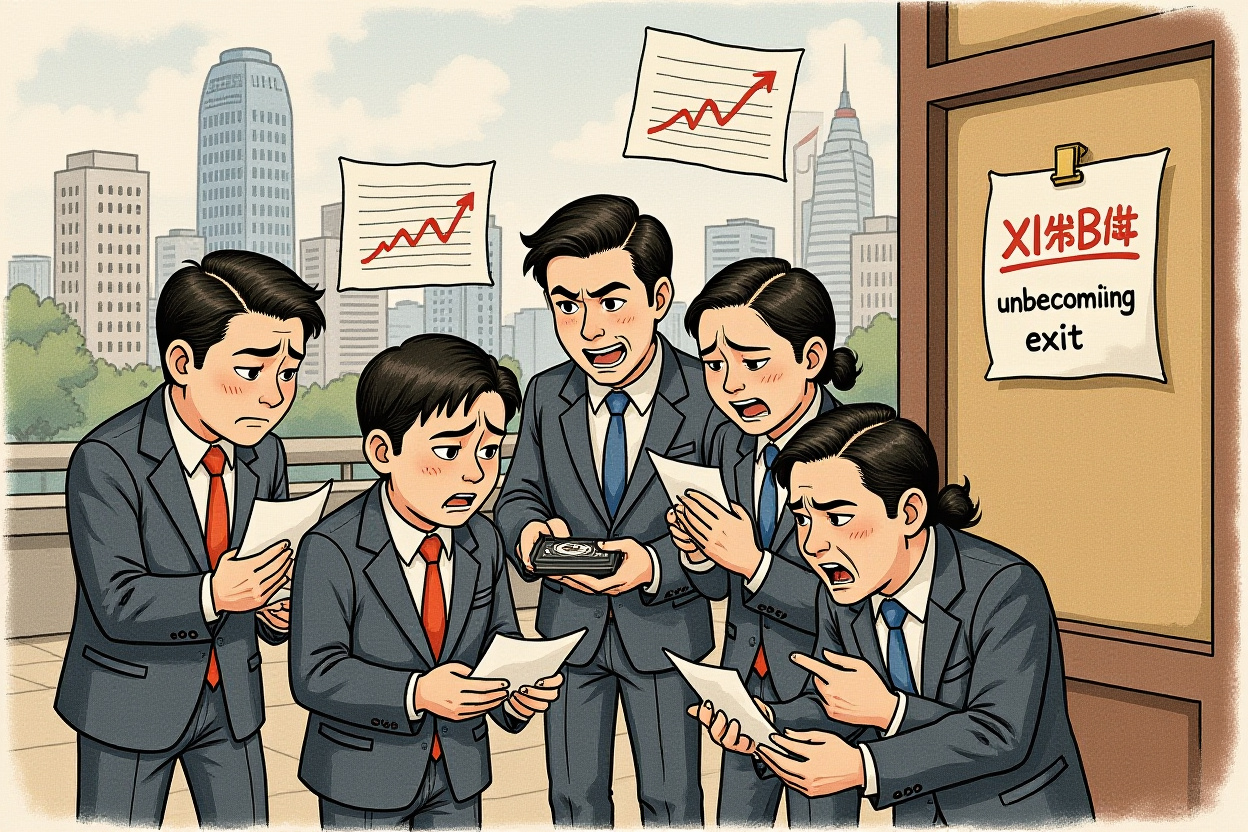
The image of an official notice, taped to a mall door in Shenzhen, has ignited a firestorm across Chinese social media and sent ripples through the investment community. The notice, addressed to the famed restaurant chain Xibei, accused it of attempting an abrupt and ‘unbecoming exit’—clearing out a store overnight without formal approval after nearly a decade of operation. This incident is far more than a local landlord-tenant dispute; it is a stark, public symptom of the profound strategic and financial pressures facing one of China’s best-known casual dining brands. At the heart of this turmoil lies the industry’s great gamble: the pivot towards precooked meals (预制菜), a strategy that has become a double-edged sword for Xibei and a critical focal point for investors gauging the health of China’s consumer discretionary sector.
The Shenzhen Incident: A Public Relations and Operational Crisis
The controversy began when a photo of a ‘Notice Requiring Xibei to Immediately Resume Operations’ from a Shenzhen shopping mall circulated online. The document laid out a timeline that painted a picture of operational discord and potential contractual breach, directly challenging Xibei’s corporate reputation.
The Mall’s Allegations and Xibei’s Response
According to the mall management’s notice, Xibei had previously applied on January 15 to cease operations by February 28, citing the negative public sentiment surrounding precooked meals. However, the mall claims that without obtaining written consent, Xibei personnel attempted to clear out the store’s contents on the evening of January 31—an act the mall derided as the ‘most unbecoming’ form of ‘escaping the premises.’ The notice demanded Xibei immediately reopen for business to fulfill its lease obligations.
Facing a burgeoning public relations crisis, Xibei issued a response to the National Business Daily (每日经济新闻) on February 3. The company stated, ‘We have noted the online information regarding Xibei’s store closure. Comprehensively considering the company’s operational costs and actual situation, we did submit an application to suspend operations to the mall on January 15. We are currently maintaining positive communication with our partner and have reached a mutually acceptable solution, which is being implemented. Customer stored-value balances can be used normally at any Xibei nationwide.’
This exchange highlights a critical tension in China’s retail landscape: the clash between a brand’s need for agile restructuring and the rigid, long-term commitments of commercial leases. For investors, it raises red flags about corporate governance, stakeholder management, and the potential for unforeseen liabilities during a downsizing phase.
Precooked Meals: From Strategic Pivot to Public Relations Albatross
Xibei’s current woes are inextricably linked to its aggressive, and now controversial, foray into the precooked meal market. This segment, once hailed as the future of food service efficiency and scalability, has faced a significant consumer backlash.
A Strategy Backfires
For years, Xibei, famous for its Northwestern Chinese cuisine like lamb skewers and hand-pulled noodles, invested heavily in building a precooked meal supply chain and brand, ‘Jia Guolong’s Meal (贾国龙功夫菜).’ The goal was to create a high-margin, scalable revenue stream less dependent on expensive dine-in real estate and labor. However, the strategy encountered fierce consumer resistance. Many Chinese diners, particularly in the post-pandemic era, began to associate precooked meals with lower quality, excessive additives, and a lack of transparency—the antithesis of the ‘wok hei’ (breath of the wok) and fresh ingredients central to Chinese culinary culture.
This sentiment turned into a widespread online movement, with hashtags criticizing the proliferation of precooked meals in restaurants trending regularly. Xibei, as a high-profile champion of the category, found itself on the front lines of this consumer revolt. The mall’s notice explicitly cited ‘precooked meal public opinion’ as Xibei’s stated reason for the initial closure application, confirming the direct financial impact of this brand damage.
Financial Distress: The Hard Numbers Behind the Headlines
The Shenzhen incident is not an isolated operational hiccup but a symptom of severe financial strain. Revelations from Xibei’s founder have provided a sobering glimpse into the company’s balance sheet, alarming market watchers.
The Staggering Loss Forecast and Closure Plan
In a recent interview with the Shanghai Securities News (上海证券报), Xibei founder Jia Guolong (贾国龙) delivered a stark warning. He projected that from September 2025 to March 2026, the company’s cumulative losses would exceed 6 billion yuan (approximately $845 million). To stem the bleeding, Jia announced a drastic restructuring plan: the closure of 102 stores across China in the first quarter, representing a staggering 30% of its total network. The Shenzhen store at the center of the ‘unbecoming exit’ controversy is confirmed to be one of these 102 locations slated for shutdown.
- Projected Loss: >6 billion RMB (~$845M USD) over a 7-month period.
- Store Closures: 102 outlets, or 30% of total network.
- Timeline: Q1 closures, with financial stress peaking in 2025-2026.
This scale of retrenchment is rare for a major, well-established restaurant group and signals a fundamental reassessment of its business model. The losses forecast are of a magnitude that suggests deep structural issues beyond temporary pandemic-related setbacks.
Capital Pressures and the Quest for an IPO
Xibei’s financial strategy has long been geared towards an eventual Initial Public Offering (IPO). The company has undergone several rounds of fundraising, restructuring its shareholding to pave the way for a listing. The immense projected losses and rapid store closures now threaten this long-held ambition. Investors are forced to question:
- Can the company achieve profitability in time for a viable IPO?
- Will further capital be required, diluting existing stakeholders?
- How will public market investors value a company emerging from such a deep and publicly visible crisis?
The precooked meal bet was, in part, a narrative crafted for public markets—a story of tech-enabled food innovation. That narrative has now fractured.
Implications for China’s Restaurant Sector and Investor Sentiment
The unfolding situation at Xibei serves as a critical case study for institutional investors analyzing China’s consumer market. It highlights several systemic risks and shifting dynamics.
Brand Risk in the Social Media Era
The speed at which the mall’s notice went viral demonstrates the extreme brand risk companies face. An operational dispute can become a national news story within hours, damaging customer trust and investor confidence. The ‘unbecoming exit’ allegation, whether fully accurate or not, has become a powerful meme that shapes perception. For a sector built on reputation and trust, this is a formidable headwind.
Re-evaluating the “New Retail” Model for F&B
Xibei’s struggles, shared by other chains that over-expanded or over-relied on capital-driven growth, are prompting a sector-wide reassessment. The integration of dining with retail (e.g., selling meal kits and sauces) and heavy investment in central kitchens for precooked meals is now under scrutiny. The key questions are:
- Consumer Acceptance: Is there a sustainable, premium market for restaurant-branded precooked meals, or is it fundamentally a lower-margin, competitive grocery category?
- Capital Efficiency: Are the massive investments in supply chain infrastructure justified by the returns, especially when core dine-in traffic is volatile?
- Operational Focus: Does diversifying into retail and manufacturing distract from the core competency of running excellent, efficient restaurants?
The saga underscores that in China’s hyper-competitive food and beverage landscape, there are no easy shortcuts to sustainable growth. The attempted ‘unbecoming exit,’ whether a miscommunication or a desperate move, reflects the intense pressure management is under to cut costs and survive a painful transition. For global investors, the episode is a reminder to scrutinize not just top-line growth and store counts, but also brand health, consumer sentiment trends, and the realism of a company’s strategic pivots. The road ahead for Xibei involves navigating out of this public relations crisis, executing its drastic downsizing plan smoothly to avoid further reputationally damaging ‘exit’ disputes, and ultimately, rediscovering a product and format that resonates with the ever-evolving Chinese consumer. All stakeholders will be watching closely to see if this beloved brand can manage this turnaround or if its challenges mark a broader reckoning for a segment of China’s once-booming restaurant industry.