



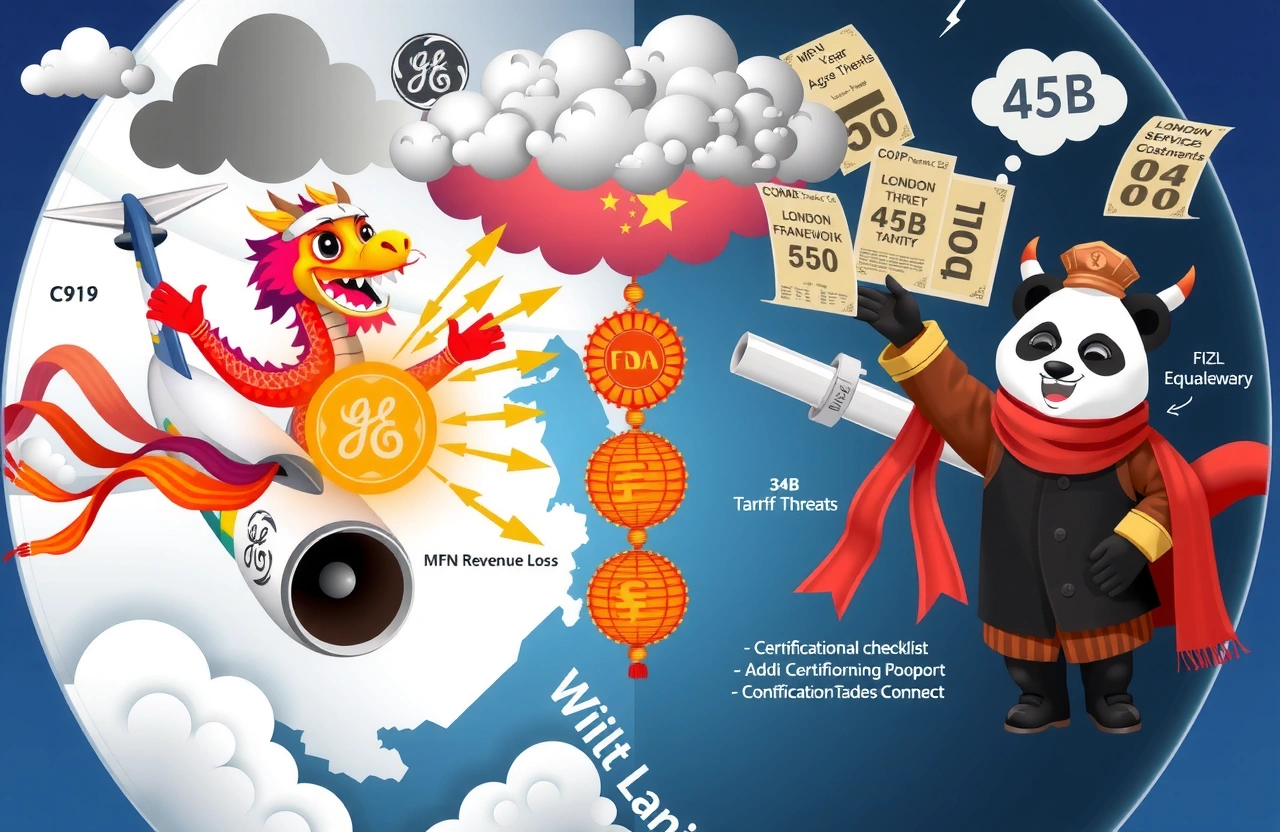
Amidst shifting economic policies, U.S. authorities delivered pivotal decisions affecting China relations this week. Just hours after President Trump threatened fresh global tariffs, Washington greenlighted GE Aerospace’s resumption of jet engine exports to China’s COMAC – signaling conflicting policy directions. Foreign Ministry Spokesperson Mao Ning (毛宁) responded cautiously, urging mutual cooperation while Commerce Ministry officials confirmed bilateral progress on easing restrictions. These moves carry profound implications for global supply chains and the future of bilateral trade relations between the world’s two largest economies.
Immediate Takeaways
– U.S. lifts export ban allowing GE Aerospace to supply jet engines to China’s Commercial Aircraft Corporation (COMAC)
– Foreign Ministry urges mutual cooperation despite new U.S. tariff announcements
– Commerce Ministry confirms implementation of London economic framework agreements
– Both nations progressing on reversing restrictive trade measures first imposed in 2021
– Aviation industry poised for major supply chain shifts after 3-year standstill
Jet Engine Export Shift: Decoding the Market Impact
The Thursday notification permitting GE Aerospace to resume LEAP engine shipments marks a strategic pivot in high-tech exports. Industry analysts estimate this unlocks $1.8 billion worth of pending orders crucial for China’s C919 passenger jet program. Previously blocked under national security concerns, the reversal reflects growing pragmatism in bilateral trade relations.
Technical Implications for COMAC
The LEAP-1C engines powering COMAC’s domestically developed aircraft require specialized maintenance ecosystems. With exports suspended since late 2021, airlines deferred orders awaiting supply chain certainty. The approvals signal:
– Restoration of flight testing schedules for 12 aircraft awaiting engines
– Implementation of five-year service agreements with GE’s Chinese joint ventures
– Potential tripling of C919 deliveries in 2026
Broader Aviation Industry Effects
This breakthrough comes as Airbus finalizes its second Tianjin assembly line, reflecting foreign manufacturers’ long-term commitments. Aviation Analysis Asia director Kelvin Lau (刘煜辉) observes: “The technology flow legitimizes aviation as a stable channel for bilateral trade relations despite geopolitical tensions.”
Tariff Uncertainty and Diplomatic Responses
President Trump’s simultaneous tariff announcements presented striking counterpoint. Foreign Ministry Spokesperson Mao Ning (毛宁) redirected queries about tariffs to “relevant departments” while stressing foundational principles.
The Consistency Imperative
Mao’s measured statement urged Washington to “walk towards each other” – diplomatic phrasing emphasizing mutual concessions. Commerce Ministry officials later reinforced this during press briefings, noting bilateral trade relations require predictable policies rather than abrupt measures. Historical data reveals tariff volatility:
– U.S.-China goods trade contracted 14% during peak tariff escalations (2020)
– Semiconductor imports from China dropped 32% under tech restrictions
– Agricultural exports rebounded 27% following Phase One tariff rollbacks
New Tariff Scenarios
Though specifics remain undisclosed, Trump’s “targeted notifications” suggest revoking Most Favored Nation (MFN) status for certain partners. If applied to China, economists project:
– Average tariffs rising from 19% to 35% across targeted sectors
– Potential $45 billion export revenue reduction for Chinese manufacturers
– Consumer electronics and textile industries facing maximum exposure
The London Framework Mechanism
Behind scenes diplomacy anchors recent developments. The referenced “London economic talks” established comprehensive channels to de-escalate disputes.
Operational Structure
Concluded last October, this bilateral mechanism features quarterly ministerial meetings complemented by working groups:
– Market Access Task Force (co-led by Vice Commerce Ministers)
– Export Control Dialogue (commerce and national security officials)
– Financial Stability Working Group (PBoC and Treasury representatives)
Tangible Progress Markers
Commerce Ministry confirmation of “accelerated implementation” references verifiable progress:
– FDA equivalency agreements facilitating Chinese pharmaceutical exports
– Mutual recognition of audit inspections easing market listings
– Streamlined visa procedures for agricultural inspectors
Corporate Actions Under Scrutiny
Both governments are scrutinizing corporate engagements as policy shifts unfold. Commerce Ministry officials noted China “approving export licenses prudently,” describing careful reciprocation.
Compliance Realignment
Following GE’s notification, aerospace contractors Bombardier and Honeywell initiated export license reviews. Parallel adaptations include:
– Huawei rebuilding U.S. supplier relationships via licensing exceptions
– SMIC resuming limited purchases from Applied Materials
– Semiconductor Manufacturing International Corporation securing ASML service contracts
Investment Safeguards
The State Administration of Foreign Exchange simultaneously enhanced currency hedging tools. Central bank Governor Pan Gongsheng (潘功胜) recently authorized:
– Expanded foreign exchange derivatives quota for importers
– Cross-border renminbi pooling for MNC regional headquarters
– Simplified capital repatriation procedures
Sectoral Implications
Supply chain professionals anticipate disruption across key industries despite broader stabilization.
Aviation Reshoring Acceleration
The engine approval accelerates COMAC’s timetable toward global acceptance:
– Expected FAA/EASA certification in Q1 2026
– 50-aircraft target for International lessors by 2028
– Workforce expansion across Shanghai manufacturing clusters
Tech Sector Reconfiguration
Tariff announcements heighten pressure on electronics manufacturers:
– Accelerated relocation of assembly plants to Southeast Asia
– Increased component stockpiling driving warehouse demand
– 17% projected boost to Vietnam’s export processing zones
Navigating Forward Risks
Though engagement mechanisms provide stability, Commerce Ministry cautions that bilateral trade relations remain susceptible to three vulnerabilities.
Political Calendars Interfering
With U.S. elections approaching, analysts note concerning precedents:
– 70% of trade restrictive measures occurred during electoral cycles
– Rhetorical escalations typically peak September-October
– Historically, 52% of announced tariffs undergo post-election modifications
Implementation Gaps Persisting
Operational realities challenge diplomatic achievements:
– Contradictory messaging from Cabinet officials
– Extended technology licensing review timelines
– Unresolved classification disputes over “critical infrastructure”
Pathways for Stakeholders
The evolving landscape requires adaptive corporate strategies to nurture bilateral trade relations.
Business Mitigation Approaches
Multinationals operating across both markets are implementing:
– Commodity-specific dual-sourcing frameworks
– Regulatory intelligence units monitoring rulemaking
– Relationship banking architecture diversification
Government Engagement Opportunities
Commerce Ministry officials encouraged participation via formal channels:
– Quarterly industry roundtables at USTR offices
– MOFCOM trade remedy public comment sessions
– Sector-specific working groups under London framework
Future Trajectory Assessment
Against the week’s contrasting announcements, measured optimism defines professional forecasts. Economists cite structured dialogue mechanisms and commercial interdependence as stabilizing agents for bilateral trade relations.
Credible Indicators for Monitoring
These metrics will signal policy directions:
– Semiconductor export licensing approval rates
– Agricultural purchasing volume data
– Monthly cross-border investment approvals
Policy Evolution Projections
Institutional views coalesce around gradual normalization:
– Delinked technology controls remaining for quantum/AI
– Tariff standstill agreements covering consumer goods
– Mutual acceptance of manufacturing subsidies framework
Sustaining Constructive Engagement
Turbulence remains unavoidable across bilateral trade relations, but durable frameworks now anchor negotiations. Foreign Ministry appeals for “meeting halfway” acknowledge pragmatic realism – neither unconditional embrace nor permanent antagonism serves economic interests.
As Commerce Minister Wang Wentao (王文涛) participates in ongoing talks, export-focused enterprises should secure certification advisors while diversifying markets. Subscribe for alerts through U.S. Commercial Service monitoring tools, and engage legislators emphasizing stability benefits through Western industry associations. Forward-leaning preparations transform diplomatic progress into competitive advantage.