



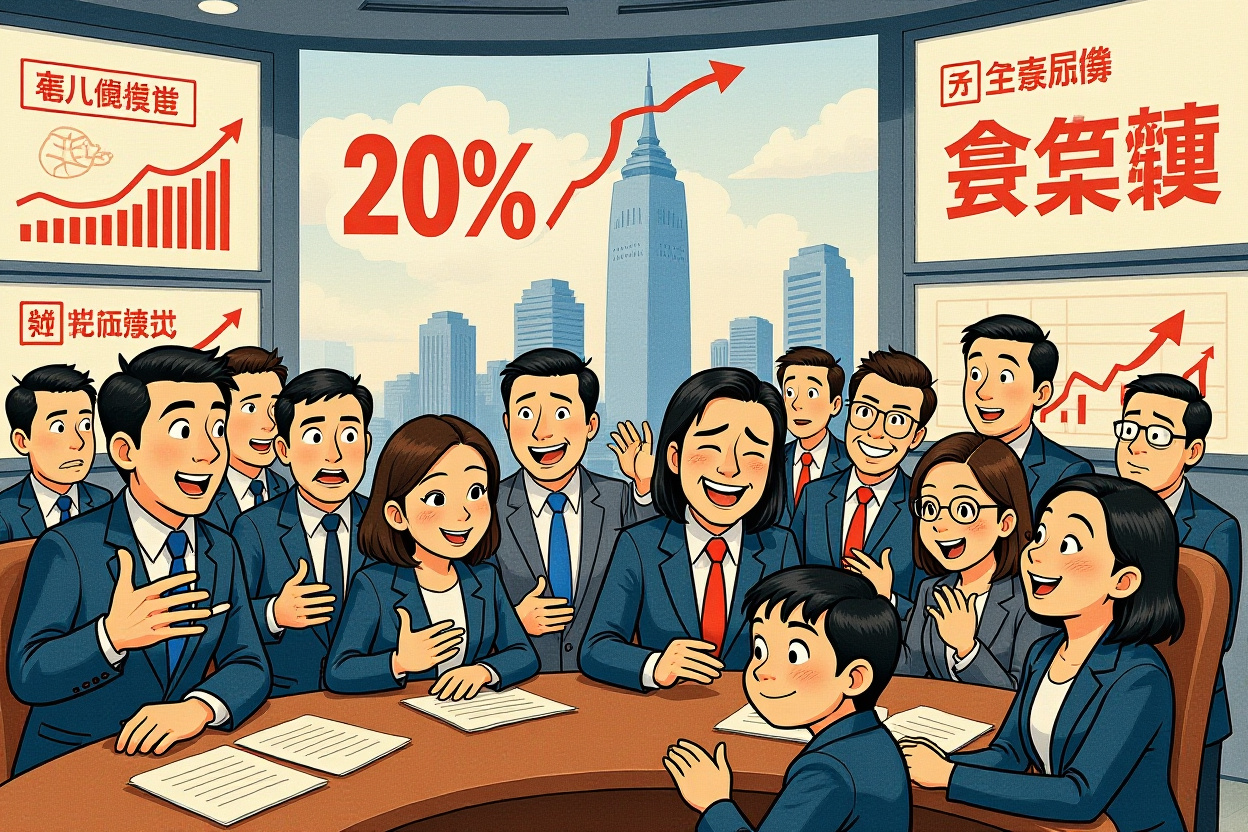
The opening bell rings at 9:30 AM Shanghai time. For most stocks, it marks the beginning of a day of gradual price discovery. For a select few, it triggers an explosive, gravity-defying ascent that concludes within a matter of minutes. The spectacle of a stock hitting its daily upward limit of 20%—a “limit-up” (涨停板, zhangting ban)—within the first ten minutes of trading is one of the most dramatic and telling events in the A-share market. It signals a potent convergence of pent-up demand, catalytic news, and speculative fervor. Understanding the mechanics and implications of such rapid-fire rallies is crucial for any professional navigating China’s dynamic equity landscape.
Anatomy of a Rapid-Fire Rally: The 8-Minute Surge to 20%
The event described by the phrase “开盘8分钟,20%涨停!(Stocks Surge 20% in 8 Minutes)” is not mere chance; it is the result of specific market rules and investor behavior. China’s A-share markets, primarily the Shanghai (SSE) and Shenzhen (SZSE) Stock Exchanges, implement a price limit mechanism to curb excessive volatility. For stocks on the ChiNext (创业板, Chuangyeban) and the STAR Market (科创板, Kechuangban), this limit is ±20% from the previous day’s closing price. A “limit-up” halts further buying at that price for the day, though selling can still occur.
Market Mechanics and Order Flow
For a stock to hit this ceiling within minutes, a massive imbalance of buy orders must exist before the market even opens. This typically unfolds in the pre-market call auction phase (集合竞价, jihe jingjia), which runs from 9:15 AM to 9:25 AM. During this period, investors submit buy and sell orders, and the exchange’s system calculates an opening price that maximizes the volume of executable trades. If a significant positive catalyst emerges overnight—such as a stellar earnings report, a major contract win, or, most potently, a favorable sector-specific policy announcement—buy orders can flood in, dwarfing sell orders.
The opening price may already be set near the 20% limit. When continuous trading begins at 9:30 AM, the remaining buy orders at the limit price are so overwhelming that they are executed immediately, pushing the price to its ceiling and triggering the limit-up status within minutes, sometimes seconds. This creates a technical backlog of unfilled buy orders, visible on the Level-2 market data screens as a towering “buy queue” (买一挂单, mai yi guadan), which can itself become a self-fulfilling signal of strength, attracting more attention.
Decoding the “Heavyweight Positive Catalyst” (重磅利好)
The core driver behind these explosive moves is invariably a “heavyweight positive catalyst” (重磅利好, zhongbang lihao). In China’s policy-influenced market, these catalysts often have distinct characteristics that differentiate them from standard corporate news.
Policy Winds: The Most Potent Fuel
The most powerful and common catalyst is a top-down policy announcement. China’s industrial and regulatory policies can dramatically alter the fundamental outlook for entire sectors overnight. For instance, a state council guideline promoting the “new infrastructure” (新基建, xin jijian) sector, a detailed plan from the National Development and Reform Commission (国家发展和改革委员会, Guojia Fazhan he Gaige Weiyuanhui) on new energy vehicles, or a technological self-reliance directive from the Ministry of Industry and Information Technology (工业和信息化部, Gongye he Xinxihua Bu) can instantly re-rate dozens of companies.
When such policies are announced after market hours or over a weekend, they create a pent-up demand shock. Investors, including institutional funds, scramble to position themselves in the beneficiaries. The stocks perceived as the purest plays often become the targets of the “开盘8分钟,20%涨停!(Stocks Surge 20% in 8 Minutes)” phenomenon. The market is not just betting on earnings; it is betting on sustained policy support, potential subsidies, and a guaranteed addressable market.
Corporate Catalysts and M&A Activity
Beyond policy, significant corporate developments can also trigger such moves. These include:
- Blockbuster Earnings: Quarterly or annual results that vastly exceed market expectations, especially if they signal a turning point or a new growth cycle.
- Major Contract Announcements: Securing a landmark supply agreement with a global giant like Tesla or Apple, or a large domestic project.
- Breakthrough Product Approvals: Particularly in sectors like biotech and pharmaceuticals, where regulatory approval from the National Medical Products Administration (国家药品监督管理局, Guojia Yaopin Jiandu Guanli Ju) can be transformative.
- Mergers & Acquisitions Rumors or Announcements: Being named as a takeover target, especially by a state-owned enterprise (SOE) in a consolidating industry, can lead to immediate re-pricing.
The Domino Effect: How Momentum “Continues to Ferment” (持续发酵)
The initial “开盘8分钟,20%涨停!(Stocks Surge 20% in 8 Minutes)” event is just the opening act. The phrase “持续发酵” (chixu fajiao), meaning to continue fermenting or brew, aptly describes the secondary and tertiary market reactions that follow.
Sector-Wide Revaluation and the “Plate Effect”
A sharp rise in a sector leader does not occur in a vacuum. It triggers a “plate effect” (板块效应, bankuai xiaoying), where capital flows into related stocks within the same industry. Analysts and media quickly dissect the catalyst, identifying secondary and tertiary beneficiaries. This broad-based buying can lift entire sectors, creating a virtuous (or sometimes speculative) cycle. The initial limit-up thus acts as a flare, illuminating investment themes and directing short-term capital flows across the market.
Retail Frenzy and Social Media Amplification
In China, retail investors play a significant role, and their behavior is heavily influenced by financial social media and news apps. A stock hitting a rapid limit-up becomes a top-trending topic on platforms like Xueqiu (雪球) or in brokerage app chat rooms. This social proof and fear of missing out (FOMO) can lead to sustained buying pressure in the following days, even if the stock itself remains limit-up and untradable. The “fermentation” occurs in the realm of market sentiment and narrative, building anticipation for when the stock finally re-opens for normal trading.
Sustainability Analysis: Bubble or Breakout?
For professional investors, the critical question is whether the momentum is sustainable or a short-lived speculative bubble. The “开盘8分钟,20%涨停!(Stocks Surge 20% in 8 Minutes)” move itself is a liquidity event; sustainability depends on fundamental follow-through.
Evaluating the Quality of the Catalyst
Not all catalysts are created equal. A strategic national policy with multi-year funding and clear implementation targets (e.g., carbon neutrality goals) has higher sustainability than a vague, aspirational statement. Similarly, a contract with tangible, near-term revenue is more solid than a non-binding memorandum of understanding (MOU). Investors must ask: Does this catalyst change the long-term discounted cash flow (DCF) model of the company, or is it a short-term sentiment boost?
Technical and Liquidity Constraints
The limit-up mechanism creates an artificial liquidity vacuum. Once the stock re-opens, it often experiences extreme volatility as pent-up selling pressure meets sustained bullish interest. The subsequent price action—whether it consolidates at a higher level or gaps down—provides the first real test of sustainable demand. High-volume consolidation above pre-news levels is a positive sign, while a rapid fade suggests the rally was predominantly speculative.
Strategic Playbook for Institutional Investors
Navigating these explosive moves requires a disciplined strategy, as chasing a limit-up stock is often impossible for larger funds.
Pre-emptive Positioning and Thematic Investing
The most effective strategy is often pre-emptive. By closely tracking policy agendas from key forums like the annual “Two Sessions” (两会, Lianghui) and analyzing government work reports, investors can identify sectors likely to receive support. Building thematic positions in advance of explicit announcements allows for capturing the full move rather than chasing it. This requires deep macro-policy research and a tolerance for uncertainty.
Secondary Beneficiaries and Supply Chain Plays
When the primary beneficiary becomes untradable, sophisticated capital flows to secondary plays. This involves identifying suppliers, technology partners, or competitors within the same ecosystem that will also benefit from the same catalyst but may not have the same extreme order imbalance. These stocks often offer a more accessible entry point with better liquidity, allowing for meaningful position sizing.
Looking Ahead: Navigating a Catalyst-Driven Market
The phenomenon of “开盘8分钟,20%涨停!重磅利好,持续发酵 (Stocks Surge 20% in 8 Minutes: Catalysts and the Sustainability of Momentum)” is a microcosm of the modern A-share market. It highlights the powerful interplay between state policy, investor psychology, and market microstructure. For the global professional, it underscores that fundamental analysis in China must be inextricably linked with policy analysis.
Moving forward, as China continues to refine its capital markets and emphasize technological self-reliance, such policy-driven revaluations will remain a feature, not a bug. The key for investors is to develop a framework to distinguish between transformative, long-term catalysts and short-term noise. Discipline is paramount: the thrill of the 8-minute surge must be tempered by rigorous due diligence on the post-rally fundamentals and liquidity dynamics. The most sustainable profits are not made in the frantic first 8 minutes, but in the calm analysis of the days and weeks that follow, as the true depth and durability of the “heavyweight positive catalyst” become clear.