



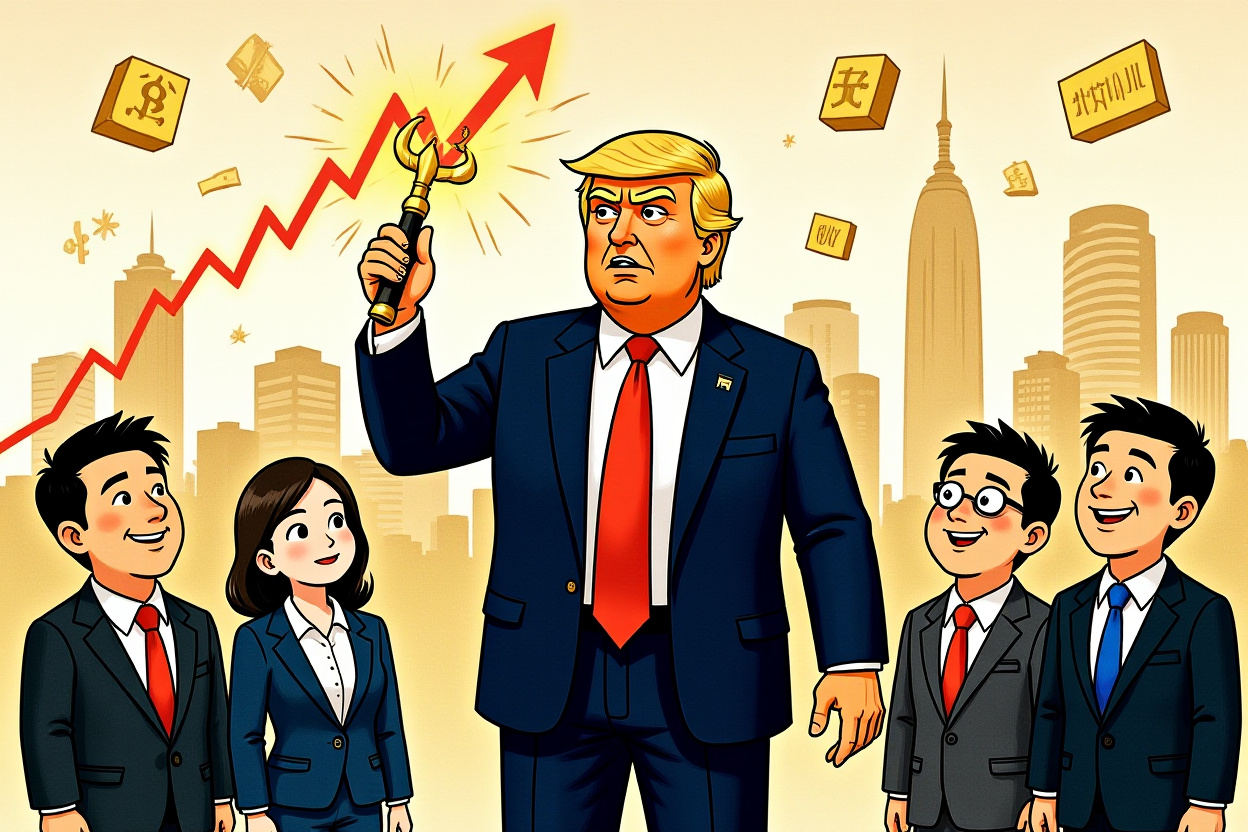
In the high-stakes arena of global finance, a remarkably straightforward strategy has gained traction among astute traders: closely monitor the words and actions of Donald Trump (唐纳德·特朗普). Over the past two years, positioning portfolios based on the former U.S. President’s public statements has repeatedly yielded substantial returns, transforming him into an unlikely but potent market force. This phenomenon, which we term ‘Trump’s market influence,’ has reshaped investment playbooks and ignited synchronized rallies across asset classes from currencies to commodities and equities.
Key Takeaways for the Discerning Investor
– Donald Trump’s comments on economic policy, currency strength, and strategic sectors have consistently preceded significant market movements, creating a viable, trend-following trading signal.- Specific interventions, such as advocating for a weaker U.S. dollar or endorsing investments in critical minerals and semiconductors, have triggered sustained bull runs in those specific areas.- The practical ‘follow Trump’ strategy proved highly profitable from 2024 into 2026, with prime examples including gold’s historic surge past $5,600/oz and the robust recovery of technology stocks following his timely ‘buy’ call.- This trend is deeply intertwined with expectations of U.S. policy shifts under a potential Trump administration and has led to correlated movements in Chinese markets due to the pervasive nature of Sino-American industrial competition.- Investors must exercise caution and fundamental diligence, as the velocity of these rallies raises legitimate questions about bubble formation and long-term sustainability beyond the political narrative.
The Anatomy of a ‘Trump Trade’: From Currency Wars to Commodity Booms
The most direct and powerful demonstrations of Trump’s market influence have unfolded in the foreign exchange and commodity markets, where his utterances often serve as immediate catalysts.
The Dollar Directive and Its Global Ripple Effects
A quintessential case occurred on January 27, 2026. Donald Trump (唐纳德·特朗普) publicly stated, ‘I’m not worried about the recent decline in the dollar; look at our business, the dollar is doing great.’ Contrary to conventional wisdom where a leader’s confidence might bolster a currency, the U.S. Dollar Index (DXY) promptly plummeted, touching a near four-year low around the 95 level. This was not an isolated event but a clear manifestation of Trump’s market influence. The market’s logic was two-fold: firstly, a weaker dollar mechanically increases the nominal price of dollar-denominated commodities like oil and gold. Secondly, traders interpreted the comment as a tacit endorsement of currency weakness to enhance U.S. export competitiveness, a cornerstone of Trump’s ‘America First’ economic platform.This episode was the culmination of a trend that began in late 2024, when Trump, on the campaign trail, started vocally criticizing ‘strong dollar’ policies. He argued that an overvalued currency made U.S. goods more expensive abroad, widened the trade deficit, and hampered domestic manufacturing. From a peak near 110, the DXY embarked on a sustained downtrend, decisively breaking through the key psychological levels of 105 and 100. The immediate aftermath of the January 2026 comment saw international gold prices catapult above $5,600 per ounce to a record high, while WTI crude oil surged past $62 per barrel. Silver, copper, and aluminum joined the broad-based commodity rally, showcasing the pervasive power of this influence.
Gold’s Meteoric Rise: Safe Haven to Geopolitical Asset
Trump further cemented his impact on the precious metals market in April 2025 with a proclamation that resonated globally: ‘Whoever has gold makes the rules!’ This statement strategically reframed gold from a mere inflation hedge into a geopolitical asset of paramount importance, akin to oil. With the United States holding the world’s largest official gold reserves—reported at 8,133 tonnes—the message carried significant weight. Other nations, perceiving this as a directive to bolster their own strategic reserves, subsequently increased their purchasing appetite. Against the backdrop of relatively inelastic annual mining supply, this shifted the fundamental supply-demand balance, adding a powerful new driver to the bull market. Consequently, gold, which traded below $2,600 per ounce in late 2024, soared to over $5,600 by early 2026, representing a gain exceeding 100%. Trump’s market influence was undeniably a key catalyst in this historic repricing.
The ‘Stock God’ Phenomenon: Calling Market Turns and Sector Winners
Beyond raw materials, Trump has repeatedly demonstrated an uncanny ability to signal inflection points in equity markets, earning him the colloquial title of a new-generation ‘stock god’ among a cohort of investors.
The April 2025 ‘Buy’ Signal: A Masterclass in Market Timing
In April 2025, global equity markets were gripped by a significant correction. On April 9, amidst the pessimism, Trump posted a succinct message on his preferred social media platform: ‘Time to buy.’ While many dismissed it as erratic, the call proved prescient. From that date forward, the Nasdaq Composite index embarked on a powerful rally, gaining nearly 50% over the subsequent months. Megacap technology stocks like Nvidia and Google (Alphabet) saw gains well over 100%. This single post validated the strategy of decoding Trump’s communications for market direction, solidifying his reputation and illustrating his profound market influence on investor psychology.
Sector-Specific Waves: Strategic Investments as Market Catalysts
Trump’s influence extends powerfully into specific industries through his advocacy for U.S. strategic investment in ‘critical minerals’ and ‘critical industries.’ His suggestions and the subsequent policy actions have created immediate and lasting ripples across global equity markets.- July 2025: The reported acquisition of a 15% stake in MP Materials Corp ($MP) for $400 million. MP is a major producer of rare earth elements, essential for permanent magnets in electric vehicles and wind turbines. Following this news, rare earth equities in both the U.S. and China experienced strong upward momentum.- August 2025: A massive $8.9 billion investment into Intel Corporation ($INTC) for a 9.9% stake. As a flagship U.S. semiconductor company, Intel used the capital to expand domestic fabrication capacity. Its stock price rallied from around $24.35 in late August 2025 to approximately $48.78 by January 29, 2026—a 100% gain—and buoyed the entire global chip sector.- September 2025: The acquisition of a 10% stake in Lithium Americas ($LAC), a key developer of lithium resources. This move further ignited investor enthusiasm across the lithium and battery supply chain.- October 2025: An investment in Trilogy Metals Inc. ($TMQ), a mineral exploration company focused on copper, zinc, and other base metals. The global copper market, in particular, has exhibited notable strength since.- January 2026: The latest significant proposal—a $1.6 billion investment for a 10% stake in American Rare Earths ($USAR). As the largest U.S. investment in the sector to date, it immediately triggered positive sentiment and buying activity in rare earth stocks worldwide.
The Sino-American Symbiosis: Why Trump’s Moves Echo in Chinese Markets
The synchronized reaction between U.S. and Chinese financial markets to Trump’s pronouncements is a critical feature of the current investment landscape, driven by the overarching framework of strategic competition.
The Competitive-Cooperative Dynamic in Action
In today’s geopolitical environment, a major industrial policy move by one superpower almost invariably prompts a reactive measure from the other. When the U.S., spurred by Trump’s rhetoric, aggressively invests in semiconductors, AI, or space technology, China correspondingly accelerates its own national initiatives in these domains to maintain parity. Conversely, in sectors where China holds a dominant position—such as rare earth processing, shipbuilding, and lithium-ion battery production—the U.S. seeks to onshore or friend-shore capabilities. This ‘action-reaction’ cycle ensures that policy signals from Washington are swiftly priced into asset valuations in Shanghai and Shenzhen. Thus, Trump’s market influence effortlessly crosses oceans, creating interconnected investment themes and rallies.
Case Studies: Chips and Rare Earths
The parallel rallies in U.S. and Chinese semiconductor stocks following the Intel investment, and in rare earth equities following the MP Materials and American Rare Earths deals, are textbook examples. Chinese A-share investors have increasingly incorporated analysis of U.S. political developments into their models, understanding that these signals highlight sectors where global capital and strategic intent are converging. This dynamic has dramatically expanded the perceived addressable market and growth runway for beneficiary industries in both countries, attracting sustained capital inflows.
Assessing the Valuation Frontier: Sustainable Trend or Speculative Bubble?
The breathtaking pace of appreciation across these Trump-influenced sectors naturally invites scrutiny regarding sustainability and potential overextension.
Narrative vs. Fundamental Reality
A significant number of companies riding this wave remain in high-growth, ‘story’ phases where valuations are based on long-term potential rather than current earnings. The ultimate validation will come from downstream demand and mass-market adoption. For instance, the aggressive expansion of AI data center capacity hinges on the successful commercialization and profitability of AI applications. Similarly, the boom in critical mineral investments assumes an uninterrupted, exponential growth trajectory for electric vehicle adoption and renewable energy infrastructure. The core risk is that the ‘Trump trade’ becomes a self-reinforcing speculative loop that deflates when fundamental milestones are delayed or missed.
Navigating the Open Window with Prudence
While the ‘follow Trump’ strategy has generated impressive alpha for over a year, all market anomalies and tactical advantages eventually attenuate. Astute market participants recognize that this specific form of political market influence is context-dependent and may evolve or diminish with policy implementation, electoral outcomes, or shifting macroeconomic conditions. The current window of opportunity, however, remains open. The strategic imperative for investors is to harness this top-down signal while coupling it with rigorous bottom-up analysis—scrutinizing company balance sheets, management quality, and technological moats—to separate durable thematic winners from purely speculative plays.
Strategic Imperatives for the Politically-Aware Investor
The emergence of Donald Trump (唐纳德·特朗普) as a preeminent market-moving force underscores a financial world increasingly dictated by political rhetoric and industrial policy. His demonstrated ability to sway major asset classes with brief comments has created a unique, if volatile, framework for investment. This Trump-triggered market influence has unlocked substantial gains but operates within a zone of heightened volatility and narrative-driven risk.For global institutional investors, fund managers, and corporate executives, the path forward requires a calibrated approach. Maintain a heightened awareness of the political discourse, particularly from key figures like Trump, and develop frameworks to quickly assess the market implications of their statements. Diversify exposure into ETFs or individual stocks within aligned strategic sectors—such as semiconductors, rare earths, clean energy, and foundational materials—but ensure positions are sized appropriately within a robust risk management framework. Continuously stress-test investment theses against fundamental data to avoid being caught in a speculative downdraft. In this era of politically-charged markets, success will belong to those who blend political acuity with financial discipline, knowing when to lean into the trend and when to step aside.