



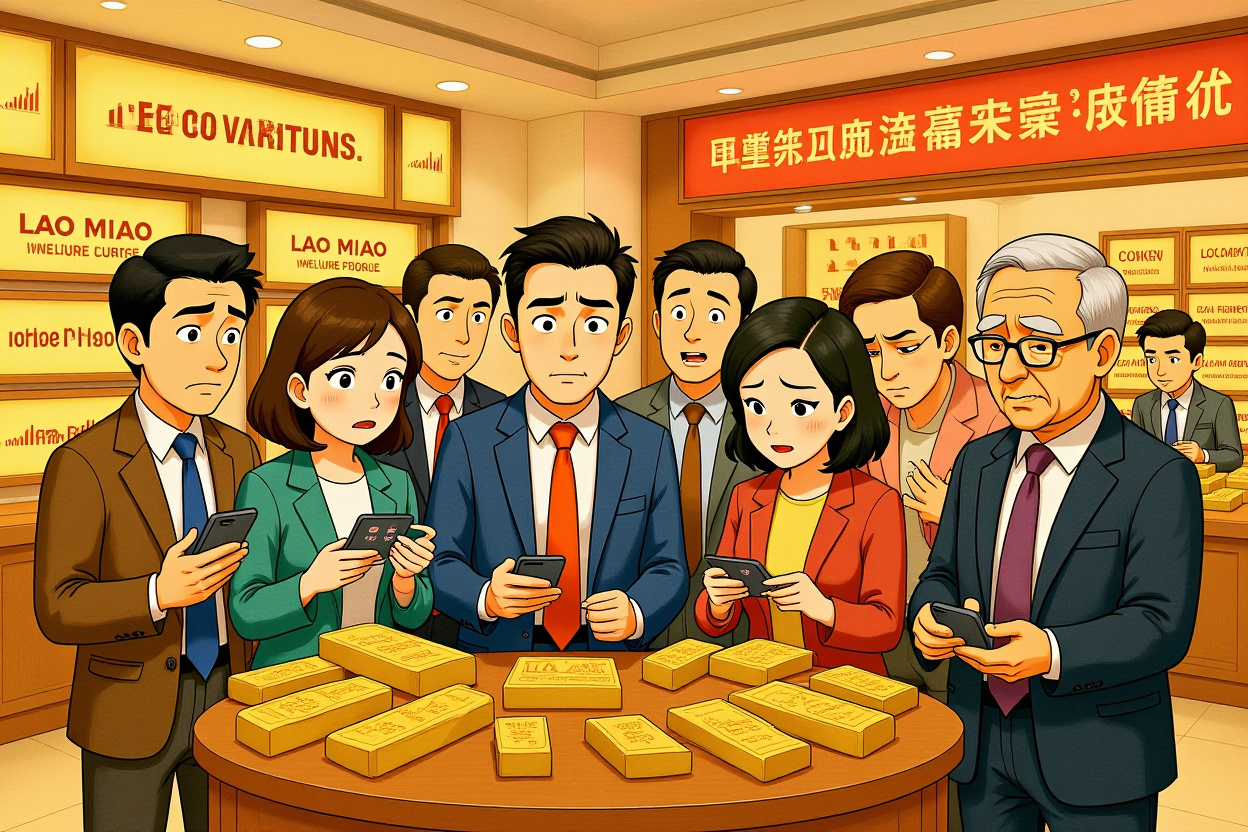
The global gold market has been rocked by a seismic shift, with prices tumbling in their most significant single-day drop in nearly four decades. This dramatic gold price plunge has reverberated through China, where retail investors have responded with a frenetic sell-off, creating long queues outside major jewelry stores and dominating social media discourse. For professionals monitoring Chinese capital markets, this event offers critical insights into retail sentiment, commodity volatility, and the interconnectedness of global financial systems.
Executive Summary: Key Takeaways from the Gold Market Turmoil
– International gold prices experienced a historic collapse, with London gold falling below $4,900 per ounce and COMEX gold dropping over 9%, marking the largest single-day decline in about 40 years.
– Chinese retail gold prices followed suit, with major brands like 老庙 (Lao Miao) and 老凤祥 (Lao Fengxiang) slashing prices by up to 170 yuan per gram overnight, triggering a wave of selling.
– Social media platforms like Weibo and Xiaohongshu exploded with热议 (heated discussions), as investors shared stories of losses and scenes of crowded malls, highlighting widespread panic.
– This gold price plunge underscores the sensitivity of Chinese retail investors to global commodity shocks and may influence broader asset classes, including equities and currencies.
– Market analysts caution that while a短期 (short-term) stabilization is possible, volatility in precious metals could persist, demanding careful portfolio management from institutional players.
The Anatomy of a Historic Gold Price Plunge
The sudden downturn in gold markets has left investors worldwide scrambling for answers. On January 30, both期货 (futures) and现货 (spot) prices nosedived, with London gold跌破 (falling below) $4,900 per ounce—a staggering 9.25% drop—while COMEX黄金 (COMEX gold) narrowly closed at $4,907.5 per ounce, still down over 9%. This event represents the most severe单日跌幅 (single-day decline) since the early 1980s, shaking confidence in what is traditionally seen as a safe-haven asset.
Global Catalysts and Market Mechanics
Several factors converged to trigger this gold price plunge. Strengthening U.S. economic data, particularly regarding inflation and employment, bolstered the U.S. dollar and reduced expectations for imminent Federal Reserve rate cuts. This shift diminished gold’s appeal as an inflation hedge. Simultaneously, technical selling pressures mounted as key support levels were breached, exacerbating the downward spiral. The伦敦金银市场协会 (London Bullion Market Association) reported unusual trading volumes, indicating widespread institutional repositioning. For Chinese markets, these global dynamics are transmitted through上海黄金交易所 (Shanghai Gold Exchange) benchmarks, which saw parallel declines, amplifying domestic reactions.
Domestic Price Adjustments: A Rapid Response from Chinese Jewelers
In China, the gold price plunge was immediately reflected in retail首饰金价 (jewelry gold prices). Data from January 31 shows sharp reductions:
– 老庙 (Lao Miao): Dropped from 1,690 yuan per gram on January 30 to 1,546 yuan per gram, a decrease of 144 yuan.
– 老凤祥 (Lao Fengxiang): Fell from 1,668 yuan to 1,498 yuan per gram, down 170 yuan.
– 周大福 (Chow Tai Fook): Adjusted from 1,685 yuan to 1,625 yuan per gram over two days, a total reduction of 81 yuan.
– 周生生 (Chow Sang Sang): Exhibited significant volatility, moving from 1,708 yuan per gram on January 29 to 1,618 yuan by January 31, after interim fluctuations. This rapid repricing signals how tightly linked Chinese consumer markets are to international benchmarks, with brands quickly passing on cost changes to maintain margins amid the gold price plunge.
Chinese Retail Investors in Crisis: From Buying Frenzy to Selling Panic
The reaction from China’s vast base of retail investors has been swift and emotionally charged. As news of the gold price plunge spread, social media platforms became arenas for real-time commentary and collective anxiety, reflecting broader trends in China’s investment culture.
Social Media Eruption and Investor Psychology
On Weibo, topics like “黄金遭遇40年来最大下跌” (Gold Experiences Largest Drop in 40 Years) and “黄金白银还会跌吗” (Will Gold and Silver Continue to Fall?) soared to热搜 (hot search) status, garnering millions of views. Netizens shared personal anecdotes, with one用户 (user) lamenting, “亏麻了” (I’m completely losing money) after补仓 (averaging down) prematurely, resulting in an 80,000-yuan loss. Others expressed resignation, stating “普通人玩不来黄金” (Ordinary people can’t play the gold game), highlighting the high-risk perception. This gold price plunge has laid bare the emotional rollercoaster for retail participants, many of whom entered the market during previous highs, drawn by gold’s reputation as a stable store of value. The sentiment shift from greed to fear is a classic market indicator, often preceding broader corrections in other asset classes like equities.
The Physical Sell-Off: Queues and Quick Exits
The most visceral manifestation of the gold price plunge has been the physical rush to sell. Reports from Beijing’s 菜百商场 (Caibai Mall) described queues stretching “二里地” (two li, approximately one kilometer), with sellers vastly outnumbering buyers. One notable case involved a woman who sold gold bars purchased at an average of 300 yuan per gram, capitalizing on the price spike before the crash. Her story, under the topic “阿姨入手均价300元金条全部卖出” (Auntie Sells All Gold Bars Bought at 300 Yuan Average), went viral, symbolizing a pragmatic “落袋为安” (pocket the profits) mentality. This behavior underscores how Chinese investors often treat gold as a liquid asset rather than a long-term hold, especially during volatility. The scenes at malls mirror past sell-offs in stocks or properties, suggesting a herd mentality that can exacerbate market swings.
Broader Implications for China’s Financial Ecosystem
This gold price plunge transcends the precious metals market, offering a lens into China’s broader financial stability, regulatory environment, and economic health. For institutional investors and corporate executives, understanding these linkages is crucial for strategic decision-making.
Interconnections with Chinese Equities and Currency Markets
Gold often serves as a barometer for risk aversion, and its暴跌 (sharp fall) can influence other asset classes. In China, where retail investors frequently diversify across黄金ETF (gold ETFs), stocks, and real estate, a loss of confidence in gold could lead to capital rotations. For instance, sell-offs in gold might free up liquidity for equities listed on the上海证券交易所 (Shanghai Stock Exchange) or深圳证券交易所 (Shenzhen Stock Exchange), particularly in sectors like consumer goods or technology. Conversely, if the gold price plunge signals deeper economic worries—such as inflation fears or currency weakness—it could dampen sentiment across the board. The人民币 (yuan) exchange rate may also feel pressure, as gold imports and exports affect trade balances. Historically, gold price movements have correlated with shifts in the沪深300指数 (CSI 300 Index), especially during periods of global uncertainty, making this event a potential precursor to equity volatility.
Regulatory and Policy Responses
Chinese authorities are likely monitoring this gold price plunge closely. The中国人民银行 (People’s Bank of China, PBOC), as the country’s central bank and a major gold holder, may adjust its reserve management strategies. In the past, PBOC Governor Pan Gongsheng (潘功胜) has emphasized stabilizing financial markets, and sudden commodity swings could prompt regulatory scrutiny. Bodies like the中国银行保险监督管理委员会 (China Banking and Insurance Regulatory Commission, CBIRC) might issue guidance to commercial banks on gold-backed products to prevent systemic risks. Additionally, the国家外汇管理局 (State Administration of Foreign Exchange, SAFE) could review capital flows related to gold trading. For investors, watching for official statements from these agencies is key, as they can signal broader policy shifts affecting all Chinese assets.
Expert Insights and Strategic Outlook for Investors
Navigating the aftermath of this gold price plunge requires nuanced analysis from market veterans. We gathered perspectives from industry experts to provide actionable guidance for professionals engaged in Chinese markets.
Quotes from Market Analysts and Economists
– Zhang Wei (张伟), a commodities analyst at 中金公司 (China International Capital Corporation Limited), notes: “This gold price plunge is primarily driven by macro factors, including a stronger dollar and reduced safe-haven demand. For Chinese investors, it’s a reminder that gold isn’t immune to global shocks. We expect support levels around $4,800 per ounce, but further volatility is likely if U.S. data surprises.”
– Li Na (李娜), a portfolio manager at a Shanghai-based hedge fund, adds: “The retail sell-off reflects poor timing and leverage issues. Many entered at peaks, and this gold price plunge has triggered margin calls. Institutional players should look for oversold conditions in gold miners listed on the Hong Kong exchange, like 紫金矿业 (Zijin Mining), as potential value plays.”
– Professor Chen Hong (陈宏) from 清华大学 (Tsinghua University) School of Economics warns: “This event highlights systemic risks in China’s retail investment culture. Regulatory enhancements, such as better investor education on commodities, are needed to prevent future panics.”
Investment Strategies in a Post-Plunge Environment
For fund managers and corporate executives, consider these approaches:
– Diversify Beyond Gold: Rebalance portfolios to include other hedges, such as Chinese government bonds or defensive stocks in sectors like utilities, which may benefit from稳定 (stability) policies.
– Monitor Technical Indicators: Watch for黄金价格 (gold price) support zones using tools from the上海黄金交易所 (Shanghai Gold Exchange). A break below current levels could signal further declines, impacting related derivatives.
– Leverage Data Analytics: Use social media sentiment analysis from platforms like Weibo to gauge retail mood, as it often leads market movements in China. This gold price plunge has shown how online trends can amplify sell-offs.
– Consider Long-Term Fundamentals: Despite the短期 (short-term) turmoil, gold’s role as a store of value remains intact, especially amid geopolitical tensions. Accumulating positions gradually during dips may pay off for patient investors.
Synthesizing the Gold Market Upheaval: Paths Forward
The unprecedented gold price plunge has laid bare the vulnerabilities and dynamics within China’s investment landscape. Key takeaways include the heightened sensitivity of retail investors to global cues, the potential for commodity volatility to spill into equities, and the importance of regulatory vigilance. As markets digest this shock, participants should brace for continued uncertainty, with gold prices likely to experience elevated fluctuations in the coming months.
Moving forward, professionals must stay agile. Regularly consult authoritative sources like the中国人民银行 (People’s Bank of China) for policy updates and the上海黄金交易所 (Shanghai Gold Exchange) for real-time data. Diversification and risk management remain paramount, whether through algorithmic trading strategies or fundamental analysis. This gold price plunge serves as a stark reminder that in today’s interconnected financial world, events in London or New York can swiftly manifest as queues in Beijing malls. By learning from this episode, investors can better navigate future turbulence and capitalize on emerging opportunities in Chinese and global markets.