



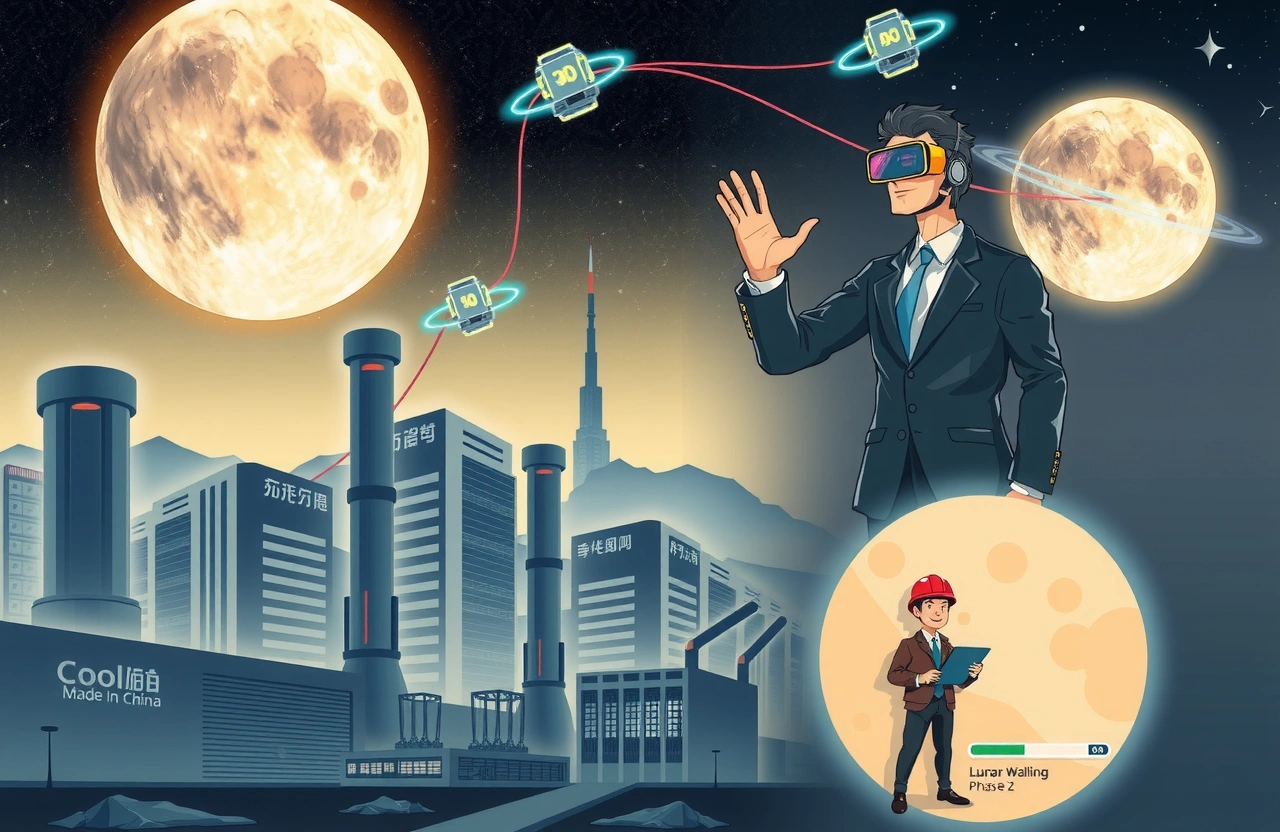
– Chen Hang (陈航) declares industrial software foundational for lunar construction
– CAD visualization combined with robotic builders prevents astronaut labor
– China’s globally competitive tech ecosystem positions nation for success
– Coolov Technology actively pursuing role in extraterrestrial infrastructure projects
Constructing Humanity’s Next Frontier
When Coolov Technology co-founder and CEO Chen Hang (陈航) addressed the 2025 China Enterprise Outbound Global Summit Forum in Shenzhen, he transported attendees to the lunar surface. Amid discussions of terrestrial globalization, Chen painted a visionary picture: Not of flags planted briefly, but permanent habitats rising from moondust. His fundamental premise? Future lunar base construction depends not on spacesuited laborers mixing concrete, but on sophisticated industrial software married with robotics.
The CAD pioneer stressed that extending civilization beyond Earth requires reimagining construction itself: ‘We must design habitats digitally before physical assembly begins – CAD software visualizes humanity’s lunar homes.’ He punctuated this with a memorable practicality: ‘You can’t have astronauts laying bricks or pouring cement. Robots execute the blueprints.’
Chen’s confidence springs from China’s integrated technological ecosystem – lead position in AI development, manufacturing automation capabilities, and state-backed space program synchronization. As the China National Space Administration advances its International Lunar Research Station roadmap, private innovators like Coolov prepare to supply critical technical components.
The Architecture of Extraterrestrial Habitation
Digital Design in Vacuum Environments
Lunar construction differs fundamentally from terrestrial building. Coolov’s specialization in cloud-based CAD solutions must adapt to vacuum operations, regolith composition variability, and cosmic radiation. Existing software that renders lighting conditions for Shanghai skyscrapers will evolve to calculate heat dispersion in airless environments and radiation shielding requirements.
Crucial design parameters:
– Regolith integration for 3D-printed structures
– Modular components for orbital assembly
– Radiation mitigation through architectural layout
– Vertical farming integration for life support
Chen illustrated this through Moon Village Association concepts: ‘Our tools already simulate material behavior. Adapting algorithms for lunar regolith compaction properties is evolutionary, not revolutionary.’
Robotics Execution Pipeline
Design visualization constitutes merely phase one. Coolov anticipates creating instruction protocols for:
– Autonomous grading/leveling machines preparing foundations
– Regolith harvesting drones for construction materials
– Precise masonry bots assembling prefabricated modules
– Self-repairing system monitors
The phased construction sequence minimizes astronaut exposure while allowing Earth-based engineers to monitor progress via satellite relays.
China’s Strategic Advantages
Chen’s conviction that China will pioneer sustainable lunar habitation rests on demonstrable strengths:
Integrated Industrial Supply Chains
From Shenzhen’s electronics factories supporting robotics innovation to Chongqing’s heavy machinery production, China maintains vertically integrated manufacturing unmatched globally. State-owned enterprises work alongside startups like Coolov through initiatives like the Tiangong Space Station’s technology transfer programs.
Public-Private Synergy
Keystone government support includes:
– Deep resources through the Belt and Road Space Information Corridor
– Regulatory pathways accelerating space technology certification
– National investment funds targeting dual-use technologies
Major contractors including China Aerospace Science and Technology Corporation now integrate startups into their research consortia.
Overcoming Off-World Engineering Obstacles
Material Science Breakthroughs
Dust Mitigation SystemsRoadmap to ImplementationTerrestrial Testing Grounds
Human-Robotics Interface DevelopmentChen’s team concentrates on astronaut supervision protocols:
– Mixed-reality command interfaces allowing helmet display control
– Gesture-based robot swarm coordination
– Automated fault detection alert systems
The Lunar Palace 1 simulation module in Beijing provides crucial ergonomic data.
Redefining Global Space Collaboration
While NASA’s Artemis program progresses, China positions itself as infrastructure builder. Forward-looking statements like Chen’s boost international partnerships:
Significant collaborations underway:
– Memorandum with UAE Space Agency for desert testing
– Academic exchanges through Asian Society of Extraterrestrial Architecture
– Observer status at European Space Agency ISRU workshops
‘A decade ago, talk of Chinese firms building Moon bases seemed fanciful,’ notes space policy analyst Liu Peng (刘鹏) at Beihang University. ‘Today, their capabilities warrant inclusion in international frameworks.’
The Call to Cosmic Enterprise
Chen Hang projects visible conviction when discussing extraterrestrial footholds: ‘Chinese innovation cycles accelerate faster globally than others recognize. When we undertake future lunar base construction, it will showcase systems-level mastery.’
For enterprises supporting this vision, opportunities emerge across sectors:
– Material suppliers developing radiation-resistant composites
– Telecommunications firms establishing Earth-Moon networks
– Software coders optimizing construction algorithms
Coolov Technology invites partnerships via their space innovation portal – specifically targeting robotics engineers and astrophysics researchers. Nine months after Chen’s declaration at Phoenix Forum, concrete progress confirms aspirations becoming tangible. The age of mooncrete mixing robots draws nearer, driven by developers visualizing humanity’s extraterrestrial dwellings from Shenzhen servers.
Subscribe to the Coolov space technologies newsletter for construction robotics breakthroughs and join China’s rising private sector driving humanity beyond terrestrial bounds.