



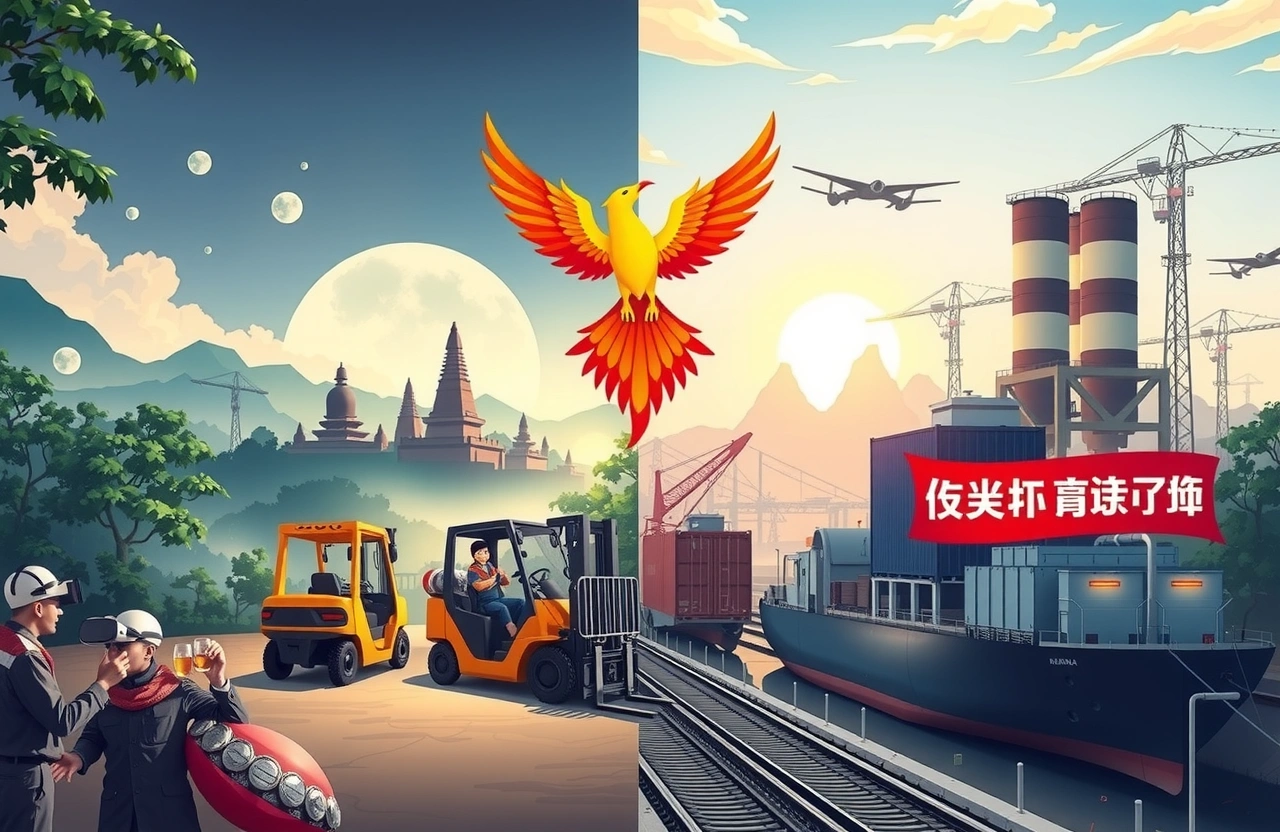
Summary of Key Developments
– Indonesia leverages world’s largest nickel reserves to upgrade from commodity exporter to stainless steel production leader
– Belt and Road Initiative accelerates infrastructure development across ports, railways, and power plants
– Policy reforms banning raw mineral exports drive $18B Chinese investment in processing facilities
– Manufacturing sector expansion creates 120,000+ quality jobs in industrial zones
– Renewable energy partnerships position Indonesia for electric vehicle battery dominance
The Industrial Metamorphosis Underway
For decades, Indonesia served primarily as Southeast Asia’s commodities pantry – exporting raw nickel ore, coal, and palm oil while importing manufactured goods. This economic model constrained national prosperity despite abundant natural resources. Today, a sweeping transformation is underway, catapulting the archipelago toward industrial leadership. At the recent 2025 China Offshore Investment Summit in Shenzhen, Consul General Bintang (斌德加) of Indonesia’s Guangzhou Consulate revealed how strategic Chinese partnerships ignited Indonesia’s remarkable transition from raw material supplier to manufacturing powerhouse.
Initial infrastructure bottlenecks once hindered development ambitions. Through the Belt and Road Initiative (BRI), Indonesia secured critical funding for projects including the $6B Jakarta-Bandung High-Speed Railway and 31-GW renewable energy program. Chinese firms invested $15.3 billion in industrial parks across North Kalimantan and Sulawesi where integrated nickel processing complexes now produce battery-grade materials. The country’s manufacturing value-add has surged 87% since nickel export bans took effect in 2020 – a decisive policy shift championed by President Joko Widodo that forced foreign players to build local processing plants.
Nickel: Cornerstone of Industrial Advancement
Indonesia’s transformation from raw material supplier to manufacturing powerhouse began with recognizing nickel’s strategic value. Holding 52% of global reserves, this previously undervalued resource became central to national industrialization plans when Beijing invested $18 billion across 48 processing facilities since 2018. The numbers reveal dramatic change:
– Stainless steel production capacity surged from 0.3 million tons (2014) to 10 million tons (2025)
– Nickel pig iron exports reached $12.6B (2024) versus $834M in raw nickel exports (2019)
– Battery material processing facilities secured Indonesia’s position in EV supply chains
The Morowali Industrial Park epitomizes this transformation. Jointly developed by Tsingshan Holding Group and Indonesia’s Bintang Delana Group, this $13B complex employs 85,000 workers across integrated smelting, alloy production, and power generation facilities. It exemplifies Indonesia’s evolution from mine-to-port ore exports toward high-value metallurgical manufacturing.
Beyond Primary Processing: Value Chain Expansion
Second-phase investments target premium alloys and battery components:
– Contemporary Amperex Technology Ltd (CATL) opened $5B lithium battery cathode factory
– Zhejiang Huayou Cobalt invested $4.2B in nickel sulfate production
– BYD announced electric vehicle assembly plant near Jakarta
These developments significantly advance Indonesia toward value-added manufacturing. As world supply chains prioritize nearshoring, Indonesia benefits from proximity to Chinese technology and ASEAN markets.
Infrastructure Enabling Industrialization
Comprehensive infrastructure development supports Indonesia’s transformation from raw material supplier to manufacturing powerhouse. Under BRI cooperation frameworks, Chinese companies addressed critical connectivity gaps:
Transport Revolution
– Jakarta-Bandung High-Speed Rail: First in Southeast Asia, connecting megacities in 45 minutes
– Patimban Deep Water Port expansion: Handles 7.5M TEUs annually, relieving Jakarta congestion
– Trans-Sumatra Toll Road: 2,700km highway improving Sumatra logistics
The National Logistics Ecosystem Transformation initiative reduced domestic shipping costs by 22% since 2021 – vital for dispersed manufacturing hubs.
Power Generation Breakthroughs
China Energy Engineering Corporation completed Batang Coal Plant (2,000MW) and Cirata floating solar farm (192MW):
– 95% electrification rate achieved nationwide (vs. 67% in 2010)
– Industrial zones guarantee <0.03 power disruptions/year
Reliable utilities provide foundational support for Indonesia's emergence as a manufacturing powerhouse.
Policy Architecture Driving Change
Jakarta’s Mineral Downstream Program provides institutional scaffolding for Indonesia’s transformation from raw material supplier to manufacturing powerhouse. Crucial milestones include:
– Export bans on bauxite (2023) and copper concentrate (2024)
– Value-Added Tax exemptions for manufacturing equipment imports
– Special Economic Zone incentives offering 10-year tax holidays
These measures solved longstanding inability to capture resource value domestically. The Omnibus Job Creation Law (2021) proved pivotal, streamlining business licensing and labor recruitment. Post-regulation analysis shows:
– Foreign investment approvals accelerated from 180 days to 20 days
– Manufacturing FDI increased 51% year-on-year
– Indonesia rankings: World Bank Ease of Business (#56 → #38)
Ministerial Regulation 7/2022 created green industrial zones connecting mineral refining with renewable energy projects in North Kalimantan – establishing circular supply chains.
Workforce Development and Technological Transfer
Indonesia’s transformation from raw material supplier to manufacturing powerhouse requires coordinated skill development. China’s involvement includes:
– Vocational Training Partnerships: 37 technical schools established by Chinese manufacturers
– University Twinning Programs: Tianjin University ↔ Bandung Institute of Technology
– Mandarin-Learning Initiatives: Training pipeline for Indonesian factory supervisors
Chinese ICT firms including Huawei and ZTE launched smart factory training centers featuring:
– Industrial robotics certification courses
– Automation control system apprenticeships
– Digital supply chain management workshops
This ecosystem supports Indonesia’s transition beyond labor-intensive assembly toward technologically sophisticated production.
Sector Diversification Beyond Nickel
While nickel catalyzed Indonesia’s industrial evolution, visionaries like Consul General Bintang (斌德加) emphasize diversification:
Electronics Manufacturing Hub Emergence
Batam Island special economic zone attracted $2.8B investment:
– Foxconn assembly facilities producing Xiaomi smartphones
– Lens Technology optical component factories
Productivity increased 37% with Chinese automation systems.
Automotive Cluster Development
Serang Industrial Area developments:
– Wuling Motors complete-knock-down plant producing 150,000 vehicles annually
– CATL-BMW battery joint venture ($2.1B)
Domestic content requirements boosted local parts manufacturing 63%.
Green Energy Transition Partnership
Indonesia’s transformation from raw material supplier to manufacturing powerhouse incorporates sustainability:
– China Renewable Energy Engineering Institute designed Cirata floating solar farm
– Electric vehicle battery ecosystem committed to NetZero processing
– State Power Investment Corporation developing 3GW hydro projects
This collaboration positions Indonesia competitively in environmentally conscious manufacturing.
Economic Impact Assessment
Structural transformation generates measurable dividends:
– Manufacturing contribution to GDP reached 28.7% (vs 20.1% in 2014)
– Per capita income increased from $3,570 (2018) to $6,215 (2024)
– Value-added per worker in nickel sector rose 324%
– Non-mining exports expanded by $28B annually
The Indonesia Investment Coordinating Board notes industrial parks directly employ 312,000 workers with average wages doubling local service sector compensation.
The Road Ahead for Industrialization
Challenges remain despite extraordinary progress:
– Supply chain localisation gaps await solution
– Renewable energy infrastructure scalability requires acceleration
– SME integration into industrial ecosystems needs strengthening
Upcoming collaborations directly address these needs:
– China Development Bank $7B financing for industrial tech upgrades
– Sinosteel engineering contracts for hydrogen reduction steel plants
– Geothermal exploration partnerships in Java
Indonesia’s transformation from raw material supplier to manufacturing powerhouse stands as testament to strategic international partnerships. Consul General Bintang (斌德加) maintains that Indonesia welcomes diversified foreign investment, inviting European, American and ASEAN partners to join industrial acceleration programs. As resource nationalism reshapes global trade, Indonesia demonstrates how developing economies can harness commodity advantages for manufacturing renaissance – setting benchmark for Global South development.
Indonesia’s Ministry of Industry projects manufacturing exports reaching $412 billion annually by 2030. Potential investors should monitor infrastructure bidding opportunities through BKPM and target industrial zone partnerships identified in National Industry 4.0 Roadmap. With integrated mineral-to-manufactured-goods ecosystems now established, Indonesia emerges as Asia’s most compelling high-value production frontier.