



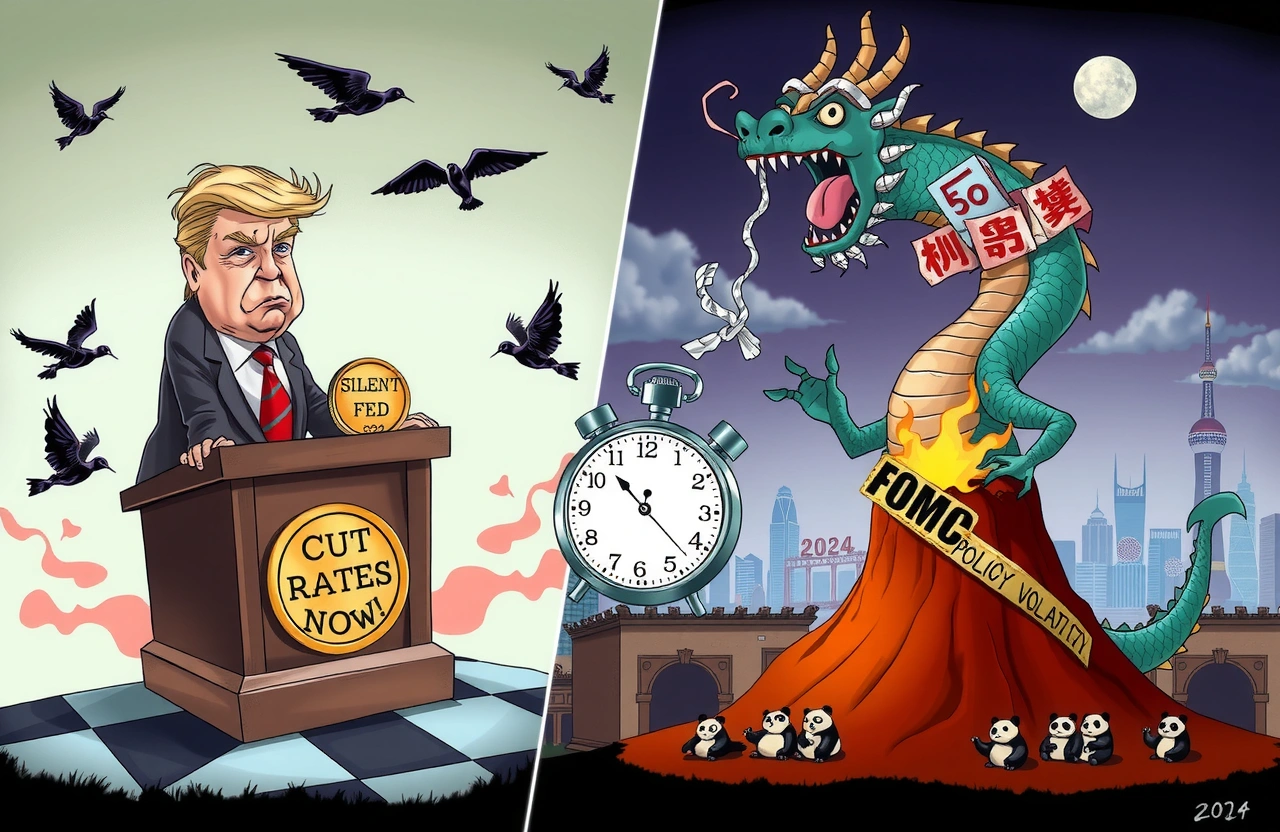
The Gathering Storm
Federal Reserve Chair Jerome Powell (杰罗姆·鲍威尔) remains strategically silent about his future, creating ripple effects across Washington and Wall Street. With Powell’s term expiring in May 2026, President Donald Trump (唐纳德·特朗普) faces mounting pressure to identify successors who align with his economic vision while navigating unprecedented procedural complexities. Fed chair succession isn’t merely administrative—it’ll determine America’s monetary policy trajectory during delicate inflationary pressures. This unresolved transition threatens financial stability as markets scrutinize every political maneuver.
Key Developments at a Glance
– Powell refuses to disclose whether he’ll resign completely or remain as Governor after 2026
– Trump confirms he’s narrowed candidates to “two or three” contenders
– Fundamental policy clash: Trump demands aggressive rate cuts vs Fed’s caution
– Treasury Secretary Steven Mnuchin (史蒂文·姆努钦) floated as potential dual-role candidate
– Board vacancy timelines create intricate appointment chess game
Powell’s Calculated Ambiguity
When pressed about his intentions during an international central bankers’ forum, Powell offered only: “I have nothing for you on that.” This tactical silence accomplishes two objectives simultaneously. First, it maintains Powell’s neutrality amid politically charged debates about monetary independence. Second, it pressures the Trump administration to reveal its selection criteria prematurely. Federal Reserve historians note this represents the most opaque Fed chair succession stance since Paul Volcker’s controversial reappointment process in 1983.
The Retention Gambit
Should Powell choose to remain as a Board Governor post-2026—which he’s legally entitled to do until 2034—he could profoundly constrain Trump’s appointments. Presidential nominees require Senate confirmation, meaning contentious candidates might face gridlock. Powell’s continued presence would serve as ideological counterweight to any dovish successor. Renaissance Macro’s Neil Dutta observes: “Powell’s leverage stems from volatility—markets fear drastic policy shifts.”
Trump’s Contender Conundrum
Tuesday’s admission of having “two to three names in mind” came without specifics, fueling intense speculation. The Fed chair succession dynamic forces Trump to reconcile competing demands: appeasing Wall Street desiring continuity versus delivering campaign promises of cheaper money. Reliable administration sources cite names circulating internally:
– Kevin Warsh: Former Fed Governor favored for hawkish deregulation stance
– Judy Shelton: Controversial economist advocating gold standard principles
– Larry Kudlow: Ex-economic advisor advocating quantitative easing reversal
The Appointment Calendar Crunch
Trump’s selection flexibility hinges critically on whether Powell vacates his Board seat entirely. Should Powell remain, Trump gets just one nomination window for Governor Adriana Kugler’s seat expiring January 2026. Historical precedent reveals Presidents typically secure political alignment by nominating allies to vacant Governorships first—a pathway now obstructed by Powell’s silence.
Irreconcilable Policy Fault Lines
Trump’s ultimatum—demanding a Fed chair who’ll “cut rates aggressively”—directly contradicts Powell’s posturing. June’s Federal Open Market Committee minutes show deepening divisions: While tariff-induced inflation worries dominate current deliberations, Trump prioritizes election-year stimulus. This Fed chair succession battle represents more than personnel selection—it’s monetary philosophy warfare.
The Inflation Standoff
Current Fed projections require sustained 2% inflation before considering cuts. Trump dismisses such metrics as “theoretical constraints hurting real Americans.” Deepening the schism, recent FOMC transcripts show officials explicitly discussing how tariffs “require prolonged restriction” until price trajectories clarify.
Historical Precedent Under Threat
Financial markets shuddered when rumors surfaced about Treasury Secretary Steven Mnuchin (史蒂文·姆努钦) potentially assuming Fed leadership while retaining Treasury. Such consolidation would shatter institutional norms maintained since Marriner Eccles separated the roles in 1935. Senior Fed historians warn this could fundamentally damage market confidence in America’s institutional independence.
Mnuchin’s Non-Denial Denial
When questioned about the scenario, Mnuchin responded: “I serve at the pleasure of the president, though Treasury remains my focus.” His careful phrasing—coupled with White House officials declaring the reports “fake news”—suggests contingency planning. Mnuchin notably added: “One logical path involves testing leadership candidates through Board nominations first,” hinting at Adriana Kugler’s impending vacancy.
Vacancy Mathematics
Beyond the Fed chair succession drama lie intricate Board arithmetic. Trump’s appointment calculus must consider:
– Lisa Cook’s term expires January 2030
– Philip Jefferson’s seat opens January 2036
– Current chatter suggests candidates might be appointed Governors before transitioning to Chair
These timelines create delicate sequencing challenges, especially if Powell remains actively undermining new leadership.
Kugler’s Critical Seat
Governor Adriana Kugler’s departure creates Trump’s sole guaranteed appointment window before 2026. Administration insiders reveal intense lobbying from bank CEOs seeking establishment-friendly appointments through the Senate Banking Committee channels. Progressive groups meanwhile demand candidates favoring stricter banking regulations.
Market Reactions
Financial volatility spiked following Powell’s evasion, with the CME FedWatch Tool signaling investor confusion. Goldman Sachs research notes: “Unprecedented uncertainty exists regarding 2027 rate paths due to leadership unknowns.” Bank executives privately express dread about potentially dual-hatting Mnuchin and warn lawmakers about blurred Treasury-Fed boundaries.
The Leverage Thesis
Many analysts believe Powell’s ambiguity constitutes tactical positioning. Neil Dutta argues: “By controlling the resignation announcement timeline, Powell essentially dictates Trump’s negotiation parameters.” Should Trump nominate radical candidates, Powell could threaten remaining—forcing moderating concessions.
The Fork Ahead
Resolution requires compromise from antithetical philosophies. Four scenarios dominate DC whispers:
1. Trump renominates Powell in exchange for faster rate cuts
2. Contested confirmation battle paralyzes Fed governance
3. Powell departs quietly allowing Trump ideological appointment
4. Unprecedented Board-Coordination with Treasury
Central bank scholars note deteriorating trust makes cooperative solutions unlikely absent market turbulence compelling compromise. Current Fed vice chair oversight may prove decisive.
Economic Consequences
Commodity Futures Trading Commission data reveals patriots excessively net-short on USD ahead of the Fed chair succession decision. Currency strategists cite historical precedent: Volatility spikes 21% on average during Fed transitions since 1980. Bond markets already price in ambiguous leadership through late 2025.
The Path Forward
Resolution requires clear signals none seem willing to provide yet. Trump must formalize criteria beyond “dovishness,” while Powell must clarify transition intentions. Financial stability demands clarifying within 12 months—before election politics dominate. Senate leaders urge leadership consultations examining statutory constraints.
Investors: Monitor Fed Governors’ speeches for sudden policy shifts. Policymakers: Preserve institutional independence protocols. Citizens: Demand transparency on nomination criteria affecting their mortgages and savings accounts. This contested Fed chair succession holds critical implications beyond Washington—global markets await resolution.