



The Shadowy Heart of a Green Revolution
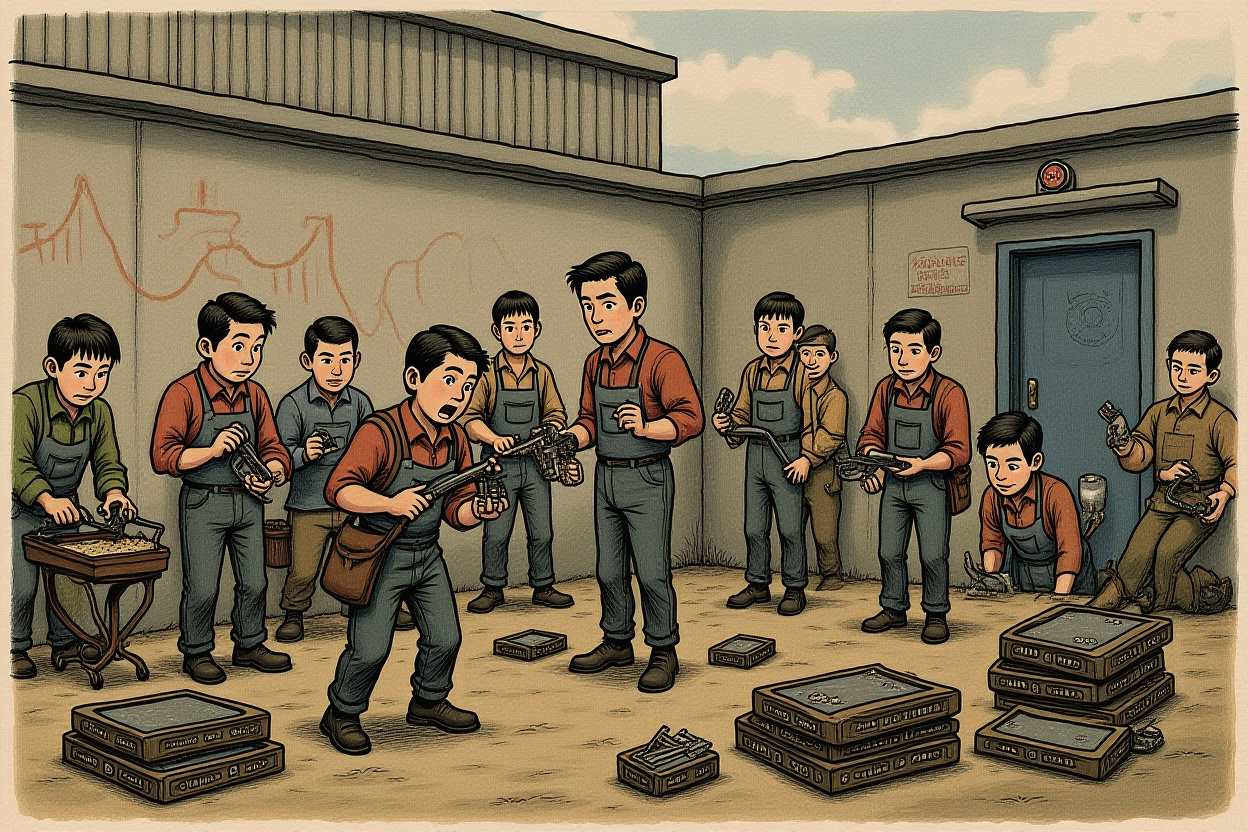
On the outskirts of an industrial park in Huizhou, Guangdong province, hidden from the main road, a small workshop operates behind an unmarked blue door and a strict security checkpoint. Here lies the unvarnished reality of a critical, yet chaotic, link in China’s electric vehicle (EV) supply chain. Inside, over a hundred used EV battery packs are strewn across a concrete yard. Workers, some without protective eyewear, operate drilling machines and cutting tools to pry open the valuable casings. This scene is not an anomaly but a symptom of a systemic issue plaguing China’s gray market battery recycling industry.
As China’s EV penetration rate soars past 50%, the first generation of electric vehicles is now reaching end-of-life, unleashing a tidal wave of retired power batteries. The China Electronics Energy Conservation Technology Association’s Battery Recycling Committee estimates the country will see 820,000 tonnes of retired power batteries in 2025 alone. This enormous market potential has attracted not only legitimate, large-scale recyclers but also a vast, underground network of unlicensed workshops. These operators, driven by high profits and low barriers to entry, now dominate the collection of retired cells, creating safety hazards, environmental risks, and distorting the economics for compliant players. The coming implementation of new regulations seeks to tame this wild frontier, but the entrenched gray market battery recycling network poses a formidable challenge.
Executive Summary: Key Takeaways
- A vast, unregulated network of small workshops currently captures an estimated 75% of China’s retired EV batteries, outcompeting official "白名单" (whitelist) recyclers on price by offering up to 30% more to suppliers.
- Profit margins are staggering: Workshops can net approximately 10,000 RMB (USD ~1,400) in profit from recycling the battery pack of a single 600km-range EV, fueling rapid, unregulated expansion.
- These workshops engage in dangerous, low-tech disassembly and often resell "refurbished" cells of questionable safety and performance to secondary markets like e-bikes, power banks, and small-scale energy storage.
- A new comprehensive regulation, the "新能源汽车废旧动力电池回收和综合利用管理暂行办法" (Interim Measures for the Recycling and Comprehensive Utilization of Waste Power Batteries from New Energy Vehicles), takes effect in April, aiming to enforce traceability and crack down on illegal operators.
- The success of the crackdown hinges on enforcing "车电一体化" (vehicle-battery integration)报废 (scrappage) policies, creating consumer awareness, and improving the economic viability for正规军 (正规军, or "正规军" /正规 army) of compliant recyclers.
Inside the Unregulated Workshop: A Process Fueled by Profit
The business model of these unlicensed workshops is straightforward and ruthlessly efficient. The owner of the Huizhou workshop, Wu Lei (a pseudonym), outlined the process. First, they source used battery packs from across the country through online platforms like Xianyu (闲鱼) and Xiaohongshu (小红书), as well as from insurance companies, auction houses, ride-hailing fleets, and individual car owners. The mantra is simple: whoever pays the most gets the battery.
Once on-site, workers manually dismantle the packs into individual cells. These cells are then tested for remaining capacity. Cells retaining over 50% of their original capacity are deemed "good quality" and prepared for resale. The preparation involves a superficial "beautification" process—reapplying protective blue film or resin coatings to make old batteries look newer. They are then sold in bulk to downstream assembly plants. As another workshop owner, Li Sen (a pseudonym), admitted, these recycled cells come with no warranty: "They’re old batteries, there’s no warranty. Once they’re used up, they’re scrapped, and we’ll回收 (回收, or "recycle") them again." This complete lack of accountability is a hallmark of the gray market battery recycling trade.
The Dangerous Disassembly Line
The working conditions observed by reporters are alarmingly hazardous. Workers operate摇臂钻床 (摇臂钻床, or radial drilling machines) and small cutting tools without proper safety equipment. Metal shards fly during drilling, often near piles of exposed batteries covered only by cardboard. The risk of thermal runaway, fire, or toxic chemical release is high, a danger compounded by the lack of professional emergency response measures on-site. These workshops operate with near-zero investment in safety or environmental protection, a key cost advantage over正规军 (正规军) recyclers who must adhere to strict standards.
The Economics of a Lucrative Gray Market
The financial incentive driving the expansion of these workshops is immense and explains their dominance in sourcing materials. According to the China Chemical and Physical Power Industry Association, approximately 75% of废旧电池 (废旧电池, or waste batteries) flow into non-whitelist enterprises, predominantly小作坊 (小作坊, or small workshops).
Wu Lei provided a detailed profit calculation. A "good quality" cell is purchased at 0.5-0.6 RMB per安时 (安时, or amp-hour, Ah) and resold for about 1.0 RMB/Ah. For a standard 100Ah cell, that’s a gross profit of roughly 50 RMB, not accounting for labor and rent. A typical EV with a 600km range uses about 200 such cells. Therefore, recycling the battery pack from one such car can yield a profit of around 10,000 RMB. This high-margin, low-overhead model allows workshops to offer suppliers prices 30% above those of正规军 (正规军) recyclers, effortlessly winning the bidding war for retired packs.
From Black Powder to Precious Metals
Cells with capacity below 50%, or those damaged by water or fire, are classified as scrap. These are either sold by weight (Ah) or by tonnage for precious metal extraction. The valuable materials—nickel, cobalt, lithium, and manganese—are the ultimate prize. A 50 kWh ternary lithium battery pack (about 370 kg) can yield approximately 155 kg of "黑粉" (黑粉, or "black powder"), the core raw material for metal extraction. This can be refined into about 28 kg of nickel, 9 kg of cobalt, and 5 kg of lithium.
With prices for battery-grade碳酸锂 (碳酸锂, or lithium carbonate) on the Shanghai Metal Market hovering around 170,000 RMB/ton and having nearly tripled since mid-2024, the value is significant. However, most small workshops lack the technology for high-efficiency extraction. As Wu Lei noted, "Extracting metals from废旧电池 (废旧电池) is technical work; it’s easy to have a safety accident if you’re not careful. Our park doesn’t do it; we usually sell it to downstream chemical plants."> This highlights their role as low-value aggregators and dismantlers within a broader gray market battery recycling ecosystem.
The Looming Tidal Wave and the正规军’s Dilemma
The scale of the impending challenge is monumental. Officials from the Ministry of Industry and Information Technology (MIIT, 工业和信息化部) have stated that China is entering a phase of large-scale power battery retirement, with annual waste generation expected to exceed 1 million tonnes by 2030.正规军 (正规军) recyclers like GEM Co., Ltd. (格林美) are preparing for this wave, forecasting a 50% increase in their recycling volume to 50,000 tonnes in 2025, capturing about 10% of the正规 (正规, or正规) market.
Yet, they operate at a severe disadvantage. A manager from a白名单 (白名单, or whitelist) enterprise confessed that despite multi-million RMB investments, their operations are only marginally profitable. To balance costs, their purchase offers cannot match those from小作坊 (小作坊). This creates a classic "劣币驱逐良币" (劣币驱逐良币, or "bad money drives out good") scenario, where high-compliance成本 (成本, or costs) undermine正规 (正规) business models. The产能利用率 (产能利用率, or capacity utilization rate) for正规 (正规) recyclers stands at a dismal 18%, according to a 2024 industry white paper, largely due to a shortage of compliant feedstock locked up by the gray market battery recycling network.
Structural Challenges and Missed Connections
Feng Siyao (冯思遥), Deputy Secretary-General of the Energy Storage Application Branch of the China Chemical and Physical Power Industry Association, pinpointed the core issue: a structural mismatch between the "capacity expansion" in recycling and the "release of规范回收的退役电池供给" (规范回收的退役电池供给, or standardized retired battery supply). "The industry built production lines in anticipation of the retirement wave, resulting in a阶段性现象 (阶段性现象, or phased phenomenon) of ‘装置先建好、原料后到来’ (装置先建好、原料后到来, or ‘build the equipment first, the raw materials arrive later’)."> Meanwhile, individual car owners, often unaware of正规回收网点 (正规回收网点, or正规回收网点), are easily tempted by the higher cash offers from unlicensed buyers.
The Regulatory Onslaught: Can New Rules Tame the Gray Market?
The central government is mounting a concerted response. The forthcoming "新能源汽车废旧动力电池回收和综合利用管理暂行办法" represents the most comprehensive regulatory framework to date. It emphasizes加强信息溯源管理 (加强信息溯源管理, or strengthened information traceability management), enforcing "车电一体化" (车电一体化)报废 to ensure batteries are retired with the vehicle through正规 (正规) channels, and clarifying legal liabilities.
The regulatory teeth are being sharpened. Wen Xuefeng (温雪峰), Deputy Director of the Solid Waste and Chemicals Department at the Ministry of Ecology and Environment, reported that in 2024 alone, over 8,300执法检查 (执法检查, or law enforcement inspections) were conducted on entities involved in废旧动力电池拆解处理 (废旧动力电池拆解处理). The new rules aim to shift the industry from "低成本竞争" (低成本竞争, or low-cost competition) to "技术竞争" (技术竞争, or technology competition).正规 (正规) recyclers are required to achieve lithium recovery rates above 90% and nickel, cobalt, and manganese rates above 98%, standards far beyond the capability of小作坊 (小作坊).
A Multi-Pronged Strategy for a正规 Future
Industry experts propose a multi-frontal assault to dismantle the gray market battery recycling advantage. Sun Xudong (孙旭东), Project Manager at the Science and Technology Innovation Department of the China Society of Automotive Engineers, suggests:
- Strengthening Policy & Supervision: Elevating the new measures to the status of a departmental规章 (规章, or regulation) to impose criminal liability for illegal recycling and establishing a dynamic "red and yellow card" exit mechanism for non-compliant enterprises.
- Optimizing Market Mechanisms: Learning from the EU’s新电池法 (新电池法, or New Battery Regulation), clearly defining the extended producer responsibility and legally mandating consumer responsibility. Linking proper battery disposal with个人信誉 (个人信誉, or personal credit) and vehicle license management could force退役电池 (退役电池) into正规 (正规) channels.
- Technological & Business Model Innovation:正规军 (正规军) must widen their profit margins through advanced technology and integrating回收治理 (回收治理, or recycling governance) into the entire battery lifecycle, from project design to decommissioning.
Feng Siyao (冯思遥) adds that for the energy storage sector,回收 (回收) requirements should be embedded in procurement contracts, grid connection approvals, and maintenance agreements, turning "末端处置" (末端处置, or end-of-life disposal) into part of the project deliverable.
Navigating the Battery Endgame
The battle for China’s retired EV batteries is a microcosm of the larger challenge in building a truly sustainable circular economy. The lucrative gray market battery recycling industry has flourished in the regulatory gaps of a booming market, demonstrating both entrepreneurial hustle and significant systemic risk. Its high-profit, low-compliance model has effectively starved正规 (正规) recyclers of feedstock, hampered environmental protection, and created a secondary market flooded with potentially unsafe电池 (电池).
The success of the new regulatory framework will not be determined by its publication but by its enforcement. Closing the price gap through policy leverage, educating consumers on their role in the battery lifecycle, and ensuring that报废 (报废) vehicles and their batteries are inseparable in the scrappage process are critical steps. For international investors and automotive executives, understanding this landscape is crucial. The stability of the battery material supply chain, the environmental credentials of the EV industry, and the long-term viability of major recyclers all depend on正规izing (正规izing) this final link. The call to action is clear: support policies that enforce traceability, conduct due diligence on supply chain partners to ensure合规 (合规, or compliance), and recognize that the true cost of a cheap, recycled battery may be far higher than it appears.