



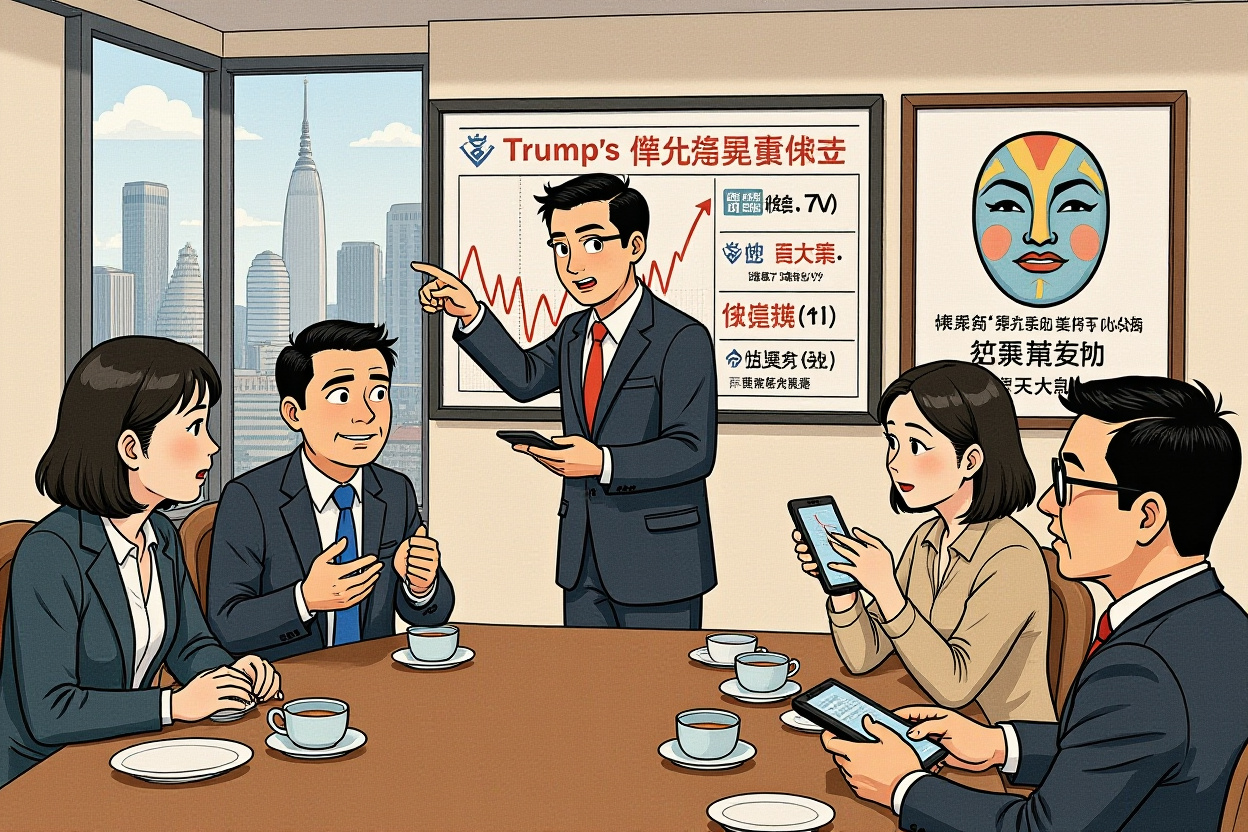
Summary: Key Takeaways on Trump’s Policy Volatility
– Gao Zhikai (高志凯), a prominent Chinese scholar, warns that Trump’s policy statements are highly unreliable, likening them to ‘Chuan Pu Bian Lian’ or ‘Trump’s face-changing,’ a reference to volatile and opportunistic shifts.
– Trump’s recent actions on issues like Greenland are viewed as political tactics aimed at managing domestic pressure ahead of the 2026 U.S. midterm elections, rather than genuine policy changes.
– For investors in Chinese equities, understanding Trump’s policy volatility is essential for navigating market uncertainty, as abrupt U.S. decisions can trigger fluctuations in trade-sensitive sectors.
– Strategic recommendations include diversifying portfolios, enhancing political risk assessments, and focusing on long-term fundamentals rather than reactive headlines.
– This analysis underscores the need for global market participants to adopt agile strategies in response to unpredictable U.S. leadership behavior.
The Unpredictable Nature of U.S. Leadership and Global Markets
In today’s interconnected financial landscape, the actions of U.S. political leaders can send ripples across global markets, particularly affecting Chinese equities. The recent comments by Gao Zhikai (高志凯), Vice Chairman of the Center for China and Globalization (CCG) (全球化智库) and a professor at Soochow University, shed light on a critical issue: Trump’s policy volatility. During an interview with Phoenix Finance, Gao Zhikai emphasized that investors should not take Trump’s statements at face value, describing them as part of a ‘face-changing’ act driven by domestic political motives. This insight is vital for sophisticated professionals who must decode political rhetoric to safeguard investments. As Chinese markets react to external pressures, from trade tariffs to geopolitical maneuvers, grasping the nuances of Trump’s policy volatility becomes a cornerstone of effective risk management.
Understanding ‘TACO’ and ‘Chuan Pu Bian Lian’: Trump’s Policy Volatility Defined
What is ‘TACO’ and How Does It Relate to Market Uncertainty?
The term ‘TACO’ in this context refers to Trump’s abrupt policy shifts, as highlighted in the Greenland incident where he quickly moved from threats of military action and tariffs to negotiation. Gao Zhikai (高志凯) interprets this as a classic example of Trump’s policy volatility, where statements are made for immediate effect without long-term commitment. For financial markets, such volatility introduces unpredictability, impacting sectors like technology and manufacturing that are sensitive to U.S.-China relations. Investors must recognize that these actions are often theatrical, designed to sway public opinion or counter political opposition, rather than signal substantive policy directions.