



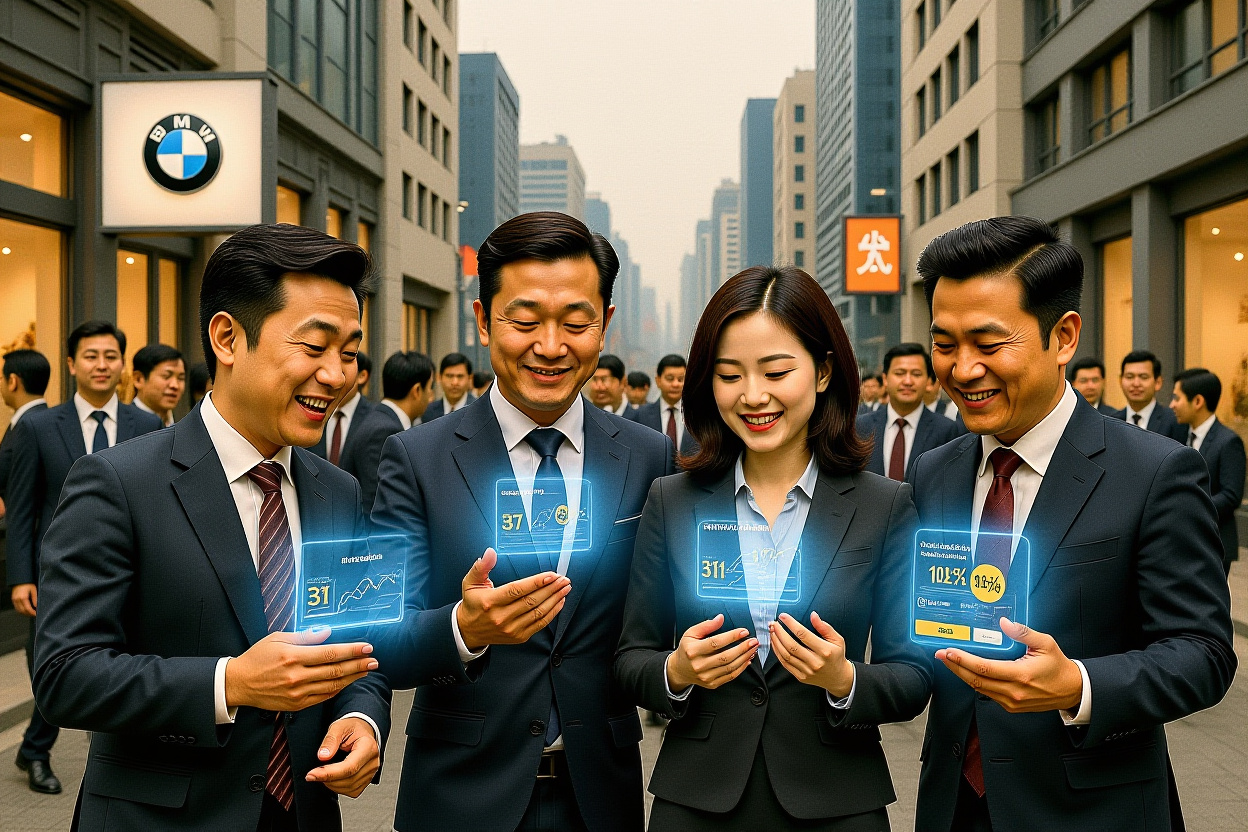
– BMW has implemented official price cuts on 31 models in China as of January 1, 2026, with 24 models seeing reductions over 10% and 5 models over 20%, signaling a major strategic shift in the luxury segment.
– The move is driven by fierce competition from Chinese electric vehicle brands like 蔚来 (Nio) and 理想汽车 (Li Auto), which are redefining luxury with advanced smart features and cockpit experiences, eroding traditional German brands’ market share.
– Analysis of dealer data reveals that terminal transaction prices were already below the new official prices, indicating that the BMW price cuts primarily aim to reduce dealer procurement costs and alleviate financial pressure rather than immediately boost consumer demand.
– Regional foot traffic data from 10 major Chinese cities shows mixed responses, with only Guangzhou, Nanjing, and Shenyang experiencing significant post-announcement increases, highlighting fragmented market dynamics.
– The price reductions underscore broader challenges for traditional automakers, including high costs from global supply chains and organizational redundancies, pointing to a potential domino effect in the industry as competitors may follow suit.
The luxury automotive landscape in China is undergoing a seismic transformation, compelling even the most established players to reassess their strategies. On January 1, 2026, 宝马 (BMW) ignited a new phase of competition by announcing sweeping official price reductions across 31 models, a move that reverberates through global financial markets. These BMW price cuts are not merely a tactical response to seasonal demand but a stark acknowledgment of the intense pressure from domestic electric vehicle (EV) manufacturers. For international investors and corporate executives, understanding the rationale behind this decision is crucial, as it reflects deeper shifts in consumer behavior, regulatory environments, and economic indicators within the world’s largest automotive market. The focus on BMW price cuts reveals how traditional luxury brands are grappling with a rapidly evolving ecosystem where Chinese preferences for smart driving and digital cockpits are setting new standards.
The Catalysts Behind BMW’s Price Reduction Strategy
The decision by 宝马 (BMW) to implement widespread price cuts stems from a confluence of market forces that have reshaped China’s automotive industry over the past three years. Initially, price wars were confined to segments below 300,000 yuan, driven by Tesla and 比亚迪 (BYD) following the phase-out of national new energy vehicle subsidies. However, this competition has now escalated into the premium tier, where 宝马 (BMW) and other German brands once dominated.
Rising Competition from Chinese EV Brands
Chinese automakers like 鸿蒙智行 (Harmony Smart Driving), 蔚来 (Nio), and 理想汽车 (Li Auto) have launched models that directly challenge traditional notions of luxury. These brands offer superior in-car intelligence, autonomous driving capabilities, and user-centric designs that resonate with local consumers. For instance, 蔚来 (Nio)’s latest vehicles feature advanced cockpit systems and battery-swapping technology, creating a value proposition that 宝马 (BMW)’s current lineup struggles to match. This has led to a fundamental divergence in demand between China and Europe, where preferences for smart features and digital integration are now paramount. The BMW price cuts aim to bridge this gap by making their vehicles more accessible, but the underlying issue of product relevance remains.
Erosion of Pricing Power in the Luxury Segment
Historically, 宝马 (BMW) maintained strong pricing power in China, with 2023 sales reaching 825,000 units, a 4.2% year-on-year increase. However, by 2025, deliveries in China plummeted to 625,500 units, a 12.5% decline, marking the second consecutive year of double-digit drops. This trend underscores how Chinese brands have compressed the pricing umbrella, forcing 宝马 (BMW) to lower official guide prices to stay competitive. The BMW price cuts are a reactive measure to prevent further market share loss, as models like the i7 M70L saw reductions of up to 301,000 yuan, approximately 16% of its original price.Analyzing the Immediate Market Impact and Consumer Response
To gauge the effectiveness of the BMW price cuts, a detailed examination of dealer foot traffic and transaction data is essential. Insights from data provider 图强汽流 (Tu Qiang Qi Liu) across 10 cities—including Beijing, Shanghai, and Shenzhen—reveal nuanced consumer behavior patterns in the days surrounding the announcement.
Regional Variations in Dealer Foot Traffic
The data indicates that only three cities—Guangzhou, Nanjing, and Shenyang—experienced a noticeable increase in showroom visits after the price cuts were announced. In contrast, seven cities saw no significant change or even higher traffic prior to the reduction, suggesting that factors like expiring purchase tax subsidies played a role. For example, Chengdu remained the top-performing city for 宝马 (BMW) sales, followed by Beijing and Shanghai, but the BMW price cuts did not uniformly drive new demand. A sales representative from a Beijing dealership noted, ‘Demand remains steady; consumers won’t immediately buy just because of a price drop. It’s only been a week, so effects may unfold gradually.’ This highlights the challenge of stimulating sales in a saturated market.
The Reality of Terminal Transaction Prices
Interestingly, the BMW price cuts have not significantly altered actual transaction prices at dealerships. For instance, the 宝马X3 (BMW X3) now has an official guide price of 349,900 yuan for the base model after reduction, but its real transaction price was already around 267,500 yuan, 82,400 yuan lower. A 2023 宝马X3 (BMW X3) owner lamented, ‘I paid about 410,000 yuan two years ago; it’s depreciated nearly 100,000 yuan.’ This disparity means consumers may perceive little immediate benefit, as one Beijing dealer explained: ‘Official guide price drops don’t greatly impact consumer perception because terminal prices were already lower. The main advantage is for us dealers, as our procurement costs from the manufacturer decrease, reducing financial pressure.’ Thus, the BMW price cuts serve more to support dealer networks than to drive retail sales.Financial Implications for BMW and Its Dealer Network
The BMW price cuts carry profound financial ramifications, affecting everything from profit margins to dealer sustainability. By lowering official prices, 宝马 (BMW) aims to alleviate strain on its distribution channels, but this comes at the cost of potentially eroding brand equity and long-term profitability.
Dealer Profitability and Cash Flow Relief
For dealerships, the reduction in procurement costs translates to lower capital requirements, banking expenses, and tax burdens. A sales supervisor in Beijing emphasized, ‘宝马 (BMW) is lightening our load; some dealers in Beijing have already exited the network due to immense financial pressure.’ This move helps dealers maintain liquidity, especially ahead of the Chinese New Year sales period. However, it also raises concerns about brand dilution. The supervisor added, ‘We’re not worried about brand impact; prices fluctuate with market demand. Survival comes first, or we can’t serve customers.’ Yet, this optimistic view overlooks the heavier burden on 宝马 (BMW) itself, as sustained price reductions could normalize lower price points, forcing further concessions.
Global Financial Performance and Cost Challenges
Globally, 宝马 (BMW) reported a slight increase in 2025 deliveries to 2.465 million vehicles, but the downturn in China—accounting for a significant portion of profits—poses risks to its 9.8% EBIT margin achieved in 2023. The BMW price cuts highlight the urgent need for cost reduction, but challenges abound:– Safety testing procedures and material costs remain high due to global supply chains.
– Organizational redundancies and personnel expenses in international operations.
– Investment in R&D to catch up with Chinese rivals in smart and electric vehicles.
These factors complicate 宝马 (BMW)’s ability to sustainably lower costs without compromising quality or innovation. For investors, monitoring 宝马 (BMW)’s quarterly reports and cost-cutting initiatives, such as those outlined in their annual financial statements available here, is crucial for assessing long-term viability.
Broader Market Dynamics and the Future of Luxury Automotive
The BMW price cuts are a microcosm of larger trends reshaping China’s automotive sector. As domestic brands ascend, traditional players must navigate a rapidly changing competitive landscape, influenced by regulatory shifts and consumer evolution.
The Ascendancy of Chinese Luxury Brands
Brands like 蔚来 (Nio) and 理想汽车 (Li Auto) have successfully redefined luxury around technology and user experience, capturing market share at the expense of German stalwarts. For example, 理想汽车 (Li Auto)’s SUVs integrate family-friendly features and extended-range electric systems, appealing to practical needs while offering premium comforts. This shift has forced 宝马 (BMW) to reconsider its product strategy, but as one industry analyst notes, ‘The generational gap in cockpit interaction and autonomous driving between Chinese and German brands is widening, making it difficult for traditional players to regain leadership.’ The BMW price cuts are a temporary fix, but long-term success requires radical innovation aligned with local preferences.
Regulatory and Economic Factors Influencing Pricing
China’s regulatory environment, including emissions standards and incentives for new energy vehicles, continues to drive market behavior. Policies from bodies like 工业和信息化部 (Ministry of Industry and Information Technology) encourage electrification, benefiting domestic EV makers. Additionally, economic indicators such as consumer confidence and disposable income growth impact luxury spending. The BMW price cuts reflect an adaptation to these realities, but they also signal potential deflationary pressures in the premium segment. Investors should watch for announcements from 中国人民银行 (People’s Bank of China) on monetary policy, as interest rate changes can affect automotive financing and demand.Strategic Outlook and Potential Industry Domino Effect
With 宝马 (BMW) leading the charge in price reductions, the industry braces for a possible cascade of similar moves from competitors. The future trajectory will depend on how effectively traditional brands can innovate and optimize costs.
Cost Reduction Efforts and Operational Efficiency
宝马 (BMW) faces the daunting task of trimming expenses without diluting its brand prestige. Key areas include:
– Localizing supply chains to reduce dependency on international components.
– Streamlining R&D processes to accelerate development of smart features.
– Enhancing digital sales channels to lower distribution costs.
Success in these endeavors could mitigate the need for further BMW price cuts, but progress may be slow given entrenched global operations. As noted in a recent report by 中国汽车工业协会 (China Association of Automobile Manufacturers), ‘Traditional automakers must embrace agile methodologies to compete with nimble Chinese startups.’
Will Competitors Follow Suit?
The BMW price cuts could trigger a domino effect, compelling rivals like 梅赛德斯-奔驰 (Mercedes-Benz) and 奥迪 (Audi) to announce their own reductions to maintain competitiveness. In 2023, 北京奔驰 (Beijing Benz) contributed about 20% of Mercedes-Benz Group’s global profit, making the Chinese market too critical to ignore. If price wars intensify, profit margins across the luxury sector could compress, affecting stock valuations and investor sentiment. Market participants should monitor official announcements from these companies and related data on platforms like 深圳证券交易所 (Shenzhen Stock Exchange) for timely insights.The BMW price cuts in China represent a pivotal moment for the global automotive industry, highlighting the relentless ascent of domestic EV brands and the urgent need for traditional luxury players to adapt. While the immediate impact on consumer demand appears limited, the reductions provide crucial financial relief to dealers and signal 宝马 (BMW)’s commitment to retaining market relevance. Key takeaways include the importance of monitoring regional sales data, understanding the disconnect between official and terminal pricing, and recognizing the long-term challenges in cost management and product innovation. For investors and executives, the situation underscores the value of diversifying portfolios toward innovative Chinese automakers while cautiously assessing traditional brands’ turnaround strategies. As competition heats up, staying informed through reliable sources and market analyses will be essential for making informed decisions in this dynamic landscape. Explore further insights on automotive market trends by following updates from major financial news agencies and regulatory bodies.