



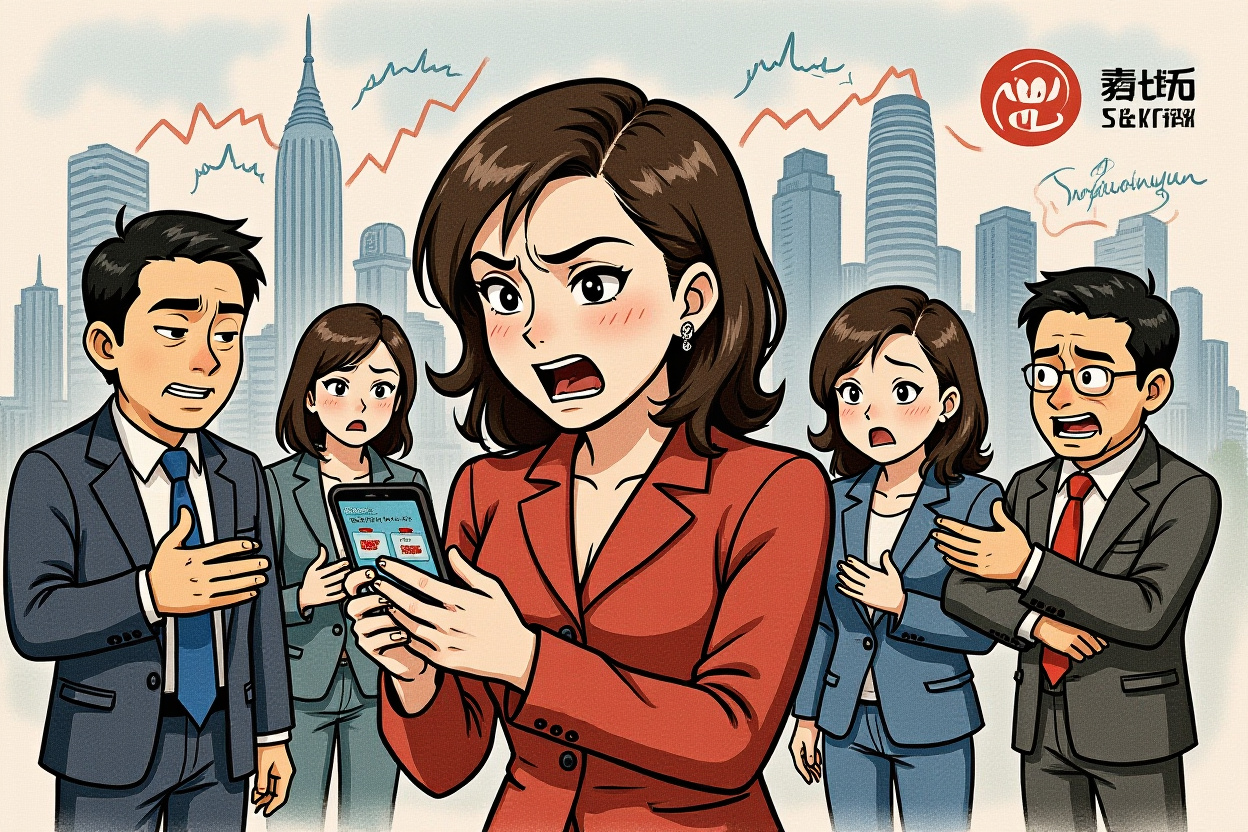
– The recent ban of actress Yan Xuejing’s (闫学晶) social media accounts stems from controversial remarks about her son’s income, exposing a significant disconnect with public sentiment.
– An in-depth look into her commercial activities reveals a family-centric business model involving multiple companies, most of which have been注销 (cancelled), indicating volatility in celebrity-backed enterprises.
– The controversy has directly impacted her endorsement deals, with brands like Tongchu (统厨) and Zuoxiangyuan (佐香园) facing consumer backlash and potential legal repercussions.
– This incident underscores the heightened scrutiny of public figures in China and the financial risks tied to their personal statements, offering lessons for investors in celebrity-linked ventures.
– Market participants should consider the reputational vulnerabilities and regulatory environment when evaluating investments tied to high-profile individuals in the Chinese equity landscape.
The Social Media Firestorm: From Live Stream to Account Ban
In late 2025, a casual comment during a live stream by veteran actress Yan Xuejing (闫学晶) ignited a wildfire of public criticism, ultimately leading to the banning of her accounts on platforms like Douyin (抖音) and Kuaishou (快手). This episode not only tarnished her public image but also pulled back the curtain on her intricate family business empire, revealing how personal missteps can trigger financial and reputational crises. For investors and professionals monitoring Chinese equity markets, this serves as a stark reminder of the intertwined nature of celebrity influence and commercial viability in today’s digital age.
The Controversial Remarks and Viral Backlash
During the live stream, Yan Xuejing discussed her son’s life in Beijing, stating that he would need an annual income of 800,000 to 1 million RMB to sustain his household, but lamented that his earnings from acting were insufficient. This comment, perceived as out of touch with the average Chinese family’s financial reality, quickly went viral on social media. Netizens accused her of embodying a “let them eat cake” mentality, highlighting a growing public sensitivity to income inequality and celebrity privilege. The backlash escalated, with false claims about her using derogatory terms like “酸黄瓜” (sour cucumber) to dismiss critics, though these were later debunked by media reports. Nonetheless, the damage was done, showcasing how swiftly public sentiment can turn against public figures in China’s hyper-connected online ecosystem.
Platform Enforcement and Regulatory Oversight
Following the uproar, Douyin and Kuaishou took action by prohibiting users from following Yan Xuejing’s accounts, a move often employed by Chinese social media platforms to mitigate controversy under regulatory pressure. This incident occurs against a backdrop of increasing scrutiny by bodies like the Cyberspace Administration of China (国家互联网信息办公室), which enforces strict content guidelines to maintain social stability. For market watchers, such platform interventions signal the operational risks for businesses reliant on celebrity endorsements or digital marketing. The rapid response underscores the need for investors to factor in regulatory compliance and public relations management when assessing companies tied to high-profile individuals in China.
Mapping Yan Xuejing’s Family Business Empire
Beyond the social media drama, a closer examination of Yan Xuejing’s commercial ventures reveals a strategic yet volatile family business empire. Utilizing data from corporate registry platform Tianyancha (天眼查), we can trace her capital allocations and corporate structures, offering insights into the financial underpinnings of her career. This family business empire, though seemingly expansive, has faced significant turnover, with most entities being注销 (cancelled) shortly after establishment, reflecting the precarious nature of celebrity-driven enterprises in China’s competitive market.
Income Streams: From Acting to Digital Advertising
Yan Xuejing’s revenue sources are multifaceted, encompassing traditional acting roles, live-streaming commerce, and digital advertising. On Douyin, where she boasts over 3.56 million followers, her advertising rates are substantial: estimates show charges of 73,000 RMB for 1-20 second videos, 94,000 RMB for 21-60 seconds, and 120,000 RMB for videos over 60 seconds. These figures highlight the lucrative potential of influencer marketing in China, but they also underscore the dependency on public goodwill. For instance, her involvement in live-streaming e-commerce—a sector projected to grow exponentially—adds another layer of income but amplifies exposure to consumer sentiment shifts. This diversification is common among Chinese celebrities seeking to monetize their fame, yet it ties their financial health directly to their public persona.
Corporate Ventures: A Timeline of Registrations and Cancellations
An analysis of her associated companies shows a pattern of ambitious starts followed by rapid closures. In 2017, she established her first firm, Tongling Ma Qianhui Film Company (铜陵马芊慧影视公司), with a注册资本 (registered capital) of 100,000 RMB. By 2020, she expanded with Yingkou Fuxing Media (营口福兴传媒) at 1.5 million RMB and Liaoning Yan Shi Fuchang Film Company (辽宁闫氏福昌影视公司) at 5 million RMB. The peak came in 2022 with three companies: Hainan Huanrong Culture (海南寰融文化公司), Hainan Xingzexing Culture (海南星泽星文化公司), and Yan Shi Fuchang Culture (闫氏福昌文化公司), with registered capitals of 5 million, 5 million, and 10 million RMB respectively. However, all these entities were subsequently注销 (cancelled). More recently, in 2024 and 2025, she founded Beijing Chunlan Culture Media Co., Ltd. (北京春蓝文化传媒有限公司) and Sanya Chunlan Culture Media Partnership (三亚春蓝文化传媒合伙企业), each with 500,000 RMB in registered capital. These are currently her only active businesses, suggesting a scaling back of her family business empire amid evolving market conditions or personal strategy shifts.
The Family-Business Nexus: Capital Ties with Lin Aofei
Central to Yan Xuejing’s commercial endeavors is her son, actor Lin Aofei (林傲霏), whose involvement exemplifies the family-centric model prevalent in China’s entertainment industry. This family business empire is bolstered by shared holdings, where Lin Aofei holds stakes in multiple of Yan Xuejing’s companies and independently owns Sanya Ao’erdihan E-commerce Company (三亚傲尔迪翰电子商务公司) with a registered capital of 100,000 RMB. Such arrangements can streamline decision-making and profit-sharing, but they also concentrate risk, as seen in the recent controversy where both individuals’ reputations are intertwined.
Shared Holdings and Operational Synergies
The mother-son duo has collaborated professionally on projects like the television series “和妈妈一起谈恋爱” (Love with Mother), leveraging their public image for commercial gain. In business, their joint investments create a bundled operational structure that can enhance brand cohesion. For example, Lin Aofei’s role in Yan Xuejing’s firms may facilitate cross-promotion across their entertainment ventures. However, this synergy becomes a vulnerability during crises; any negative publicity affecting one member can ripple through the entire family business empire, potentially jeopardizing partnerships and revenue streams. Investors should note that while family-linked businesses can offer stability in some contexts, in the volatile celebrity sector, they may amplify exposure to reputational shocks.
Risks of Family-Bundled Operations in Entertainment
In China’s entertainment industry, where personal branding is paramount, family-bundled models are common but fraught with peril. The Yan Xuejing case illustrates how a single misstep can trigger cascading effects, from social media bans to endorsement losses. For corporate executives and fund managers, this highlights the importance of due diligence on governance structures within celebrity-associated companies. Scrutinizing the separation—or lack thereof—between personal and business assets can reveal hidden risks. Moreover, regulatory bodies like the State Administration of Radio, Film, and Television (国家广播电视总局) may impose stricter oversight on such entities, affecting their market valuations. Thus, understanding the dynamics of this family business empire is crucial for assessing investment viability in related equities.
Commercial Fallout: Endorsement Deals Under Threat
The controversy has had immediate tangible impacts on Yan Xuejing’s commercial partnerships, demonstrating how swiftly brand alliances can unravel in the face of public outcry. Her endorsements for brands like Tongchu (统厨), a condiment brand under Tianjin Chaoshi Seasoning Brewing Co., Ltd. (天津市超时调料酿造有限公司), and Zuoxiangyuan (佐香园), owned by Liaoning Dihua Monosodium Glutamate Food Co., Ltd. (辽宁帝华味精食品有限公司), are now in jeopardy. This section of her family business empire is particularly vulnerable, as consumer sentiment directly drives sales and brand equity in China’s competitive FMCG (fast-moving consumer goods) market.
Brand Reactions and Consumer Sentiment
Following the incident, Tongchu’s parent company stated that its legal department is “following up” on the matter, with no resolution yet, indicating potential contract renegotiations or termination. Meanwhile, Zuoxiangyuan has remained silent, but its online stores and social media accounts have been flooded with comments from consumers vowing to boycott the brand unless the endorsement is changed. This backlash exemplifies the power of social media in shaping commercial outcomes in China. For instance, on platforms like Xiaohongshu (小红书), user-generated content can amplify negative perceptions, leading to real-time sales dips. Market analysts estimate that such incidents can cause short-term revenue declines of 10-20% for affected brands, emphasizing the financial stakes involved.
Legal Implications and Contractual Risks
Endorsement contracts in China often include morality clauses that allow brands to terminate agreements if the celebrity’s actions damage their image. Yan Xuejing’s remarks could be construed as a breach, potentially leading to lawsuits or索赔 (compensation claims). Legal experts note that similar cases have resulted in settlements ranging from hundreds of thousands to millions of RMB, depending on the contract terms and demonstrated losses. For investors, this underscores the need to evaluate the legal frameworks governing celebrity endorsements in portfolios, particularly in sectors like consumer goods where brand reputation is critical. Resources like the China Consumer Association (中国消费者协会) announcements can provide guidance on prevailing standards.
Broader Implications for Celebrity Economics in China
The Yan Xuejing saga is not an isolated incident but part of a larger narrative about the evolving role of public figures in China’s economy. Her family business empire serves as a microcosm of the opportunities and pitfalls in celebrity-driven ventures, offering lessons for institutional investors and corporate executives navigating this space. As social media amplifies both fame and scrutiny, the financial implications of personal conduct have never been more pronounced.
Public Expectations vs. Private Realities
In China, there is an increasing expectation for celebrities to align their public statements with societal norms, especially regarding economic issues like income inequality. Yan Xuejing’s “crying poor” remarks, though perhaps an honest reflection of her family’s situation, clashed with the struggles of ordinary citizens, triggering a backlash. This disconnect highlights a cultural shift where audiences demand authenticity and empathy from public figures. For businesses leveraging celebrity influence, this means that thorough vetting of spokespersons’ public personas is essential. Market research firms often conduct sentiment analysis using tools like Baidu Index (百度指数) to gauge public perception, which can inform partnership decisions and risk assessments.
Investment Considerations for Celebrity-Linked Ventures
For fund managers and investors, the Yan Xuejing case underscores several key considerations. First, the volatility of celebrity-backed companies requires robust risk management strategies, including diversification away from single-individual dependencies. Second, environmental, social, and governance (ESG) criteria should incorporate reputational risk factors, as public scandals can erode shareholder value rapidly. Third, monitoring regulatory trends, such as guidelines from the China Securities Regulatory Commission (中国证券监督管理委员会) on disclosure requirements for celebrity-associated firms, can provide early warning signals. Data from exchanges like the Shenzhen Stock Exchange (深圳证券交易所) show that stocks tied to controversial figures often experience short-term sell-offs, making timing and due diligence critical.
Navigating the New Normal: Strategies for Stakeholders
In the wake of this controversy, stakeholders across China’s financial and entertainment sectors must adapt to a landscape where personal and commercial realms are inextricably linked. Yan Xuejing’s family business empire, though currently under strain, offers a roadmap for understanding these dynamics. Moving forward, proactive measures can mitigate risks and capitalize on opportunities in this high-stakes environment.
For Public Figures: Balancing Expression and Expectation
Celebrities and influencers must recognize that their words carry financial weight. Implementing media training and social media protocols can help align personal expression with public expectations. Additionally, diversifying income sources beyond endorsements—such as investments in stable sectors like technology or real estate—can buffer against reputational shocks. Yan Xuejing’s shift to smaller, recent companies like Beijing Chunlan Culture Media may indicate a strategic pivot towards less volatile ventures, a move other public figures could emulate to safeguard their family business empire.
For Investors and Corporations: Enhanced Due Diligence
Institutional players should deepen their scrutiny of celebrity-linked investments by analyzing not just financial metrics but also public sentiment trends and regulatory exposure. Tools like social listening platforms and partnerships with reputational risk firms can provide real-time insights. Furthermore, incorporating clauses in contracts that address morality breaches and contingency plans for endorsement disruptions can protect bottom lines. For example, brands might consider rotating spokespersons or investing in corporate social responsibility initiatives to build resilience.
As the dust settles on Yan Xuejing’s account ban, the key takeaway is clear: in China’s interconnected digital economy, the line between personal conduct and commercial success is increasingly blurred. Her family business empire, once a symbol of entrepreneurial ambition, now stands as a cautionary tale about the perils of misaligned public perception. For savvy investors and business leaders, this episode reinforces the need for holistic risk assessment and adaptive strategies in navigating celebrity-driven markets. Stay informed by monitoring regulatory updates and market analyses to make data-driven decisions that account for the human elements shaping China’s equity landscape.