



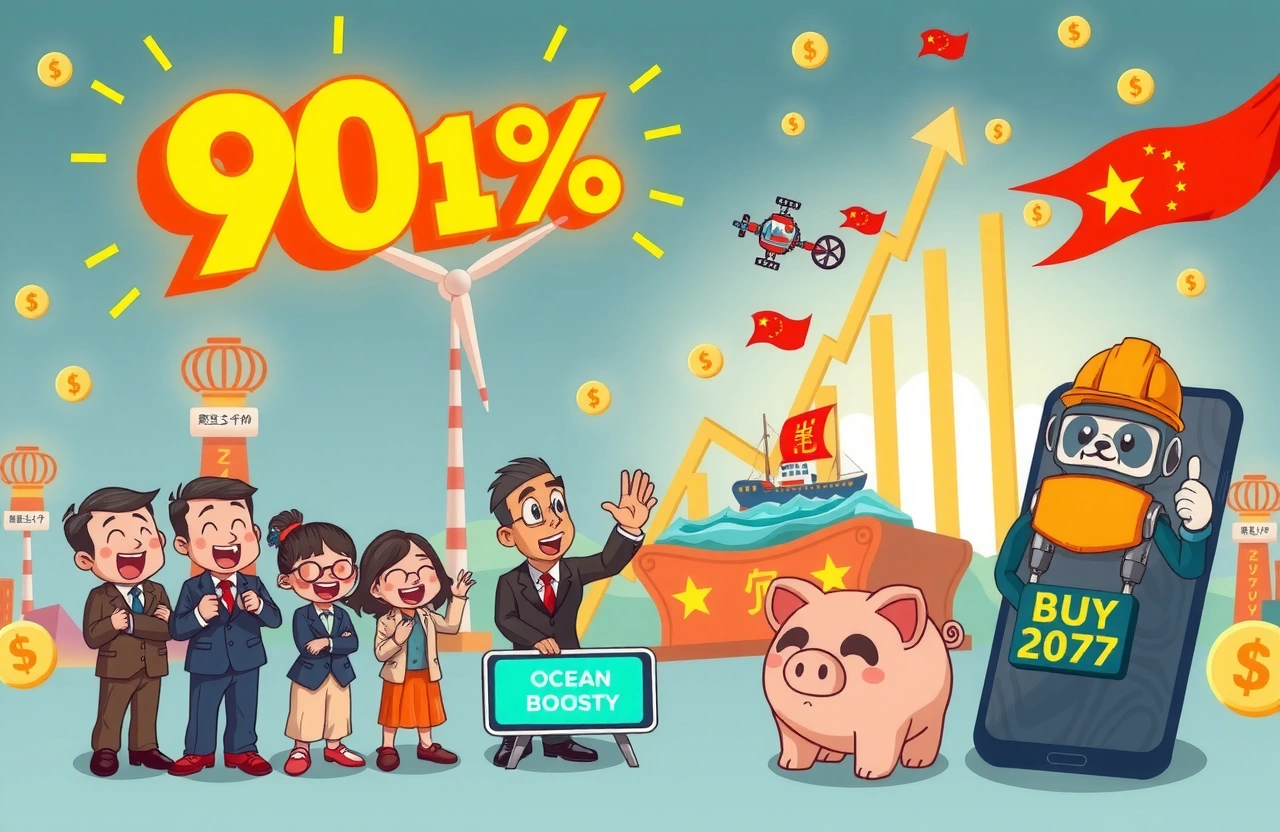
Market watchers caught their breath on July 2nd as China’s A-share market staged a stunning reversal. After sluggish morning trading dragged major indices down nearly 1%, an explosive afternoon surge transformed the session into a textbook case of market dynamism. This sudden rally wasn’t random noise – powerful intersecting forces drove capital toward overlooked sectors, presenting both tactical opportunities and insights into China’s evolving industrial priorities.
Key Takeaways
- Tangshan steel production cuts triggered explosive gains across metal stocks with Chongqing Iron & Steel soaring 90% intraday
- Simultaneous commodity rally saw polysilicon futures hit limit-up (+8%) while glass futures gained 6%
- Ocean economy stocks recorded 20+ limit-ups on new strategic policy directives
- Rotation strategy unfolded as capital exited overheated sectors targeting oversold industries
- Broker consensus highlights deep-sea tech investments as structural opportunity
The Anatomy of the Afternoon Surge
Wednesday’s truncated trading volume offered few clues initially. Having contracted from 1.5 trillion yuan to 1.41 trillion yuan, the constrained liquidity suggested investor hesitation. Yet the tension broke decisively at the 1:30 pm session restart with buy orders flooding steel producers. The afternoon surge began when Shengde Xintai rocketed 17% within minutes before hitting its 20% circuit breaker, followed by Chongqing Iron & Steel, Liugang Group and Shougang Company locking limit-up positions.
Commodity Market Linkages Accelerated Gains
The synchronized surge across equities and futures markets created a self-reinforcing loop. While steel equities surged:
- Polysilicon futures hit daily limit-up (8%) on Zhengzhou Exchange
- Industrial silicon futures advanced 4.6%
- Glass futures spiked 6.3% on capacity constraints
The tangible fundamentals behind the metal rally prompted algorithmic traders to execute commodity-equity arbitrage strategies, magnifying momentum. Tangshan production constraints created immediate physical market shortages – futures markets functioned as leading indicators that equities merely validated during the afternoon session.
Ocean Economy Stocks Surf the Policy Wave
Parallel to metals, the ocean sector experienced its own surge. From specialized manufacturers like Deepwater Hibiscus to fishery operators such as Zhangzidao Group, 22 marine economy stocks hit their 10% daily limit. This validated policy-focused capital positioning near-term winners following Beijing’s latest strategic directives.
Policy Catalysts Igniting Sector Moves
Twin regulatory developments converged to drive Wednesday’s gains:
Tangshan Environmental Production Cuts
Market-moving documents distributed to mills revealed aggressive July emission controls:
- Production halts mandated July 4-15 at BF/BOF facilities
- Electric arc furnaces restricted to night operations
- Sintering plants facing 50% capacity utilization caps
Local enforcement aligns with China’s dual carbon goals. Shenwan Hongyuan analysts calculate output reductions could slash national steel production by 9.4 million metric tons monthly, explaining the scramble to cover futures positions during the afternoon surge.
Deep Sea Economy Strategic Elevation
Central Financial Commission directives July 1st designated marine industries as sovereignty priorities:
- Deep-sea technology classified as emerging strategic industry
- Provincial marine economy zones accelerated in Guangdong/Shandong
- $3.2 billion capital allocation for subsea fiber-optic networks
The symbolism proved crucial – elevating ocean development alongside lunar missions confirmed governmental commitment. Shanghai Securities News quoted unnamed officials noting marine GDP targets triple growth within seven years.
Capital Rotation Strategies Explained
While catalysts provided rationale, Wednesday’s winners shared common technical traits:
- Steel sector traded below historical P/B 38% prior to surge
- PV glass makers saw 16% short interest buildup pre-rally
- Ocean stocks averaged 22% liquidity discount versus AI peers
Quantitative analysis by China Merchant Securities shows mean-reversion trading algorithms initiated order cascades as institutional investors executed strategic pivots. Notable rotation patterns emerged:
- AI/high-PE chips saw largest net outflows
- Pharmaceutical distribution networks recorded secondary inflows
- Active funds reshuffled 3.8% AUM toward value sectors
Goldman Sachs strategist Zhang Zhiwei notes: “Broadening leadership outside technology demonstrates institutional conviction toward diversified exposure. Wednesday proved rotation investing remains vital during consolidation.”
Market Consolidation Phase Signals
Despite the dramatic intraday reversal, macro conditions warrant vigilance. Five warning indicators emerged:
- Margin balance declines across major brokerages (CICC/Galaxy)
- Blue-chip ETF premiums evaporating
- MSCI China futures backwardation widening
- Sector ETF flow dispersion spikes to 18-month highs
Technical analysis shows critical support at 3000 Shanghai Composite – while breached briefly July 2nd, institutions rushed defensive positions around this pivotal level. Macro cushions exist via:
- Overall corporate profitability rebound (Q1 +11% YoY)
- Manufacturing PMI reclaiming growth threshold
- SSE STAR Market IPO subscriptions doubling
Morgan Stanley maintains cautiously constructive outlook predicting 8-10% annual upside with selective allocation required.
Ocean Economy: Investing Framework
The marine sector transformation creates multi-layered opportunities:
Deep-Sea Technology Platforms Boom
Government designation as strategic priority propels specialized developers:
- Robotic unmanned underwater systems
- High-pressure material engineering
- Submarine battery endurance breakthroughs
Growth highlights include:
- Underwater sensors market expanding 29% CAGR
- Trench-capable communication equipment pilot deployments
- Commercial ROV vendors hitting export milestones
Orient Securities recommends exposure to system integrators benefiting from national oceanic laboratories’ procurement acceleration.
Sea Wind Power Economics Improves
Coastal turbine capacity expands under grid parity:
- Levelized costs declined 30% since 2022
- Offshore O&M automation lowering operational expenses
- Cable/connection infrastructure standardization
CICC projections show achievable 18GW annual installations nationwide by 2028.
Secondary Marine Segments Rising
Beyond headline industries:
- Marine pharmaceuticals contribute key cancer therapeutics
- Desalination technology addresses regional droughts
- Subsea mineral extraction enters viability studies
Analysts suggest evaluating manufacturing expertise adapted to high-saline environments.
Strategic Portfolio Positioning Guidance
Experts recommend structured approaches:
- Tier allocation across infrastructure vendors + technology innovators
- Premarket futures analysis signaling sector momentum
- Quant factor screening for high beta/value hybrids
Citi Private Bank suggests accumulating scale leaders during consolidation cycles while maintaining trailing stops protecting gains.
Searches published daily at China Securities Journal reveal institutions gained early insight into Tangshan curtailment rumors. Subscription tracking secures intelligence advantages highlighted during Wednesday’s volatility – understanding administrative calendars especially around environmental inspections proves vital.
This afternoon surge clarified broader truths beyond immediate profits. Rising strategic sectors represent national priorities where governmental resources ensure fundamental progress. Investors agile enough positioning within infrastructure modernization waves will uncover compound opportunities.
Monitor Ministry of Ecology environmental disclosure filings weekly – unexpected announcements frequently drive volatility in commodities-linked equities. Similarly, provincial marine investment blueprints published quarterly reveal regional devotion translating policy into action. Using these governmental indicators transforms reactive investing into foresight-enabled strategic allocation.