



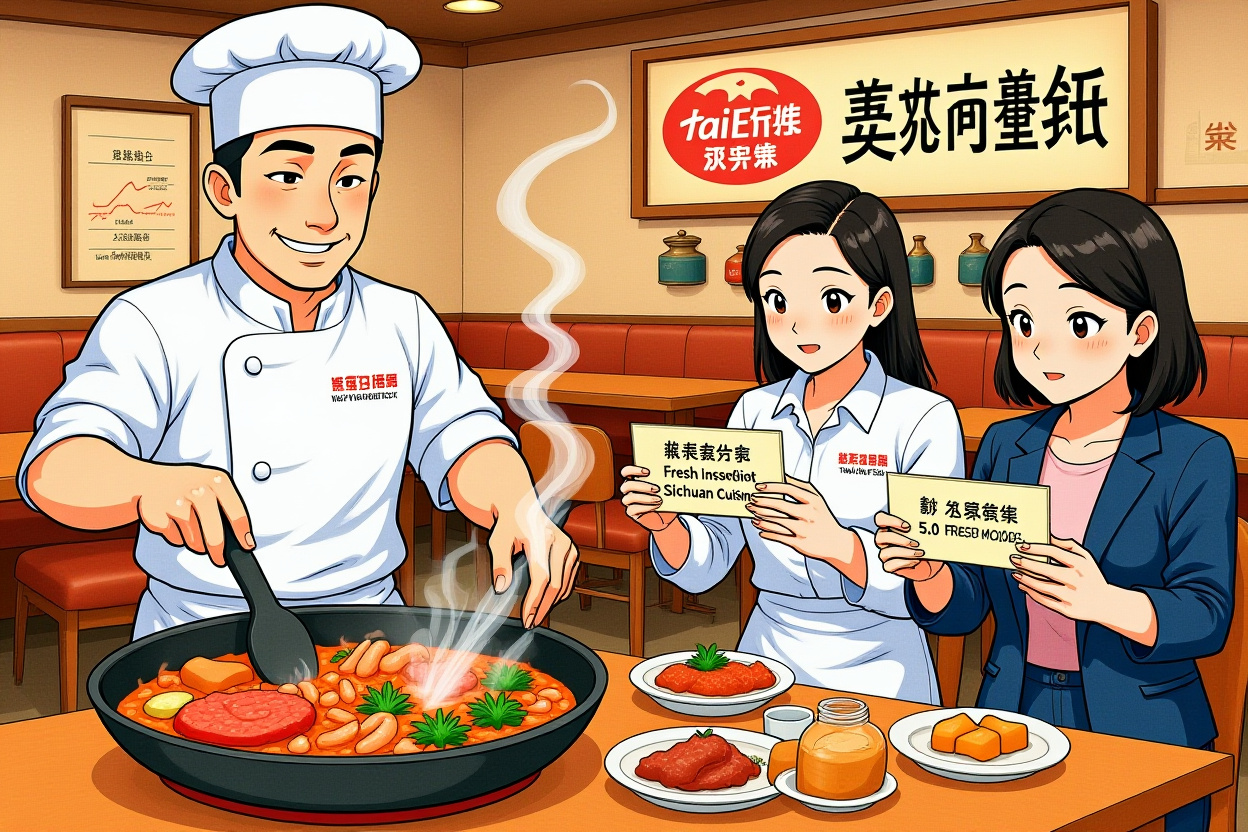
– Tai Er, a flagship brand under Jiumaojiu Group (九毛九集团), is undergoing a significant brand transformation, moving beyond its core sour fish (酸菜鱼) offering to embrace a broader ‘fresh ingredient Sichuan cuisine’ (鲜料川菜) concept.
– The pivot is driven by declining sales in the sour fish segment, intensified competition, and the growing consumer demand for fresh,现炒 (freshly cooked) dishes post the预制菜 (pre-made dish) controversy.
– Operational challenges include higher supply chain costs, the need for skilled chefs, and the difficulty of重塑品牌认知 (rebranding) after years of being synonymous with sour fish.
– For investors, this strategic shift highlights the volatility in China’s consumer dining sector and the importance of adaptive business models in the face of changing market trends.
The landscape of China’s casual dining scene is shifting beneath the feet of even its most established players. If you visited a Tai Er (太二) restaurant at the beginning, middle, and end of 2025, you might witness a brand in real-time metamorphosis. The once ubiquitous ‘Tai Er Sour Fish’ (太二酸菜鱼) signage is evolving, first adorned with the characters for ‘fresh and alive’ (鲜活), and now, in some locations, completely rebranded to ‘New Tai Er – Fresh Ingredient Sichuan Cuisine’ (新太二·鲜料川菜). This isn’t just a cosmetic change; it’s a fundamental Tai Er’s strategic pivot that speaks volumes about the pressures and opportunities within China’s hyper-competitive food and beverage market. For international investors tracking consumer trends and corporate adaptability, understanding this transformation is crucial for assessing the future trajectory of parent company Jiumaojiu Group and the broader Chinese dining sector.
The Anatomy of Tai Er’s Brand Transformation
The visual and culinary changes at Tai Er are the most immediate indicators of its new direction. This Tai Er’s strategic pivot is not a fleeting experiment but a coordinated rollout that began earlier in the year and is now entering a more defined testing phase.
The New Store Concept: “New Tai Er – Fresh Ingredient Sichuan Cuisine”
In late December, several ‘New Tai Er – Fresh Ingredient Sichuan Cuisine’ outlets quietly opened in Guangzhou and Foshan. In these pilot stores, the iconic sour fish dish remains on the menu but has been deliberately deprioritized. Portions have been reduced from 350g to 300g, and the price has been lowered from approximately 139 yuan to 99 yuan, according to store staff. The stated goal, as relayed to media, is to encourage customers to order more of the other new dishes. The menu now expands into five signature series centered on ‘live fish, live shrimp, fresh beef, fresh chicken, and fresh pork,’ introducing over 20 new items. These are not traditional Sichuan staples but innovative fusion dishes, such as Cheese Spicy Shrimp (78 yuan) and Stir-Fried Fresh Beef (72 yuan).
Financial Rationale and the “5.0 Fresh Model”
This overhaul is part of a brand upgrade strategy dubbed the ‘5.0 Fresh Model’ (5.0鲜活模式), which Tai Er confirmed in March 2025. The company states that the current ‘New Tai Er’ format is a deepening of this fresh model, building upon earlier门店调改 (store modifications) that introduced live fish, fresh chicken, and fresh beef. According to Jiumaojiu Group’s Q3 2025 financial report, the parent company aims to have 200 Tai Er stores converted to this ‘fresh’ model by year-end, starting from a base of over 530 outlets. The scale of this Tai Er’s strategic pivot underscores a significant capital and operational commitment.
Driving Forces: Why Abandon a Winning Formula?
Tai Er’s decision to move away from the dish that made it famous is a calculated response to several converging market forces. This Tai Er’s strategic pivot is fundamentally a survival and growth tactic in a rapidly evolving industry.
Eroding Profitability in the Sour Fish Niche
The sour fish segment, once a blue ocean, has become a red ocean of competition. The brand’s financial performance has been under pressure since 2024. Jiumaojiu Group’s H1 2025 results showed a 10.14% year-on-year decline in revenue to 27.53 billion yuan and a 16.05% drop in net profit to 60.69 million yuan. Crucially, Tai Er’s revenue alone fell by 13.3% to 19.48 billion yuan. Two primary factors are at play: the widespread consumer backlash against预制菜 (pre-made dishes), which damaged trust in centralized kitchen models, and the proliferation of lower-cost ‘平替’ (budget alternative) sour fish restaurants squeezing Tai Er’s market share.
The Allure of the Expansive Sichuan Cuisine Market
While the sour fish niche contracts, the broader Sichuan cuisine market is booming. According to Hongcan Big Data (红餐大数据), as of October 2024, the number of Sichuan cuisine restaurants in China exceeded 150,000, accounting for 11.4% of all Chinese正餐 (full-service restaurant) outlets and solidifying its position as the top cuisine category by store count. By repositioning within this vast and growing category, Tai Er is attempting to tap into a larger and more resilient consumer base. Furthermore, the emphasis on ‘fresh’ (鲜活) and ‘现炒现做’ (freshly cooked) directly addresses post-pandemic and post-pre-made-dish-scandal consumer preferences for transparency and ingredient quality.Navigating the Minefield: Key Challenges in Execution
Despite the strategic logic, Tai Er’s transition is fraught with operational, financial, and branding hurdles. Success is far from guaranteed, and the execution risks are substantial.Pricing Pressure and Increased Cost Structure
Tai Er’s new positioning places it in a challenging price segment. Data from Hongcan Big Data indicates that 43.2% of Sichuan cuisine restaurants fall into the 30-60 yuan per person range, with 27.7% in the 60-80 yuan bracket. Tai Er’s per-capita消费 (spending) of 74-80 yuan, as seen in its new套餐 (set meal) offerings, is at the higher end of the mass market. Branding consultant Zhan Junhao (詹军豪) notes that Tai Er’s pricing creates a模糊的价值锚点 (blurred value anchor): it’s too expensive for性价比 (cost-performance) seekers yet lacks the场景 (ambiance) and emotional value of true premium establishments. Moreover, the shift to daily fresh ingredients and on-site cooking inevitably raises supply chain costs. Lin Yue (林岳), Chief Consultant at Lingyan Management Consulting, estimates that this change could increase operational costs by 15%, squeezing margins further.The Human Capital Challenge: The Chef Bottleneck
The core of the fresh-cooked model is skilled kitchen staff. Unlike the centralized kitchen system, which ensured consistency through standardization, ‘现炒’ (wok cooking) relies on chef expertise. Training chefs to a proficient level takes years, not months. An industry veteran with over 20 years in Sichuan cuisine noted that a chef needs three to five years to truly master the craft. While Tai Er has initiated intensive training programs—reportedly around one month per menu rollout—Lin Yue (林岳) cautions that maintaining consistent flavor and quality across hundreds of stores with different chefs will be an immense challenge. This constraint has historically limited the expansion speed of fresh-cooked chains like Feidachu辣椒炒肉 (Feidachu Chili Fried Pork), which has only 188 stores after nine years.Investment Implications and Sector Analysis
For institutional investors and market analysts, Tai Er’s transformation is a critical case study in corporate agility within the Chinese consumer discretionary space. This Tai Er’s strategic pivot has direct implications for portfolio positioning and sector outlook.Assessing Jiumaojiu Group’s Financial Health and Strategy
The performance of Tai Er is paramount to Jiumaojiu Group, as it constitutes the lion’s share of the group’s revenue. The ongoing store conversions represent significant capital expenditure. Investors will closely monitor same-store sales growth, customer traffic, and average spending at the converted ‘New Tai Er’ outlets. Key metrics to watch in upcoming quarterly reports include:– Gross margin trends to see if the higher cost of fresh ingredients is offset by premium pricing or operational efficiencies.
– The pace of store conversions versus the rollout of new ‘New Tai Er’ formats.
– Management commentary on customer reception and repeat rates for the new Sichuan cuisine menu.
The success or failure of this Tai Er’s strategic pivot will heavily influence Jiumaojiu Group’s stock valuation and its ability to navigate the post-pre-made-dish era.
Broader Trends in China’s Dining and Consumer Sector
Tai Er’s move is symptomatic of larger shifts. The consumer demand for freshness and transparency is reshaping entire supply chains. Companies that can effectively communicate and deliver on ‘fresh’ and ‘healthy’ credentials are likely to gain market share. Furthermore, the consolidation and repositioning within specific cuisines, like Sichuan food, indicate a maturation of the market where differentiation through ingredient quality and烹饪技艺 (culinary skill) is becoming more important than pure novelty or marketing. Investors should scrutinize other major chains for similar strategic adjustments.Expert Verdicts and the Road Ahead
Industry observers are divided on Tai Er’s prospects, highlighting the high-stakes nature of this corporate maneuver. The consensus is that the path forward is promising but perilous.A Race Against Time and Consumer Perception
The most daunting challenge may be rebranding. Zhan Junhao (詹军豪) emphasizes that Tai Er is deeply associated with sour fish in the public consciousness. Attempting to重塑认知 (reshape this perception) under the same brand name risks consumer confusion. The marketing and education costs to establish Tai Er as a credible Sichuan cuisine brand are potentially enormous and could take years to bear fruit. Lin Yue (林岳) describes the move as ‘a path that seems to follow the trend but is actually more difficult in operation.’ Tai Er is essentially in a race against time to prove the viability of its new model before financial pressures from the transition mount.Strategic Alternatives and Long-Term Viability
Some analysts suggest that launching a new sub-brand for Sichuan cuisine might have been a less risky approach. However, leveraging the existing Tai Er brand recognition offers potential for faster traction if executed flawlessly. The long-term viability hinges on several factors:– Sustained consumer uptake of the new menu items beyond the initial novelty.
– Ability to manage a complex dual supply chain for live and fresh ingredients at scale.
– Success in training and retaining a large workforce of competent chefs.
– Navigating the competitive response from both entrenched Sichuan cuisine players and other sour fish specialists.
Tai Er’s bold transformation from a单品类 (single-category) champion to a multi-offering Sichuan cuisine contender is one of the most watched narratives in China’s餐饮业 (food service industry). This Tai Er’s strategic pivot reflects the intense dynamism of the Chinese consumer market, where brand loyalty is fragile and operational excellence is non-negotiable. For investors, the key takeaways are clear: monitor same-store sales data meticulously, assess management’s execution capability on supply chain and training, and watch for consumer sentiment indicators on social media and review platforms like大众点评 (Dianping). The coming quarters will be critical in determining whether this pivot stabilizes Jiumaojiu Group’s earnings or leads to further volatility. As always in the Chinese equity markets, adaptability is the ultimate currency, and Tai Er’s journey will serve as a vital benchmark for the sector’s health and direction.