



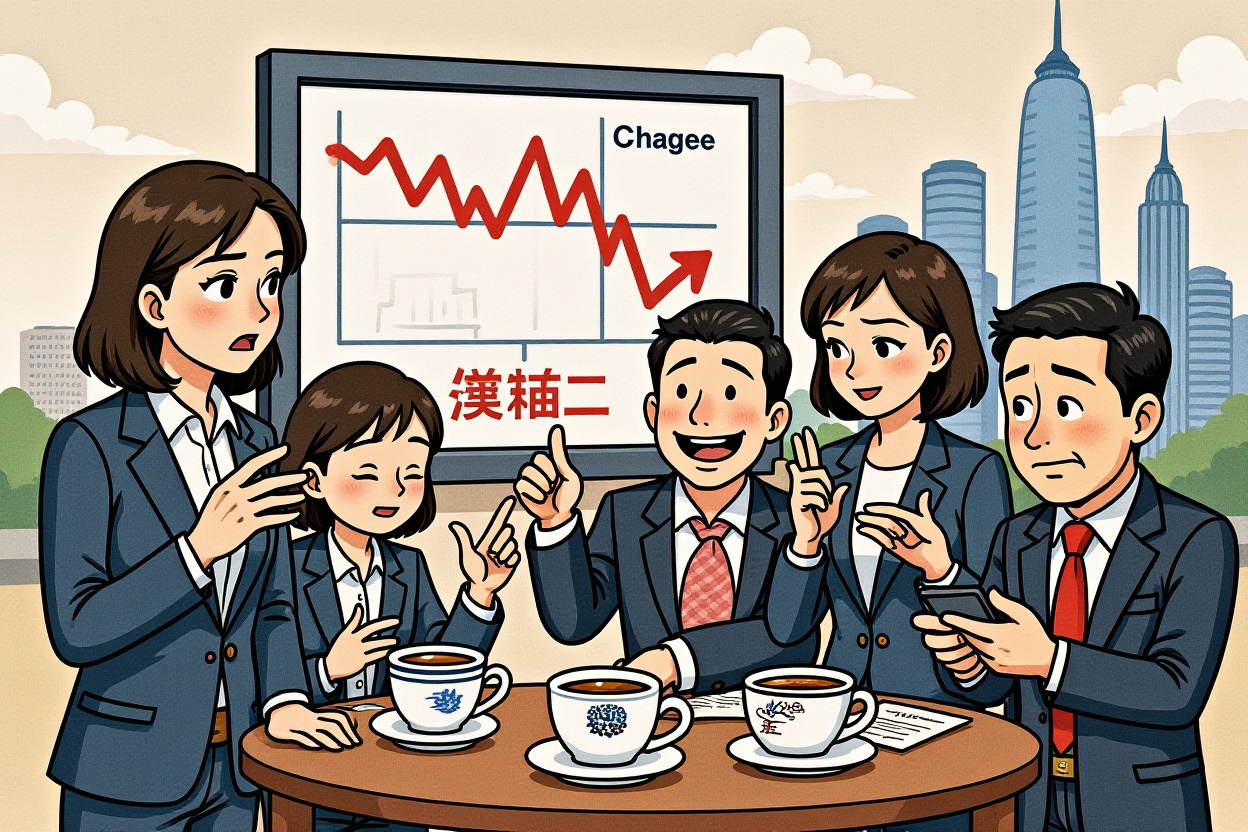
A sudden social media firestorm over caffeine content has sent shares of popular tea chain Chagee (霸王茶姬) tumbling to a record low, casting a harsh spotlight on the potential vulnerabilities of China’s booming beverage sector. The incident, which saw the topic “霸王茶姬大跌” (Chagee Plummets) rocket to the top of the trending charts on Weibo (微博), underscores how quickly consumer sentiment and online discourse can translate into tangible market volatility. For investors navigating the high-growth but often opaque New Tea Drink (新式茶饮) landscape, this caffeine controversy serves as a critical case study in brand risk management, regulatory perception, and the evolving expectations of Chinese consumers. The fallout extends beyond a single company, prompting urgent questions about product transparency, health narratives, and the sustainability of valuations in a fiercely competitive market.
The Spark: How a Social Media Post Ignited a Market Sell-Off
The immediate trigger for the Chagee caffeine controversy was a post from a social media influencer who made provocative claims about high-caffeine beverages. The influencer suggested that popular workday pick-me-ups like those from Chagee were operating in a regulatory grey area, akin to “brushing against quasi-drugs.” This incendiary framing quickly went viral, tapping into broader public conversations about health, wellness, and the ingredients in fast-moving consumer goods.
Viral Concerns and Consumer Reactions
The post catalyzed a wave of user-generated content and discussion under the hashtag “霸王茶姬 咖啡因” (Chagee Caffeine). Consumers took to social media to share their experiences and concerns:- Users posted comparative charts of caffeine content across different Chagee menu items, attempting to crowdsource data often not prominently displayed by the company.
– Numerous anecdotes described adverse effects such as insomnia and heart palpitations after consumption, personalizing the health risk narrative.
– The discussion shifted rapidly from taste and branding to one of ingredient safety and bodily impact, a dangerous pivot for any consumer-facing company.This rapid, decentralized spread of concern exemplifies the modern risk environment in China, where social media platforms like Weibo and Xiaohongshu (小红书) can amplify niche complaints into national crises within hours, directly impacting investor confidence.
Chagee’s Initial Crisis Response
Facing the escalating online storm, Chagee issued an initial statement on the afternoon of December 26. The company’s response was characteristically defensive, focusing on legal recourse rather than public reassurance. It stated it had “noticed rumors and false information targeting the company” and vowed to “resolutely defend its rights according to the law.” While standard in corporate China, this legalistic first response may have done little to calm public fears or address the core consumer concern about caffeine content, potentially exacerbating the perception of a company out of touch with its customer base.
Market Fallout: A Record Drop and Investor Flight
The direct financial impact of the caffeine controversy was severe and immediate. The negative sentiment flowing from social media channels directly translated into a historic sell-off in Chagee’s U.S.-listed shares, offering a stark lesson in the market’s sensitivity to brand perception.
Pre-Market to Close: Tracing the Sell-Off
The stock’s decline began in pre-market trading, signaling that institutional investors and traders were reacting to the overnight social media trend from China. The sell-off intensified at the open, painting a clear picture of panic and reassessment:- **Pre-Market:** Stock down approximately 10%, indicating early alarm.
– **Intraday Low:** Shares plunged nearly 16% at their worst point during the trading session.
– **Closing Bell:** The stock settled at $11.90 per share, closing at its lowest level since the company’s public debut.
Historical Context: From IPO High to Record Low
The closing price of $11.90 represents a catastrophic decline for early investors. Compared to its April IPO price, the stock has now fallen over 64%. This wipeout of value highlights the extreme volatility and sentiment-driven nature of the market for recent Chinese consumer IPOs. The controversy has effectively erased the growth narrative, forcing a fundamental re-rating of the stock based on newly perceived risks related to product safety, public relations, and regulatory scrutiny. The caffeine controversy has proven to be a materially significant event, transitioning Chagee from a high-flying growth story to a case study in crisis management failure.
The Company’s Pivot: Chagee’s Detailed Response and Strategic Moves
Following the dramatic market drop, Chagee released a more nuanced and detailed response in the evening of December 26. This second statement marked a strategic shift from legal threats to consumer education and product roadmap disclosure, directly addressing the caffeine controversy.
Contextualizing Caffeine Content: Tea vs. Coffee
In an attempt to reframe the narrative, Chagee’s statement provided comparative data, a crucial step in moving the conversation from emotion to fact. The company argued that a cup of its freshly brewed, leaf-based tea contained caffeine levels “roughly equivalent to a latte per 100ml” and was “significantly lower than an Americano.” This comparison was strategic, aiming to normalize its product against the globally accepted and regulated coffee industry. The company emphasized its use of “original leaf tea broth” rather than tea dust, powder, or industrial flavorings, asserting that this commitment to quality naturally results in a fuller flavor and, consequently, the inherent caffeine levels found in premium tea leaves.
Product Innovation and the “Light Caffeine” Future
Critically, the response outlined concrete steps Chagee is taking to address diverse consumer needs, showcasing proactive innovation rather than mere reaction:- **Existing Solution:** The company highlighted its “Light Caffeine·Boyajuexian” (轻因·伯牙绝弦) product, launched in March, which reportedly reduces caffeine content by approximately 50% while aiming to preserve the core tea taste.
– **Future Roadmap:** Most notably, Chagee revealed it is “actively exploring the possibility of caffeine-free tea.” This forward-looking statement is a direct attempt to mollify health-conscious consumers and open a new market segment, suggesting a future product that delivers “complete tea aroma, charm, and flavor” without the stimulant.The detailing of this R&D pipeline is a clear attempt to signal to investors that management is strategic, responsive to market signals, and working to diversify its product-related risks beyond the current caffeine controversy.
Broader Implications: Risks and Realities for China’s Beverage Sector
The Chagee caffeine controversy is not an isolated incident but a symptom of larger pressures facing China’s consumer brands. It exposes interconnected risks in the areas of regulation, competition, and consumer sophistication that every player in the New Tea Drink sector must now confront.
The Looming Shadow of Regulatory Scrutiny
While China’s State Administration for Market Regulation (SAMR, 国家市场监督管理总局) has not yet commented, the incident raises the specter of tighter oversight. The influencer’s “quasi-drug” rhetoric, though sensationalist, touches a nerve in a regulatory environment that has shown zero tolerance for perceived public health risks in food and beverage, as seen in past crackdowns on infant formula and supplements. Key regulatory risks now in focus include:- **Mandatory Labeling:** Potential new rules requiring clear, standardized caffeine content labeling on packaging and menus.
– **Marketing Restrictions:** Scrutiny of marketing claims related to energy, alertness, or health benefits.
– **Product Standards:** Possible formulation guidelines or limits for caffeine in ready-to-drink beverages, similar to those in other markets.For chains like Chagee, Nayuki (奈雪的茶), and Heytea (喜茶), proactive engagement with regulators and pre-emptive transparency may become essential cost-of-doing-business expenses to avoid future, more damaging interventions.
Consumer Power and the “Healthy Lifestyle” Megatrend
The controversy powerfully demonstrates the influence of the modern Chinese consumer. Driven by rising incomes and increased health awareness, especially post-pandemic, consumers are no longer passive recipients of products. They are investigators, commentators, and activists. The megatrend towards “healthy lifestyles” (健康生活) means that ingredients are under a microscope. Brands that fail to align with this values-driven consumption—by offering clear information, healthier alternatives, and responsible marketing—risk being sidelined. The swift market punishment of Chagee is a potent warning to all consumer-facing companies: ignore evolving consumer values at your peril.
Competitive Dynamics in a Saturated Market
China’s New Tea Drink market is fiercely competitive, with margins often pressured by intense marketing spend and rapid store expansion. An event like the caffeine controversy can fundamentally alter competitive positioning:- **Vulnerable Brands:** Competitors with similar product profiles may face collateral damage as consumers broadly question tea caffeine levels.
– **Opportunistic Moves:** Rivals may seize the moment to promote their own transparency initiatives, “healthier” formulations, or decaffeinated options to capture shifting demand.
– **Investment Thesis Re-evaluation:** Venture capital and public market investors may apply heightened due diligence on ingredient sourcing, supply chain transparency, and crisis management plans before funding or valuing similar companies. The sector’s growth-at-all-costs narrative has been punctured by a focus on operational and reputational risk.
Investment Takeaways and Forward-Looking Analysis
For institutional investors and fund managers focused on Chinese equities, the Chagee episode provides several critical lessons and frames essential questions for ongoing due diligence.
Key Risk Factors Exposed by the Caffeine Controversy
This event highlights non-financial risk factors that must be integrated into investment models for Chinese consumer stocks:- **Social Media Sentiment Risk:** The speed and scale at which online discourse can impact brand equity and stock price.
– **Product Transparency Deficit:** The market penalty for perceived opacity in ingredients or health impact.
– **Crisis Management Capability:** The tangible value of a sophisticated, empathetic, and swift public communications strategy.
– **Regulatory Tail Risk:** The potential for sudden changes in the regulatory landscape triggered by public outcry or media scrutiny.
Monitoring the Path Forward for Chagee and the Sector
The immediate crisis may fade, but its implications will shape the sector for quarters to come. Investors should monitor several key developments:- **Chagee’s Execution:** Can the company successfully launch a compelling caffeine-free product to diversify its menu and address the controversy head-on?
– **Industry Response:** Will competitors band together to establish voluntary labeling standards to pre-empt regulation and rebuild category trust?
– **Regulatory Signals:** Any public statements, draft guidelines, or investigations launched by SAMR or the National Health Commission (国家卫生健康委员会) concerning caffeine or beverage labeling.
– **Consumer Sentiment Metrics:** Tracking same-store sales, brand sentiment surveys, and social media discussion trends for Chagee and its peers in the coming months.The dramatic sell-off in Chagee shares following the caffeine controversy is more than a one-day headline; it is a watershed moment for China’s consumer investment landscape. It underscores that in the age of social media and health-conscious consumption, a company’s product formulation and public communication are as critical to its valuation as its store count and revenue growth. For the broader New Tea Drink sector, the incident serves as an urgent call to action—prioritize transparency, innovate for wellness, and prepare for a regulatory environment that is increasingly attentive to consumer protection. Investors, in turn, must elevate their analysis beyond traditional metrics to rigorously assess brand resilience, supply chain integrity, and management’s ability to navigate the complex interplay of consumer trends and public policy. The market has spoken, and the message is clear: in today’s China, ignoring a caffeine controversy can be very costly.