



Executive Summary: Key Market Takeaways
As the year draws to a close, China’s hyper-competitive food delivery and instant retail market has entered a new phase of rivalry—a direct battle for the most critical operational asset: the delivery rider. Platforms are deploying significant financial incentives to attract experienced riders from competitors, underscoring a fundamental evolution in industry dynamics.
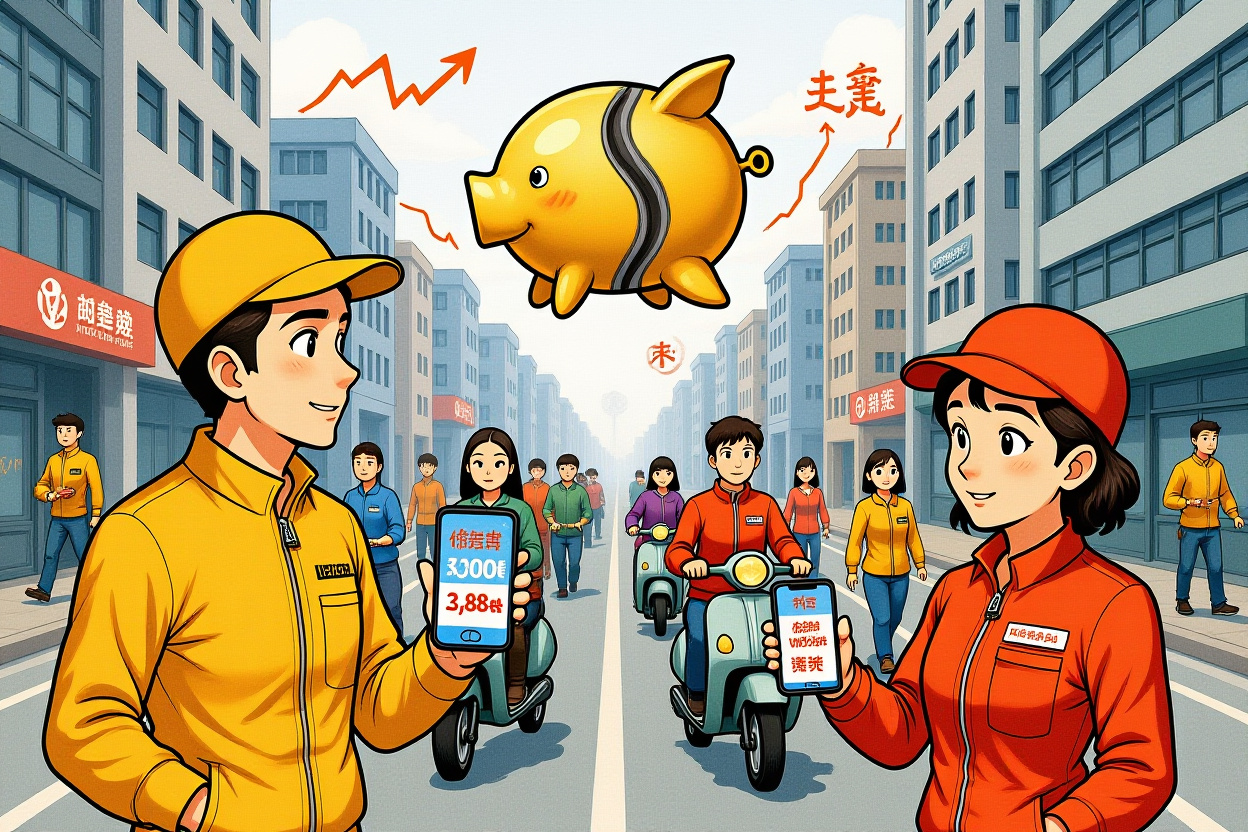
– Meituan (美团) and Taobao Flash (淘宝闪购) are offering one-time bonuses of up to 3,000 yuan (approximately $420) to riders who switch platforms and meet specific order volume targets, with additional referral fees.
– This delivery rider recruitment war is currently concentrated in key urban areas like Beijing and is a tactical response to year-end order peaks and fluctuating delivery capacity.
– The competition reflects a deeper industry transition from subsidizing users and merchants to competing for stable, high-quality human resources, which are now seen as a core competitive advantage.
– Expert analysis suggests that while cash incentives provide short-term relief, long-term platform success will depend on building sustainable rider ecosystems through improved welfare, benefits, and professional development.
– Data indicates high rider mobility across platforms, forcing companies to balance immediate recruitment drives with longer-term retention strategies focused on job security and dignity.
The Battle for Riders Heats Up as Year-End Demand Peaks
The final weeks of the calendar year have traditionally been a period of intense activity for China’s delivery platforms, marked by promotional campaigns and holiday demand. This year, however, the frontline of competition has visibly shifted from digital app interfaces to the streets, with platforms engaging in a direct delivery rider recruitment war. The immediate catalyst is the need to secure sufficient delivery capacity to handle seasonal order surges, but the underlying motives run much deeper, touching on the very foundation of platform economics in the local services sector.
This strategic skirmish involves real money being deployed to lure away the most valuable commodity: experienced riders who require minimal training and can immediately contribute to order fulfillment efficiency. The current delivery rider recruitment war is a clear signal that in the maturing Chinese on-demand economy, operational excellence and reliable service delivery are now paramount, and they are fundamentally dependent on a motivated and stable workforce.
High-Value “Transfer Fees”: A Look at the Competing Offers
According to exclusive reports from National Business Daily (每日经济新闻), both Meituan and Alibaba’s Taobao Flash have rolled out targeted incentive programs in parts of Beijing. These are not broad, nationwide campaigns but precise, tactical operations aimed at specific rider segments from rival platforms.
– Meituan’s Offer: The platform is targeting riders who worked for competitors Ele.me (饿了么) and JD.com’s delivery service in November. Riders who completed more than 720 orders in that month and agree to join Meituan’s “Le Pao” (乐跑) premium rider program for six consecutive weeks are eligible for a bonus of 2,888 yuan.
– Taobao Flash’s Offer: This platform is offering a 3,000 yuan reward to riders who delivered over 140 orders for platforms like JD.com, Meituan, or SF Express (顺丰) between December 15 and 21. To claim the bonus, they must join Taobao Flash’s “You Xuan” (优选) program and complete four consecutive weeks of service. Furthermore, Taobao Flash adds a 1,000 yuan incentive for the person who referred the new rider.
A Meituan rider in Beijing confirmed to reporters that Taobao Flash has consistently offered perks to attract Meituan riders, with several of his colleagues recently moving for the latest bonus. However, station managers note that while short-term cash attracts newer or financially pressured riders, the most stable professionals prioritize consistent order volume and overall platform support. This delivery rider recruitment war is thus creating a more fluid labor market where loyalty is increasingly transactional.
Regional Gambits with National Implications
The concentrated nature of these offers in Beijing highlights the strategic importance of key metropolitan markets. Industry sources cited by Jiemian News (界面新闻) note that training a completely inexperienced rider takes at least two weeks. In the heat of a market share battle, platforms like Taobao Flash opt for the faster, albeit more expensive, route: paying above-market premiums to instantly onboard seasoned couriers.
This tactic is not entirely new but has intensified in scale. For instance, in July 2024, Taobao Flash offered riders in Beijing’s Sanlitun area an extra 1,200 yuan per week for completing only 20-30 daily orders—far below the typical 40-50 order benchmark. This effectively provided a monthly income boost of nearly 5,000 yuan, leading to a noticeable exodus from Meituan. However, by September, as subsidies tapered, a significant回流 (return flow) of riders back to Meituan was observed, demonstrating the fickle nature of purely cash-driven loyalty in this delivery rider recruitment war.
Why Riders Have Become the Pivotal Resource in Platform Economics
The escalating delivery rider recruitment war is a symptom of a fundamental truth: without riders, the vast ecosystems of food delivery and instant retail simply cannot function. Riders have evolved from being interchangeable operational components to becoming the crucial human nodes that connect digital platforms to physical consumers. Their performance directly impacts customer satisfaction, order efficiency, and ultimately, platform profitability and brand reputation.
As competition has moved beyond simple price wars and user subsidies, the quality and reliability of the last-mile delivery experience have emerged as key differentiators. Consequently, controlling a stable, high-performing rider workforce is now a strategic imperative. This delivery rider recruitment war underscores that human capital is as critical as technological capital in the current phase of China’s digital economy.
From Price Wars to Talent Wars: A Historical Shift
The competition landscape has undergone a clear evolution. The past decade was defined by brutal subsidy battles to acquire users and merchant partners. Today, with user growth stabilizing and merchant partnerships largely established, the battlefield has shifted to operational execution. The moment captured earlier this year when JD.com founder Liu Qiangdong (刘强东) personally made deliveries in a rider uniform and shared a hot pot meal with couriers was symbolic. During that gathering, he expressed empathy for the job’s difficulties, extended offers like social insurance contributions, and openly invited riders from Meituan and Ele.me to join JD.com. This public appeal was a stark admission of the industry-wide “thirst for talent.”
Ai Media Consulting CEO and Chief Analyst Zhang Yi (张毅) emphasized in an interview that the core reason for this cash-fueled delivery rider recruitment war is that rider stability and service quality are the bedrock of a platform’s competitiveness. They are the key guarantee of fulfillment capability. While effective in the short term, Zhang warns that such tactics elevate operational costs and do not foster stable team growth, potentially harming healthy market development in the long run.
Understanding the Fluid Nature of China’s Gig Economy Workforce
The effectiveness of bonus-driven recruitment campaigns is amplified by the inherent characteristics of China’s gig economy. Delivery riding is often seen as a job with low entry barriers and high fluidity. Official data suggests over 12 million registered online delivery personnel nationwide. Most platforms utilize a hybrid model of dedicated riders and crowdsourced “众包” (zhongbao) workers, resulting in flexible, non-standard employment relationships with high turnover rates.
Data Reveals High Cross-Platform Mobility
QuestMobile data provides quantitative evidence of this mobility. In September 2024, the monthly active user overlap among rider apps for Meituan Crowdsourcing (美团众包), Ele.me’s Fengniao Crowdsourcing (蜂鸟众包), and JD.com’s Instant Delivery Rider App (京东秒送骑士App) was 250,000. By September 2025, that overlap had skyrocketed to 2.088 million—a sevenfold increase. This indicates a massive population of riders in a “观望状态” (wait-and-see state), ready to switch platforms based on personal circumstances and the attractiveness of incentives offered in the ongoing delivery rider recruitment war.
This fluidity presents a dual challenge for platforms: it allows for rapid capacity scaling through poaching but makes building a loyal, long-term workforce exceptionally difficult. The short-term incentives seen today are a direct response to this reality, acting as a “速效药” (quick fix) for capacity gaps during peak demand periods like year-end.
The Strategic Pivot: From “Recruiting” to “Retaining” Riders
Recognizing the limitations of a perpetual cash bonus war, leading platforms are simultaneously embarking on a higher-level competition focused on ecosystem building and rider welfare. This represents a more sustainable, though less immediately impactful, approach to winning the delivery rider recruitment war by focusing on long-term retention over short-term acquisition.
Comprehensive Welfare Initiatives Take Center Stage
Throughout 2024, Meituan, Taobao Flash, and JD.com have all announced various measures aimed at improving rider well-being and fostering a sense of belonging:
– Social Insurance Support: Platforms have rolled out subsidies to help riders contribute to social security funds (社保补贴). Meituan announced that its national subsidy program, launched in November, has begun distributing funds to riders across the country.
– Penalty Reforms: Several platforms have announced the cancellation of fines for late deliveries, reducing pressure on riders.
– Housing and Family Support: JD.com declared in December a plan to invest 220 billion yuan over five years to provide 150,000 “小哥之家” (Little Brother Homes) to improve living conditions for delivery and courier personnel. Meituan has pledged a 100-billion-yuan investment over five years to expand pilot programs like “亲子假” (parent-child leave) and “秋收假” (autumn harvest leave) for riders.
– Humanitarian Aid: Programs offering disease assistance and children’s education support have also been introduced.
Chen Liteng (陈礼腾), a digital life analyst at Wangjing Society E-commerce Research Center (网经社电子商务研究中心), noted that these diversified retention strategies mark a new phase. “As the food delivery industry moves from subsidy competition to a new stage of service quality competition, the ability to build a stable and efficient rider ecosystem will become the key to differentiated competition and an important factor in determining the long-term market structure,” Chen stated.
Building Sustainable Competitive Moats
Analyst Zhang Yi (张毅) argues that the correct development direction is for platforms to transition from short-term subsidy-based recruitment to long-term protection of rider rights and interests. Sustainable barriers, he says, are built through social security, housing support, reasonable order pricing, and humane care—factors that improve the fundamental quality of the job. Ultimately, platforms must rely on refined operations, efficiency gains, and superior management for long-term development, moving beyond the cyclical delivery rider recruitment war.
Market Implications and Forward Guidance for Investors
The current delivery rider recruitment war and the parallel push for rider welfare have significant implications for investors, corporate executives, and market watchers focused on Chinese equities and the consumer internet sector. This evolution signals several critical trends.
Rising Operational Costs and Margin Pressures
The direct financial incentives for rider poaching and the substantial long-term investments in welfare programs will inevitably pressure platform operating costs. In the short term, this may compress margins, especially for players aggressively engaged in the talent grab. Investors should monitor quarterly financial reports from companies like Meituan (美团), Alibaba (阿里巴巴集团), and JD.com (京东集团) for disclosures on sales, general, and administrative expenses related to rider incentives and benefits. The delivery rider recruitment war is a clear cost driver that must be balanced against revenue growth from increased order volume and market share.
The Emergence of a New Investment Thesis: Human Capital Stability
The market is beginning to price in the quality of a platform’s operational execution and its ability to maintain a stable service workforce. Platforms that successfully navigate this delivery rider recruitment war by building a loyal, efficient rider network may command a premium. This shifts the investment narrative from pure gross merchandise volume growth to metrics like rider retention rates, average delivery times, and customer satisfaction scores. Institutional investors should factor these non-financial operational key performance indicators into their valuation models for Chinese delivery and instant retail platforms.
Regulatory and Social Governance Considerations
The heightened focus on rider welfare occurs against a backdrop of increased regulatory scrutiny on the gig economy in China. Government bodies like the Ministry of Human Resources and Social Security (人力资源和社会保障部) have been advocating for better protection of flexible workers’ rights. Platforms’ voluntary moves towards providing社保补贴 (social insurance subsidies) and improving working conditions can be seen as pre-emptive steps to align with potential future regulations, mitigating regulatory risk. This proactive approach could be viewed positively by long-term investors concerned with environmental, social, and governance factors.
Synthesizing the Battle: Key Takeaways and the Path Ahead
The year-end delivery rider recruitment war between Meituan and Taobao Flash is more than a temporary scramble for manpower; it is a vivid manifestation of the Chinese on-demand economy’s maturation. The competition has decisively moved into the realm of human resource strategy, where rider experience, stability, and welfare are directly linked to platform performance and valuation.
The key takeaway for business professionals and investors is that the era of competing solely on consumer-facing subsidies is over. The new battleground is operational excellence, which is intrinsically tied to the management and motivation of a massive gig workforce. While cash bonuses will continue to be a tactical tool in this delivery rider recruitment war, the strategic winners will be those who complement such tactics with genuine, long-term investments in their riders’ professional lives and well-being.
Forward-looking market guidance suggests closely watching which platforms can best execute this dual strategy: effectively managing short-term capacity needs through smart incentives while concurrently building the institutional frameworks for rider support that foster loyalty and reduce costly turnover. The companies that master this balance will likely emerge with stronger brand equity, more resilient operations, and sustainable competitive advantages in the fiercely contested Chinese market.
For global investors and corporate strategists, understanding this dynamic is crucial. The evolution of China’s delivery rider recruitment war offers a blueprint for how platform economies worldwide might evolve as they scale—highlighting that ultimately, even the most digital of businesses rely on the satisfaction and stability of the human beings who deliver their core service.