



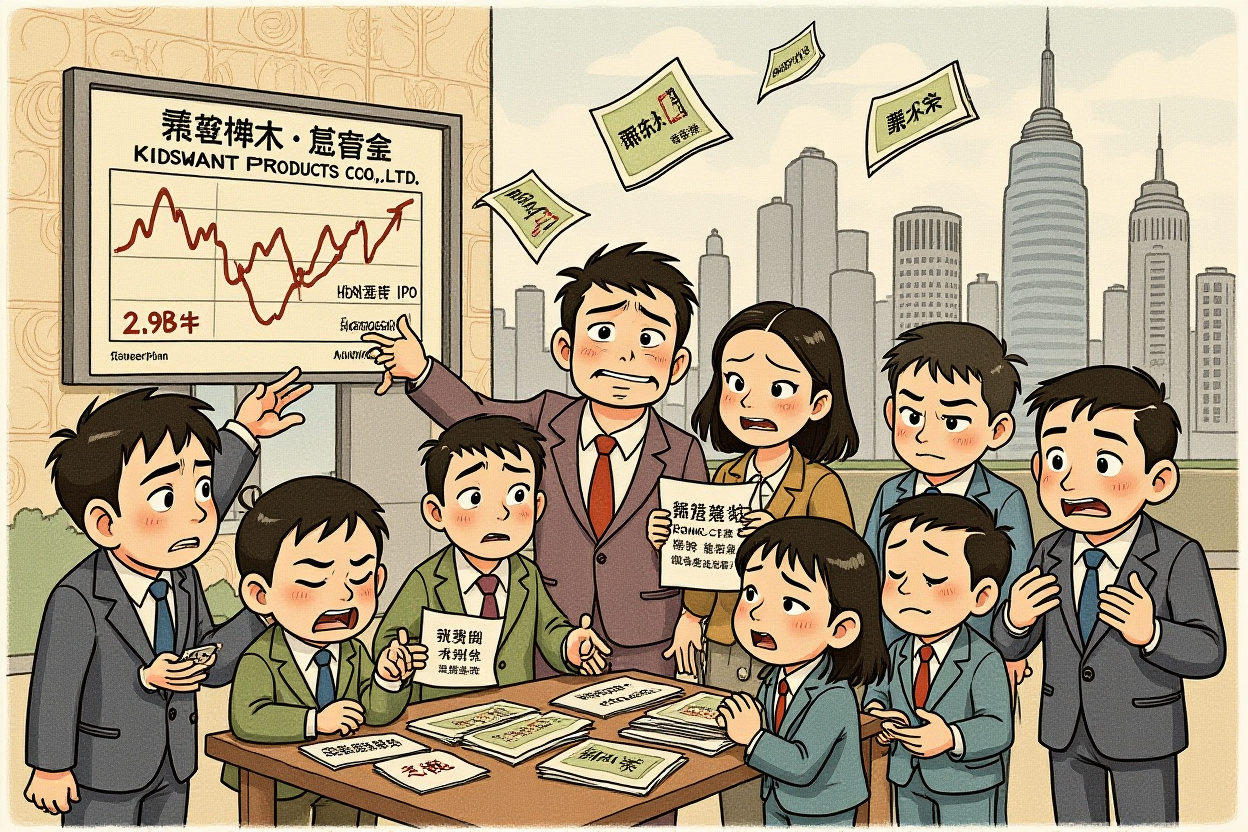
Executive Summary
- Kidswant Children Products Co., Ltd. (孩子王), once China’s leading maternity and child retail chain, is seeking a dual listing in Hong Kong amidst a severe operational and financial crisis.
- The company’s core “big-store membership model” is failing, with plummeting per-store revenue, declining membership fees, and a collapse in customer trust due to poor service and product quality issues.
- To artificially boost profits, Kidswant embarked on two high-premium acquisitions into skincare and scalp care, ballooning its goodwill to 1.9 billion yuan and its long-term debt by over 125%.
- The Hong Kong IPO is seen as a desperate move to “replenish blood” and service its crushing debt burden, rather than a solution to its fundamental business model problems.
- Investors should scrutinize whether this listing can be anything more than a short-term lifeline for a company struggling to find a viable growth path.
A Dual Listing Bid Masking Deep Distress
Kidswant Children Products Co., Ltd. (孩子王), once hailed as the “first share of maternity and child retail,” finds itself at a critical crossroads. After a splashy debut on the Shenzhen ChiNext board in 2021, the company is now sprinting towards a secondary listing on the Hong Kong Stock Exchange. This move, however, is not a tale of triumphant expansion but a desperate scramble for survival. The story of Kidswant is a stark case study in how a beloved retail concept can unravel, leaving behind a trail of broken promises, mounting debt, and a failing membership model that once defined its success. The core question for sophisticated investors is stark: can a Hong Kong listing truly serve as a lifeline for a company whose fundamental business engine is sputtering?
Kidswant built its empire on a unique “big-store model,” operating massive outlets averaging over 2,000 square meters—ten times the size of a typical competitor’s store. These spaces were not just shops; they were destinations, offering a vast array of over 10,000 SKUs, children’s play areas, parenting classes, and even nanny referral services. This one-stop-shop experience fueled rapid growth and a loyal member base, propelling its Gross Merchandise Value (GMV) to 13.8 billion yuan in 2024, ranking first in the new consumption market for parent-child families. Yet, beneath this surface success, severe cracks were forming. Its A-share journey has been disastrous, with net profit halving from 202 million yuan in 2021 to 105 million yuan in 2023, and its market capitalization plunging from a peak of 29.2 billion yuan to around 14 billion yuan. This Hong Kong listing attempt is, by all accounts, a pressured move to raise capital and address the very crises that caused its mainland market value to collapse. The prospects for Kidswant’s Hong Kong listing serving as a sustainable turnaround are exceedingly dim without a fundamental operational overhaul.
The Illusion of Growth and the Reality of Debt
A closer look at the recent financials reveals a troubling picture. To counter the profit decline in its core business, Kidswant embarked on an aggressive acquisition spree. In December 2024, it acquired a 60% stake in cosmetics firm Xingyan Biological (幸研生物) for 162 million yuan. Just six months later, in June 2025, it paid a staggering 1.65 billion yuan for a 65% stake in Siyu Hair Care (丝域), a leading scalp care chain. These moves were billed as creating a “second growth curve” targeting mothers’ personal care needs.
The immediate financial impact has been a sharp, acquisition-driven rebound in reported net profit to 181 million yuan in 2024 and 209 million yuan for the first nine months of 2025. However, this came at a tremendous cost. The Siyu acquisition alone carried a goodwill premium of 583.35%. Consequently, Kidswant’s goodwill assets have ballooned to 1.9 billion yuan—a severe risk if the acquired businesses underperform. More critically, the spending binge was funded by debt. As of Q3 2025, its long-term borrowings surged by 125.35% to 2.044 billion yuan. Combined with short-term borrowings and current portions of long-term debt totaling nearly 1.1 billion yuan, the company faces total debt pressures far exceeding its cash reserves of just 1.262 billion yuan. This precarious debt position is the primary driver behind the urgent Hong Kong IPO, a move market observers bluntly describe as an attempt to “replenish blood.” The question of whether Kidswant’s Hong Kong listing can be a viable long-term solution is overshadowed by its immediate need to service this debt mountain.
The Great Unraveling: A Membership Model in Crisis
At the heart of Kidswant’s troubles is the systemic failure of the membership model that was once its crown jewel. The company’s entire value proposition was predicated on locking in parents with a premium, service-heavy experience that justified annual membership fees and fostered extreme loyalty. This model is now in freefall, and its breakdown explains why the core business cannot generate the cash needed to sustain the company. Understanding this collapse is key to evaluating any future prognosis, including the potential outcome of a Hong Kong listing.
Plummeting Metrics and Eroding Trust
The data paints a clear picture of decline. The average revenue per directly-operated store has been nearly halved over seven years, falling from 24.15 million yuan per year in 2018 to 12.48 million yuan in 2024. Store efficiency, measured by sales per square meter (坪效), has declined for three consecutive years. The most telling metric, however, lies in its membership economics. While Kidswant boasts a cumulative 97 million registered members, only about 9.75 million (10%) are active. More damning is the collapse in prepaid membership fees, a direct indicator of customer loyalty and perceived value. Contract liabilities related to premium membership annual cards have dwindled from 130 million yuan in 2022 to just 46.33 million yuan by Q3 2025.
This “de-membering” is driven by a toxic mix of operational failures. Customers report chaotic in-store experiences with overly aggressive sales staff from various branded counters swarming them. A foundational convenience—the one-stop shop—has been undermined by a cumbersome checkout process that强制 requires the use of Kidswant’s app, frustrating customers who prefer simpler methods like providing a phone number. The premium “Black Gold” membership, priced at 199 yuan, is now frequently discounted and criticized for its complex rules and limited benefits. Promised cash rebates are often restricted to purchases on the platform or higher-priced self-operated products, creating a gap between marketing promise and reality. As one industry expert notes, the model’s reliance on being a channel for third-party brands, rather than building strong private labels, leaves it vulnerable. In Q3 2025, Kidswant’s own and exclusive brand GMV was only 14.4% of the total, compared to over 30% for a key competitor like Aiyingshi (爱婴室). This lack of differentiation forces it to compete on price, particularly in low-margin, essential categories like奶粉 (milk powder), which comprised over 55% of its revenue in H1 2025. This structural weakness makes the success of a Hong Kong listing for Kidswant highly dependent on fixing its core value proposition first.
The Downward Push: Grappling with a Saturated and Risky Market
Facing stagnation in its core high-tier city markets, Kidswant has identified expansion into lower-tier cities (下沉市场) as a strategic imperative. The logic is sound on paper: birth rates are relatively higher, and the market is growing faster. Consultancy Frost & Sullivan projects the maternity and child specialty store market in third-tier and below cities to grow from 140.5 billion yuan in 2025 to 174.3 billion yuan in 2029. However, this so-called blue ocean is already a fiercely competitive red ocean, presenting new and possibly insurmountable challenges for Kidswant’s strained business model.
Fierce Competition and Internal Weaknesses Collide
The lower-tier market is a fragmented landscape dominated by approximately 290,000 small and medium-sized maternity and child stores. To penetrate it, Kidswant launched a franchise strategy in 2024, aiming for a lighter, faster expansion model. Yet, it is a latecomer facing entrenched players like Haipaike (海拍客), which already controls 10.1% of the下沉 market share by providing supply chain services to small stores.
Kidswant’s更大的隐忧 (greater hidden worry), however, may come from within. Its historical weakness in quality control poses a monumental risk in a franchise model, where oversight is more challenging. The company has a long record of regulatory penalties for selling substandard goods, including children’s clothing and strollers. As recently as July 2025, its children’s apparel failed safety checks in Shandong for issues like pH value and fastness. The Black Cat Complaint platform hosts over 1,126 complaints against Kidswant, with product quality being a major focus. For a brand dealing in children’s products, these are not minor issues; they are existential threats to trust.
Furthermore, Kidswant’s premium positioning may cause “水土不服” (inability to acclimatize) in price-sensitive下沉 markets. Cheng Weixiong (程伟雄), a fashion industry independent analyst and founder of Shanghai Liangqi Brand Management Co., Ltd., suggests a dual-brand strategy might be necessary. “A feasible strategic suggestion is: while坚守 (holding fast to) the ‘Kidswant’ master brand in first- and second-tier cities, incubate a new brand with a more fitting positioning and more flexible operations for the下沉 market,” he stated. This expansion, therefore, acts as a full-scale stress test on Kidswant’s供应链 (supply chain),品控 (quality control), and brand operational capabilities—areas where it has already demonstrated significant vulnerability. The viability of Kidswant’s Hong Kong listing is thus intertwined with its ability to succeed in this perilous new frontier.
Weighing the IPO: Lifeline or False Hope?
The impending Hong Kong listing of Kidswant presents a complex puzzle for global investors. On one hand, it offers a potential cash infusion that could stave off a liquidity crisis, allowing the company to pay down some debt and buy time. The dual-listing status might also improve its profile among international institutional investors. However, a sober analysis suggests these are short-term tactical gains that do little to address the company’s profound strategic ailments. The capital raised will likely be consumed by balance sheet repair rather than funding transformative growth.
The fundamental issues remain unaddressed: a broken membership model, declining store productivity, weak private label development, and the immense execution risks of its下沉 market and acquisition strategies. The 19 billion yuan in goodwill sits on its books like a sword of Damocles, threatening future earnings with massive impairment charges. The company is effectively trying to outrun its operational meltdown with financial engineering and new narratives. For investors, the critical question is not whether Kidswant will list in Hong Kong, but what happens after the champagne cork pops. Will the funds enable a genuine turnaround, or will they simply delay an inevitable reckoning?
A Call for Prudent Scrutiny
For fund managers and institutional investors evaluating this offering, due diligence must extend far beyond the prospectus. Key areas for deep scrutiny include:
- Post-IPO Capital Allocation: Exactly how much of the proceeds will be used to repay the surging并购贷 (acquisition loans) and other debt versus investment in core business revitalization?
- Same-Store Sales Growth: Can management articulate a credible, detailed plan to reverse the multi-year decline in per-store revenue and membership value, beyond just opening new franchise locations?
- Integration and Synergy Realization: What are the tangible, quantifiable synergies between the core母婴 (maternity and child) business and the newly acquired skincare/scalp care segments? Where is the evidence that cross-selling to “宝妈们” (mothers) will work at scale?
- Quality Control Overhaul: What specific, measurable steps is the company taking to overhaul its supply chain and quality assurance systems, especially for the franchise network?
Until Kidswant demonstrates a clear and executable path to fixing its core business, the Hong Kong listing represents a high-risk proposition. The narrative of a “second curve” is compelling, but it is built on a foundation of debt and a crumbling first curve. Investors should approach with extreme caution, recognizing that for a company in this position, a successful listing is the beginning of a much harder journey, not the end of its troubles. The burden of proof lies entirely with Kidswant to show that this is more than just a short-term港股续命 (Hong Kong life-extension) play.