



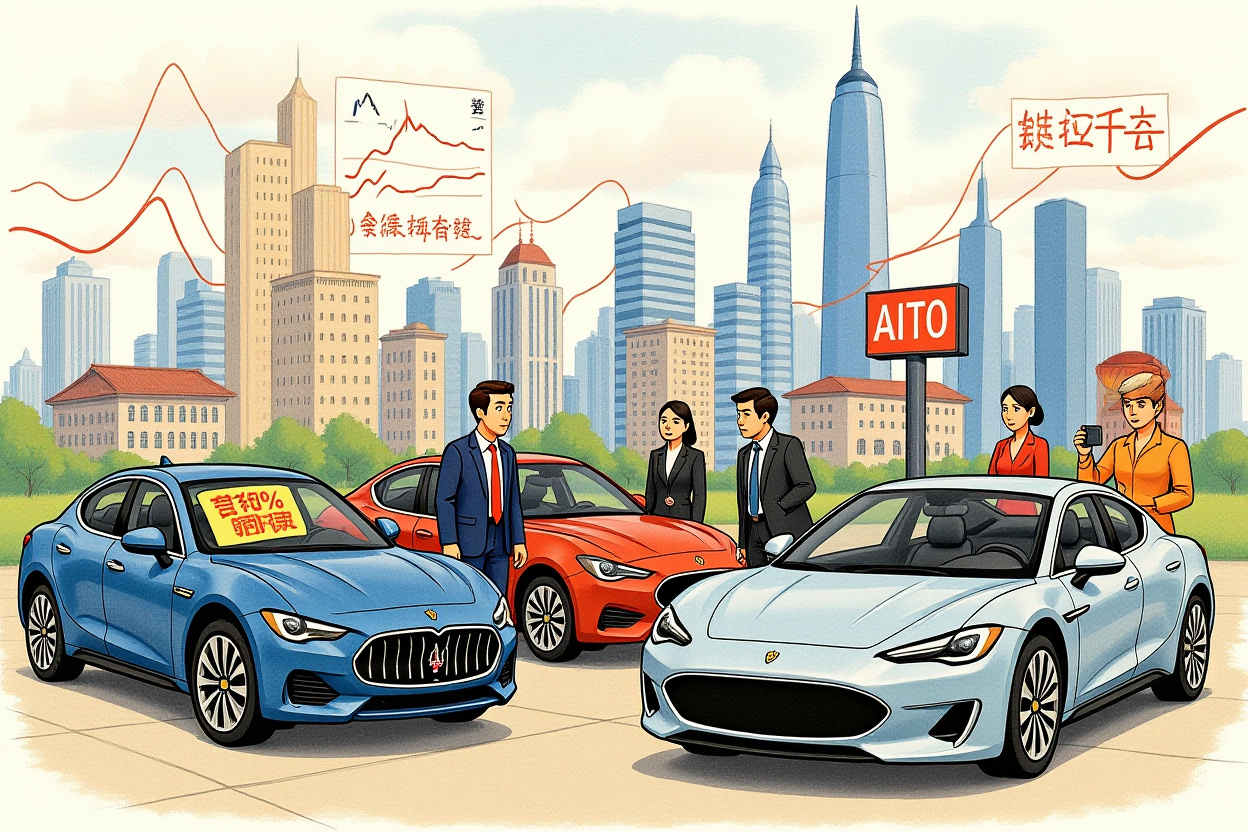
The Chinese luxury car market is undergoing a seismic transformation. Once-dominant imported luxury cars are now facing unprecedented price collapses, with models like the Maserati Grecale electric SUV reportedly available for under 360,000 yuan (approximately $50,000) and Aston Martin DBX V8 offered at a 65% discount. This dramatic shift is not merely a seasonal sale but a fundamental recalibration, signaling that imported luxury cars are increasingly struggling to compete against the rapid ascent of sophisticated, high-value Chinese domestic brands. The era where a European badge commanded a massive premium is fading, replaced by a market where technology, user experience, and rational value are king. For global investors and industry executives, understanding this pivot is critical for navigating the future of automotive investments in the world’s largest car market.
Executive Summary: Key Market Takeaways
Before diving into the details, here are the critical insights from the current imported luxury car downturn:
– Imported luxury cars are experiencing severe price erosion, with discounts of 60% or more becoming common for brands like Maserati and Aston Martin, directly challenging their premium positioning.
– The overall imported car market in China has contracted sharply, falling from a peak of 1.43 million units in 2014 to just 400,000 units in the first ten months of 2025, a decline of 30% year-on-year.
– Chinese domestic brands now dominate the high-end segment, capturing over 80% of the 300,000 yuan-plus new energy vehicle market, with brands like AITO and Nio achieving average transaction prices that rival or exceed traditional luxury marques.
– Foreign luxury brands are responding with accelerated localization, including establishing R&D centers in China and integrating local supply chains, but face significant challenges in matching the pace of innovation set by domestic players.
– The trend underscores a broader consumer shift where rationality, advanced digital features, and overall value are outweighing traditional brand prestige, reshaping competitive dynamics for all imported luxury cars.
The Great Price Unraveling: Imported Luxury Cars in a Discount Frenzy
The most visible symptom of the market shift is the staggering price cuts across the imported luxury car segment. What was once unthinkable—owning a Maserati for the price of a premium mid-size sedan—is now a reality in Chinese showrooms.
Maserati’s Market Maneuvers: From Premium to Promotional
A recent social media frenzy highlighted the Maserati Grecale Folgore, a pure-electric SUV with an original manufacturer’s suggested retail price (MSRP) nearing 900,000 yuan. Reports surfaced of it being sold for a bare-bones price of 358,800 yuan, a discount exceeding 60%. While some dealerships clarified that such rock-bottom prices were for clearing specific old inventory, the signal to the market was clear. A salesperson from a Wuhan-based Maserati 4S store confirmed to reporters that even current models are seeing deep cuts. The 2023 Grecale GT, with inventory aged 2-3 years, is being offered at around 388,000 yuan for the vehicle, with a complete out-the-door price of approximately 488,000 yuan. Compared to its official guide price range of 650,800 to 1,038,800 yuan, this represents a monumental devaluation for the imported luxury car brand.
Aston Martin and Beyond: A Sector-Wide Trend
The discounting plague is not confined to Maserati. A visit to dealerships in Shanghai revealed that Aston Martin, another pinnacle of imported luxury cars, is offering equally compelling incentives. The 2024 DBX with a 4.0T V8 engine, with an MSRP of 2.448 million yuan, is now available for a naked car price between 1.6 and 1.7 million yuan. Factoring in options, luxury car tax, and purchase tax, the final price lands around 2 million yuan, effectively a 65% discount on the original sticker. Furthermore, the newly launched Aston Martin Vantage Roadster saw its official price drop by 450,000 yuan just seven months after launch. This pattern extends to other marques: McLaren Artura models are being promoted at 70% of their list price, and even Porsche—long considered a resilient brand—is offering significant discounts. Porsche 718 models are reported at 74% to 79% of MSRP, with the Macan SUV available for a starting price in the 400,000-yuan range. The collective price softening indicates a fundamental loss of pricing power for imported luxury cars.
Data Tells the Story: The Structural Decline of China’s Imported Car Market
The dramatic price cuts are a symptom of a deeper, structural issue. The imported car market in China is not just in a cyclical slump; it is in a sustained contraction that has reshaped the automotive landscape over the past decade.
A Decade of Decline: From Peak to Trough
Brand-Specific Struggles: When Icons FalterThe data paints a bleak picture for specific imported luxury car brands. Maserati’s journey is emblematic. In 2017, it achieved sales of 14,400 units in China, making it the brand’s largest single global market. By 2024, its sales had plummeted to just 1,228 vehicles, a decline of over 70%, less than a tenth of its peak. From January to October 2025, Maserati’s import sales were 1,081 units, with only 58 units sold in October alone. The brand’s retail network has shrunk, with management undergoing multiple changes in a futile attempt to reverse the trend. Other ultra-luxury names are not immune. Bentley’s import sales in the first ten months of 2025 fell 21% year-on-year to 1,689 units. Ferrari was down 19% to 599 units, Lamborghini down 21% to 375 units, and Porsche saw a 26% decline in deliveries in the first three quarters of the year. This widespread downturn confirms that the challenges facing imported luxury cars are systemic.
The Rise of the Dragon: How Chinese Domestic Brands Are Reshaping Luxury
The primary force driving the decline of imported luxury cars is the formidable and rapid ascent of Chinese automotive brands. No longer content with the economy segment, domestic players have successfully moved up the value chain, offering products that directly compete with—and often surpass—traditional imported luxury cars in key areas valued by modern consumers.
Domestic Dominance in the High-End Segment
Consumer Shift: Rational Value Over Legacy PrestigeForeign Brands Fight Back: Localization and Learning from ChinaStrategic Adjustments and Production MovesEmbracing Chinese Supply Chains and InnovationSynthesis and Forward Outlook: Navigating the New Luxury LandscapeThe evidence is overwhelming: the market dynamics for imported luxury cars in China have irrevocably changed. The confluence of deep discounts, a shrinking import market, and the formidable rise of Chinese domestic brands points to a permanent shift in consumer preferences and competitive benchmarks. The traditional model of relying on brand heritage and imported status is no longer a viable strategy. For international investors and corporate strategists, this environment demands a nuanced understanding. The growth narrative in Chinese automotive is increasingly centered on domestic champions and those foreign players that can successfully localize not just production, but their entire innovation and value proposition. The future of the luxury car segment will be defined by agility, software integration, and deep consumer insight—areas where Chinese companies currently set the pace. Monitoring the adaptation strategies of brands like Porsche and BMW, while tracking the continued innovation from AITO, Nio, and others, will be key to identifying winners in this transformed market. Stakeholders must look beyond the immediate price wars and focus on which companies are fundamentally re-engineering themselves for the intelligent electric era. The call to action is clear: closely analyze the evolving partnerships, supply chain integrations, and product launches to make informed decisions in a market where the rules are being rewritten by Chinese ingenuity.