



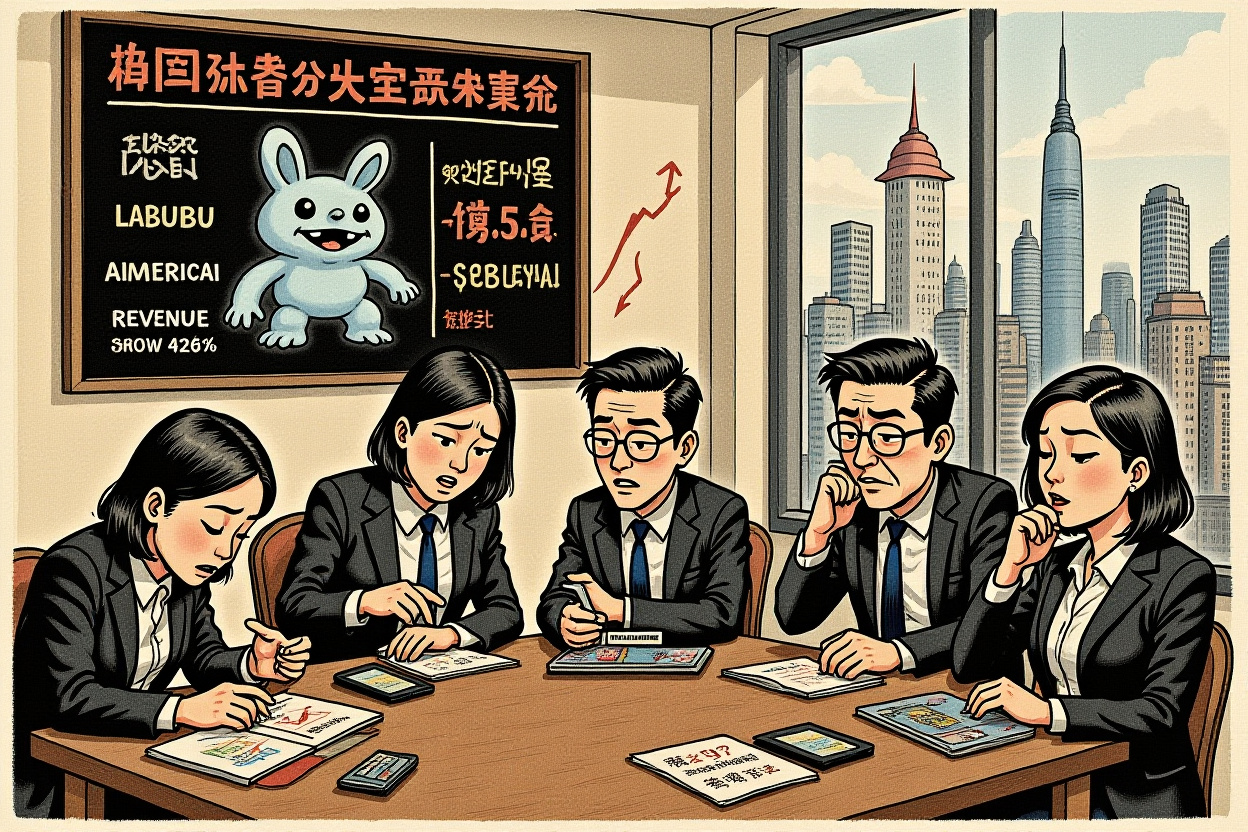
– Pop Mart’s shares have plunged approximately 40% amid cooling demand for its flagship IP Labubu, erasing around $24 billion in market value since August highs.
– North American revenue growth slowed sharply to 424% in Q4 2023 from higher rates, signaling deceleration in a key market and sparking investor anxiety.
– Market comparisons to the 1990s Beanie Babies crash have intensified, with secondary market price drops and surging short positions against Pop Mart stock.
– The company plans to double its U.S. retail presence to 120 stores and 200 vending machines by 2024, but sustainability concerns persist over high growth baselines.
– Experts warn that Pop Mart’s valuation now hinges on Labubu’s longevity as an IP, challenging its aspiration to become a Chinese Disney or Sanrio.
The Rapid Ascent and Sudden Descent of Labubu
The story of Labubu is a quintessential tale of modern pop culture euphoria meeting financial reality. This spiky-toothed monster character, created by Pop Mart (泡泡玛特), surged from obscurity to become the engine behind a 3200% stock rally from 2022 lows, captivating collectors worldwide. However, the very speed of this rise has now precipitated a dramatic fall, with shares tumbling about 40% in recent weeks and ranking among the worst performers in the Hong Kong market. The central question haunting investors is whether Labubu represents a durable intellectual property or a fleeting trend, with the specter of a Labubu bubble burst looming large.
From Market Darling to Pariah: A Timeline of Volatility
Pop Mart’s journey on the Hong Kong Stock Exchange (香港交易所) has been a rollercoaster. After its 2020 IPO, the company benefited from a global collectibles boom, with Labubu driving merchandise sales and secondary market premiums. However, by August 2023, the stock peaked, only to shed roughly $24 billion (approximately RMB 174 billion) in market capitalization by December—a sum equivalent to triple the total market value of Sanrio (三丽鸥), the Japanese Hello Kitty giant. The decline accelerated after Bloomberg reported disappointing Black Friday sales in the U.S., triggering a two-day sell-off that wiped nearly 14% off the stock. This volatility underscores the fragility of growth dependent on viral IPs, where investor sentiment can shift overnight.
North American Growth Halts: Decoding the Slowdown
The United States had been hailed as Pop Mart’s next frontier, but recent data paints a concerning picture. According to analytics firm YipitData, based in New York, Pop Mart’s revenue growth in North America slowed to 424% for the quarter ending December 6, 2023. While still impressive, this marks a more than halving from the previous quarter’s growth rates, indicating a rapid deceleration. This slowdown is critical because North America represents a key growth pillar for Pop Mart’s international expansion strategy, and any stumble here amplifies fears of a broader Labubu bubble burst.
Behind the Numbers: Holiday Sales and Consumer Fatigue
Historical Echoes: The Beanie Babies ParallelSecondary Market Signals and Investor PsychologyInvestor Sentiment and Structural ChallengesThe dramatic repricing of Pop Mart shares reflects deeper anxieties about the sustainability of its growth narrative. With the stock down nearly 3% in early Thursday trading and among the worst performers in the Hang Seng China Enterprises Index (恒生中国企业指数), confidence is eroding. The company faces the classic problem of high comparables: after explosive growth, maintaining momentum becomes exponentially harder. This scenario raises the risk of a Labubu bubble burst, where declining hype triggers a negative feedback loop of reduced sales, inventory backlogs, and margin pressure.
Short Positions and Valuation Concerns
The surge in short selling highlights professional investors’ skepticism. Short sellers borrow shares to sell, betting on price declines, and their activity has soared as growth doubts mount. Richard Lin (林理查), chief consumer analyst at浦银国际 (Pu Bank International), provided insight: ‘The market is very focused on Pop Mart’s short-term performance. The big question is, if it can’t maintain very high year-on-year growth through year-end, then with the base so high, can it still grow next year?’ This query underscores the mathematical challenge Pop Mart confronts. Valuation metrics, once sky-high on future growth projections, are now being recalibrated, with price-to-earnings ratios compressing as analysts downgrade forecasts.
Pop Mart’s Strategic Response and Industry Implications
In response to the turmoil, Pop Mart is pushing forward with aggressive retail expansion, particularly overseas. The plan to double U.S. stores and vending machines by 2024 signals a bet on physical presence to sustain growth. However, this requires significant capital expenditure and comes amid rising operational costs. Moreover, the company must diversify beyond Labubu, investing in other IPs like Molly and Dimoo, to mitigate over-reliance on a single character. The broader implication for Chinese consumer brands is clear: viral success in the digital age can be ephemeral, and building enduring franchises requires more than hype—it demands narrative depth, community engagement, and prudent financial management.
Lessons for the Chinese Consumer Sector
The Path Forward: Navigating UncertaintyAs Pop Mart confronts this crisis, several factors will shape its trajectory. First, holiday season sales data from December and January will be scrutinized for signs of stabilization or further decline. Second, the company’s quarterly earnings reports must transparently address growth metrics and guidance. Third, investor communication will be crucial to rebuild trust; silence or evasion could exacerbate sell-offs. Ultimately, the Labubu phenomenon is a stress test for Pop Mart’s business model, highlighting the perils of dependency on cyclical trends in the fickle world of pop culture collectibles.
The recent turmoil around Pop Mart serves as a stark reminder of the risks inherent in trend-driven investments. While Labubu’s charm captured imaginations, its commercial sustainability is now under a microscope, with parallels to historical bubbles serving as a sobering backdrop. For investors, the key is to differentiate between short-term noise and long-term value, focusing on Pop Mart’s IP diversification, international execution, and financial health. As the market digests these developments, staying informed through reliable sources like the Hong Kong Exchange filings and analyst reports is essential. Consider this episode a case study in the volatile intersection of pop culture and finance—a reminder to balance optimism with due diligence in the dynamic Chinese equity landscape.