



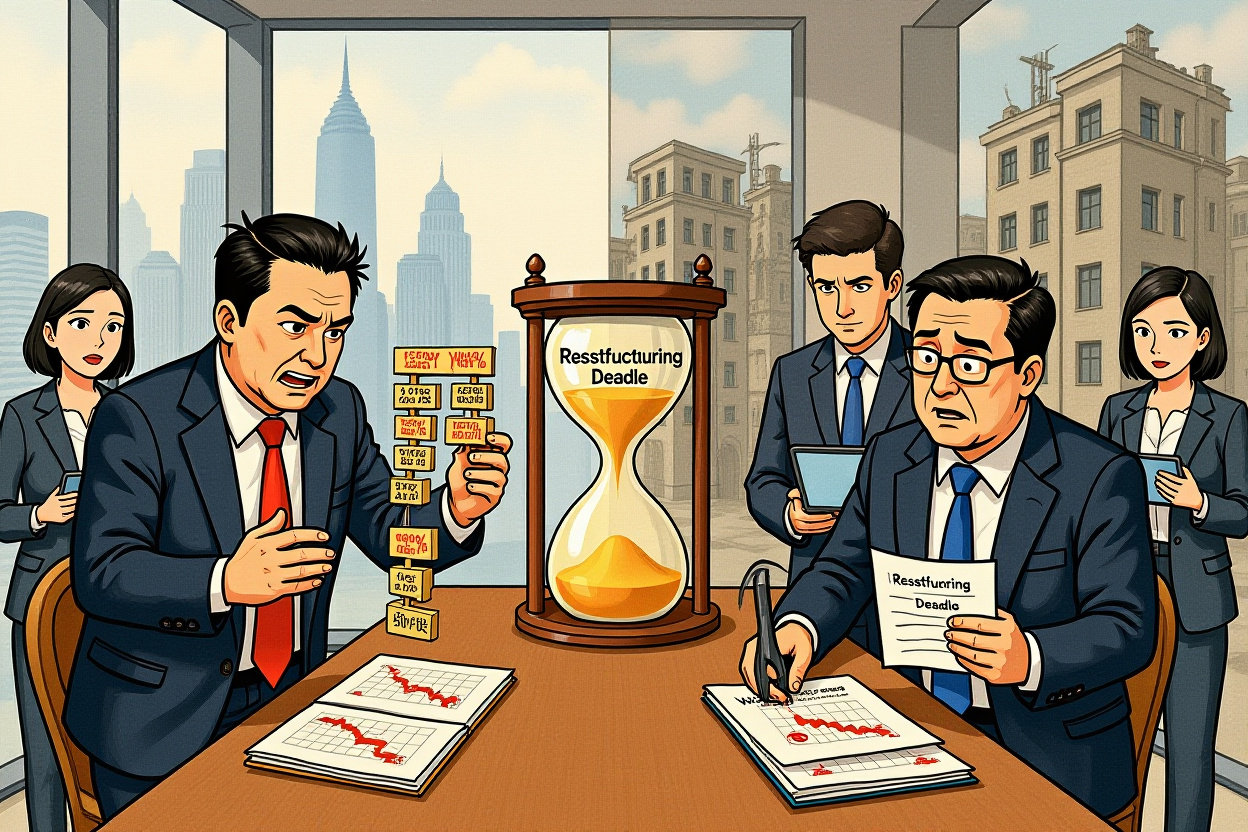
– The escalating infighting between major shareholder Ping An and founder Wang Wenxue (王文学) threatens to derail China Fortune Land Development’s (华夏幸福) critical debt restructuring process.
– Founder Wang Wenxue’s (王文学) entire shareholding is now pledged, creating a severe risk of control loss if the stock price falls further, potentially leading to management ouster and delisting.
– The conflict emerges just as industry experts like Li Bei (李蓓) of Banxia Investment and Meng Xiaosu (孟晓苏) signal a potential bottoming and recovery for China’s real estate sector.
– The company’s fate serves as a critical case study on corporate governance and stakeholder alignment during systemic industry crises, with lessons for investors and regulators alike.
A House Divided: Can China Fortune Land Development Survive Its Own Crisis?
In the intricate tapestry of China’s equity markets, few stories encapsulate the volatility and high-stakes drama of the property sector’s downturn like that of China Fortune Land Development (华夏幸福). Once a high-flying pioneer with a market capitalization exceeding 120 billion yuan, the company now teeters on the brink, its survival jeopardized not just by market forces but by a severe and very public rift between its management and largest shareholder. This major shareholder and management infighting represents a profound threat, raising the specter that the company could collapse just as the long-awaited dawn for Chinese real estate begins to break. For global investors monitoring Chinese equities, the unfolding saga offers crucial insights into restructuring risks, governance failures, and the fragile path to recovery in one of the world’s most consequential markets.
The Ascent and Unraveling of a Property Pioneer
Founded by entrepreneur Wang Wenxue (王文学), China Fortune Land Development carved a unique niche in China’s crowded property landscape. Its signature model involved acting as a comprehensive service provider for industrial new cities, partnering with local governments to develop large-scale integrated zones. This innovative approach fueled rapid growth and made it a darling of investors for years.
The Debt Crisis and Initial Restructuring Framework
The company’s fortunes reversed dramatically in February 2021 when it announced its first formal debt default, revealing overdue principal and interest totaling 52.55 billion yuan. Wang Wenxue (王文学) publicly acknowledged the severe liquidity crisis, appealing for support. By September 2021, the company unveiled a comprehensive debt restructuring plan aimed at addressing over 219 billion yuan in financial obligations through asset sales, extensions, debt-for-equity swaps, and other measures. Significant progress was reported, with nearly 1.39 trillion yuan of debt restructured by end-2022, and a landmark $4.96 billion offshore debt restructuring—the largest of its kind for a Chinese developer—completed in early 2023.
The Role of Ping An in Early Rescue Efforts
During this initial phase, major shareholder Ping An Insurance Group (中国平安), through its asset management arm, played a reportedly constructive role. Ping An Asset Management pledged not to withdraw loans and to support extensions, later signing a restructuring agreement for approximately 30 billion yuan in debt, setting a positive example for other creditors. This cooperation was widely seen as essential to early restructuring progress.
The Fracture: Ping An’s Escalating Opposition to Pre-restructuring
The cooperative facade shattered in 2024. The catalyst was a proposed “substitution belt” asset transfer scheme, where China Fortune Land Development aimed to sell two subsidiaries with substantial assets and receivables to a local state-owned asset manager for a nominal sum, aiming to offload related bank debt. Ping An’s representative on the board, Wang Wei (王葳), voted against related asset impairment items in the 2025 interim report, citing imprudence.
Public Declaration of War and Governance Accusations
The conflict entered the public domain in November 2025. After the Intermediate People’s Court of Langfang accepted a creditor’s application for the company’s pre-restructuring—a move designed to accelerate the process—Ping An’s director Wang Wei (王葳) published a statement declaring she was completely unaware of the announcement. She accused management of bypassing board procedures, violating corporate governance rules, and undermining the major shareholder and management infighting. This public rebuke marked a point of no return in the dispute.
The Multi-Pronged Counterattack: Investigation, Sell-Off, and Litigation
Ping An did not stop at a statement. It launched a concerted offensive:
– Investigation: The creditor committee, chaired by Ping An Asset Management, voted to hire a top-tier accounting firm to conduct a special financial due diligence on China Fortune Land Development.
– Shareholding Reduction: Ping An Life Insurance and its affiliates sold 7.815 million shares in late October 2025, reducing their stake from 25.19% to 24.99%. While small, the move sent a clear warning signal to the market.
– Legal Action: Soon after, Ping An Life Insurance and Ping An Asset Management filed a lawsuit in the Shanghai Financial Court against the company’s largest single shareholder, China Fortune Holding, and founder Wang Wenxue (王文学), concerning an arbitration agreement validity dispute.
Financial Fallout and the Looming Control Crisis
The market reacted swiftly and negatively to the visible discord. Following Ping An’s public opposition, China Fortune Land Development’s stock price entered a steep decline, falling over 36% from a November high to around 2.32 yuan by mid-December. The company’s market capitalization, once above 120 billion yuan, now sits below 10 billion yuan, representing a loss of over 90% from its peak.
The Precarious State of Wang Wenxue’s Pledged Shares
In mid-December, the company disclosed that founder and controlling shareholder Wang Wenxue (王文学) had pledged his entire remaining 18.59 million shares, representing 0.48% of total equity. Together with his concert parties, a total of 484 million shares are now pledged, constituting over 82% of their combined holding. The disclosure further noted that China Fortune Holding, the core shareholder vehicle, is technically insolvent with negative net assets. This creates an extremely dangerous scenario: a further drop in the stock price could trigger margin calls on these pledged shares. If Wang Wenxue (王文学) cannot meet these calls, he could lose control of the company, leading to a complete ouster of the founding management team.
The Specter of Delisting and a Zero-Sum Game
Analysts fear that if the pre-restructuring fails due to this major shareholder and management infighting, the company’s only path could be bankruptcy liquidation and delisting. Historical precedents show that delisting processes are typically accompanied by catastrophic share price declines, which would almost certainly force the liquidation of pledged shares. The outcome would be a lose-lose situation: shareholders face total loss, creditors recover minimal value, employees lose jobs, and the company ceases to exist as a listed entity. Even if the broader property sector recovers, a delisted China Fortune Land Development with a decimated management team would be incapable of seizing new opportunities.
The Broader Context: Signs of Life in China’s Property Sector
Ironically, the internal crisis at China Fortune Land Development intensifies just as cautious optimism begins to emerge for the Chinese real estate market. Several prominent voices have recently pointed to potential green shoots.
Expert Commentary on Market Bottoming and Recovery
At the 2025 Analyst Conference, renowned fund manager Li Bei (李蓓) of Banxia Investment presented a thesis titled “From Small Fortunes to a Big Bull Market.” She noted that leading developers can now achieve most sales within six months of land acquisition, with new project net profit margins exceeding 10%. Meanwhile, veteran property sector figures like former national housing reform team leader Meng Xiaosu (孟晓苏) and Tongce Group Chairman Sun Yigong (孙益功) have publicly suggested the market is finding a bottom, with a return to normalcy possible in the coming years.
Successful Restructurings of Industry Peers
Adding to the contrasting narrative, peers who were once in similar distress have made significant strides. Country Garden (碧桂园) has reportedly essentially finalized its debt restructuring, reducing liabilities by over 90 billion yuan. Sunac China (融创) has gained court approval for its approximately $9.6 billion offshore debt restructuring plan, becoming the first major developer to virtually clear its offshore debt. These successes highlight that restructuring is achievable with stakeholder alignment, making the infighting at China Fortune Land Development all the more stark.
The Path Forward: Cooperation or Catastrophic Collapse?
The situation presents a clear dichotomy. The current trajectory of conflict risks destroying value for all involved. Ping An, as the largest shareholder with a massive financial exposure, and Wang Wenxue’s (王文学) management team, with its deep operational expertise, are locked in a battle that could sink the entire ship.
The Imperative for Stakeholder Alignment
Market observers increasingly argue that a negotiated settlement is the only viable path. The phrase “合则两利,斗则两伤” (cooperation benefits both, conflict harms both) is repeatedly cited. A collaborative approach could leverage Ping An’s financial resources and influence with creditors alongside the existing management’s understanding of the company’s complex assets and business model. This major shareholder and management infighting must be resolved to unlock the value that still exists within the company’s portfolio, especially its unique industrial park assets.
A Call for Constructive Dialogue and Compromise
The resolution likely requires compromise from both sides: management must improve transparency and governance to regain shareholder trust, while Ping An may need to support a restructuring plan that offers a realistic, albeit longer-term, recovery path rather than insisting on immediate, unrealizable valuations. The alternative—a protracted legal battle leading to liquidation—serves no one’s interests and would be a cautionary tale for the entire market.
The fate of China Fortune Land Development is no longer just a story about property market cycles; it is a real-time test of corporate governance under extreme duress. The visible major shareholder and management infighting has exposed critical vulnerabilities that extend beyond balance sheets. For international investors, the case underscores the importance of scrutinizing shareholder dynamics and governance structures alongside financial metrics when assessing Chinese equities. As the first glimmers of a real estate dawn appear on the horizon, the key question remains: will the company’s stakeholders find a way to unite and navigate toward the light, or will their conflict ensure it falls in the final darkness before daybreak? The coming weeks will be decisive, and all market participants should monitor developments closely, understanding that the outcome will send powerful signals about the resolvability of China’s lingering corporate debt crises.