



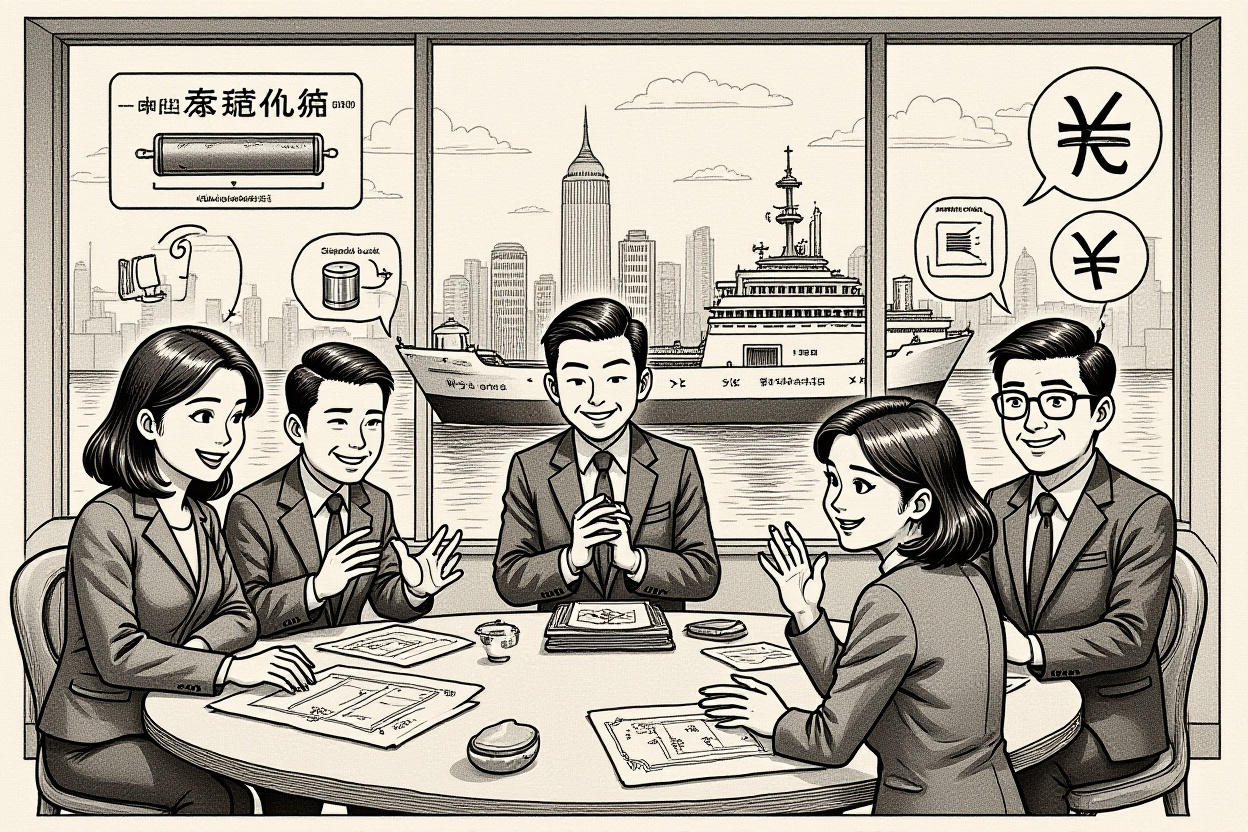
– The global shift towards green shipping is creating a trillion-yuan market opportunity, particularly in China’s inland waterways, with Hubei Province aggressively targeting leadership.
– Policy support, including the ‘Hubei Plan,’ aims for shipbuilding产值 to exceed 1300 billion yuan by 2027, with electric propulsion systems already holding a 62% national market share.
– Wuhan is evolving into a ‘ship and ocean engineering design capital,’ aiming to control high-value segments of the electric vessel revolution through R&D and standard setting.
– Hubei faces challenges from industry fragmentation and competition from other Yangtze River provinces, requiring enhanced regional collaboration to secure its leading position.
– Investors should monitor advancements in battery swapping, hydrogen fuel cells, and autonomous shipping technologies emerging from Hubei’s innovation ecosystem for strategic opportunities.
As China’s new energy vehicle penetration surpasses the historic 50% mark, the quest for the next clean technology frontier has decisively shifted to the water. The electric vessel revolution is gaining momentum, promising to transform inland shipping from a major carbon emitter into a pillar of green logistics. Nowhere is this ambition more palpable than in central China’s Hubei Province, a traditional inland shipping powerhouse that is now staking its claim to lead this transformative industry. With the Yangtze River as its lifeline and a comprehensive policy blueprint in hand, Hubei is not just building ships—it is orchestrating a systemic shift towards sustainable waterborne transport, targeting a market projected to be worth trillions of yuan. This move positions Hubei at the heart of China’s broader ‘dual carbon’ goals and offers significant implications for global investors eyeing the green transition in maritime sectors.
The Trillion-Yuan Electric Ship Market Opportunity
The global maritime industry is under increasing pressure to decarbonize, and China’s inland waterways are at the epicenter of this change. With over 110,000 vessels plying the Yangtze River system, the scale of the required green retrofit is staggering. Experts like Zhao Xia (赵霞), Deputy Director of the Yangtze River Basin Economic Research Institute at the Hubei Provincial Academy of Social Sciences (湖北省社科院长江流域经济研究所), point to a ‘trillion-yuan industrial market’ emerging from this transition. This electric vessel revolution is driven by national policies, including the ‘dual carbon’ goals aiming for carbon peaking by 2030 and neutrality by 2060, which mandate a wholesale shift away from fossil fuels in transportation.
Global and Domestic Trends Driving Adoption
Internationally, the push for electric and alternative-fuel vessels is accelerating, but China’s unique context—a dense network of inland rivers and a national commitment to sustainability—creates a uniquely fertile ground. According to industry forecasts, China’s electric vessel market size is projected to exceed 36 billion yuan by 2026, with global electric ship份额 potentially reaching 15% by 2030. The recent launch of the world’s first 10,000-tonne pure electric bulk carrier, the ‘Gezhouba’号 (葛洲坝号), in Yichang, Hubei, is a testament to this progress. Its battery capacity, equivalent to 500 electric cars, underscores the technological leaps being made, with annual operational savings estimated at 617.5 tons of fuel and over 2000 tons of CO2 reductions. For more data, refer to the Ministry of Transport’s (交通运输部) reports on inland shipping growth.
Hubei’s Strategic Position in This New Arena
Hubei’s geographical advantage is undeniable. It boasts the longest stretch of the Yangtze River’s main channel of any province, over 1000 kilometers. Coupled with a robust industrial base of 53 shipbuilding enterprises and over 300 supporting companies, it has a head start in the electric vessel revolution. Data shows Hubei-made electric vessel core power systems already command a 62% national market share, and the province leads the Yangtze basin with 145 green-powered vessels in operation and 233 under construction, accounting for 33% of the national total. This foundation is supported by early initiatives, such as the 2023 memorandum between the Ministry of Industry and Information Technology (工业和信息化部) and the Hubei Provincial Government to pilot green and smart inland ship development.
Hubei’s Ambition to ‘Steer’ the Yangtze River’s Green Transformation
Hubei’s strategy extends beyond manufacturing; it aims to build an entire ecosystem encompassing R&D, finance, and application—effectively moving from ‘building a ship’ to ‘operating a river.’ The Yangtze River is an economic artery, contributing over 2 trillion yuan indirectly to the regional economy annually, with its ports handling an estimated 30.6 billion tons of cargo in the first three quarters of 2025. The electric vessel revolution here is not just about technology but about reshaping regional logistics and economic corridors.
Infrastructure and Economic Impact
The province’s high-grade waterways stretch over 2,213 kilometers, and it is strengthening its role as the de facto leader of mid-Yangtze shipping. The recent formation of the ‘Yangtze River Middle Reaches Urban Agglomeration Multimodal Transport Enterprise Alliance’ involving Wuhan, Changsha, and Nanchang solidifies Wuhan’s status as a key shipping hub, aiming to link the China-Europe Railway Express hub with the Yangtze River midstream shipping center. This integration enhances Hubei’s leverage in the electric vessel revolution by creating demand for efficient, green transport solutions.
Policy Drivers and Concrete Targets
The ‘Hubei Province Promotion of Inland River Ship Industry Transformation, Upgrade and High-Quality Development Work Plan’ (湖北省推动内河船舶产业转型升级和高质量发展工作方案), or the ‘Hubei Plan,’ sets ambitious targets: shipbuilding产值 exceeding 1300 billion yuan by 2027, with an average annual growth rate of over 15%, and maintaining leadership in electric propulsion system market share. This electric vessel revolution is backed by solid growth, with the industry’s产值 reaching 727.1 billion yuan in the first three quarters of 2025, a 17.3% year-on-year increase. The plan aligns with national directives, such as the ‘Opinions on Promoting High-Quality Development of Inland River Shipping’ (关于推动内河航运高质量发展的意见) issued by the Ministry of Transport, which emphasizes battery, LNG, and methanol power technologies.
Challenges in the Electric Vessel Revolution
Despite its strengths, Hubei’s shipbuilding sector faces significant hurdles that could slow its charge in the electric vessel revolution. Addressing these is critical for maintaining a competitive edge in this rapidly evolving market.
Industry Fragmentation and Supply Chain Dependencies
As Zhao Xia (赵霞) notes, while there are many supporting enterprises, a lack of dominant industry leaders weakens cluster effects. Some critical components still rely on supply from other provinces, impacting local synergy and agile response capabilities. For instance, despite high market share in power systems, other key parts may be sourced from coastal regions, creating vulnerabilities. This fragmentation necessitates stronger integration within Hubei’s industrial chain to sustain growth in the electric vessel revolution.
Intensifying Competition from Other Provinces
Hubei is not alone in recognizing this opportunity. Coastal provinces like Jiangsu, Shanghai, Fujian, and Zhejiang have also rolled out supportive policies with incentives for electric vessel development. Inland rivals along the Yangtze, such as Anhui, Hunan, and Jiangxi, are also vying for a piece of the green shipping pie. Hubei must continuously innovate and scale up to maintain its edge, as highlighted in its plan to focus on ‘green化, 智能化, 标准化, 高端化, and 国际化’—green, smart, standardized, high-end, and international development.
Wuhan: The ‘Brain’ of China’s Ship Design Innovation
At the heart of Hubei’s strategy is Wuhan, which is transitioning from a traditional manufacturing base to a ‘Ship and Ocean Engineering Design Capital.’ This shift is crucial for capturing higher value in the electric vessel revolution, moving from low-margin assembly to high-profit design and intellectual property.
Unmatched Research and Development Capabilities
Wuhan is home to an impressive innovation matrix: seven academicians in the shipbuilding field, 12 master ship designers, seven research institutes under the China State Shipbuilding Corporation (中国船舶集团有限公司), and top universities like Huazhong University of Science and Technology (华中科技大学) and Wuhan University of Technology (武汉理工大学). This concentration of talent drives innovation, with over 80% of China’s green and intelligent ship R&D design originating in Wuhan. Institutions like the Hanjiang National Laboratory and Donghu Laboratory provide cutting-edge research support, forming a closed loop from basic research to engineering validation in the electric vessel revolution.
From ‘Made to Print’ to Leading Design and Standards
By focusing on concept design, key technology development, and standard setting, Wuhan aims to move up the value chain. Controlling these high-margin, high-barrier segments will grant Hubei greater market influence and pricing power in the global electric vessel revolution. For example, breakthroughs in electric, methanol, hydrogen, and ammonia power technologies, as well as autonomous navigation systems, can set industry benchmarks. The goal is for ‘Hubei standards’ to become national and international norms, as outlined in the ‘Hubei Plan’ for developing standardized ship types.
Building a Collaborative Industrial ‘Fleet’ Across Hubei
Success in the electric vessel revolution requires more than a strong ‘brain’; it needs a coordinated ‘body.’ The ‘Hubei Plan’ emphasizes the ‘integration of five chains’: industry, innovation, talent, capital, and service, to create a synergistic ecosystem across the province.
Regional Specialization and Synergy
The plan outlines a clear division of labor: Wuhan as the R&D and design core; Yichang (宜昌) as a green intelligent ship industry demonstration zone; Jingzhou (荆州) as a ship and marine engineering equipment industry agglomeration area; and Huanggang (黄冈) as a pioneer in inland shipbuilding transformation. This setup allows for efficient technology transfer and scaled production. For instance, new energy动力 systems designed in Wuhan can be first trialed on demonstration vessels in Yichang, then rolled out for mass production in Jingzhou and Huanggang once proven, fostering a rapid iteration cycle in the electric vessel revolution.
The Path to a National Industrial Cluster
As Zhao Xia (赵霞) explains, this collaborative model is essential for Hubei to achieve its goal of building a national-level industrial cluster for ships and marine engineering equipment. By forming a ‘fleet’ of cities with complementary strengths, Hubei can enhance its造船 capacity, currently at 5.31 million deadweight tons—the highest among inland provinces—and drive the electric vessel revolution forward. This approach also mitigates risks from external competition by creating a resilient, integrated supply chain within the province.
The Road Ahead: From ‘Made in Hubei’ to ‘Led by Hubei’
The final phase of Hubei’s strategy involves going global, transforming its role from a manufacturer to a leader in the electric vessel revolution. The ‘Hubei Plan’ explicitly encourages ship enterprises to integrate into global supply chains, moving from ‘product export’ to ‘service export,’ including design, consulting, and operational management.
International Expansion and Standard Setting
By advancing in areas like electric, methanol, hydrogen, and ammonia power technologies, as well as autonomous navigation, Hubei aims not only to supply the domestic market but to set international standards. The ambition is for ‘Hubei standards’ to become national and even industry benchmarks worldwide, similar to how Chinese standards have influenced other sectors. This aligns with China’s broader push for technological self-reliance and global influence in green industries, making the electric vessel revolution a key exportable competency.
Implications for Investors and the Global Market
For international investors, fund managers, and corporate executives, Hubei’s push into the electric vessel revolution signals a significant shift in the maritime technology landscape. Key areas to watch include:
– Battery and energy storage solutions for large-scale marine applications.
– Hydrogen fuel cell and alternative fuel infrastructure development.
– Smart shipping and autonomous navigation systems integration.
– Financing models for vessel retrofits and new builds, potentially involving green bonds or public-private partnerships.
Companies involved in these sectors should monitor partnerships and investment opportunities emerging from Hubei, as its progress will be a key indicator of China’s broader capability to decarbonize its industrial transport sectors. The province’s success could also influence global shipping regulations and accelerate the adoption of green technologies worldwide.
Hubei Province has laid out a comprehensive roadmap to not only participate in but to lead the electric vessel revolution on China’s inland waterways. By leveraging its geographical advantage, industrial base, and concentrated innovation power, it is positioning itself at the forefront of a market with trillion-yuan potential. However, realizing this ambition requires overcoming internal fragmentation and external competition through enhanced regional collaboration and global engagement. The journey from a manufacturing hub to a design and standards leader is challenging but critical for long-term dominance. As the ‘Gezhouba’号 sets sail, it symbolizes more than a technological milestone; it represents Hubei’s determined voyage towards a greener, smarter, and more economically powerful future on the Yangtze. For global market participants, closely watching Hubei’s execution of this strategy—particularly its progress in meeting the 2027 targets and fostering international alliances—will provide invaluable insights into the future trajectory of green maritime logistics. Engage with local industry reports, attend investment forums in Wuhan, and consider strategic positions in companies aligned with this transformative shift to capitalize on the electric vessel revolution.