



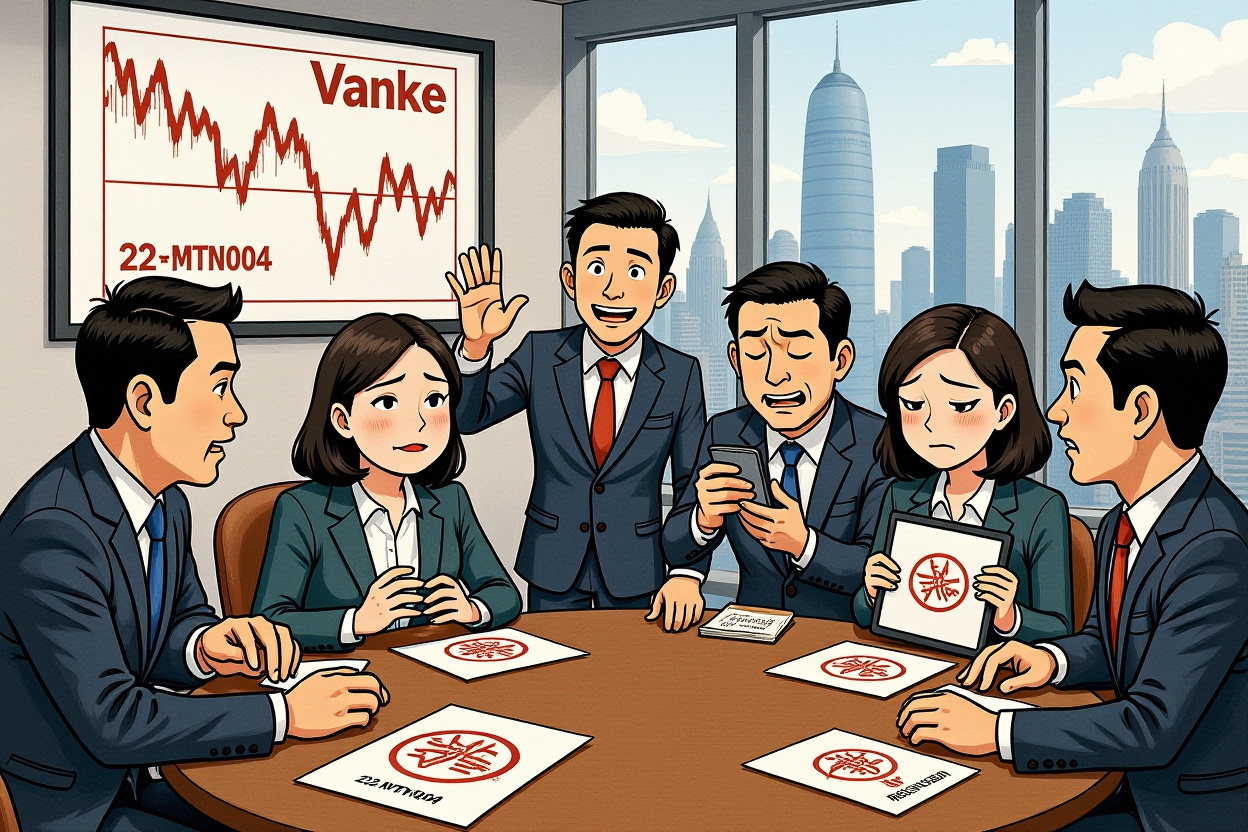
Summary: Key Takeaways from Vanke’s Bond Extension Rejection
– Vanke’s (Vanke) proposal to extend its 2 billion yuan “22万科MTN004” mid-term note failed to achieve the required 90% creditor approval, highlighting severe debt restructuring challenges.
– The rejection triggers a 5-business-day grace period, with Vanke apologizing and scheduling a second holder meeting for December 18, 2025, to seek alternative solutions.
– Creditor divisions, high approval thresholds, and lack of consensus on collateral or payment terms underscore the complexities in China’s corporate bond market amid property sector stress.
– Immediate market reaction was negative, with Vanke’s stocks and bonds falling, reflecting investor anxiety over liquidity risks and broader sector contagion.
– Attention now shifts to another major bond, “22万科MTN005” with 37 billion yuan due in late December, whose extension meeting could further test market confidence.
The Failed Vanke Mid-Term Note Extension: A Critical Juncture
In a stark reminder of the ongoing pressures in China’s property sector, Vanke (Vanke), once considered a bastion of stability, faces a liquidity crunch after creditors overwhelmingly rejected its proposal to extend a 2 billion yuan mid-term note. This Vanke mid-term note extension failure for the “22万科MTN004” bond, which was due on December 15, 2025, signals deepening distress among even the most resilient developers and has sent ripples through global markets. The outcome underscores how China’s corporate debt landscape is fraught with high-stakes negotiations, where creditor dissent can derail restructuring efforts and exacerbate financial vulnerabilities. For international investors, this event serves as a critical case study in assessing credit risk and regulatory responses within Chinese equities.
The “22万科MTN004” Bond at a Glance: Terms and Timing
The bond in question, “22万科MTN004,” is a medium-term note issued by Vanke with a face value of 2 billion yuan (approximately $280 million USD), carrying a coupon rate of 3.00%. Originally slated for maturity and full repayment on December 15, 2025, Vanke sought a 12-month extension to December 2026, citing cash flow constraints amidst a prolonged property downturn. According to the bond’s trustee, Shanghai Pudong Development Bank 上海浦发银行 (Shanghai Pudong Development Bank), the extension was proposed under three distinct plans, each with varying terms for interest payments and collateral. However, none garnered sufficient support, pushing Vanke to invoke a grace period clause—a move that temporarily averts default but heightens uncertainty. This Vanke mid-term note extension debacle reflects broader trends where developers struggle to refinance amid tightening credit conditions and weak sales.
Three Proposals, One Outcome: Understanding the Rejection
The voting process revealed deep fissures among bondholders, with all three extension proposals failing to meet the stringent 90% approval threshold mandated by the bond’s terms. Here’s a breakdown of the proposals and voting results:
– Proposal 1 (Vanke’s Original Plan): This involved deferring both principal and interest payments by 12 months without any additional collateral. It received zero votes in favor, with 16 holders opposing it, representing 76.70% of the total voting rights.
– Proposal 2 (Creditor-Amended Plan): This required upfront payment of accrued interest by December 15, 2025, plus collateral such as guarantees from Shenzhen Metro Group 深铁集团 (Shenzhen Metro Group) or other state-owned enterprises. It gained support from 7 holders (83.40% of votes) but was opposed by 11 holders (16.05%), still below the 90% mark.
– Proposal 3 (Alternative Creditor Plan): Similar to Proposal 2 but with less specific collateral requirements, it secured only 1 holder’s support (18.95% of votes) and faced 16 opposers (76.70%).
The inability to reach consensus, even on creditor-friendly terms, points to fragmented holder bases and divergent risk appetites, complicating this Vanke mid-term note extension effort. Industry experts note that smaller bondholders, who may have acquired debt at discounted prices, often prioritize immediate repayment over long-term restructuring, creating alignment challenges.
Creditor Voting Dynamics: Why the 90% Hurdle Proved Insurmountable
The high approval requirement of 90% for bond modifications is not uncommon in China’s debt markets, but it has become a significant obstacle in the current environment of financial stress. This threshold, embedded in the “22万科MTN004″募集说明书 (prospectus), is designed to protect minority holders but can stall urgent restructurings when consensus is elusive. The Vanke mid-term note extension failure exemplifies how such clauses can amplify creditor holdout risks, especially when holders have conflicting interests—from institutional investors seeking stability to speculative funds aiming for quick gains. Moreover, the lack of standardized frameworks for debt workouts in China contrasts with more established systems in Western markets, where cram-down provisions or collective action clauses might facilitate agreements.
Divergent Interests Among Bondholders: A Recipe for Deadlock
Interviews with market participants reveal that bondholder composition plays a crucial role in these votes. For Vanke’s bond, holders likely include a mix of domestic banks, asset managers, and offshore funds, each with different cost bases and investment horizons. Some may hold only this specific bond, making them less inclined to accept delays, while others with broader exposure to Vanke or the property sector might favor extensions to avoid a default cascade. Additionally, the absence of strong collateral proposals in Vanke’s initial offer weakened creditor confidence, as seen in the preference for Proposals 2 and 3, which demanded guarantees. This fragmentation underscores why the Vanke mid-term note extension faced such steep odds, and it mirrors trends observed in other Chinese developer debt crises, such as those involving China Evergrande Group 中国恒大集团 (China Evergrande Group).
Vanke’s Response and the Grace Period Mechanism: A Temporary Reprieve
Following the vote, Vanke issued a public apology, stating in its announcement: “The company is aware of the voting results and deeply apologizes for the impact caused by the extension-related matters. We will communicate openly with all parties, study improvement measures, and continue to seek solutions for this bond to safeguard the long-term common interests of all stakeholders.” This conciliatory tone aims to maintain creditor relations but also highlights the precarious position of developers navigating debt maturities. Concurrently, Vanke is leveraging a 5-business-day grace period stipulated in the bond terms, which allows it to avoid an immediate default if repayment occurs within this window. During the grace period, interest accrues at an elevated rate of 3.05% (up 5 basis points from the original 3.00%), adding to Vanke’s financial burden but buying time for negotiations.
How the 5-Day Grace Period Works in Practice
The grace period mechanism, common in Chinese bond agreements, provides a brief buffer for issuers to rectify payment delays. For “22万科MTN004,” it runs from December 15 to December 20, 2025 (assuming no holidays), during which Vanke must either repay the bond in full or secure a new agreement with holders. If it fails, a formal default would be declared, potentially triggering cross-default clauses on other debts and leading to ratings downgrades. Vanke has announced it is “preparing to convene a second holder meeting to discuss related arrangements,” scheduled for December 18, 2025, as disclosed by Shanghai Pudong Development Bank 上海浦发银行 (Shanghai Pudong Development Bank). This meeting will be critical for the Vanke mid-term note extension saga, as it offers a last-ditch opportunity to revise terms and garner support, though past precedents suggest success is uncertain.
Market Reaction and Broader Implications for China’s Property Sector
The rejection of Vanke’s bond extension sent shockwaves through financial markets, reflecting heightened investor concern over liquidity risks in China’s property sector. Immediately after the news, Vanke’s shares and bonds tumbled: on the Shenzhen Stock Exchange 深圳证券交易所 (Shenzhen Stock Exchange), Vanke A-shares fell 2.79%, while its Hong Kong-listed entity, Vanke Enterprise 万科企业 (Vanke Enterprise), dropped 3.53%. In the bond market, instruments like “21万科02” plummeted over 20%, triggering a temporary trading halt. This sell-off underscores how even perceived stalwarts like Vanke are not immune to the sector’s woes, which have been exacerbated by sluggish home sales, tightening regulatory scrutiny, and economic headwinds. The Vanke mid-term note extension failure thus serves as a bellwether for other developers facing similar debt walls in 2025 and beyond.
What This Means for International Investors and Fund Managers
For global institutional investors, the event highlights several key risks in Chinese equity and debt markets:
– Credit Differentiation: Not all developers are equal, but Vanke’s struggles suggest that even higher-rated entities face refinancing challenges, necessitating more granular credit analysis.
– Regulatory Environment: China’s authorities, including the People’s Bank of China 中国人民银行 (People’s Bank of China) and the China Securities Regulatory Commission 中国证监会 (China Securities Regulatory Commission), may intervene to prevent systemic contagion, but their approach remains cautious, focusing on market-driven solutions rather than bailouts.
– Portfolio Implications: Exposure to Chinese property bonds requires careful monitoring of extension votes and grace periods, as these can lead to sudden volatility and capital losses.
Experts like Zhang Zhiwei 张智威 (Zhang Zhiwei), chief economist at Pinpoint Asset Management, note that “the Vanke mid-term note extension outcome could set a precedent for how creditors handle developer debt restructurings, potentially leading to more contentious negotiations across the sector.” Investors should review their holdings and consider diversification or hedging strategies to mitigate such event risks.
Looking Ahead: Second Meeting and Other Bonds in the Spotlight
All eyes are now on the second holder meeting for “22万科MTN004” scheduled for December 18, 2025, where Vanke and its creditors will reconvene to discuss revised terms. Given the previous deadlock, success may hinge on offering enhanced collateral, such as guarantees from state-backed entities like Shenzhen Metro Group 深铁集团 (Shenzhen Metro Group), which is a major shareholder in Vanke. Additionally, Vanke faces another imminent test with its “22万科MTN005” bond, a 37 billion yuan note due on December 28, 2025, whose extension meeting is set for December 22, 2025. The outcome of these meetings will be pivotal in determining whether Vanke can avoid a default spiral and restore market confidence. This Vanke mid-term note extension process, if unresolved, could pressure regulators to step in with liquidity support or policy easing, though such measures have been limited so far.
The Upcoming December 18th Holder Meeting: What to Expect
The second meeting, convened by Shanghai Pudong Development Bank 上海浦发银行 (Shanghai Pudong Development Bank), will likely feature new proposals that address creditor concerns over collateral and payment timing. Potential scenarios include:
– Enhanced Collateral: Vanke might offer tangible assets or third-party guarantees to secure the extension, similar to terms in Proposal 2.
– Staggered Payments: A compromise could involve partial repayments during the extension period to appease holders seeking immediate liquidity.
– Regulatory Mediation: Chinese authorities could encourage state-owned banks to support the restructuring, though direct intervention remains uncertain.
Investors should monitor announcements from Vanke and the bond trustee for updates, as any agreement would need to achieve the 90% approval threshold—a daunting task given past divisions.
“22万科MTN005”: Another Litmus Test for Vanke’s Debt Strategy
With a larger balance of 37 billion yuan and a similar 3.00% coupon, the “22万科MTN005” bond represents an even greater liquidity challenge for Vanke. Its extension meeting on December 22, 2025, will follow closely on the heels of the first bond’s outcome, potentially influencing creditor sentiment. If the Vanke mid-term note extension for “22万科MTN004” fails again, holders of “22万科MTN005” may demand tougher terms, increasing the risk of a broader default. Market data suggests that Vanke has approximately 50 billion yuan in bonds maturing in 2025-2026, making these votes critical for its survival. Analysts from China International Capital Corporation Limited 中金公司 (China International Capital Corporation Limited) warn that “a series of extension failures could trigger downgrades and force asset sales, further eroding Vanke’s market position.”
Synthesizing the developments, Vanke’s bond extension rejection is more than an isolated event—it is a symptom of systemic stress in China’s property sector, where debt burdens collide with weak demand and regulatory constraints. The Vanke mid-term note extension failure highlights the fragility of creditor negotiations and the high stakes involved in corporate restructurings. For investors, the key takeaways are to closely monitor the second holder meeting, assess exposure to Chinese developer debt, and stay informed on regulatory shifts. As the situation evolves, proactive risk management and due diligence will be essential to navigate the volatility. Consider consulting with financial advisors or accessing real-time data from sources like the Shanghai Stock Exchange 上海证券交易所 (Shanghai Stock Exchange) for updates, and review your portfolios to ensure alignment with the changing landscape of Chinese equities.