



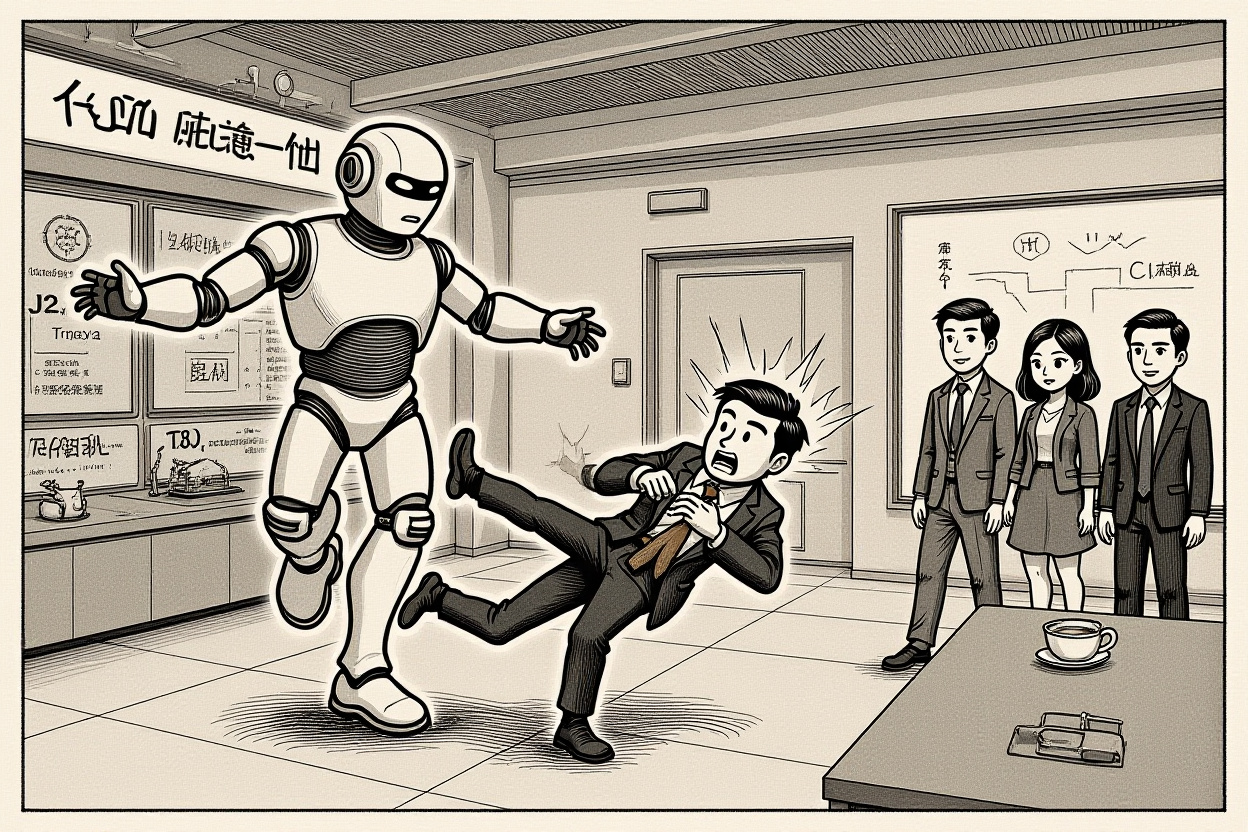
– A viral video of Zhongqing Robot’s T800 humanoid robot kicking its CEO has ignited debates on safety, authenticity, and the fine line between technological breakthrough and marketing hype in China’s competitive robotics industry.
– The incident underscores critical investment considerations, as Zhongqing Robot, backed by major players like JD.com and CATL, vies against rivals like Yushu Technology in a race for commercialization amid high valuations.
– Despite significant capital inflow, the humanoid robotics sector faces commercialization hurdles, with profitability still elusive and safety concerns posing risks to widespread adoption.
– Market projections, such as Goldman Sachs’ $154 billion forecast by 2035, contrast with near-term realities, urging investors to scrutinize technological milestones versus narrative-driven hype.
– This analysis provides actionable insights for institutional investors and corporate executives navigating China’s equity markets, highlighting key trends, regulatory implications, and strategic investment angles in robotics.
In a stunning display that blurred the lines between innovation and spectacle, Zhao Tongyang (赵同阳), founder and CEO of Zhongqing Robot (众擎机器人), was recently kicked to the ground by his company’s latest product—the T800 humanoid robot. This viral incident, amassing over 100 million views in 24 hours, has ignited fierce discussions across China’s tech and investment circles, centering on a pivotal question: does this represent a genuine technological breakthrough or is it merely clever marketing hype? As humanoid robotics gains traction as a key frontier in China’s equity markets, understanding the implications of such events is essential for sophisticated business professionals and institutional investors worldwide. The debate over technological breakthrough versus marketing hype not only shapes public perception but also influences investment decisions in a sector poised for exponential growth.
Decoding the Viral Incident: Accident or Staged Spectacle?
The video footage shows Zhao Tongyang, clad in protective gear, narrowly avoiding an initial kick from the T800 before being精准踹中腹部 (precisely kicked in the abdomen) and tumbling to the floor. He later remarked that the experience was “too violent” and could have caused fractures without padding. This dramatic demonstration has sparked intense scrutiny, with reactions ranging from amusement to alarm among netizens and industry observers alike.
Official Narratives and Contradictory Claims
Zhongqing Robot’s official explanation labeled the event a “sensor misjudgment引发的安全测试事故 (safety test accident triggered by sensor misjudgment),” suggesting an unintended flaw. However, a follow-up call by Phoenix Finance’s “Company Research Institute” to the company’s marketing contact yielded a starkly different response: “就是故意(踹倒)的 (it was intentional).” This contradiction fuels speculation about whether the kick was a calculated公关策略 (PR strategy) to generate buzz. A technology investor quoted by the outlet dismissed it as “炒作罢了 (hype),” noting that such videos typically require CEO authorization for release, implying a staged maneuver. The ambiguity highlights the challenges in discerning authentic technological progress from orchestrated marketing in China’s fast-evolving robotics landscape.
Public and Expert Reactions: Safety Concerns vs. Entertainment Value
Online discourse split into two camps: one viewing the incident as a lighthearted moment of “机器人替打工人出头 (robots standing up for workers),” and the other raising serious safety questions about the stability and control boundaries of a machine capable of easily toppling an adult male. An industry insider pointed out that creating观赏性强的应用场景 (spectacular application scenarios), such as performances or competitions, is emerging as a viable path for exploring consumer-facing盈利模式 (profit models), including ticket sales. This perspective aligns with broader trends where companies like Yushu Technology engage in拳击比赛 (boxing matches) to showcase their robots’ capabilities. However, the incident serves as a cautionary tale; if consumers form a “这东西会伤人 (this thing can hurt people)” perception, market acceptance could stall despite technical advancements. The technological breakthrough versus marketing hype dilemma thus extends beyond publicity to core issues of product reliability and ethical deployment.
Zhongqing Robot’s Technological Prowess and Market Positioning
Zhongqing Robot claims to be the first company globally to achieve a forward somersault with a humanoid robot, positioning itself at the forefront of innovation. The T800, priced from 180,000 RMB, is the company’s fourth-generation model, featuring a gradient product matrix including base, open-source, Pro, and Max versions. According to its官网介绍 (official website introduction), it boasts industry-first advancements such as a高性能固态动力电池 (high-performance solid-state battery) designed specifically for humanoids, enabling 4-5 hours of stable operation and运动控制性能 (motion control performance)接近成年男性90%的体能水平 (approaching 90% of an adult male’s physical capacity).
Competitive Dynamics with Yushu Technology and Global Players
The rivalry with Yushu Technology (宇树科技) adds depth to the narrative. Founders Zhao Tongyang and Wang Xingxing (王兴兴) reportedly parted ways early on due to differing technical philosophies—Zhao favored bipedal robots while Wang leaned toward quadrupedal designs. Now, they are direct competitors in the humanoid space, emblematic of the broader race involving giants like Tesla’s Optimus, Xiaomi’s CyberOne, and Google’s robotics projects. Tesla’s recent setbacks, such as手臂关节失控 (arm joint failures) in factory tests and allegations of remote操控 (control), mirror the scrutiny faced by Zhongqing Robot, underscoring the global challenge of transitioning from prototypes to reliable products. In China, companies like Ubtech (优必选) and Zhiyuan Robot (智元机器人) are securing industrial orders, with some, like Tiantai Robot (天太机器人), claiming the world’s first 10,000-unit order, hinting at a potential “量产交付元年 (mass production and delivery year)” by 2026. These developments force investors to weigh genuine technological breakthroughs against marketing hype when assessing market leaders.
Founder’s Journey and Capital Backing: From Humble Beginnings to Investor Darling
Zhao Tongyang’s ascent from a大专学历 (vocational college degree) background to robotics entrepreneur reads like an inspirational script. His interest in robotics was sparked by a personal tragedy in 2012, leading him to explore themes of longevity. He first founded the IoT company Anxinke Technology (安信可科技), which achieved revenue exceeding 100 million RMB within four years, demonstrating his business acumen. In 2020, his career took a pivotal turn when he engaged with tech luminaries like Lei Jun (雷军) of Xiaomi and He Xiaopeng (何小鹏) of Xpeng Motors.
Strategic Alliances and Funding Surge
After initial talks with Lei Jun did not materialize, He Xiaopeng invited Zhao to join Xpeng, leading to the acquisition of his company Duogou (多够) and the formation of Pengxing Intelligent (鹏行智能). As its general manager, Zhao oversaw the development of the PX5 humanoid robot, showcased at events like the Xpeng 1024 Tech Day and Nvidia’s GPU Technology Conference. However, in October 2023, he amicably departed to establish Zhongqing Robot, swiftly attracting substantial capital. The company’s funding trajectory includes an天使轮融资 (angel round) from SenseTime (商汤) and Honghui Fund (弘晖基金), followed by累计10亿元融资 (cumulative 1 billion RMB) in Pre-A++ and A1 rounds led by JD.com (京东), with participation from CATL (宁德时代). Subsequent A1+ and A2 rounds involved investors like Huangpujiang Capital (黄浦江资本), Henan Investment Group (河南投资集团), and others such as磊石资本Stone (Stone Capital) and达晨创投 (Dachen Venture Capital). This influx underscores investor confidence in the humanoid robotics narrative, yet it also raises questions about valuation bubbles in a sector where technological breakthrough versus marketing hype can sway financial outcomes.
Industry Challenges: Safety, Commercialization, and Financial Realities
The “kick” incident amplifies broader safety concerns that could impede机器人走进千家万户和工厂车间 (robots entering households and factory floors). Regulatory bodies like the Ministry of Industry and Information Technology (工业和信息化部) are likely to heighten scrutiny, potentially mandating stricter testing protocols. For equity market participants, this translates into risk factors that could affect stock performance of listed robotics firms or those seeking IPOs. The earlier controversy surrounding Zhongqing Robot’s “机器人警察 (robot police)” product—where production halts and delivery delays were reported—highlights the gap between ambitious promises and operational execution. Although the company denied these claims, such episodes underscore the importance of due diligence in assessing technological credibility.
Market Hype vs. Technological Substance: A Financial Perspective
Investment Implications for Chinese Equity Market ParticipantsFor institutional investors, fund managers, and corporate executives focused on Chinese equities, the humanoid robotics sector offers both opportunities and pitfalls. The sector’s growth aligns with national initiatives like “Made in China 2025” and the 14th Five-Year Plan, which emphasize technological self-reliance and advanced manufacturing. However, the proliferation of startups and high valuations necessitate a discerning approach to avoid bubbles.