



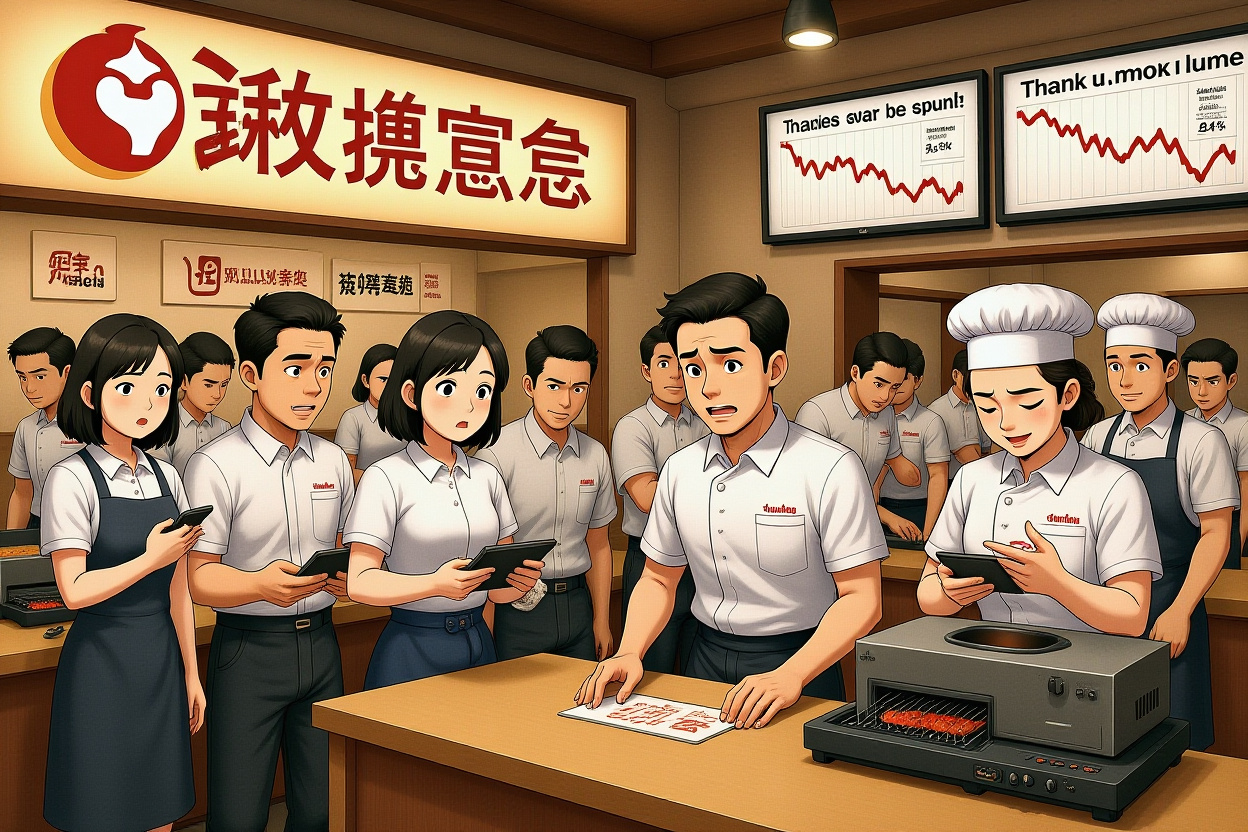
Executive Summary
Key insights from the decline of Thank u mom炸鸡 in China’s competitive food and beverage market.
- Thank u mom炸鸡, once a viral brand with 60 stores, now operates only one location in China, reflecting broader restaurant industry trends.
- The brand’s initial success was driven by K-drama popularity and non-fried marketing, but it failed to innovate as consumer preferences shifted.
- China’s炸鸡 market is projected to grow to 9.2 trillion yuan by 2028, attracting giants like KFC and Haidilao, intensifying competition.
- Survival in this sector hinges on供应链效率 (supply chain efficiency), product innovation, and cost control, as seen in successful brands like临榆炸鸡腿 (Linyu Chicken Leg).
- Investors should monitor restaurant industry trends for opportunities in scalable, innovative F&B models amid market consolidation.
The Rise and Fall of a Once-Dominant Brand
Thank u mom谢谢妈妈炸鸡, a South Korean-inspired炸鸡 (fried chicken) chain, captivated Chinese consumers during the peak of Hallyu (Korean Wave) influence. Founded on the premise of non-fried, healthier options, it expanded rapidly across major cities like Hangzhou and Xiamen. However, by 2024, only one store remains operational in Jiaxing, Tongxiang, signaling a stark reversal in fortunes. This case exemplifies volatile restaurant industry trends, where cultural fads can fuel rapid growth but also precipitate decline without sustained innovation.
Initial Success Driven by Cultural Trends
In 2014, the Korean drama My Love from the Star popularized啤酒配炸鸡 (beer with fried chicken) across Asia, creating a cultural phenomenon. Thank u mom炸鸡 leveraged this trend, opening its first Chinese store in Hangzhou’s湖滨银泰 (Hubin Yintai) shopping mall. The brand emphasized非油炸健康炸鸡 (non-fried healthy fried chicken) using German oil-free BBQ fryers, each costing 70,000 yuan. This差异化 (differentiation) appealed to health-conscious consumers, leading to queues lasting over two hours and daily sales peaking at 50,000 yuan per store. At its height, the brand operated nearly 60 locations, generating annual revenues exceeding 100 million yuan, according to industry reports.
Peak Performance and Operational Metrics
During its prime, Thank u mom炸鸡 achieved remarkable operational efficiency. The best-performing stores recorded 16 table turns per day, with monthly sales reaching 1.2 million yuan in spaces under 100 square meters. He Xuefeng (何学峰), the Chinese entrepreneur behind the brand’s local operations, implemented standardized processes inspired by global chains like KFC and Starbucks. However, conflicts with South Korean partners over management styles led to a split in 2016, forcing He Xuefeng (何学峰) to operate independently. This disruption marked the beginning of a downward spiral, with store closures starting in Ningbo by 2017 and accelerating through 2023.
Factors Behind the Decline
Multiple elements contributed to Thank u mom炸鸡’s downfall, highlighting critical restaurant industry trends. As consumer preferences evolved, the brand’s reliance on Korean cultural appeal waned, and it struggled to adapt to a saturated market. Management disputes and insufficient innovation further exacerbated its challenges, offering lessons for investors in Chinese equity markets.
Shifting Consumer Preferences and Market Saturation
China’s炸鸡 market has grown intensely competitive, with over 17,500 stores and 10,000 brands as of 2024, per红餐大数据 (Hongcan Big Data). Thank u mom炸鸡 failed to refresh its menu or marketing beyond the initial韩流滤镜 (Hallyu filter). Consumers, particularly younger demographics, now prioritize好吃不贵 (tasty and affordable) options over novelty. This shift is evident in the success of local brands like临榆炸鸡腿 (Linyu Chicken Leg), which emphasizes authentic flavors and cost efficiency. The broader restaurant industry trends show that brands must continuously innovate to retain relevance in dynamic consumer landscapes.
Management and Strategic Missteps
The partnership dissolution with South Korean stakeholders in 2016 left Thank u mom炸鸡 without cohesive strategic direction. He Xuefeng (何学峰)’s focus on standardization initially drove growth, but the brand lacked the resources to compete with deep-pocketed rivals. For instance,肯德基 (KFC) launched its炸鸡兄弟 (Chicken Brothers) sub-brand in 2024, offering extended hours and diverse menus, while海底捞 (Haidilao) introduced小嗨爱炸 (Xiao Hai Ai Zha) with social-dining elements. Thank u mom炸鸡’s inability to scale供应链效率 (supply chain efficiency) or introduce compelling new products left it vulnerable in a price-sensitive environment.
Broader Restaurant Industry Trends in China
The decline of Thank u mom炸鸡 mirrors wider patterns in China’s food and beverage sector, where restaurant industry trends emphasize consolidation, innovation, and operational excellence. With the炸鸡 market expected to reach 9.2 trillion yuan by 2028, according to共研产业研究院 (Gongyan Industry Research Institute), both local and international players are vying for dominance. Understanding these dynamics is crucial for institutional investors evaluating Chinese equity opportunities in consumer discretionary sectors.
Market Growth and Competitive Landscape
China’s炸鸡 industry has expanded at an 8.13% compound annual growth rate from 2019 to 2024, reaching 4.8 trillion yuan. Projections indicate further growth to 9.2 trillion yuan by 2028, driven by urbanization and changing dining habits. Major entrants like肯德基 (KFC) and海底捞 (Haidilao) leverage existing供应链 (supply chains) and brand equity to capture market share. For example,炸鸡兄弟 (Chicken Brothers) operates from 11 a.m. to 2 a.m., maximizing坪效 (per-square-meter efficiency) through外卖 (delivery) and self-pickup models. These developments underscore restaurant industry trends where scale and integration determine longevity.
Entry of Major Players and Niche Brands
Established corporations are entering niche segments to diversify revenue streams.海底捞 (Haidilao)’s小嗨爱炸 (Xiao Hai Ai Zha) focuses on拌酱炸鸡 (sauced fried chicken) and youth-oriented aesthetics, while临榆炸鸡腿 (Linyu Chicken Leg) has expanded to 5,000 stores nationwide. These brands excel in供应链效率 (supply chain efficiency) and product localization, such as incorporating藤椒味 (Sichuan pepper flavor) or卤香 (braised spices). For investors, these restaurant industry trends highlight opportunities in brands that balance innovation with cost control, potentially yielding stable returns in volatile markets.
Survival Strategies: Efficiency and Innovation
In China’s crowded F&B landscape, successful brands demonstrate that restaurant industry trends favor those mastering both operational efficiency and creative differentiation. Thank u mom炸鸡’s downfall contrasts with resilient players who adapted to consumer demands through technological and culinary advancements.
Operational Efficiency and Supply Chain Mastery
Efficiency is the backbone of profitability in restaurant industry trends. Brands like老韩煸鸡 (Lao Han Bian Ji) employ三炸一煸 (three-fries-one-stir) techniques to enhance flavor and reduce waste, while肯德基 (KFC)’s炸鸡兄弟 (Chicken Brothers) utilizes existing冷链 (cold chain) networks to minimize costs. These approaches enable smaller footprints and higher turnover, critical in high-rent urban areas. For example, a 20-square-meter炸鸡兄弟 (Chicken Brothers) outlet operates with three staff, serving both lunch and late-night crowds. This model aligns with global restaurant industry trends where供应链优化 (supply chain optimization) drives margin improvement.
Product and Experience Innovation
Innovation extends beyond menu items to encompass entire consumer experiences.海底捞 (Haidilao)’s小嗨爱炸 (Xiao Hai Ai Zha) integrates social dining elements, such as vibrant interiors and limited-edition merchandise, targeting Gen Z’s desire for拍照打卡 (photo-sharing) moments. Similarly,老韩煸鸡 (Lao Han Bian Ji)改造 (transforms) traditional干煸辣子鸡 (dry-fried chili chicken) into snackable formats, expanding consumption occasions. These strategies reflect restaurant industry trends where brands that continuously evolve product offerings and engage customers emotionally outperform those relying on transient hype.
Investment Implications for Chinese Equity Markets
The turbulence in China’s restaurant sector offers valuable insights for investors monitoring consumer discretionary stocks. Restaurant industry trends indicate that brands with robust供应链 (supply chains), innovation pipelines, and scalable models are better positioned to navigate economic shifts and regulatory changes.
Risks and Opportunities in F&B Investments
Volatility in consumer preferences and intense competition pose risks, as seen in Thank u mom炸鸡’s case. However, companies demonstrating resilience through restaurant industry trends like digital integration and franchise models present opportunities. For instance, brands leveraging美团 (Meituan) and饿了么 (Ele.me) for delivery have enhanced accessibility, while those adopting ESG practices may attract sustainable investment. Investors should analyze same-store sales, customer retention metrics, and supply chain durability when evaluating F&B equities in Chinese markets.
Future Outlook and Strategic Recommendations
Looking ahead, restaurant industry trends suggest consolidation will accelerate, with larger players acquiring innovative startups. Policymakers in China are also promoting domestic consumption, potentially benefiting well-positioned F&B brands. Investors might focus on companies with strong omnichannel strategies and regional diversification to mitigate risks. Monitoring announcements from regulatory bodies like国家市场监督管理总局 (State Administration for Market Regulation) can provide early signals of market shifts. Ultimately, success in this sector hinges on aligning with evolving restaurant industry trends to capitalize on China’s growing middle-class expenditure.
Key Takeaways and Forward Guidance
The story of Thank u mom炸鸡 serves as a cautionary tale for the broader restaurant industry trends in China. From cultural phenomenon to near-obscurity, its journey underscores the importance of agility and innovation in a fast-paced market. Brands that prioritize供应链效率 (supply chain efficiency), consumer-centric product development, and strategic scalability are more likely to thrive. For investors, this highlights the need to diligence management capability and market positioning in F&B investments. As China’s economy evolves, staying attuned to restaurant industry trends will be essential for identifying growth opportunities and avoiding pitfalls in the dynamic equity landscape. Consider exploring emerging brands that demonstrate these competencies for potential portfolio diversification.