



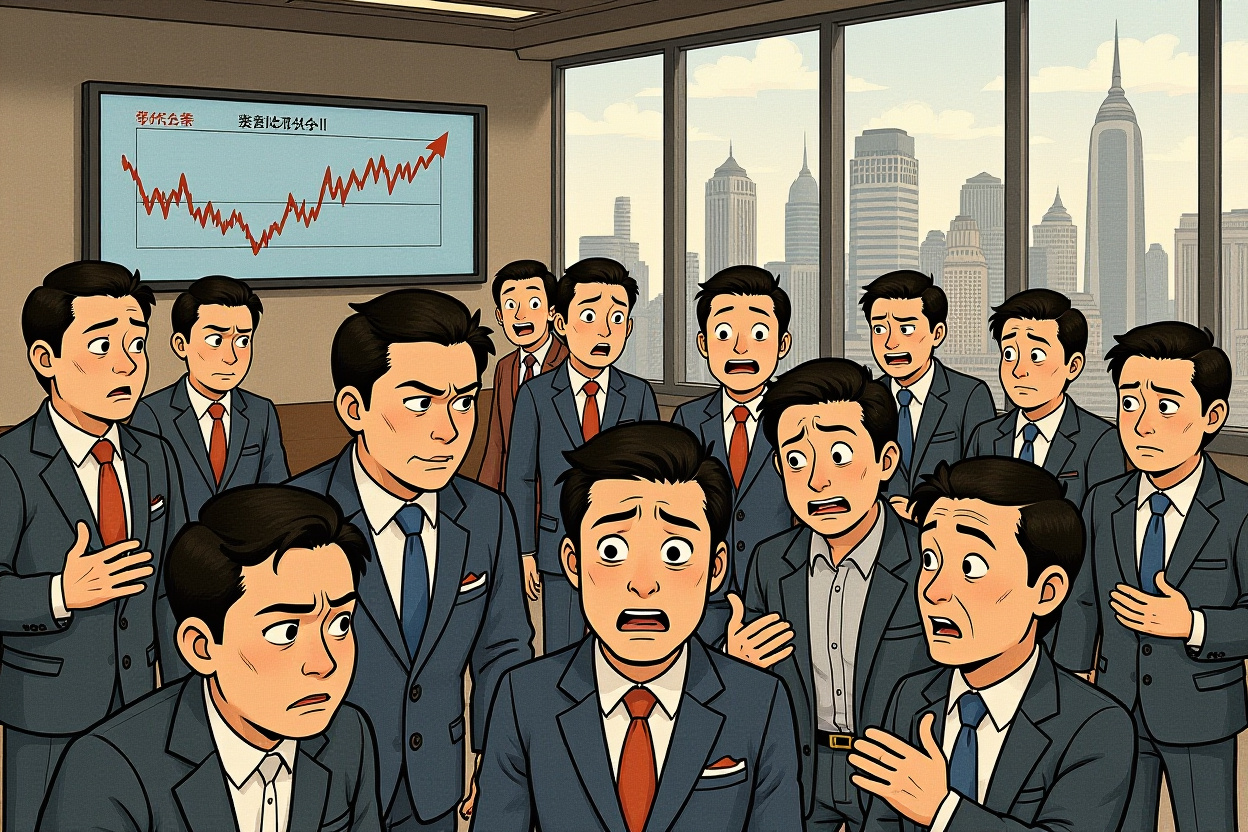
Executive Summary
Key insights and implications for investors in Chinese equities:
– Yonghui Superstores (永辉超市) faces over 102 billion yuan in cumulative losses since 2021, with a 88.96% debt-to-asset ratio raising bankruptcy concerns.
– Major shareholders, including founder Zhang Xuansong (张轩松) and JD.com (京东), have cashed out over 1.3 billion yuan, signaling eroding confidence.
– Ye Guofu’s (叶国富) 6.27 billion yuan acquisition has yielded paper gains but now risks dragging down Miniso (名创优品) due to Yonghui’s financial strain.
– The ‘fat reform’ store overhaul, inspired by Pang Donglai (胖东来), costs up to 18 million yuan per store but lacks core employee welfare elements, drawing criticism.
– With cash flow lasting less than two years, the 2026 completion target for store transformations is a make-or-break milestone for survival.
A Retail Giant in Peril
Yonghui Superstores (永辉超市), once a powerhouse in China’s retail sector, is now grappling with a financial crisis that threatens its very existence. The company’s ambitious transformation, dubbed the ‘fat reform’ in homage to Pang Donglai’s (胖东来) successful model, has yet to stem the bleeding after 17 months of implementation. For international investors tracking Chinese equities, Yonghui’s trajectory serves as a cautionary tale about the risks of high-stakes turnarounds in a volatile market.
At the heart of this drama is Ye Guofu (叶国富), the billionaire behind Miniso (名创优品), whose 6.27 billion yuan investment in Yonghui initially appeared prescient. However, mounting losses and shareholder exits have cast doubt on Ye Guofu’s gamble, with the 2026 deadline for full store upgrades looming as a critical test. The outcome will not only determine Yonghui’s fate but also influence broader sentiment toward China’s retail sector.
Financial Freefall and Operational Contraction
Yonghui’s financial health has deteriorated sharply, with operational metrics painting a grim picture. For the first three quarters of 2025, revenue plummeted 22.21% year-over-year to 42.43 billion yuan, while net losses attributable to shareholders soared over eightfold to approximately 710 million yuan. This extends a brutal trend: between 2021 and 2024, the company accumulated losses exceeding 95 billion yuan, pushing the five-year deficit past 102 billion yuan.
The retail chain’s store footprint has shrunk dramatically in response. From over 1,000 stores at the end of 2023, Yonghui now operates just 450 locations as of September 2025—a 55% contraction in under two years. Recent closures include key outlets in Shenzhen’s prime shopping districts, underscoring the urgency of the ‘fat reform’ initiative. With an average of 102 net store closures per quarter, the company is racing to stabilize its operations before cash reserves are depleted.
Shareholder Exodus Accelerates
As Yonghui’s financial woes deepen, key stakeholders are rapidly reducing their exposure. In November 2025, Chairman Zhang Xuansong (张轩松) and his affiliates announced plans to sell up to 90.75 million shares, representing 1% of total equity. At the prevailing stock price of 4.74 yuan per share, this move would unlock roughly 430 million yuan in liquidity for the insiders.
This follows a pattern of divestment by major players. Earlier in July 2025, JD.com (京东) slashed its stake by 114 million shares, cashing out over 600 million yuan and reducing its holding below the 5% reporting threshold. Analysis by Guangzhou Daily (广州日报) suggests JD’s cumulative 6.2 billion yuan investment in Yonghui has resulted in approximately 2 billion yuan in losses. Similarly, Vice President Luo Wenxia (罗雯霞) sold 108,700 shares in November, further eroding internal confidence.
The Founder’s Retreat and Broader Implications
Zhang Xuansong’s latest divestment is particularly telling, given his role as Yonghui’s chairman and legal representative. His reduced stake to 8.72% aligns with his brother Zhang Xuanning’s (张轩宁) March 2023 sale of 90.48 million shares for over 300 million yuan. This gradual exit by the founding family suggests diminishing belief in a near-term recovery, despite their public support for the ‘fat reform’ strategy.
For global investors, these transactions highlight the challenges facing Chinese retail stocks. Even well-capitalized backers like JD.com have struggled to generate returns, reflecting structural issues in the sector. The shareholder exodus also complicates Ye Guofu’s position, as he now shoulders greater responsibility for Yonghui’s revival without the full backing of its original architects.
The Costly ‘Fat Reform’ Gamble
Yonghui’s ‘fat reform’ initiative, inspired by Pang Donglai’s (胖东来) highly successful retail model, represents a massive bet on operational transformation. According to Vice President Wang Shoucheng (王守诚), standard store upgrades cost between 5 million and 8 million yuan, while smaller locations require around 3 million yuan. However, the company’s capital raising documents reveal a much higher figure—55.97 billion yuan allocated to refurbish 298 stores, implying an average cost of 18.78 million yuan per outlet.
This aggressive spending aims to replicate Pang Donglai’s customer-centric approach, which emphasizes employee welfare and service quality. Yet the execution has drawn criticism from none other than Pang Donglai founder Yu Donglai (于东来). During a March 2025 industry event, he publicly challenged Yonghui’s management, asking why a reportedly profitable store in Zhengzhou wasn’t raising worker salaries. He stressed that allocating 60-70% of profits to staff, a core tenet of his philosophy, was non-negotiable for successful emulation.
Yu Donglai’s Critique and Cultural Clash
Yu Donglai’s intervention underscores a fundamental mismatch in Yonghui’s adaptation of the ‘fat reform’. While investing heavily in physical upgrades, the company has hesitated to implement the labor-friendly policies that define Pang Donglai’s culture. This half-hearted approach risks alienating both employees and customers, potentially undermining the entire transformation.
Yu’s remarks at the Global Supplier Conference further highlight this tension. He noted that if he had known Ye Guofu (叶国富) earlier, he would have advised against entering the supermarket business. Such skepticism from the very icon Yonghui seeks to emulate raises questions about the viability of Ye Guofu’s gamble, especially as the 2026 deadline approaches.
Ye Guofu’s High-Stakes Bet
When Ye Guofu (叶国富) acquired a 29.4% stake in Yonghui for 6.27 billion yuan in September 2024, it was hailed as a masterstroke. The stock surged 153.19% within four months, peaking at 7.87 yuan per share in December 2024 and generating paper profits of nearly 9.6 billion yuan. This ‘copycat king’ seemed to have pulled off another coup, leveraging his retail expertise to revitalize a floundering giant.
However, the euphoria has faded as Yonghui’s underlying issues persist. By November 2025, the share price had retreated to 4.01 yuan, down over 30% year-to-date and nearly halving from its peak. This volatility reflects investor skepticism about Ye Guofu’s ability to execute a turnaround, particularly given Yonghui’s precarious finances.
Financial Strain and Contagion Risk
Yonghui’s balance sheet reveals alarming leverage, with a debt-to-asset ratio of 88.96% as of Q3 2025. Current assets of 112.39 billion yuan fall short of 178.36 billion yuan in current liabilities, producing a worrisome current ratio of 0.63. More critically, cash reserves have dwindled to 33.58 billion yuan—the lowest in a decade—implying the company has less than two years of liquidity at current burn rates.
The fallout is already affecting Ye Guofu’s flagship venture, Miniso (名创优品). Its H1 2025 financials include a 119 million yuan loss from the Yonghui investment, along with quarterly amortization expenses of 5 million yuan related to the acquisition. While these are non-cash adjustments, they highlight the contagion risk from Ye Guofu’s gamble and could pressure Miniso’s valuation if Yonghui’s situation worsens.
The 2026 Make-or-Break Deadline
Yonghui has pinned its hopes on completing the ‘fat reform’ across all stores by 2026, a timeline that now carries existential weight. Success would validate Ye Guofu’s investment and potentially restore profitability, while failure could trigger a downward spiral toward insolvency. The company must demonstrate that its expensive store upgrades can drive sustainable growth, not just temporary buzz.
Key milestones to watch include same-store sales growth, employee retention rates, and margin improvements. Investors should monitor quarterly disclosures from the Zhengzhou (郑州) pilot locations, which have been at the forefront of the transformation. Any deviation from the 2026 schedule or budget overruns would signal deeper troubles.
Strategic Imperatives and Investor Guidance
For Ye Guofu to salvage his bet, several steps are essential. First, Yonghui must address its capital structure, possibly through asset sales or equity injections, to reduce the 88.96% leverage ratio. Second, the ‘fat reform’ must evolve to include meaningful wage increases and profit-sharing, as Yu Donglai advocates. Finally, transparent communication with stakeholders is crucial to rebuild trust amid the shareholder exodus.
International investors should approach Yonghui with caution, focusing on the 2026 deliverables. Diversified exposure to China’s consumer sector, through ETFs or select competitors, may offer safer alternatives. Those considering a position in Yonghui should wait for concrete evidence of operational improvement, such as two consecutive quarters of reduced losses or comparable-store sales growth.
Navigating the Uncertainty
Ye Guofu’s Yonghui gamble encapsulates the high-risk, high-reward nature of Chinese equity investments. While the initial paper gains were impressive, the underlying business remains deeply challenged. The ‘fat reform’ represents a bold attempt at reinvention, but its success hinges on cultural and operational changes that go beyond cosmetic upgrades.
As the 2026 deadline approaches, stakeholders must weigh the potential for a dramatic turnaround against the very real possibility of further value erosion. Ye Guofu’s legacy as a retail visionary hangs in the balance, alongside the fortunes of thousands of employees and investors. In China’s fast-moving market, even the most calculated bets can unravel quickly—making vigilant analysis and disciplined risk management more critical than ever.