



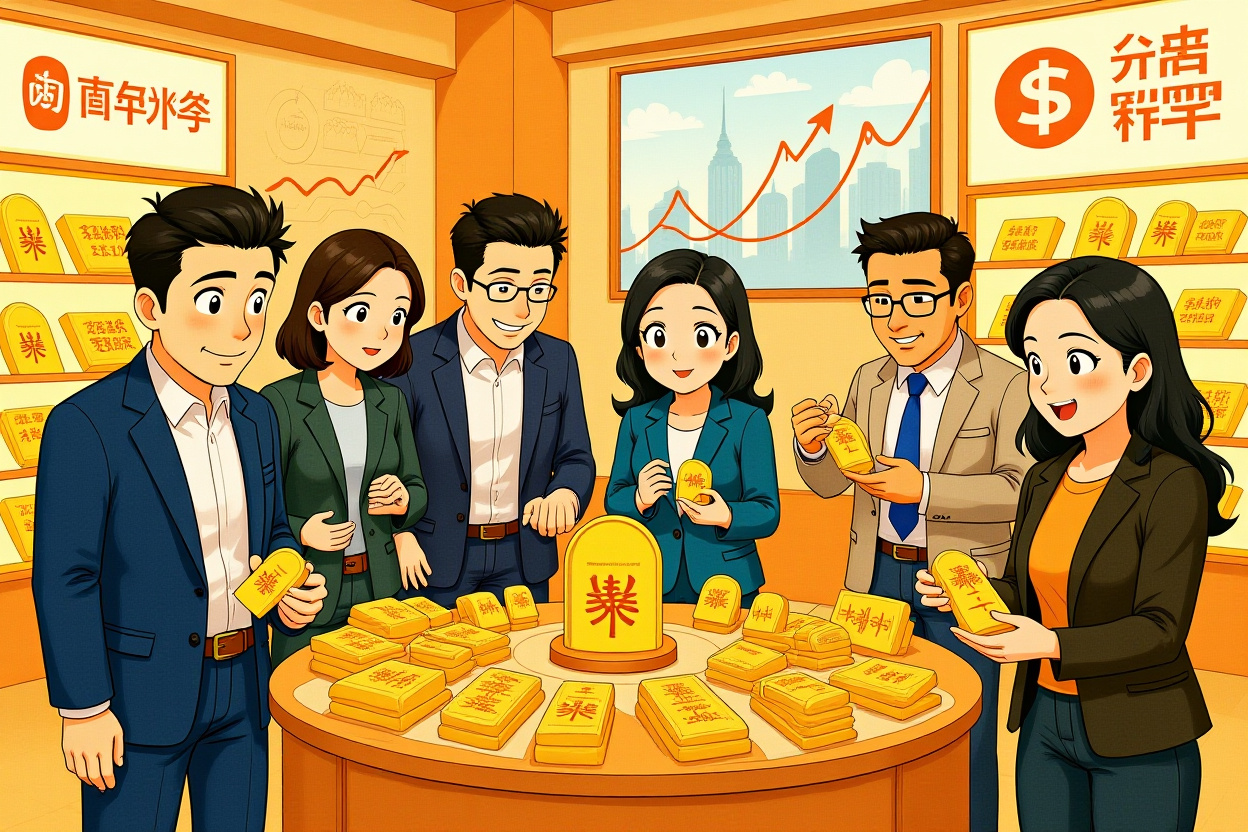
– Pain gold products, featuring popular IP collaborations, are experiencing explosive growth, with Triple-digit increases in category sales on major e-commerce platforms.
– Young consumers demonstrate ‘carefully calculated sensibility,’ blending emotional attachment with perceived investment value in their purchasing decisions.
– Gold brands are expanding demographic reach through IP partnerships, attracting male consumers and younger audiences previously disinterested in traditional gold.
– The pain gold phenomenon reflects broader shifts toward emotional consumption with tangible value anchors, creating new opportunities across retail sectors.
– Secondary markets for pain gold show significant premiums over original prices, indicating strong collector demand and potential investment returns.
The New Gold Standard: Understanding Pain Gold’s Market Disruption
As international gold prices surged past $4,000 per ounce in 2025, a parallel gold market has emerged that defies conventional investment logic. Pain gold—gold products infused with intellectual property from anime, games, and pop culture—commands premiums that make bullion seem affordable by comparison. While traditional gold investors monitor macroeconomic indicators, young Chinese consumers are driving a revolution in precious metals consumption that prioritizes emotional connection over pure metallurgical value.
This pain gold phenomenon represents more than a niche collector trend. During the recent Double 11 shopping festival, pain gold category sales demonstrated triple-digit year-over-year growth on Taobao and Tmall, establishing itself as a substantial segment within the broader gold market. The success of pain gold reveals fundamental shifts in how younger generations approach consumption, investment, and emotional fulfillment through material possessions.
Defining the Pain Gold Phenomenon
Pain gold typically refers to gold products that incorporate elements from popular intellectual properties, ranging from gaming characters to animated series. These items often contain minimal actual gold content—sometimes as little as 0.01 grams—yet command prices equivalent to multiple grams of pure gold. The term itself plays on the Chinese concept of ‘pain’ in spending, suggesting both the financial sacrifice and emotional satisfaction involved in acquiring these coveted items.
Consumer Li Xin (李欣) illustrates this dynamic with her 2018 purchase of a Zhou Dafu (周大福) and Sanrio collaboration piece containing less than 0.2 grams of gold for 258 RMB. Despite gold prices nearly quadrupling since her purchase, the secondary market value of her pain gold item hasn’t kept pace with bullion appreciation. ‘I wasn’t really considering the price—I was buying the IP,’ she explains, capturing the emotional calculus that drives pain gold acquisitions.
Market Mechanics: Pain Gold’s Economic Underpinnings
The pain gold market operates on principles distinct from traditional gold investing. Where bullion markets respond to interest rates, inflation expectations, and geopolitical stability, pain gold valuations hinge on IP popularity, limited edition status, and community demand. This creates pricing anomalies where a 1.33-gram Zhou Sheng Sheng (周生生) Onmyoji collaboration piece originally priced at 749 RMB now commands 2,300 RMB on secondary platforms like Xianyu—a 207% premium over its gold content value.
Industry data reveals the scale of this emerging category. During October 2025, pain gold sales on Taobao and Tmall increased over 70% month-over-month, while the broader gold category saw new customer sales grow by double digits year-over-year. The 2025 China Gold Jewelry Consumer Insight Report indicates that gold jewelry ownership among 18-24-year-olds has jumped to 62%, up dramatically from 37% in 2019, suggesting pain gold is expanding the overall gold market rather than cannibalizing existing segments.
Brand Strategies and IP Collaboration Economics
Major gold brands have aggressively embraced pain gold as a growth vector. Zhou Dafu (周大福) has launched collaborations with NBA, while Chao Hong Ji (潮宏基) introduced its ‘Butter Bear’ series. The most successful partnerships demonstrate crossover appeal, such as Zhou Dafu’s Black Myth: Wukong (黑神话:悟空) collection that achieved record sales while attracting previously untapped demographic segments.
– Zhou Dafu (周大福) NBA Collection: Leveraged sports fandom to reach male consumers
– Zhou Sheng Sheng (周生生) Onmyoji Series: Tapped into gaming community with premium pricing
– Chao Hong Ji (潮宏基) Butter Bear Line: Combined cuteness appeal with gold’s perceived value
According to industry statistics, gold brands participated in over 50 IP collaboration campaigns in the first three quarters of 2025 alone. However, the barrier to entry remains significant for smaller IPs, with custom manufacturing requiring minimum orders to achieve viable pricing. A representative from a gold customization factory explained that producing a single double-sided gold card with 0.01 grams of gold costs approximately 300 RMB, while bulk orders of 100 units reduce the per-unit cost to 20 RMB.
Consumer Psychology: The Emotional Calculus of Pain Gold
Young consumers approach pain gold with what industry observers term ‘carefully calculated sensibility’—a blend of emotional attachment and rational economic consideration. This psychological framework allows purchasers to justify premiums that would be unthinkable for generic gold products while maintaining a narrative of prudent financial behavior. The pain gold trend represents a sophisticated evolution in emotional consumption, where buyers seek both immediate gratification and long-term value preservation.
Consumer Chen Ying captures this mindset: ‘My affection for these IPs is genuine, but pouring money solely for passion might eventually drain my energy. Gold transforms this impulse purchase into strategic reserves—besides emotions, it leaves asset allocation.’ Her comment highlights how pain gold serves as a psychological bridge between indulgence and responsibility, allowing consumers to engage in fandom while maintaining a self-image as savvy investors.
From Luxury to Legacy: The Value Transformation
Pain gold’s appeal extends beyond the core collector community to consumers transitioning from luxury goods to more traditionally valuable purchases. Data from Tmall’s jewelry category indicates that at least half of recent gold purchasers had previously bought luxury items on the platform. When accounting for luxury brands without Tmall flagship stores, this proportion likely increases significantly.
– Luxury Bag Alternative: Consumers shifting from handbags to gold for better value retention
– Social Validation: Pain gold receives family approval where anime merchandise might not
– Investment Narrative: Gold content provides psychological safety net for emotional spending
This transition reflects broader reevaluation of consumption priorities post-pandemic, with tangible assets gaining appeal over experiential or purely status-driven purchases. The pain gold market cleverly positions itself at the intersection of these trends, offering both emotional resonance and traditional value propositions.
Double 11 Dynamics: Pain Gold as Market Bellwether
The 2025 Double 11 shopping festival provided the most comprehensive view yet of pain gold’s mainstream potential. Now in its 17th year, Double 11 has evolved from pure price competition toward more nuanced consumption drivers, with pain gold emerging as a standout category. The festival demonstrated how emotional consumption is maturing toward what analysts describe as ‘from virtual to tangible’—seeking physical embodiments of affective connections.
Platform data reveals fascinating category cross-pollination. The 2025 Tmall Double 11 Pet Consumption Observation Report shows premiumization in pet products, with cat litter in the 200+RMB price segment growing from 34% to 45% of category sales between 2023 and 2025. Similarly, specialized pet supplements addressing cardiac and urinary issues increased over 120%, indicating consumers’ willingness to spend on preventative care for beloved animals.
Beyond Youth: The Expanding Emotional Consumption Landscape
Zhang Yi (张毅), founder and chief analyst at iiMedia Research, observes that emotional consumption is no longer confined to younger demographics. ‘Beyond young people, this year’s Double 11 shows emotional consumption markets rising across all age groups, including middle-aged, elderly, and children. Platforms and brands are strengthening emotional scenario narratives in their Double 11 marketing,’ he notes.
This expansion creates opportunities for categories beyond gold. Zhang suggests that jewelry brands can develop innovative craftsmanship services, enhance IP matrices, and create low-barrier small-weight series. Precious metals, jade, and other materials with value preservation recognition offer IP extension potential, while companies like Pop Mart (泡泡玛特) and museum cultural creations continue exploring new IP and brand value extensions.
Investment Implications and Market Outlook
For investors and market observers, pain gold represents both a discrete opportunity and a indicator of broader consumption trends. The category’s growth suggests potential for brands that successfully navigate IP partnerships, while the underlying consumer behavior shifts have implications across retail sectors. The pain gold market’s resilience—maintaining premiums even as gold prices fluctuate—indicates a sustainable rather than speculative phenomenon.
Forward-looking analysis suggests several development vectors for pain gold and related categories. Digital 3C products with high practical value could explore IP collaborations, lightweight designs, and accessory markets. The customization economy shows particular promise, with consumers increasingly willing to commission personalized pieces that reflect specific interests rather than mass-market preferences.
Risk Considerations and Market Evolution
Despite its current momentum, the pain gold market faces several challenges. Authentication concerns deter some potential buyers, as illustrated by recent graduate Wang Ke (王可), who hesitated to join a group purchase for her favorite character Xiao Yi (萧逸) due to trust issues with non-branded gold. IP licensing complexities and manufacturing minimums create barriers for smaller properties, potentially limiting category diversity.
– Authentication Challenges: Consumers wary of non-branded pain gold authenticity
– IP Fragmentation: Niche properties struggle to achieve production economies
– Market Saturation Risk: Proliferation of collaborations could dilute premium pricing
However, the fundamental drivers—emotional connection, value preservation, and social validation—suggest lasting category staying power. As Zhang Yi notes, ‘Young people need more value preservation security in emotional consumption to offset consumption guilt, with many consumers pursuing preferences while containing concerns about consumption risks.’
Strategic Takeaways for Market Participants
The pain gold phenomenon offers actionable insights for brands, investors, and retailers operating in China’s consumer markets. Success in this space requires understanding the nuanced relationship between emotional drivers and economic considerations that characterize contemporary Chinese consumption. Brands should view IP collaborations not as short-term marketing tactics but as strategic initiatives that build lasting consumer relationships.
For investors, pain gold represents both a direct opportunity through brands mastering this category and an indicator of broader consumption trends favoring products that blend emotional and practical value. The category’s performance during Double 11 suggests resilience even amid economic uncertainty, though careful evaluation of specific IP partnerships and brand execution capabilities remains essential.
The evolution of pain gold reflects larger transformations in how consumers assign value, make purchase decisions, and balance emotional fulfillment with financial pragmatism. As markets continue to navigate post-pandemic realities, the principles demonstrated by pain gold’s success—authentic connection, tangible value, and community engagement—will likely inform winning strategies across multiple consumer categories. Market participants who understand these dynamics will be best positioned to capitalize on the next wave of consumption innovation.