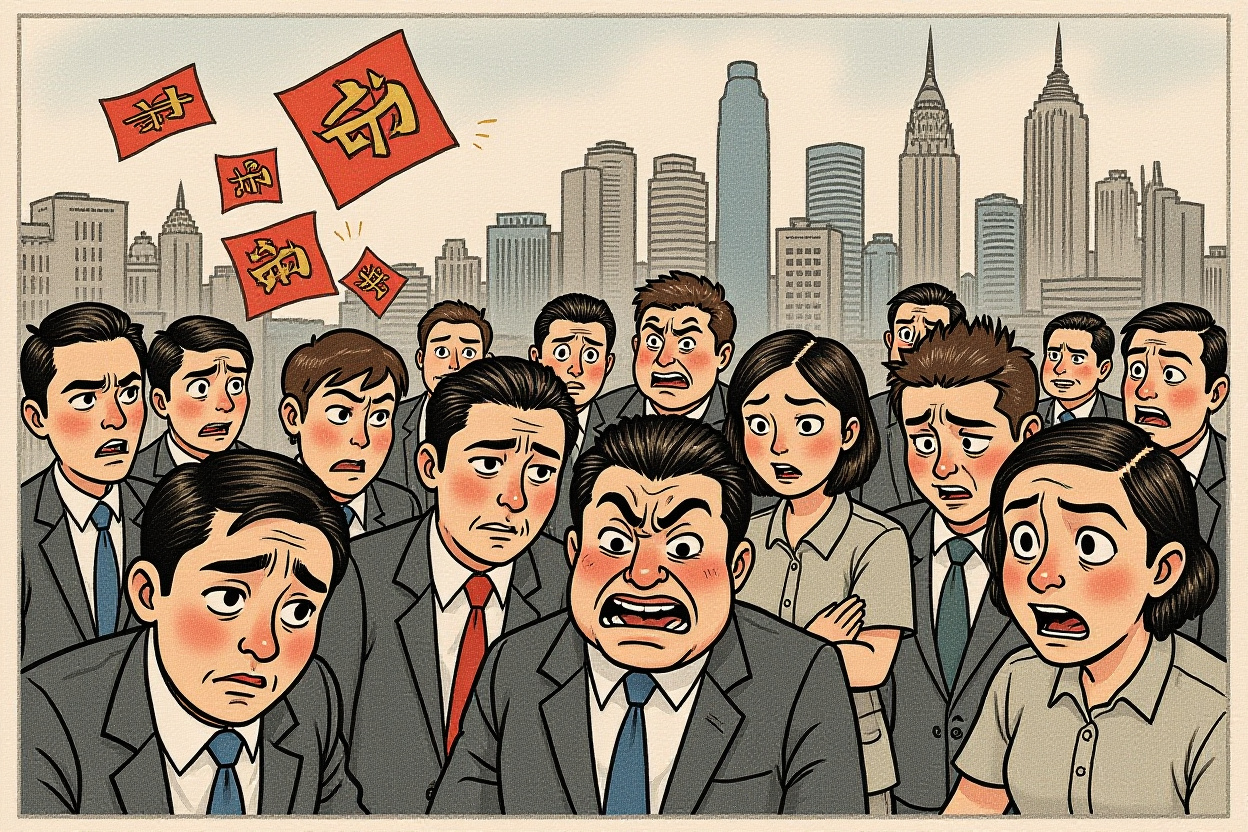
– Nantong Sanjian (南通三建), once a billion-yuan revenue builder, faces complete asset wipeout after Evergrande Group’s (恒大集团) collapse, with courts offering 25 million yuan rewards for asset clues. – The company’s debt surpasses 260 billion yuan against mere 6.5 million yuan in cash, highlighting severe insolvency and legal battles across China. – Unpaid wages to migrant workers exceed billions, intensifying social unrest and regulatory penalties amid failed debt recovery efforts. – This case exposes systemic risks in China’s construction industry, where advance funding models and developer dependencies lead to widespread bankruptcies. – Investors must reassess exposure to Chinese real estate-linked firms, focusing on regulatory shifts and diversification strategies to mitigate similar asset wipeout scenarios. The Qingdao Intermediate Court’s unprecedented 25 million yuan reward for information on Nantong Sanjian’s (南通三建) hidden assets underscores the desperate state of China’s construction sector, where the asset wipeout of once-dominant firms reveals deep vulnerabilities tied to real estate giants like Evergrande Group (恒大集团). For international investors monitoring Chinese equities, this saga exemplifies how intertwined debt networks and regulatory gaps can trigger catastrophic financial failures. As Huang Yuhui (黄裕辉), Nantong Sanjian’s chairman, navigates a labyrinth of lawsuits and evaporating wealth, the fallout serves as a stark warning about the perils of overreliance on single developers in volatile markets. This asset wipeout not only erases corporate value but also jeopardizes thousands of livelihoods, demanding urgent attention from global financial professionals seeking to decode China’s economic resilience. The Legal Quagmire: Pursuing Nantong Sanjian’s Assets Court-Ordered Rewards and Execution Challenges In a dramatic escalation of debt recovery efforts, the Qingdao Intermediate Court has offered a 25 million yuan bounty—10% of the total 250 million yuan debt owed to Qingdao Bank (青岛银行)—for clues on Nantong Sanjian’s (南通三建) concealed assets. This marks the second such reward in 2023, following a Shenzhen Futian Court offer of 30% for a smaller 2.167 million yuan claim. These measures highlight creditors’ desperation amid a cycle of ‘execution-consumption restriction-termination of execution,’ where legal victories yield minimal payouts. For instance, attempts to auction a 950-square-meter Tianjin office building—valued at under 5 million yuan, or 5,000 yuan per square meter—failed due to lack of buyers, while efforts to freeze listed equity stakes were thwarted by prior claims. – Debt Execution Statistics: Nantong Sanjian faces 256 enforcement cases totaling 14.8 billion yuan, with 422 dishonesty records involving 10.6 billion yuan, per Tianyancha (天眼查) data. – Terminated Cases: 1,314 concluded cases reveal 41 billion yuan in unresolved debts, reflecting the scale of this asset wipeout. Statistical Overview of Legal Battles Nantong Sanjian’s (南通三建) legal woes are staggering, with 2,282 case filings—mostly as defendant—painting a picture of a company engulfed in litigation. The asset wipeout has left courts and creditors scrambling, as seen in Qingdao Bank’s (青岛银行) multi-year pursuit of repayment. Outbound links to Chinese court announcements, such as those from the Supreme People’s Court (最高人民法院), could provide deeper insights into enforcement trends. This legal paralysis not only stalls debt recovery but also deters potential investors, exacerbating the company’s liquidity crisis and reinforcing the asset wipeout narrative. From Glory to Ruin: Nantong Sanjian’s Meteoric Rise and Fall Historical Achievements and Expansion Founded decades ago, Nantong Sanjian (南通三建) cemented its reputation by spearheading iconic projects like Shanghai’s Oriental Pearl Tower (东方明珠), Beijing Olympic venues, and the European record-holder Federation Tower in Russia. Under Huang Yuhui’s (黄裕辉) leadership since 2012, revenue soared toward 100 billion yuan, fueled by ambitious expansion and a skilled workforce. The company’s portfolio—spanning from Kuwait’s royal palaces to Shanghai’s Jinmao Tower (金茂大厦)—showcased its engineering prowess, attracting global partnerships and positioning it as a construction titan. However, this rapid growth masked underlying risks, particularly its reliance on advance funding models where builders cover costs upfront—a practice that would later precipitate its asset wipeout. – Peak Performance Metrics: At its height, Nantong Sanjian employed over 50,000 workers and secured contracts worth billions, dominating China’s construction landscape. – Global Recognition: Awards for projects like the科威特皇宫 (Kuwait Palace) underscored its international appeal, drawing investments from entities like the China International Capital Corporation (中金公司). The Fateful Partnership with Evergrande The turning point came when Huang Yuhui (黄裕辉) aligned with Xu Jiayin (许家印), Evergrande Group’s (恒大集团) founder, transforming Nantong Sanjian (南通三建) into Evergrande’s ‘preferred general contractor.’ By 2018, Xu Jiayin (许家印) hailed Huang as an ‘Excellent Strategic Partner,’ cementing a relationship that propelled Nantong Sanjian’s revenue toward 100 billion yuan. This alliance, however, embedded the company in Evergrande’s debt-laden ecosystem, where advance funding for construction—without robust risk controls—left it exposed. When Evergrande defaulted in 2021, Nantong Sanjian discovered it was owed 36 billion yuan, becoming the developer’s largest creditor and triggering an irreversible asset wipeout. The Evergrande Effect: How One Developer’s Collapse Caused an Asset Wipeout Debt Accumulation and Financial Hemorrhage Evergrande Group’s (恒大集团) implosion exposed Nantong Sanjian’s (南通三建) precarious financials, with the builder holding 36 billion yuan in unpaid contracts—a sum that dwarfed its assets and catalyzed the asset wipeout. H1 2023 financials reveal revenue plunging to under 1 billion yuan against 260 billion yuan in liabilities, including 20 billion yuan in defaulted debts. Cash reserves have evaporated to just 6.5 million yuan, rendering the company technically insolvent. This asset wipeout stems from construction sector norms, where firms like Nantong Sanjian borrow heavily to fund projects, betting on developers’ solvency—a gamble that failed spectacularly with Evergrande. – Comparative Analysis: Similar fates have befallen Hefei Construction (合肥建工) and Nantong Liujian (南通六建), both undergoing debt restructuring after Evergrande-linked losses. – Regulatory Context: The People’s Bank of China (中国人民银行) has warned of systemic risks in real estate, yet enforcement remains fragmented, per outbound links to PBOC reports. The Domino Effect on Nantong Sanjian The asset wipeout at Nantong Sanjian (南通三建) illustrates how Evergrande’s downfall rippled across supply chains, forcing Huang Yuhui (黄裕辉) to auction listed equity and accept regulatory penalties. Despite his public appearances to address debts, recovery is implausible given the 36 billion yuan hole. This scenario mirrors broader trends where construction firms’ asset wipeouts amplify China’s property crisis, affecting bond markets and investor confidence. For instance,南通六建 (Nantong Liujian) and江苏建工 (Jiangsu Construction) have also filed for bankruptcy, signaling sector-wide distress that could depress Chinese equity indices. Industry-Wide Implications: A Sector in Peril Other Construction Firms Facing Similar Fates Nantong Sanjian’s (南通三建) asset wipeout is not isolated; giants like Huahao Construction (华昊建设) and Jiangsu Provincial Construction (江苏建工) have entered debt restructuring, collectively underscoring a crisis in Chinese construction. Data from the China Construction Industry Association (中国建筑业协会) indicates that over 20 major firms have insolvency rates exceeding 50% post-Evergrande, with advance funding models amplifying losses. This asset wipeout trend threatens to destabilize regional economies, as construction contributes roughly 7% to China’s GDP, according to National Bureau of Statistics (国家统计局) releases. – Bankruptcy Statistics: In 2022 alone, 15 top-tier construction firms underwent restructuring, with liabilities totaling 500 billion yuan. – Investor Alerts: International funds like BlackRock (贝莱德) have reduced exposure to Chinese construction stocks, citing asset wipeout risks in recent reports. Regulatory Responses and Economic Impact Chinese regulators, including the China Securities Regulatory Commission (中国证监会), have introduced measures like debt-for-equity swaps to curb asset wipeouts, but enforcement is lagging. The State Council’s (国务院) 2023 guidelines on protecting migrant workers’ wages aim to address social fallout, yet Nantong Sanjian’s case shows implementation gaps. For global investors, this signals need for cautious engagement, with outbound links to CSRC announcements providing updates on policy shifts. The asset wipeout phenomenon could slow China’s economic recovery, pressuring yuan-denominated assets and compelling portfolio reassessments. The Human Toll: Migrant Workers and Social Unrest Scale of Unpaid Wages and Legal Repercussions Beyond financial metrics, Nantong Sanjian’s (南通三建) asset wipeout has humanitarian dimensions, with unpaid wages to migrant workers estimated in the billions. Cases in Shenyang (1038 million yuan) and Luohe (1850 million yuan) have triggered administrative penalties, including blacklisting and fines, yet workers rarely recover funds due to creditors’ priority in asset seizures. This social strain exacerbates public discontent, potentially fueling protests that could attract scrutiny from China’s State-owned Assets Supervision and Administration Commission (国资委). – Worker Impact: Surveys suggest over 10,000 migrant families face hardship from Nantong Sanjian’s defaults, highlighting the asset wipeout’s ripple effects. – Legal Framework: Recent amendments to the Labor Contract Law of the People’s Republic of China (中华人民共和国劳动合同法) strengthen wage protections, but enforcement remains inconsistent. Investor Insights: Navigating the Aftermath Lessons for International Investors The asset wipeout at Nantong Sanjian (南通三建) offers critical lessons: diversify away from developer-dependent firms, monitor advance funding exposures, and heed regulatory signals from bodies like the China Banking and Insurance Regulatory Commission (中国银行保险监督管理委员会). Investors should prioritize companies with robust liquidity buffers and ESG compliance to mitigate similar risks. For instance, firms like China State Construction Engineering (中国建筑) have weathered storms through diversified portfolios, underscoring the value of strategic hedging. – Risk Mitigation Strategies: Allocate to sectors with lower real estate ties, such as tech or consumer goods, and use tools like credit default swaps for protection. – Data Sources: Leverage platforms like Wind (万得) for real-time debt analytics and outbound links to exchange disclosures. Future Outlook and Recovery Possibilities While Nantong Sanjian’s (南通三建) asset wipeout appears irreversible, potential resolutions include government-led restructuring or asset sales to state-owned enterprises. However, recovery odds are slim given the debt magnitude. Investors should watch for policy stimuli from the National Development and Reform Commission (国家发展和改革委员会) aimed at stabilizing construction, but prepare for prolonged volatility. The asset wipeout saga may accelerate industry consolidation, benefiting resilient players but demanding heightened due diligence. Nantong Sanjian’s precipitous decline from industry leader to asset wipeout casualty underscores the systemic risks in China’s construction and real estate sectors, driven by overleveraging and developer dependencies. For global investors, this case reinforces the imperative to scrutinize debt exposures, advocate for regulatory reforms, and balance portfolios with defensive assets. As China grapples with economic headwinds, proactive monitoring of firms with high advance funding ratios and engagement with transparent reporting can shield against similar downturns. Move now to reassess your Chinese equity holdings, integrating these insights to fortify your investment strategy against future asset wipeouts.
Nantong Sanjian’s Asset Wipeout: The Cascading Impact of Evergrande’s Downfall