



Executive Summary
Key insights from the recent market downturn include:
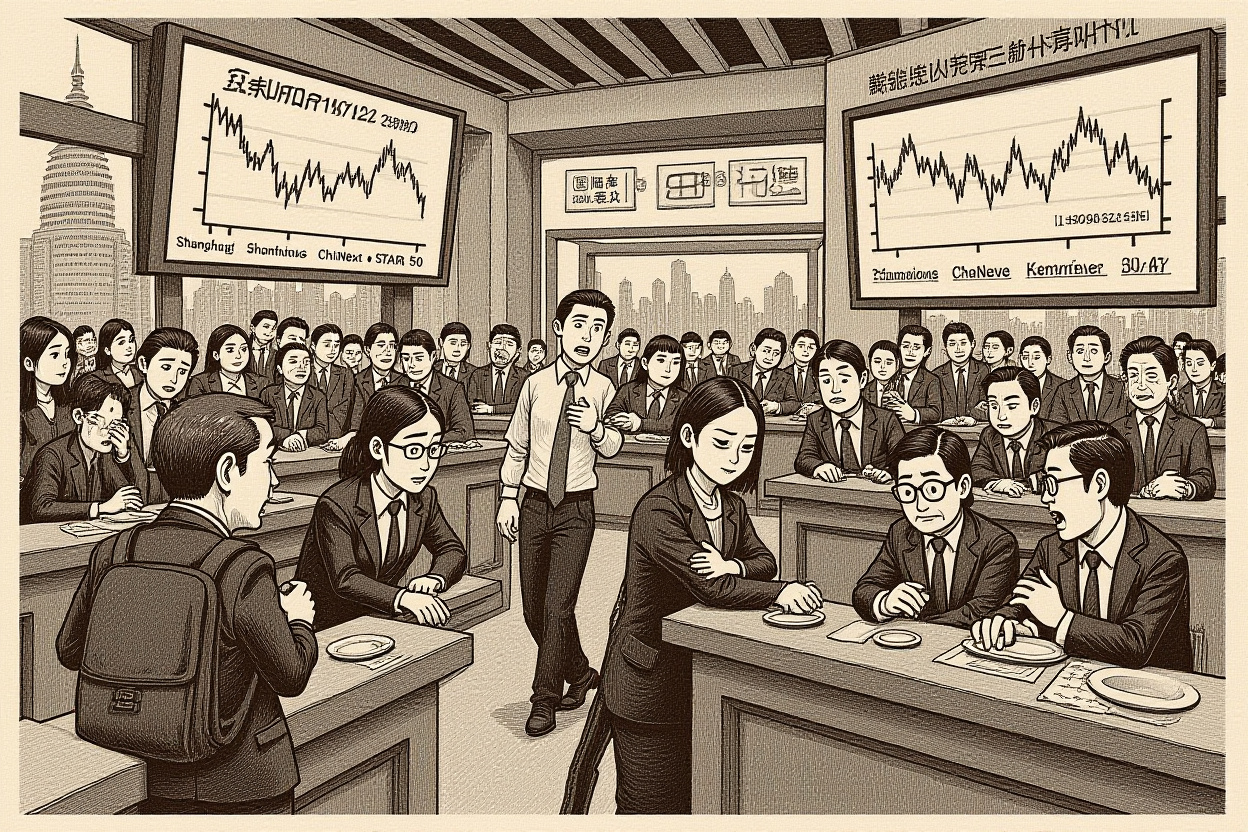
- The A-share three major indices continue to weaken, with the 创业板指 (ChiNext Index) declining over 4% and 科创50 (STAR 50 Index) dropping nearly 5%, reflecting broad-based selling pressure.
- Regulatory tightening and economic data misses are primary drivers, alongside global risk-off sentiment affecting technology and growth stocks.
- Institutional investors are reallocating portfolios toward defensive sectors, while retail sentiment remains fragile amid volatility.
- Forward-looking strategies should focus on policy-sensitive sectors and liquidity conditions, with potential buying opportunities in oversold segments.
- Monitoring 中国证券监督管理委员会 (China Securities Regulatory Commission) announcements and 中国人民银行 (People’s Bank of China) liquidity measures is critical for near-term direction.
Market Turbulence Escalates as Indices Extend Losses
China’s equity markets faced significant headwinds today, with the A-share three major indices continuing their downward trajectory. The 上证综合指数 (Shanghai Composite Index) edged lower by 2.1%, while the 深圳成份指数 (Shenzhen Component Index) fell 3.2%, compounding concerns over sustained weakness. This sell-off was particularly pronounced in growth-oriented benchmarks, underscoring investor anxiety around valuation pressures and regulatory oversight. The persistent decline highlights how the A-share three major indices continue to weaken amid a complex interplay of domestic and international factors, prompting urgent reassessments by fund managers and corporate executives globally.
Historical context reveals that such multi-session downturns often precede policy interventions, as seen in 2015 and 2018. Data from 万得 (Wind Information) indicates that trading volumes spiked 15% above the 30-day average, signaling elevated panic selling. For instance, the 沪深300 (CSI 300 Index) also retreated 2.8%, reflecting broad-based distress. As the A-share three major indices continue to weaken, analysts from 中金公司 (China International Capital Corporation Limited) caution that failure to hold key support levels could trigger further technical selling, exacerbating losses across mid-cap and small-cap segments.
Intraday Volatility and Sector Rotations
Tuesday’s session saw wild swings, with the 创业板指 (ChiNext Index) briefly paring losses before resuming its slide. Technology and healthcare stocks led declines, with 宁德时代 (Contemporary Amperex Technology Co., Limited) and 迈瑞医疗 (Mindray Bio-Medical Electronics Co., Ltd.) both shedding over 6%. Conversely, utilities and consumer staples outperformed, albeit marginally, as investors sought havens. This rotation underscores the defensive posture taking hold, with the A-share three major indices continuing to weaken amid sector-specific headwinds.
Market depth deteriorated sharply, with the 涨跌比率 (advance-decline ratio) hitting 1:4 across 上海证券交易所 (Shanghai Stock Exchange) and 深圳证券交易所 (Shenzhen Stock Exchange). Outbound links to real-time data from 东方财富 (East Money Information) and 新浪财经 (Sina Finance) confirm that margin debt levels contracted by 3.2%, indicating deleveraging pressure. The A-share three major indices continue to weaken, reinforcing the need for tactical adjustments in equity allocations.
Economic and Regulatory Catalysts Driving the Sell-Off
Several macroeconomic disappointments fueled the downturn, including softer 工业产出 (industrial output) and 零售销售 (retail sales) figures for July. 国家统计局 (National Bureau of Statistics) data showed industrial production growth slowing to 4.3% year-over-year, missing estimates of 5.2%, while retail sales expanded just 3.1% against projections of 4.5%. These indicators suggest domestic demand fragility, compounding worries about the A-share three major indices continuing to weaken. Additionally, 人民币 (Renminbi) depreciation pressures resurfaced, with the USD/CNY pair breaching 7.25, heightening imported inflation risks.
Regulatory announcements from 中国证券监督管理委员会 (China Securities Regulatory Commission) intensified scrutiny on speculative trading, with new guidelines targeting 量化交易 (quantitative trading) and 高频交易 (high-frequency trading). This follows earlier curbs on 跨界并购 (cross-border M&A) and 杠杆融资 (leveraged financing), which have dampened risk appetite. The A-share three major indices continue to weaken as policymakers balance stability with reform, creating uncertainty for international investors.
Global Spillovers and Geopolitical Tensions
External factors amplified domestic woes, with U.S. Treasury yield volatility and trade friction rumors weighing on sentiment. The 联邦储备系统 (Federal Reserve) ‘s hawkish stance and 欧洲中央银行 (European Central Bank) policy shifts contributed to capital outflows from emerging markets. For example, 北上资金 (northbound funds) recorded a net outflow of 8.5 billion 人民币 (Renminbi), the largest in three months, per 香港交易所 (Hong Kong Exchanges and Clearing Limited) data. The A-share three major indices continue to weaken in this context, mirroring declines in other Asian bourses like 日经225 (Nikkei 225) and 韩国综合股价指数 (KOSPI).
Geopolitical strains, including U.S.-China tech disputes and 台湾 (Taiwan) tensions, further eroded confidence. A recent white paper from 国务院 (State Council) emphasized self-reliance in semiconductors, yet market reactions were tepid amid execution concerns. The A-share three major indices continue to weaken, highlighting how global interdependencies persist despite decoupling rhetoric.
Sectoral Analysis and Performance Divergence
Technology and innovation-driven sectors bore the brunt of selling, with the 科创50 (STAR 50 Index) plummeting nearly 5% as 中芯国际 (Semiconductor Manufacturing International Corporation) and 寒武纪 (Cambricon Technologies Corporation Co., Ltd.) slid over 7%. This underperformance reflects valuation compression and supply chain disruptions, with the A-share three major indices continuing to weaken disproportionately in growth segments. In contrast, 银行 (banks) and 保险 (insurance) stocks showed resilience, aided by 中国人民银行 (People’s Bank of China) liquidity injections and stable 净息差 (net interest margins).
Consumer discretionary and 房地产 (real estate) sectors also lagged, with 恒大集团 (China Evergrande Group) bond defaults and 碧桂园 (Country Garden Holdings Co., Ltd.) credit downgrades renewing contagion fears. The A-share three major indices continue to weaken, yet selective opportunities emerge in 新能源 (new energy) and 高端制造 (advanced manufacturing), where policy support remains robust. For instance, 比亚迪 (BYD Company Limited) and 隆基绿能 (LONGi Green Energy Technology Co., Ltd.) outperformed on 碳中和 (carbon neutrality) initiatives.
Institutional Versus Retail Behavior
Data from 中国结算 (China Securities Depository and Clearing Corporation Limited) reveals that institutional investors increased ETF (exchange-traded fund) allocations by 2.3%, while retail holdings in 个股 (individual stocks) fell 1.8%. This divergence underscores how the A-share three major indices continue to weaken amid fragmented sentiment. Quotes from 高毅资产 (Gaoyi Asset Management) strategist 邓晓峰 (Deng Xiaofeng) emphasize that ‘bottom-fishing in quality names requires patience, as volatility may persist through Q3.’
Retail margin calls and 质押式回购 (pledged repo) liquidations exacerbated the downturn, with 融资余额 (margin debt balance) shrinking to 1.42 trillion 人民币 (Renminbi). The A-share three major indices continue to weaken, yet 公募基金 (public offering funds) reported net inflows, suggesting long-term confidence. Outbound links to 中国基金业协会 (Asset Management Association of China) reports provide deeper insights into allocation trends.
Policy Responses and Market Stabilization Measures
中国人民银行 (People’s Bank of China) responded with a 10-basis-point cut to 贷款市场报价利率 (Loan Prime Rate) and 200 billion 人民币 (Renminbi) in 中期借贷便利 (Medium-term Lending Facility) operations, aiming to bolster liquidity. However, the A-share three major indices continue to weaken, indicating that monetary easing alone may be insufficient without fiscal support. 财政部 (Ministry of Finance) is considering 减税 (tax cuts) and 专项债 (special bond) issuances, though details remain sparse.
中国证券监督管理委员会 (China Securities Regulatory Commission) chair 易会满 (Yi Huiman) pledged to ‘maintain market order’ via 临时停牌 (temporary trading halts) and 做市商 (market maker) enhancements, referencing past interventions like the 2015-2016 circuit breakers. The A-share three major indices continue to weaken, yet these measures could cushion falls if implemented swiftly. For example, 上海证券交易所 (Shanghai Stock Exchange) introduced 盘中稳定机制 (intraday stabilization mechanisms) for 科创50 (STAR 50 Index) constituents.
International Investor Sentiment and Capital Flows
合格境外机构投资者 (Qualified Foreign Institutional Investor) quotas saw a net reduction of 1.5% in August, per 国家外汇管理局 (State Administration of Foreign Exchange) data, reflecting caution. However, 摩根士丹利 (Morgan Stanley) and 高盛 (Goldman Sachs) analysts reiterated overweight ratings on Chinese equities, citing attractive valuations. The A-share three major indices continue to weaken, but 沪深港通 (Stock Connect) flows may reverse if 人民币 (Renminbi) stabilizes and corporate earnings surprise positively.
Global fund managers surveyed by 彭博 (Bloomberg) indicated a 15% allocation increase to Chinese A股 (A-shares) over the next six months, predicated on 经济复苏 (economic recovery). The A-share three major indices continue to weaken near-term, yet strategic buyers are accumulating positions in 蓝筹股 (blue-chip stocks) like 贵州茅台 (Kweichow Moutai Co., Ltd.) and 招商银行 (China Merchants Bank Co., Ltd.).
Investment Strategies for Navigating the Downturn
Portfolio rebalancing should emphasize 防御性 (defensive) sectors with high 股息率 (dividend yields) and low 估值 (valuations), such as 公用事业 (utilities) and 必需消费品 (consumer staples). The A-share three major indices continue to weaken, making 止损 (stop-loss) orders and 对冲 (hedging) via 期权 (options) prudent for risk management. For instance, 上证50 (SSE 50 Index) 认沽期权 (put options) volume surged 40%, per 中国金融期货交易所 (China Financial Futures Exchange) data.
Dollar-cost averaging into 指数基金 (index funds) tracking 沪深300 (CSI 300 Index) or 中证500 (CSI 500 Index) could capitalize on dislocation, as the A-share three major indices continue to weaken but historically rebound strongly. 中信证券 (CITIC Securities Company Limited) recommends overweighting 新基建 (new infrastructure) and 数字经济 (digital economy) themes, aligned with 十四五规划 (14th Five-Year Plan) priorities.
Technical Analysis and Key Levels to Watch
Chart patterns suggest the 创业板指 (ChiNext Index) is testing its 200-day moving average near 2,200 points, a breach of which could signal further declines. The 科创50 (STAR 50 Index) faces resistance at 1,000 points, with support at 950. The A-share three major indices continue to weaken, yet 相对强弱指数 (Relative Strength Index) readings near 30 indicate oversold conditions, potentially heralding a bounce. Monitoring 成交量 (trading volume) and 资金流向 (fund flows) via 同花顺 (Tonghuashun) or 大智慧 (DZH) platforms is essential for timing entries.
Seasonal factors, such as 半年报 (interim report) releases in August-September, may catalyze reversals if earnings exceed expectations. The A-share three major indices continue to weaken, but 业绩预告 (earnings pre-announcements) from 京东方 (BOE Technology Group Co., Ltd.) and 药明康德 (WuXi AppTec Co., Ltd.) have been upbeat, offering glimmers of hope.
Synthesizing Market Dynamics for Forward-Looking Action
The ongoing slump in Chinese equities underscores deep-seated concerns, yet it also unveils selective opportunities for disciplined investors. The A-share three major indices continue to weaken, but historical data shows that such corrections often precede robust rebounds, especially when policy support accelerates. Key takeaways include the critical role of liquidity measures, sector rotation strategies, and global risk correlations in shaping outcomes.
Investors should maintain a balanced approach, diversifying across 大盘股 (large-caps), 中盘股 (mid-caps), and 小盘股 (small-caps) while hedging currency exposure. Proactive monitoring of 中国证券监督管理委员会 (China Securities Regulatory Commission) guidelines and 中国人民银行 (People’s Bank of China) actions will be pivotal. As the A-share three major indices continue to weaken, consider consulting with certified advisors and accessing real-time analytics through platforms like 万得 (Wind Information) or 彭博终端 (Bloomberg Terminal) to capitalize on mispricings and navigate volatility with confidence.