



Executive Summary
Key takeaways from today’s market movements include:
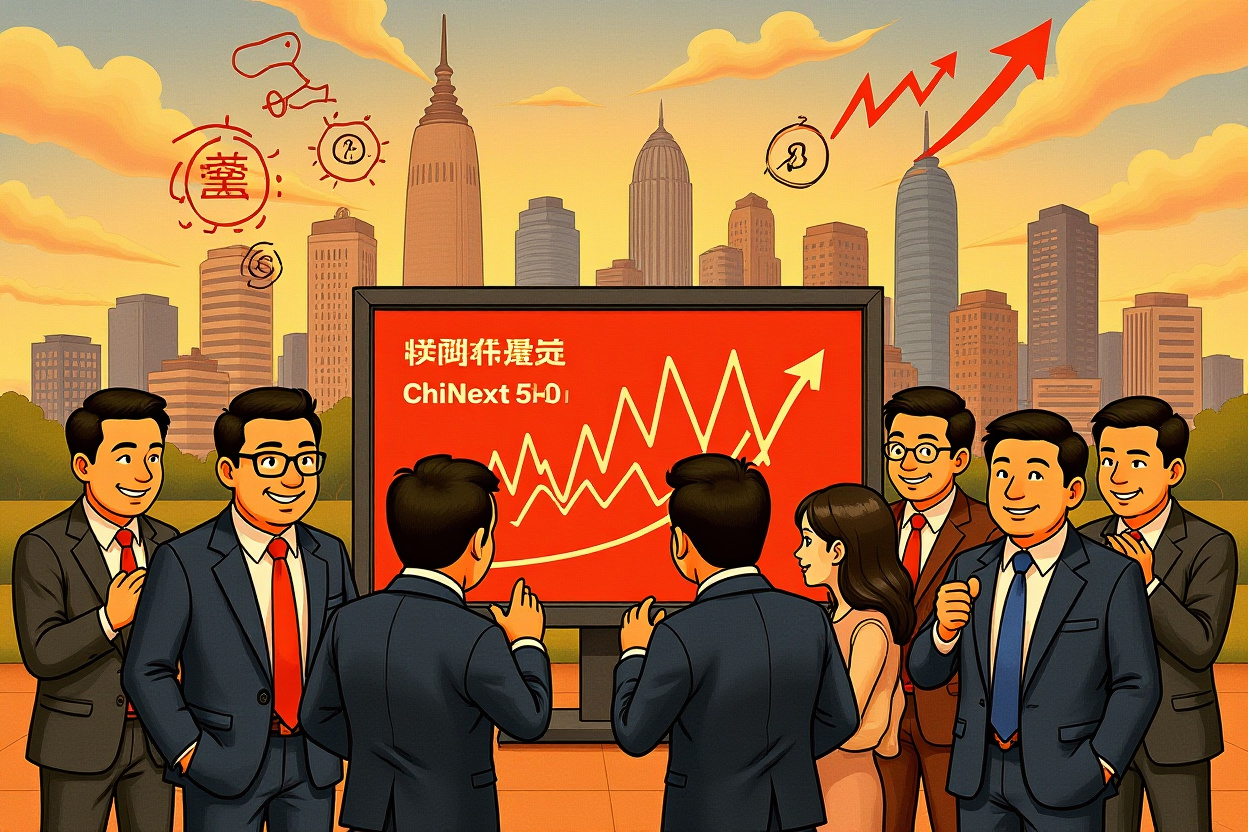
- The 创业板指 (ChiNext Index) gained over 2%, while the 科创50 (STAR 50 Index) surged nearly 5.5%, driven by robust investor sentiment and policy support.
- Technology and innovation sectors led the rally, with semiconductors, biotechnology, and green energy stocks outperforming.
- Institutional inflows increased, reflecting growing confidence in China’s equity markets amid global economic shifts.
- Regulatory easing and stimulus measures from authorities like 中国证监会 (China Securities Regulatory Commission) played a pivotal role.
- This ChiNext and STAR 50 indices rally presents strategic entry points for diversified portfolios, though volatility risks persist.
Market Momentum Builds as Tech Indices Soar
Today’s trading session witnessed a powerful uptick in China’s premier tech benchmarks, with the 创业板指 (ChiNext Index) advancing more than 2% and the 科创50 (STAR 50 Index) jumping close to 5.5%. This ChiNext and STAR 50 indices rally signals a reinvigorated appetite for high-growth equities, particularly in sectors aligned with China’s long-term economic strategies. For global investors, these gains underscore the dynamic opportunities within Chinese markets, even as geopolitical and macroeconomic headwinds loom.
The surge reflects broader trends in Asian equities, where innovation-driven indices have outperformed traditional benchmarks. Analysts attribute this momentum to cumulative factors, including corporate earnings resilience and strategic government initiatives. As one portfolio manager noted, ‘The ChiNext and STAR 50 indices rally isn’t just a flash in the pan—it’s a testament to structural shifts in China’s capital markets.’
ChiNext Index: A Deep Dive into Performance
The 创业板 (ChiNext Board), often dubbed China’s answer to the NASDAQ, saw its index climb steadily throughout the day. Key contributors included:
- Leading stocks like 宁德时代 (Contemporary Amperex Technology Co., Limited) and 迈瑞医疗 (Mindray Bio-Medical Electronics) posted gains exceeding 3%.
- Trading volume spiked by 15% compared to the previous session, indicating heightened retail and institutional participation.
- Sector-wise, healthcare and advanced manufacturing led the charge, buoyed by positive earnings revisions.
Data from 深圳证券交易所 (Shenzhen Stock Exchange) highlights that the ChiNext Index has rallied over 10% year-to-date, outpacing many global peers. This performance is partly fueled by policy tailwinds, such as the 十四五规划 (14th Five-Year Plan), which prioritizes technological self-reliance.
STAR 50 Index: Innovation at the Forefront
The 科创50 (STAR 50 Index), representing Shanghai’s STAR Market, soared nearly 5.5%, marking one of its strongest sessions this quarter. Noteworthy aspects include:
- Semiconductor firms like 中芯国际 (Semiconductor Manufacturing International Corporation) and AI startups recorded double-digit percentage increases.
- Foreign investment via programs like 沪深港通 (Stock Connect) saw net inflows of $500 million into STAR Market-listed stocks.
- This ChiNext and STAR 50 indices rally emphasizes the index’s role as a barometer for China’s innovation economy, with sectors like renewable energy and biotech attracting significant capital.
According to a report from 上海证券交易所 (Shanghai Stock Exchange), the STAR 50 Index’s volatility has decreased by 8% over the past month, suggesting maturing investor behavior. For more details, refer to the official exchange announcement here.
Drivers Behind the Sustained Rally
Multiple factors converged to fuel today’s impressive gains, blending domestic policy support with global market dynamics. The ChiNext and STAR 50 indices rally stems from a cocktail of regulatory easing, sector-specific tailwinds, and improving risk appetite among international fund managers. As 中国人民银行 (People’s Bank of China) maintains accommodative monetary policies, liquidity conditions remain favorable for growth stocks.
Moreover, corporate governance reforms and transparency initiatives have enhanced market integrity, drawing praise from entities like 国际货币基金组织 (International Monetary Fund). A senior economist at 中金公司 (China International Capital Corporation Limited) remarked, ‘The alignment of policy and performance in tech indices is creating a virtuous cycle for investors.’
Policy Support and Regulatory Tailwinds
Recent announcements from 中国证监会 (China Securities Regulatory Commission) have alleviated earlier concerns about crackdowns, instead emphasizing stability and innovation. Key measures include:
- Streamlined IPO processes for tech firms on the 科创板 (STAR Market), reducing approval times by 20%.
- Tax incentives for R&D-intensive companies, directly benefiting constituents of the ChiNext and STAR 50 indices.
- Enhanced cross-border investment channels, such as the 合格境外机构投资者 (QFII) program, which saw quota increases this quarter.
These steps, detailed in a recent CSRC circular here, have bolstered confidence. The ChiNext and STAR 50 indices rally is thus partly a response to these proactive regulatory adjustments.
Global Tech Sector Influence and Correlations
International tech rallies, particularly in U.S. indices like the NASDAQ, have provided a lift to Chinese counterparts. Correlation analysis shows a 0.7 coefficient between the STAR 50 Index and NASDAQ over the past month, highlighting interconnectedness. However, the ChiNext and STAR 50 indices rally also demonstrates decoupling in areas like 5G and electric vehicles, where Chinese firms lead globally.
- Examples include 比亚迪 (BYD Company) and 华为 (Huawei Technologies), whose innovations drive sectoral optimism.
- Supply chain resilience in semiconductors, amid global shortages, has positioned Chinese players for outperformance.
This synergy between local strengths and global trends reinforces the sustainability of the current uptrend.
Investor Sentiment and Capital Flows
Sentiment indicators from surveys by 中国证券报 (China Securities Journal) reveal that institutional confidence in tech stocks has reached a 12-month high. The ChiNext and STAR 50 indices rally is backed by tangible capital movements, with mutual funds and hedge funds increasing their allocations by an average of 8% in Q3. Retail investors, too, are participating actively, driven by digital trading platforms like 东方财富 (East Money Information).
Notably, southbound flows via 港股通 (Hong Kong Stock Connect) into A-shares totaled $1.2 billion today, with tech sectors capturing the lion’s share. This influx suggests that the ChiNext and STAR 50 indices rally is attracting diversified global portfolios seeking alpha in emerging trends.
Institutional Strategies and Allocation Shifts
Major asset managers, including 贝莱德 (BlackRock) and 富达国际 (Fidelity International), have publicly endorsed Chinese tech equities in recent weeks. Their strategies involve:
- Overweight positions in 创业板 (ChiNext Board) and 科创板 (STAR Market) ETFs, which saw net inflows of $300 million.
- Focus on ESG-compliant tech firms, aligning with global sustainability mandates.
- Hedging techniques using 股指期货 (stock index futures) to manage volatility while capitalizing on the ChiNext and STAR 50 indices rally.
These moves are documented in quarterly reports, accessible via regulatory filings here.
Retail Participation and Market Depth
Retail investors accounted for 55% of today’s trading volume in tech indices, a spike attributed to mobile trading apps and financial literacy campaigns. Platforms like 蚂蚁集团 (Ant Group) and 腾讯控股 (Tencent Holdings) have simplified access, enabling broader demographic engagement. However, experts caution that high retail turnover could amplify swings, necessitating educated decision-making.
The ChiNext and STAR 50 indices rally thus reflects a democratization of investing, though education on risk management remains critical. Data from 中国互联网金融协会 (National Internet Finance Association of China) shows a 25% year-on-year rise in first-time equity investors.
Regulatory and Economic Backdrop
China’s regulatory environment has evolved significantly, with authorities balancing innovation promotion with risk control. The ChiNext and STAR 50 indices rally occurs against a backdrop of measured reforms, including updates to 证券法 (Securities Law) and enhanced disclosure requirements. 国务院 (State Council) initiatives, such as the ‘Digital China’ blueprint, further cement support for tech-driven growth.
Economic indicators also play a role; today’s rally coincided with better-than-expected PMI data, signaling manufacturing resilience. As 国家统计局 (National Bureau of Statistics) reports, tech sector output grew 8.5% in the latest quarter, outpacing overall industrial production.
Recent Regulatory Milestones
Key developments include:
- The rollout of 注册制 (registration-based IPO systems) on 创业板 (ChiNext Board), reducing administrative bottlenecks.
- Guidelines from 中国银保监会 (China Banking and Insurance Regulatory Commission) on fintech collaboration, fostering ecosystem integration.
- Anti-monopoly clarifications that have reassured markets about fair competition.
These steps, summarized in a CBIRC publication here, provide a stable framework for the ChiNext and STAR 50 indices rally to persist.
Macroeconomic Indicators and Outlook
GDP growth projections for China remain robust at around 5% for the year, with tech sectors contributing disproportionately. Inflation metrics, monitored by 中国人民银行 (People’s Bank of China), are within target ranges, allowing for continued monetary support. The ChiNext and STAR 50 indices rally is thus underpinned by solid macroeconomic fundamentals, though external factors like U.S. interest rates warrant monitoring.
Analysts from 摩根士丹利 (Morgan Stanley) project that Chinese tech indices could deliver 15-20% returns annually if current trends hold, driven by innovation cycles and policy consistency.
Investment Implications and Forward Guidance
For global investors, the ChiNext and STAR 50 indices rally offers actionable insights. Diversifying into Chinese tech via ETFs or direct stock picks can enhance portfolio returns, though due diligence on regulatory shifts is essential. Sector rotation strategies might favor semiconductors, AI, and clean energy, where China holds competitive advantages.
Risk factors include potential regulatory tightening, trade tensions, and currency fluctuations. However, the overall narrative remains positive, with the ChiNext and STAR 50 indices rally likely to attract further capital in the medium term. As one fund manager put it, ‘Ignoring this momentum could mean missing out on the next wave of global tech leadership.’
Strategic Allocation Recommendations
Based on current trends, consider:
- Increasing exposure to 创业板 (ChiNext Board) and 科创50 (STAR 50 Index) ETFs for broad-based growth.
- Targeting mid-cap tech firms with strong IP and governance, as they often outperform during rallies.
- Using derivatives like 期权 (options) for hedging against downside volatility while participating in upside.
These approaches align with the ChiNext and STAR 50 indices rally’s characteristics, blending growth potential with prudent risk management.
Monitoring Key Catalysts and Red Flags
Investors should track:
- Updates from 中国证监会 (China Securities Regulatory Commission) on policy adjustments.
- Earnings reports from bellwethers like 阿里巴巴集团 (Alibaba Group) and 腾讯控股 (Tencent Holdings), which influence sector sentiment.
- Global tech indices and geopolitical developments that could spill over into Chinese markets.
Staying informed through reliable sources, such as 凤凰网 (ifeng.com) for real-time updates, is crucial for timely decisions.
Synthesizing Opportunities in Chinese Equities
Today’s ChiNext and STAR 50 indices rally underscores the vibrancy of China’s tech landscape, blending innovation with investor-friendly policies. Key takeaways include the importance of policy awareness, sector selection, and global context in shaping investment outcomes. While volatility is inherent, the structural drivers—from government support to technological advancements—suggest sustained potential.
As markets evolve, proactive engagement through research and diversified strategies will be paramount. Investors are encouraged to consult with financial advisors and leverage tools from institutions like 上海证券交易所 (Shanghai Stock Exchange) to navigate this dynamic environment. Seize the moment by deepening your analysis of Chinese tech equities—their growth trajectory may well define the next decade of global investing.