



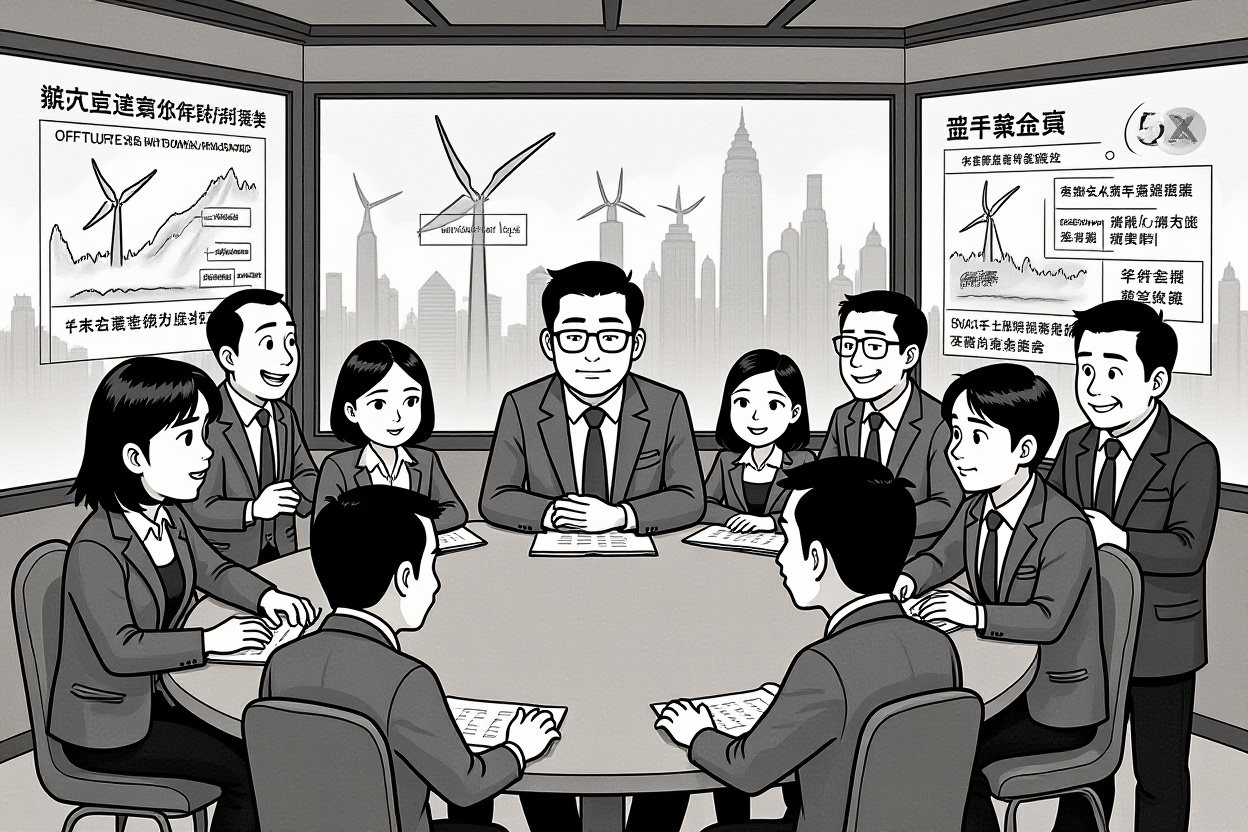
Market Shift as Wind Power Emerges from Downturn
China’s wind power industry is witnessing a remarkable transformation as Morgan Stanley’s recent rating upgrade signals a definitive end to the sector’s prolonged downturn. After nearly three years of intense competition and margin pressure, the industry’s collective anti-involution efforts have finally borne fruit, with early 2025 marking the inflection point for pricing power and profitability restoration. This anti-involution success story represents a crucial case study in market self-correction within China’s renewable energy landscape, offering valuable insights for global investors monitoring the country’s clean energy transition. The sector’s resilience demonstrates how strategic industry coordination can overcome cyclical challenges while aligning with national carbon neutrality goals.
The timing of this recovery couldn’t be more strategic, coinciding with China’s intensified focus on energy security and the upcoming 15th Five-Year Plan period. International investors who had grown cautious during the sector’s consolidation phase are now repositioning themselves to capture the upside potential. This anti-involution achievement underscores the maturity developing within China’s renewable energy markets, where quality and sustainability are gradually superseding pure cost competition as key investment criteria.
Key Market Insights
– Morgan Stanley’s upgrade reflects confidence in sustained wind power demand growth, with annual installations expected to exceed 110GW during the 15th Five-Year Plan period
– Price recovery is underway with onshore turbine costs rising 8% and offshore turbines increasing 12% year-over-year in 2025
– Industry self-regulation through the Fair Competition Self-Discipline Convention has effectively curbed destructive pricing practices
– Wind power’s investment attractiveness surpasses solar due to superior power curve characteristics and stable tariff prospects
– Offshore wind projects in Guangdong, Shandong, and Jiangsu are poised for accelerated development following anticipated regulatory support
Industry Self-Discipline Catalyzes Price Recovery
The wind power sector’s successful anti-involution strategy stems from a multi-pronged approach that addressed fundamental market imbalances. Morgan Stanley analyst Eva Hou (侯伊娃) emphasizes that the industry’s turnaround represents a textbook example of market forces and regulatory wisdom converging at the right moment. The anti-involution measures have not only stabilized prices but also improved overall industry health by shifting focus from quantity to quality metrics.
Demand Growth and Bidding Trends
Market data reveals impressive momentum building across the wind power value chain. Annual new installations have surged from 48GW in 2021 to 79GW in 2024, while bidding volumes have tripled from 54GW to 164GW during the same period. This demand acceleration has provided the necessary scale for manufacturers to achieve better economies while maintaining pricing discipline. The anti-involution environment has enabled companies to prioritize technological innovation over destructive price wars, leading to more sustainable business models.
Project pipelines continue to expand robustly, with state-owned enterprises leading the charge. China Datang Corporation (中国大唐集团) and China Huaneng Group (中国华能集团) have both announced ambitious wind power expansion plans, citing improved returns under the new market structure. The anti-involution success has created a virtuous cycle where higher quality standards justify premium pricing, which in turn funds further research and development investments.
Self-Regulation Mechanisms
The October 2024 signing of the China Wind Power Industry Fair Competition Self-Discipline Convention by twelve major manufacturers marked a watershed moment for sector governance. This anti-involution framework established clear guidelines for responsible bidding practices and quality standards, addressing concerns that had emerged following several high-profile turbine failures. The convention’s implementation demonstrates how industry-led initiatives can complement regulatory oversight in creating healthy market conditions.
Participants in the self-regulation scheme report improved project viability and better risk management outcomes. The anti-involution mechanism has particularly benefited smaller component suppliers who previously struggled with unpredictable order volumes and margin compression. By stabilizing the competitive landscape, the industry has created a more predictable environment for long-term investment planning across the value chain.
15th Five-Year Plan: A New Era for Wind Power
China’s upcoming 15th Five-Year Plan (2026-2030) positions wind power as a cornerstone of the country’s energy strategy, with ambitious targets that reflect confidence in the sector’s anti-involution transformation. Policy documents indicate that wind installation will accelerate significantly during this period, potentially reaching 120GW annually by 2028-2030. This growth trajectory underscores how the anti-involution achievements have aligned industry capabilities with national strategic objectives.
Installation Targets and Projections
Morgan Stanley’s analysis suggests the 15th Five-Year Plan will catalyze unprecedented wind power development, with cumulative installations potentially exceeding 600GW by 2030. This projection factors in the sector’s enhanced anti-involution maturity, which enables more efficient project execution and better resource allocation. The investment bank’s models indicate that wind power could capture approximately 40% of China’s new renewable energy capacity additions during the plan period.
Regional development patterns show interesting variations, with northern provinces focusing on large-scale onshore projects while coastal regions prioritize offshore wind farms. The anti-involution framework has helped standardize development approaches across regions, reducing duplication and improving coordination between provincial energy bureaus. This harmonization is critical for optimizing grid integration and maximizing the value of wind power investments.
Policy Drivers
Document No. 136, issued by the National Development and Reform Commission (国家发展和改革委员会), provides crucial policy support for the wind power sector’s anti-involution transition. The document establishes favorable tariff mechanisms and grid connection guarantees that enhance project bankability. These policy enhancements reflect lessons learned from earlier development phases where inadequate support mechanisms sometimes undermined project economics.
The anti-involution alignment between policy and market realities has created unusually favorable conditions for wind power investment. Industry participants note that current policies effectively balance developer returns with consumer affordability, creating sustainable growth conditions. This policy-market synergy represents a significant improvement over previous cycles where misaligned incentives sometimes led to suboptimal outcomes.
Wind vs. Solar: Investment Attractiveness
The renewed investor interest in wind power reflects fundamental advantages that have become more apparent following the sector’s anti-involution restructuring. Compared to solar PV, wind power offers superior capacity factors and more predictable generation profiles, which translate into better revenue stability for project developers. This anti-involution driven quality focus has accentuated wind power’s inherent strengths relative to other renewable options.
Comparative Advantages
Wind power’s technological evolution has produced turbines with capacity factors exceeding 40% in optimal locations, compared to solar PV’s typical 15-25% range. This efficiency advantage becomes increasingly valuable as grid integration challenges grow more complex. The anti-involution environment has accelerated innovation in turbine design and materials, further widening wind power’s performance lead over alternative technologies.
Power purchase agreement structures also favor wind development in the current anti-involution context. Wind farms typically secure longer-term contracts with more favorable curtailment provisions, reducing revenue uncertainty. This contractual stability has become particularly valuable as renewable penetration increases and grid management becomes more challenging.
Developer Preferences
Major energy developers are rebalancing their portfolios to reflect wind power’s enhanced attractiveness in the post-anti-involution landscape. Huadian New Energy (华电新能源) has committed to a 1:1 wind-solar installation ratio during the 15th Five-Year Plan period, while CGN New Energy (中广核新能源) is targeting a 2:1 wind-solar mix. These allocation decisions signal confidence in wind power’s ability to deliver superior returns under the new market structure.
The anti-involution transformation has particularly influenced developer preferences for offshore wind projects, where quality and reliability considerations outweigh pure cost factors. This shift toward value-based decision making represents a fundamental improvement in market dynamics that benefits all stakeholders. Developers report that the anti-involution environment has made project financing more accessible and cost-effective, further enhancing wind power’s competitive position.
Offshore Wind Power Acceleration
Offshore wind development is emerging as a major growth vector within China’s broader wind power anti-involution narrative. With vast maritime resources and strong coastal demand centers, offshore projects offer scale advantages that complement onshore development. The anticipated Deep Sea Offshore Wind Power Development Management Measures, expected in late 2025 or early 2026, will provide further impetus to this segment’s anti-involution maturation.
Regulatory Support
The forthcoming offshore wind regulations represent the next phase in the sector’s anti-involution evolution, addressing specific challenges related to deep-water development and grid connection. These measures will establish clear frameworks for project approval, environmental assessment, and power offtake arrangements. The regulatory certainty provided by these rules is essential for attracting the large-scale investment required for offshore wind expansion.
Industry participants anticipate that the new regulations will incorporate lessons from European offshore wind markets while adapting best practices to Chinese conditions. This calibrated approach exemplifies the sophisticated policy development now characterizing China’s renewable energy sector. The anti-involution principles applied to offshore wind regulation emphasize sustainable development rather than rapid capacity expansion at any cost.
Regional Hotspots
Guangdong, Shandong, and Jiangsu provinces are leading China’s offshore wind charge, with combined targets exceeding 30GW by 2030. These regions benefit from strong wind resources, proximity to load centers, and supportive provincial governments. The anti-involution framework has helped coordinate development across these regions, avoiding the duplication and overcapacity issues that sometimes plagued earlier renewable energy booms.
Project economics continue to improve as technology costs decline and execution capabilities mature. The anti-involution environment has fostered healthy competition among offshore wind developers while maintaining discipline in bidding processes. This balance between competition and sustainability represents a significant achievement that bodes well for the segment’s long-term development.
Investment Implications and Value Chain Opportunities
The wind power sector’s anti-involution success creates compelling opportunities across the value chain, from turbine manufacturing to specialized components and service providers. Investors should focus on companies with strong technological capabilities and sustainable business models that align with the new market paradigm. The anti-involution transformation has fundamentally altered risk-return profiles, making thorough due diligence more important than ever.
Key Sectors to Watch
Morgan Stanley highlights particular promise in submarine cable manufacturers and advanced component suppliers who benefit from the industry’s quality focus. Companies like Zhongtian Technology (中天科技) and Hengtong Optic-Electric (亨通光电) are well-positioned to capitalize on offshore wind expansion. The anti-involution environment rewards technological leadership and operational excellence, creating clear differentiation among market participants.
Wind turbine OEMs with strong R&D capabilities and service networks offer attractive exposure to the sector recovery. The anti-involution dynamics have increased barriers to entry while rewarding scale and innovation, benefiting established players. Investors should monitor order book quality and aftermarket service revenue streams when evaluating turbine manufacturers.
Risk Assessment
While the anti-involution progress is encouraging, investors must remain mindful of potential challenges. Grid integration constraints, raw material price volatility, and potential policy shifts represent ongoing concerns. However, the sector’s demonstrated ability to navigate the anti-involution transition suggests enhanced resilience to these headwinds.
The anti-involution framework itself requires vigilant maintenance to prevent backsliding into destructive competition. Industry participants and regulators must continue collaborating to uphold quality standards and responsible bidding practices. This ongoing commitment to anti-involution principles is essential for sustaining the sector’s hard-won gains.
Strategic Positioning for the Recovery Cycle
China’s wind power sector stands at an inflection point, with the anti-involution transformation creating sustainable growth conditions for the first time in years. The combination of robust demand fundamentals, supportive policies, and industry discipline suggests this recovery cycle has staying power. Investors should consider increasing allocation to quality wind power companies while maintaining diversification across the value chain.
The anti-involution success story offers broader lessons for China’s renewable energy development model, demonstrating how market forces and strategic oversight can combine to create healthy industry ecosystems. As the 15th Five-Year Plan approaches, wind power’s role in China’s energy mix appears more secure than ever. Market participants should monitor implementation of key policies and technological advancements to optimize their positioning within this evolving landscape.