



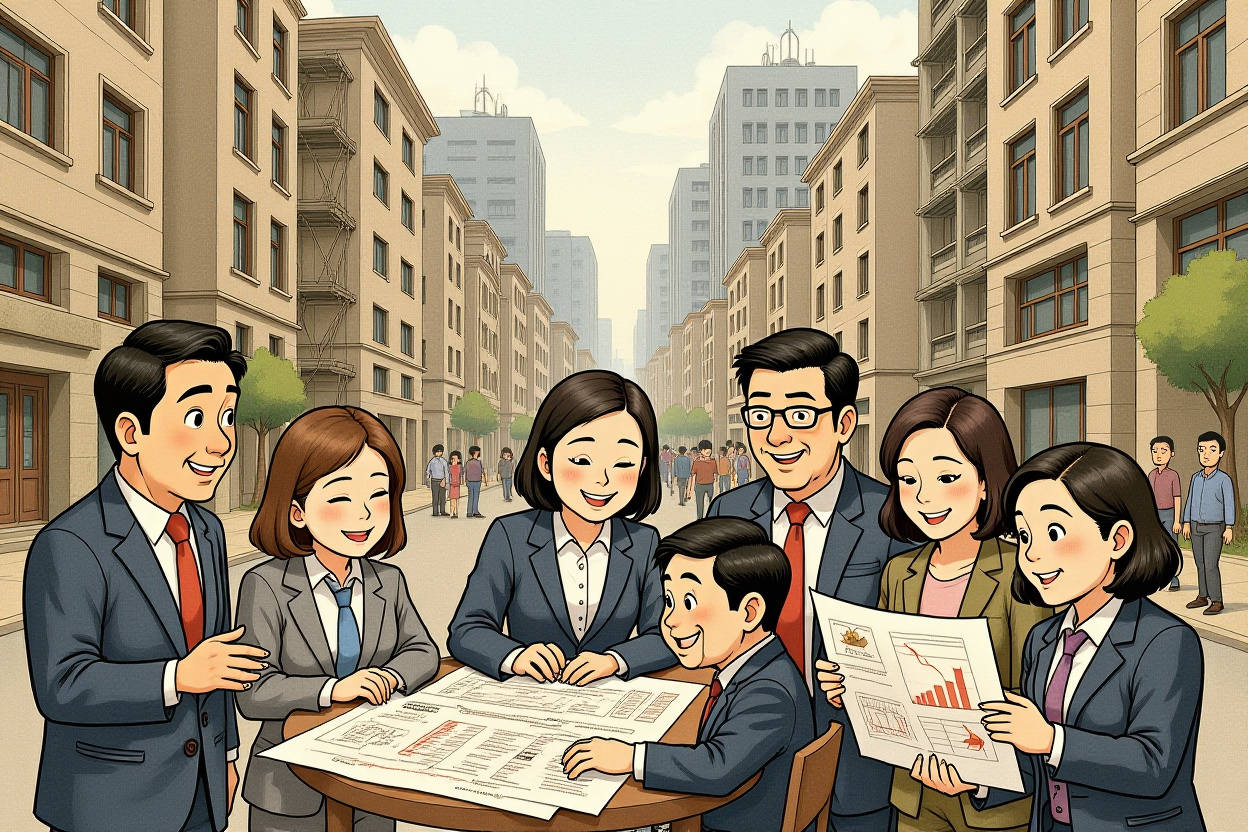
The dream of getting rich overnight through demolition compensation is fading fast across China’s cities. In its place, a new reality is emerging: the era of self-funded demolition and renewal. Owners of old, dilapidated homes are stepping up, taking matters into their own hands to improve their living conditions. This shift marks a dramatic departure from the past, where residents could expect hefty payouts from developers or local governments. Now, the responsibility—and the cost—falls largely on the homeowners themselves. This transformation is driven by national policy changes, economic realities, and the urgent need to upgrade aging urban infrastructure without relying on the unsustainable models of the past.
The Policy Shift: From Government-Led to Resident-Led Renewal
On August 28, 2025, a pivotal document was released: the Opinions of the Central Committee of the Communist Party of China and the State Council on Promoting High-Quality Urban Development. Among its many provisions, one sentence stood out: ‘Steadily advance the renovation of urban villages and dangerous old buildings, support the independent renewal and in-situ reconstruction of old housing, and continue to promote the renovation of old urban residential communities.’ This statement encapsulates a broader trend that has been building throughout the year.
Early Signals from Leadership
Back in March, during the press conference on people’s livelihoods at the Third Session of the 14th National People’s Congress, Minister of Housing and Urban-Rural Development Ni Hong highlighted the government’s stance. He stated that urban old residential communities built before the year 2000 should be included in the scope of urban renewal renovations. He encouraged local governments to explore models where residents take the lead in renewing their old homes. Then, in July, the Central Urban Work Conference reinforced this direction, emphasizing urban renewal as a key lever for high-quality urban development. The phrase ‘independent renewal and in-situ reconstruction’ is the crystallized summary of these discussions.
What Does Self-Funded Demolition and Renewal Entail?
The process of self-funded demolition and renewal, often referred to as ‘in-situ reconstruction,’ typically unfolds in five key steps. This resident-led approach fundamentally changes how urban renewal projects are initiated and executed.
Step 1: Designation as Dangerous Housing
The first step involves official recognition. An old residential community must be formally assessed and designated as dangerous housing or structurally unsound. This designation is crucial, as it triggers eligibility for renewal programs and sets the stage for collective action.
Step 2: Resident Collective Decision-Making and Fundraising
Once designated, the homeowners become the implementing agents. They must organize, usually through community autonomy mechanisms, to reach a consensus on moving forward with renewal. This is often the most challenging phase, as it requires a high degree of coordination and agreement among all residents. Then comes the fundraising. Residents collectively raise the necessary capital, often through proportional contributions based on apartment size or value.
Step 3: Demolition by a Selected Developer
With funds in place and decisions made, the community publicly invites and selects a development and construction unit. This partner is responsible for safely demolishing the existing structures, managing waste, and preparing the site for rebuilding.
Step 4: Reconstruction on the Original Land
The new construction must adhere to the original land use rights and building area, though slight optimizations in layout or efficiency are often permitted. The goal is to rebuild modern, safe, and comfortable housing on the very same footprint.
Step 5: Resident Relocation
Finally, upon completion, the original residents move back into their new homes. This ensures community continuity and allows homeowners to benefit directly from the significant upgrade in their living environment.
Key Players in the New Model of Urban Renewal
This new model redistributes roles and responsibilities among three main actors, creating a collaborative framework for urban regeneration.
The Homeowners: Active Participants and Funders
Homeowners are no longer passive recipients of compensation or relocation offers. They are now active decision-makers, funders, and overseers of the entire renewal process. This requires a significant commitment of time, effort, and financial resources.
The Government: Facilitator and Regulator
The government’s role has shifted from direct funder and implementer to policy setter, process regulator, and coordinator. It provides the legal and administrative framework, ensures fairness and safety, and may offer partial subsidies or incentives to make projects feasible.
The Construction Unit: Service Provider
Developers and construction companies now act as service providers hired by the community, rather than profit-driven entities acquiring land for large-scale development. Their focus is on delivering a quality project according to the residents’ specifications and budget.
Case Studies: Self-Funded Renewal in Action
Real-world examples illustrate both the challenges and the successes of this new approach. They provide valuable insights for other communities considering a similar path.
Pingyao Town’s Taoyuan Residential Quarter
In Hangzhou’s Pingyao Town, the Taoyuan Residential Quarter embarked on an in-situ reconstruction project last year. The financial breakdown was stark: residents shouldered 84% of the total cost, with the government providing a 16% subsidy. Each household contributed between 200,000 and 300,000 RMB, a substantial sum for most families. This case highlights the significant financial burden placed on homeowners.
Zhe Gong New Village: A Decade-Long Endeavor
Perhaps the most cited example is Zhe Gong New Village, a community dating back to 1983. The renewal project here was monumental. For a standard 75-square-meter apartment, the resident’s contribution was around 100,000 RMB. However, costs escalated for those opting to expand their living space, with additional square meters costing over 30,000 RMB each. When factoring in expenses for new parking spaces and temporary rental accommodations during construction, some families ended up investing close to 1 million RMB. The entire project, a testament to perseverance, took a decade to complete from initial discussion to moving back in. The total investment reached 530 million RMB, with residents funding a staggering 83% of it. It’s important to note that this community primarily housed professors and staff from Zhejiang University of Technology, a demographic with relatively higher and more stable incomes, which was likely a critical factor in the project’s feasibility.
Why the Era of Demolition Windfalls is Over
The dramatic stories of instant wealth from demolition are etched in public memory. A prime example is Guangzhou’s Liede Village, where a decade ago, demolition turned villagers into multimillionaires overnight, with each household receiving multiple apartments. This created a new class of landlords living off rents and dividends. As recently as last year, Liede Village made headlines again for distributing 500 million RMB in annual dividends.
The Economic and Demographic Backdrop
This model, however, was a product of its time. For two decades, China experienced rapid urbanization and population growth. Cities expanded outward, and local governments could finance massive compensation packages by selling newly vacated land to developers at a great profit due to rising land values and increased development density. That era has ended. The national population has declined for three consecutive years, and the urbanization rate has plateaued at around 67%. With nearly 940 million people already living in cities, the demand for endless new construction has plummeted, especially in smaller cities that are now contracting. The new policy direction, as outlined in the recent Opinions, acknowledges this shift. Urban development is moving from a phase of ‘large-scale incremental expansion’ to one of ‘stock quality improvement and efficiency enhancement.’ The focus is now on making existing urban spaces better, not bigger.
The Implications: Empowerment and Exclusion
The move toward self-funded demolition and renewal has a dual nature. It empowers proactive communities but also risks leaving others behind.
Good News: Agency and Upgraded Living
For the first time, residents of old communities have a direct pathway to drastically improve their housing without waiting for a government buyout or having to purchase a new commercial property on the open market. They can take control of their destiny and directly reap the benefits of a modernized home, which often sees a significant appreciation in market value post-renewal.
Bad News: The End of the Dream and Financial Barriers
Conversely, the fantasy of a life-changing payout from a demolition notice is now just that—a fantasy. Furthermore, the high cost of self-funded renewal creates a major barrier to entry. As the Ministry of Housing and Urban-Rural Development’s 2020 data shows, there are nearly 160,000 old residential communities in China, involving over 42 million households and approximately 40 billion square meters of floor space. Most of these communities do not have the economic means of Zhe Gong New Village. The gap between communities that can ‘be renewed’ and those that cannot is likely to widen, potentially leading to a new form of urban inequality where the condition of one’s housing becomes even more tied to one’s wealth.
Navigating the Future of Urban Living
The paradigm has undeniably shifted. As Li Si, Party Working Committee Secretary of Hangzhou’s Zhaohui Street, aptly put it: ‘It used to be ‘you want me to change,’ now it’s ‘I want to change.” The responsibility for improving China’s vast stock of aging housing has been decisively placed back into the hands of the people who live in it. This model of self-funded demolition and renewal represents a pragmatic, though challenging, solution to the complex problems of urban decay and fiscal constraints. It rewards proactive and financially capable communities with safer, more valuable, and more modern homes. However, it also demands a sober assessment of personal finances and community cohesion. For those sitting on older properties, the time for passive waiting is over. The future of your home may depend on your willingness to organize with your neighbors, explore financing options, and actively engage in the process of renewal. The dream of a windfall is gone, but the opportunity for self-determination and a significantly upgraded living environment is now on the table.