



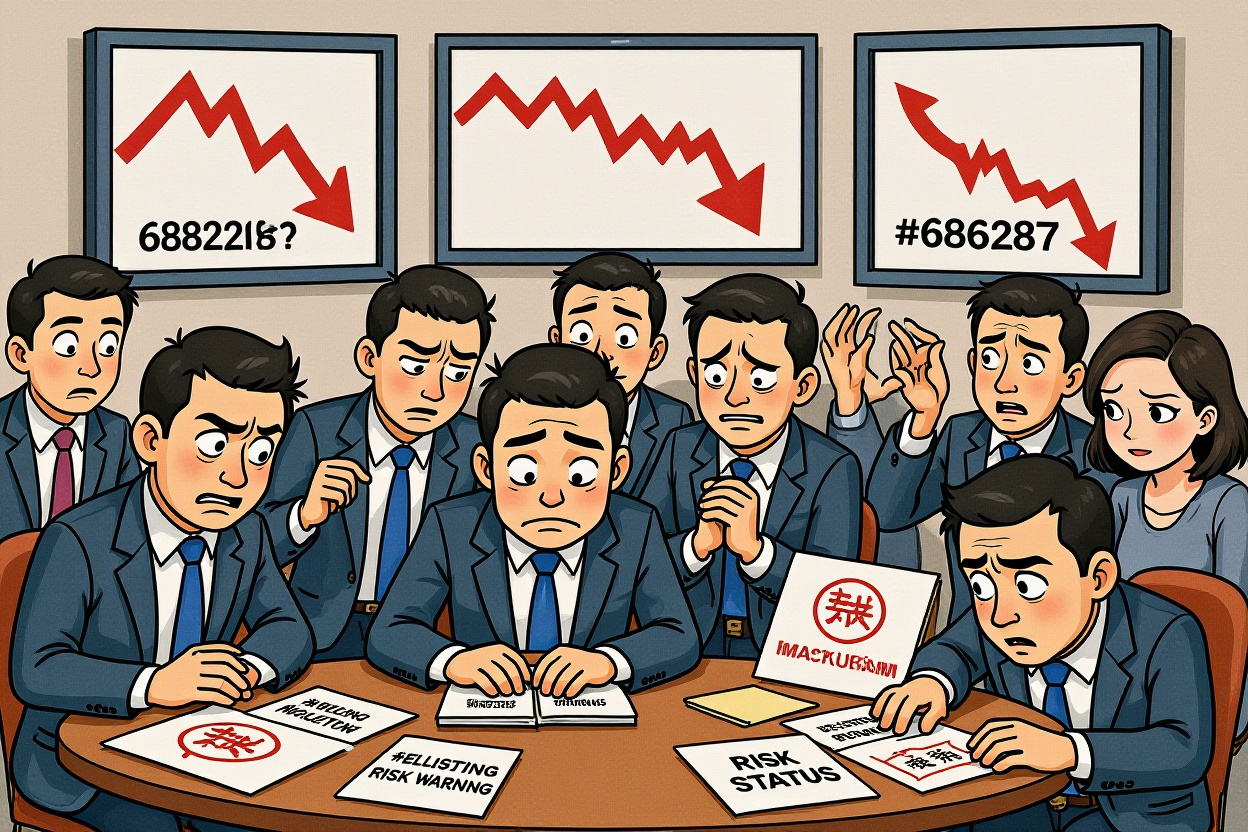
The recent parabolic rise and sudden halt in trading of stock code 688287 (CYSY Biotech) has become a stark case study in the volatility and regulatory scrutiny of China’s innovation-focused stock boards. Triggering three consecutive daily 20% price limit-up gains—a rare feat on the科创板 (Sci-Tech Innovation Board, STAR Market)—the stock’s rally was abruptly paused by a mandatory trading suspension for verification, casting a harsh light on the company’s precarious financial health and its looming risk of强制退市 (compulsory delisting). This incident underscores the critical balance regulators seek between market freedom and investor protection, while serving as a potent reminder for sophisticated investors to look beyond short-term momentum and rigorously assess fundamental viability. The 688287停牌核查 (688287 suspension for review) is not merely a procedural footnote but a pivotal moment that may determine the company’s future on the public markets.
Summary of Key Market Implications
– Stock 688287, CYSY Biotech, witnessed three straight trading sessions hitting the 20% upside limit, a significant and unusual move on the STAR Market.
– The Shanghai Stock Exchange (SSE) mandated a trading suspension for verification starting February 26, 2024, citing the need to protect investors and ensure orderly trading.
– Despite the price surge, the company faces severe financial distress, including a negative net asset value and consecutive annual losses, placing it under正式的退市风险警示 (formal delisting risk warning).
– The 688287停牌核查 highlights the active role of Chinese regulators in cooling speculative fervor and enforcing market rules, especially on innovation-focused boards.
– Investors must disentangle speculative trading from fundamental reality, as companies under delisting risk warnings represent high-stakes, binary investment propositions.
The Parabolic Surge: Anatomy of a 60% Rally
The trading activity preceding the 688287停牌核查 was extraordinary. Over three consecutive trading days, the share price of CYSY Biotech smashed through the 20% daily volatility limit set for科创板 (Sci-Tech Innovation Board) stocks. This rally propelled the stock’s value by over 60% in a very short timeframe, creating significant market buzz and attracting speculative capital.
Context of the Rally on the Sci-Tech Innovation Board
The STAR Market is designed to host innovative companies in strategic sectors like biotech, often with relaxed profitability requirements for listing but higher daily price limits (20% vs. 10% on main boards). While volatility is expected, three consecutive limit-up days are rare and typically signal either a major fundamental catalyst or potent market speculation. In the case of 688287, no company-specific, material positive announcements—such as breakthrough drug approvals, major partnership deals, or significant revenue contracts—were disclosed to the Shanghai Stock Exchange to justify such a move. This absence of public fundamental drivers pointed squarely towards sentiment-driven trading, potentially fueled by retail investor forums and short-term momentum strategies. The rally occurred against a backdrop of broader sector interest in biotechnology, but its intensity and lack of clear justification raised immediate red flags for market watchers and regulators alike.
The Regulatory Hammer: Understanding the Trading Suspension for Verification
In response to the abnormal price movements, the Shanghai Stock Exchange (SSE) exercised its authority under the科创板 (Sci-Tech Innovation Board) rules, announcing a trading suspension for verification of stock 688287. This mechanism is a key tool in China’s market stability toolkit.
Mechanics and Precedents of SSE Trading Halts</h3
A trading suspension for verification is a proactive regulatory measure. According to SSE rules, when a stock exhibits "abnormal fluctuations"—defined rigorously by criteria including price limit hits, volume surges, and public media coverage—the exchange can mandate a halt. The company is then required to conduct a self-examination and disclose a verification announcement, confirming whether any undisclosed material information exists, if operations are normal, and if any factors could explain the price moves. This process is designed to ensure information symmetry and cool overheated speculation. Precedents abound, particularly on the more volatile创业板 (ChiNext) and STAR boards. For instance, similar halts have been imposed on stocks like 300XXX after multiple limit-up days. The outcome of such verifications varies; some companies resume trading after reporting "no abnormalities," while others may uncover issues leading to longer suspensions. The announcement of the 688287停牌核查 directly attributed the halt to the need to "protect investors' interests" and "promote the stable and healthy development of the market," signaling regulatory concern over the disconnect between price and fundamentals.
The Elephant in the Room: Assessing the Severe Delisting Risk</h2
While the suspension paused trading, the most critical and enduring threat to 688287 is its officially flagged risk of强制退市 (compulsory delisting). This is not a hypothetical scenario but a formal status with specific, ticking clocks.
Financial Metrics Triggering the Warning
While the suspension paused trading, the most critical and enduring threat to 688287 is its officially flagged risk of强制退市 (compulsory delisting). This is not a hypothetical scenario but a formal status with specific, ticking clocks.
Financial Metrics Triggering the Warning
CYSY Biotech is under a正式的退市风险警示 (formal delisting risk warning), denoted by the “*ST” prefix before its stock name. This warning was triggered by meeting specific financial criteria defined in the SSE Listing Rules:
– Negative Net Assets: The company’s latest annual report showed audited net assets were负值 (negative). This means its total liabilities exceed its total assets, a severe indicator of financial insolvency.
– Consecutive Annual Losses: The company has reported net losses for multiple consecutive years, failing to demonstrate a path to profitability.
– Qualified Audit Opinion Issues: While not always the case, such financial distress often accompanies audit reports with emphasis-of-matter paragraphs or qualified opinions, further eroding credibility.
The公告 (announcements) from CYSY Biotech have repeatedly cautioned investors about these risks. The company’s core business, focused on novel drug delivery technologies, has yet to achieve commercial scale or generate substantial revenue to offset high R&D and operational costs. The dramatic price surge, therefore, created a dangerous paradox: a soaring market valuation superimposed on a balance sheet signaling potential corporate failure.
The Path to Potential Delisting and Investor Implications</h3
If CYSY Biotech cannot rectify its situation, it faces a clear delisting process. According to rules, if the conditions for the risk warning (like negative net assets) persist until the disclosure of the next annual report, the SSE will decide to suspend its listing. Following that, if failing to meet restoration standards within a prescribed period (e.g., reporting positive net assets or profitability), the final termination of listing will occur. For investors, this creates a binary outcome. The 688287停牌核查 event adds a layer of short-term uncertainty, but the delisting risk represents an existential threat. Investors holding shares in a delisted company face immense challenges; the stock typically moves to the老三板 (Old Third Board) for limited trading at drastically reduced valuations, with low liquidity and high barriers to exit. This stark reality is why professional funds and institutional investors often have strict mandates against investing in stocks under such warnings.
Broader Market Signals and Regulatory Intent</h2
This event is not an isolated incident. It provides a clear window into the operational philosophy of Chinese securities regulators under the leadership of the中国证券监督管理委员会 (China Securities Regulatory Commission, CSRC) and its Chairman易会满 (Yi Huiman).
A Message to the Market: Speculation vs. Fundamentals</h3
The swift action to initiate a 688287停牌核查 sends an unambiguous message to all market participants, especially on the科创板 (Sci-Tech Innovation Board). Regulators are willing to intervene to prevent what they perceive as disorderly, speculation-driven trading that detaches prices from underlying company value. This aligns with the broader, years-long campaign to foster a "healthy, stable, and long-term oriented" capital market. The SSE’s statement explicitly linking the halt to investor protection underscores this priority. For the STAR Market, which aims to channel capital to genuine technological innovation, such episodes are sensitive. Regulators must avoid stifling the price discovery for high-potential, early-stage companies while preventing the board from becoming a casino. The handling of 688287 demonstrates a low tolerance for volatility that appears fundamentally unanchored.
Implications for Other “*ST” and Speculative Stocks</h3
This episode serves as a cautionary tale for traders focusing on similarly situated companies. Other stocks under delisting risk warnings or those with weak fundamentals experiencing sudden surges may now face increased scrutiny and a higher probability of similar trading suspensions. It reinforces the need for investors to conduct thorough due diligence. Key documents to review include:
– Annual and interim reports, focusing on cash flow, debt levels, and auditor notes.
– All regulatory filings and风险提示公告 (risk提示 announcements) on the SSE website.
– The specific listing and trading rules of the board (Sci-Tech Innovation Board, ChiNext, Main Board) on which the company trades.
This event is not an isolated incident. It provides a clear window into the operational philosophy of Chinese securities regulators under the leadership of the中国证券监督管理委员会 (China Securities Regulatory Commission, CSRC) and its Chairman易会满 (Yi Huiman).
A Message to the Market: Speculation vs. Fundamentals</h3
The swift action to initiate a 688287停牌核查 sends an unambiguous message to all market participants, especially on the科创板 (Sci-Tech Innovation Board). Regulators are willing to intervene to prevent what they perceive as disorderly, speculation-driven trading that detaches prices from underlying company value. This aligns with the broader, years-long campaign to foster a "healthy, stable, and long-term oriented" capital market. The SSE’s statement explicitly linking the halt to investor protection underscores this priority. For the STAR Market, which aims to channel capital to genuine technological innovation, such episodes are sensitive. Regulators must avoid stifling the price discovery for high-potential, early-stage companies while preventing the board from becoming a casino. The handling of 688287 demonstrates a low tolerance for volatility that appears fundamentally unanchored.
Implications for Other “*ST” and Speculative Stocks</h3
This episode serves as a cautionary tale for traders focusing on similarly situated companies. Other stocks under delisting risk warnings or those with weak fundamentals experiencing sudden surges may now face increased scrutiny and a higher probability of similar trading suspensions. It reinforces the need for investors to conduct thorough due diligence. Key documents to review include:
– Annual and interim reports, focusing on cash flow, debt levels, and auditor notes.
– All regulatory filings and风险提示公告 (risk提示 announcements) on the SSE website.
– The specific listing and trading rules of the board (Sci-Tech Innovation Board, ChiNext, Main Board) on which the company trades.
This episode serves as a cautionary tale for traders focusing on similarly situated companies. Other stocks under delisting risk warnings or those with weak fundamentals experiencing sudden surges may now face increased scrutiny and a higher probability of similar trading suspensions. It reinforces the need for investors to conduct thorough due diligence. Key documents to review include:
– Annual and interim reports, focusing on cash flow, debt levels, and auditor notes.
– All regulatory filings and风险提示公告 (risk提示 announcements) on the SSE website.
– The specific listing and trading rules of the board (Sci-Tech Innovation Board, ChiNext, Main Board) on which the company trades.
The 688287停牌核查 event may thus cool speculative appetite across the board for fundamentally challenged companies, potentially leading to a repricing of risk in this segment of the market.
Strategic Guidance for Professional Investors</h2
For institutional investors and fund managers navigating Chinese equities, the 688287 saga offers critical lessons for risk management and investment strategy.
Deconstructing Momentum in High-Risk Segments</h3
When encountering explosive price movements, especially on the科创板 (Sci-Tech Innovation Board) or创业板 (ChiNext), the first step must be a fundamental reconciliation. Key questions arise:
– Is there a verifiable, material corporate development (patent, contract, trial result) driving the revaluation?
– What are the company’s core financial health indicators (liquidity ratio, debt-to-asset ratio, burn rate)?
– What is its regulatory status regarding delisting,信息披露 (information disclosure) violations, or other compliance issues?
In the case of 688287, a basic check of its "*ST" status and negative equity should have raised immediate alarm bells, framing any price increase as a high-risk speculative play rather than a fundamental investment opportunity. The subsequent 688287停牌核查 validated this cautious approach.
Navigating the Regulatory Landscape and Exit Planning</h3
Understanding the triggers and processes for regulatory actions like trading halts and delisting is non-negotiable. Investors must factor in the liquidity risk posed by potential suspensions. Furthermore, developing a clear exit strategy for positions in companies showing financial deterioration is essential. Waiting for a formal delisting warning is often too late, as liquidity can dry up beforehand. The event underscores the importance of a disciplined investment framework that prioritizes financial sustainability and regulatory compliance alongside growth narratives, particularly in the innovative but risky sectors championed by China’s specialized boards.
When encountering explosive price movements, especially on the科创板 (Sci-Tech Innovation Board) or创业板 (ChiNext), the first step must be a fundamental reconciliation. Key questions arise:
– Is there a verifiable, material corporate development (patent, contract, trial result) driving the revaluation?
– What are the company’s core financial health indicators (liquidity ratio, debt-to-asset ratio, burn rate)?
– What is its regulatory status regarding delisting,信息披露 (information disclosure) violations, or other compliance issues?
In the case of 688287, a basic check of its "*ST" status and negative equity should have raised immediate alarm bells, framing any price increase as a high-risk speculative play rather than a fundamental investment opportunity. The subsequent 688287停牌核查 validated this cautious approach.
Navigating the Regulatory Landscape and Exit Planning</h3
Understanding the triggers and processes for regulatory actions like trading halts and delisting is non-negotiable. Investors must factor in the liquidity risk posed by potential suspensions. Furthermore, developing a clear exit strategy for positions in companies showing financial deterioration is essential. Waiting for a formal delisting warning is often too late, as liquidity can dry up beforehand. The event underscores the importance of a disciplined investment framework that prioritizes financial sustainability and regulatory compliance alongside growth narratives, particularly in the innovative but risky sectors championed by China’s specialized boards.
The dramatic surge and ensuing suspension of CYSY Biotech (688287) crystallize the potent tensions in China’s evolving equity markets. On one side, market forces and investor sentiment can propel prices with breathtaking speed. On the other, a vigilant regulatory framework, exemplified by the 688287停牌核查, stands ready to intervene in the name of stability and investor protection. However, the most formidable force at play is the uncompromising arithmetic of financial fundamentals. The severe delisting risk警告 (warning) hanging over 688287 acts as a sobering counterweight to its fleeting price glory. For the global investment community, this episode is a masterclass in due diligence. It reinforces that in Chinese markets, particularly on the high-growth, high-volatility boards, rigorous scrutiny of financial statements and regulatory filings is the indispensable first line of defense. The call to action is clear: prioritize fundamental health and regulatory standing over speculative momentum. Integrate delisting risk assessments into every investment checklist for Chinese small-cap and innovation board stocks. By doing so, investors can better navigate the exciting yet perilous landscape of China’s quest to build world-class capital markets, avoiding the pitfalls that turn rapid gains into irreversible losses.