



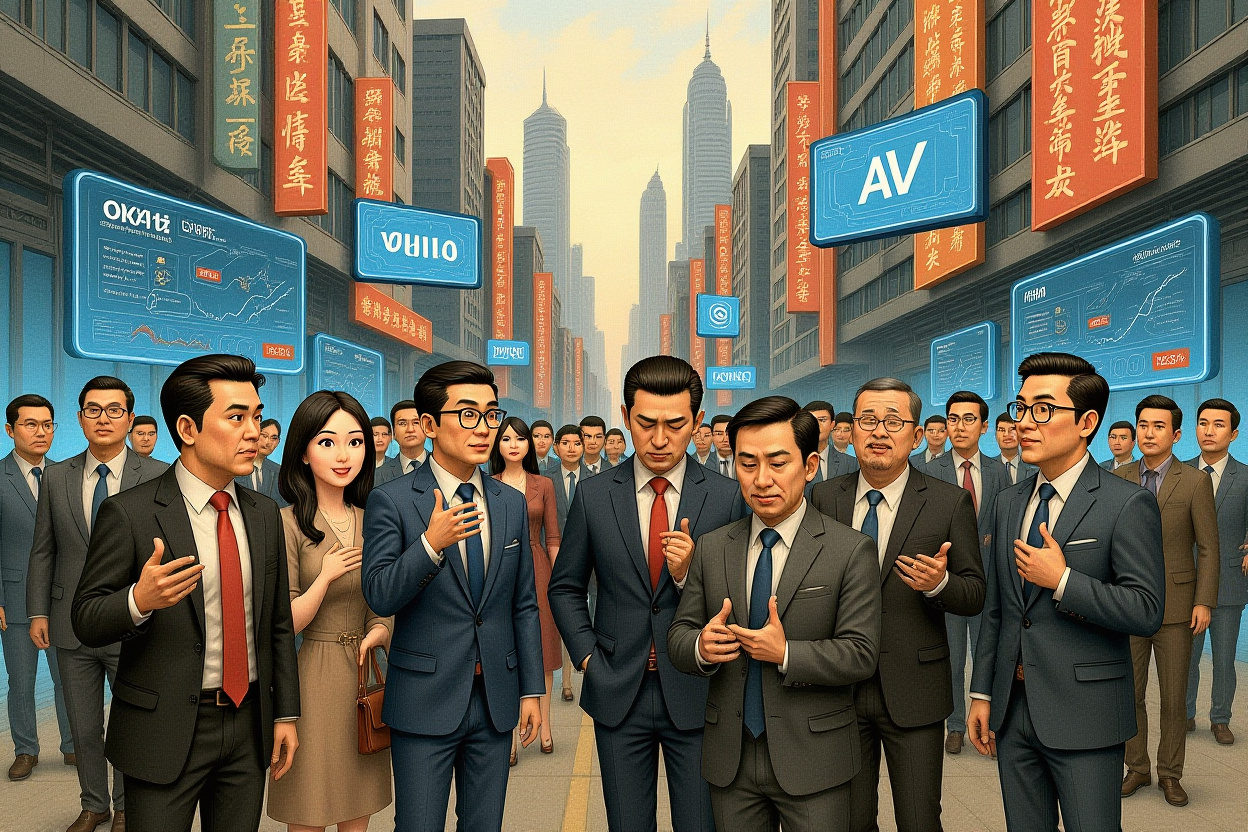
Executive Summary
In a dramatic shift for the global smartphone industry, 2026 has ushered in the most widespread and severe price increases in nearly five years. Led by major Chinese brands, this trend is reshaping competitive dynamics and forcing a strategic pivot towards artificial intelligence (AI). Here are the critical takeaways for investors and market watchers.
– OPPO and vivo have officially announced significant price adjustments across multiple model series, with hikes ranging from 200 to 500 yuan, driven primarily by soaring storage chip costs that have quadrupled year-over-year.
– The cost-pressure wave is triggering a market reshuffle, disproportionately squeezing mid-tier manufacturers and potentially dampening consumer demand in the vital low-to-mid-range segment, which accounts for a large portion of volume sales.
– AI has emerged as the definitive new battlefield, with innovations like system-level AI assistants and GUI Agent technology offering a path to differentiation and growth beyond traditional hardware specs.
– This 2026 smartphone market transformation is expected to be prolonged, with supply chain analysts forecasting elevated component costs through at least 2027, compelling all players to innovate or consolidate.
– For institutional investors, the upheaval presents both risk and opportunity, highlighting the need to scrutinize supply chain resilience, AI ecosystem strength, and brand positioning in a rapidly evolving landscape.
The Smartphone Industry’s Perfect Storm: Unpacking the 2026 Price Shock
The smartphone market, long characterized by incremental updates and fierce price competition, has hit a major inflection point. In March 2026, two of China’s largest smartphone makers, OPPO (欧珀) and vivo (维沃), simultaneously announced substantial price increases for a wide range of models. This coordinated move is not a mere marketing tactic but a direct response to an unprecedented cost crunch rippling through the entire electronics supply chain. For global investors focused on Chinese equities, understanding the drivers behind this 2026 smartphone market transformation is essential for assessing company valuations and sector trajectory.
The most immediate and severe pressure point is the cost of memory. Storage chips, comprising DRAM (运行内存) and NAND (闪存), are fundamental components in every device. From the first quarter of 2025, prices began a steep climb, exacerbated by soaring demand from artificial intelligence (AI) and cloud computing sectors. As AI model training consumes vast amounts of high-performance memory, chip manufacturers have prioritized allocation for data centers, squeezing capacity for the consumer electronics market. Xiaomi Group (小米集团) President Lu Weibing (卢伟冰) confirmed the severity, noting that storage chip quotes in Q1 2026 had surged to nearly four times their level from a year ago.
Beyond Memory: A Full-Spectrum Cost Surge
While memory is the headline, it is far from the only component seeing inflation. The industry is grappling with a synchronized rise in costs for other critical parts. Premium OLED (有机发光二极管) displays, essential for flagship devices, have become more expensive due to complex manufacturing processes and material costs. High-density batteries, needed to power increasingly capable devices, and advanced thermal management materials are also contributing to the bill of materials (BOM) increase. This represents a full-industry cost uplift cycle, differing from the isolated component shortages of the past.
The duration of this pressure is what truly defines the current 2026 smartphone market transformation. According to supply chain intelligence, global memory giants Samsung Electronics (三星电子) and SK Hynix (SK海力士) have notified clients of plans for further DRAM price hikes in the second quarter of 2026, with DDR5颗粒 (DDR5颗粒) expected to rise by approximately 40%. Industry consensus suggests this inflationary trend, which began in late 2025, will persist through the end of 2027. This prolonged timeline forces manufacturers to make structural, rather than temporary, adjustments to their pricing and product strategies.
Market Reshuffle: The Winners, Losers, and Mounting Pressure
The wave of price increases is acting as a powerful catalyst for market consolidation. In a saturated market where growth is elusive—IDC reported a 0.6% year-on-year decline in China’s 2025 smartphone shipments to approximately 285 million units—the added burden of higher prices threatens to further suppress replacement cycles. This dynamic is reshaping the competitive landscape, creating clear divisions between those with scale and those without.
OPPO’s initial adjustments targeted its A and K series, devices in the 1000-2500 yuan bracket. Similarly, rumors swirled around Xiaomi’s Redmi (红米) sub-brand planning modest hikes. This strategic focus on the low-to-mid range is deliberate. As analyst Yuan Shuai (袁帅) notes, consumers in this segment are highly price-sensitive but less attached to brand prestige, making it slightly easier for companies to pass on some cost increases without catastrophic demand destruction. In contrast, flagship models from brands like Honor (荣耀) have seen more selective adjustments, such as raising prices only on higher-storage variants of its foldable Magic V6, to protect brand image in the high-margin premium segment.
The Precarious Position of Mid-Tier Players
The situation is markedly more dire for China’s mid-tier smartphone manufacturers. Brands like Meizu (魅族), Nubia (努比亚), and Red Magic (红魔) operate in the long shadow of the top six players—Huawei (华为), OPPO, vivo, Xiaomi, Honor, and Apple (苹果)—which collectively command over 80% of the domestic market. These smaller players already suffer from weaker supply chain bargaining power, limited channel reach, and lower brand recognition. The dual squeeze of soaring input costs and potentially softening demand creates an existential threat.
The announcement by Meizu in February 2026 to suspend in-house development of new phone models for the domestic market serves as a stark warning signal for this cohort. Survival for others will depend heavily on the financial backing and procurement leverage of their parent companies, such as ZTE (中兴通讯) for Nubia and Red Magic. Without the economies of scale enjoyed by market leaders, navigating this prolonged 2026 smartphone market transformation will require niche strategies, deep partnerships, or painful restructuring.
AI as the New Battleground: Seeking Growth Beyond Hardware
With hardware margins under siege and consumer excitement over camera megapixels or battery capacity waning, the industry’s strategic focus has decisively shifted. The new frontier is artificial intelligence, specifically the development of “AI phones” that transcend being mere tools to become proactive, context-aware assistants. This pivot is central to the broader 2026 smartphone market transformation, offering a potential path to value creation and differentiation that can justify higher price points.
The concept gained significant momentum in December 2025 with the launch of the “Doubao Phone,” a collaboration between ByteDance’s (字节跳动) AI model Doubao (豆包) and ZTE’s Nubia brand. Priced at 3,499 yuan, this device sold out rapidly in a limited release, and its announcement buoyed ZTE’s stock price. Its core innovation is a system-level GUI Agent, an AI assistant that can “see” the screen and simulate human-like taps, swipes, and inputs to perform multi-step tasks across different applications without requiring those apps to open their APIs. For example, a user could verbally instruct the phone to compare flight prices and book the cheapest option, with the AI handling all the steps until the final payment confirmation.
The Two Paths to an AI Future: GUI Agent vs. A2A
The Doubao Phone’s approach, while groundbreaking, has sparked controversy. Granting an AI system such deep access to the user interface raises significant privacy and security concerns, leading to access blocks from major platforms like Alibaba’s (阿里巴巴) Taobao (淘宝) and Tencent’s (腾讯) WeChat (微信). Some security experts draw parallels between GUI Agent technology and the methods used by malicious bots and scripts.
This has paved the way for an alternative, more collaborative technical route championed by giants like Huawei and OPPO: the Application-to-Application (A2A) model. Here, the AI assistant works through standardized interfaces provided by apps themselves, asking them to perform specific functions. This method is inherently more secure and stable but faces a major hurdle: it requires extensive cooperation from third-party app developers to open their capabilities. Thus, the race in the AI phone era is as much about ecosystem building and developer relations as it is about raw algorithmic power.
For smaller manufacturers, partnering with an external AI provider like Doubao offers a faster, capital-efficient route to the AI trend without the billion-dollar investments required for in-house large language model (LLM) development. In contrast, leaders like Huawei, with its XiaoYi (小艺) assistant, and Xiaomi, which integrated AI deeply into its HyperOS (澎湃OS), are betting on controlling the core AI experience to reinforce their ecosystem lock-in. The unfolding competition in this domain is a critical aspect of the ongoing 2026 smartphone market transformation.
Innovation and Adaptation: Strategies for a Transformed Landscape
Faced with relentless cost pressure, smartphone makers are not solely relying on software. Hardware innovation is also accelerating, often in tandem with AI, to create compelling new use cases. A prime example is the recent launch of Honor’s ROBOT Phone, which features a gimbal-stabilized rear camera system. This appeals to professional content creators and, more importantly, serves as a high-quality sensor array for its “AI Agent Brain,” providing rich visual data to improve the system’s understanding of the environment.
This illustrates a broader trend: the convergence of specialized hardware with advanced AI to deliver experiences that were previously impossible. It’s a direct response to the need for differentiation in a market where pure spec sheets no longer drive upgrades. Companies are exploring everything from advanced materials for better durability and thermal management to novel form factors, all while ensuring these innovations feed into and enhance the AI-driven user experience.
Strategic Imperatives for Investors and Executives
For corporate executives and institutional investors monitoring this sector, several strategic imperatives emerge from the current tumult. First, supply chain resilience and vertical integration have become paramount. Companies with stronger control over key components or long-term supply agreements will navigate the cost crisis more effectively. Second, evaluating a company’s AI strategy is no longer optional; it is central to future growth. Key questions include: Does the company have a viable path to a differentiated AI experience? Is it building or accessing a sustainable AI ecosystem?
Finally, the financial health and scale of smartphone brands will be severely tested. Investors should scrutinize balance sheets, cash flow, and inventory management. Smaller players may become acquisition targets, while leaders might spin off or restructure struggling sub-brands. The 2026 smartphone market transformation is, in essence, a stress test for every participant in the value chain.
Navigating the Transformed Smartphone Market of 2026 and Beyond
The simultaneous price hikes by OPPO and vivo are not an isolated event but a symptomatic manifestation of a deeper, structural shift in the global smartphone industry. The era of easy growth and predictable component costs has ended, replaced by a prolonged period of inflationary pressure and intensified competition for a new kind of value—AI-powered intelligence. This 2026 smartphone market transformation will have lasting repercussions, accelerating consolidation and rewarding those who can master the complex triad of hardware innovation, software AI integration, and ecosystem partnership.
For market participants, the path forward requires vigilance and adaptability. Investors are advised to look beyond quarterly shipment volumes and focus on metrics like R&D investment in AI, depth of developer partnerships, and supply chain cost management. Corporate strategists must balance the immediate need to manage margins with the long-term imperative to define their role in the AI-driven future. While the cost storm may last into 2027, the innovations and alliances forged today will determine the winners in the next chapter of mobile computing. The call to action is clear: closely monitor the execution of AI strategies and supply chain maneuvers by leading players, as these will be the primary drivers of stock performance and market share in the coming years of this great smartphone market transformation.