



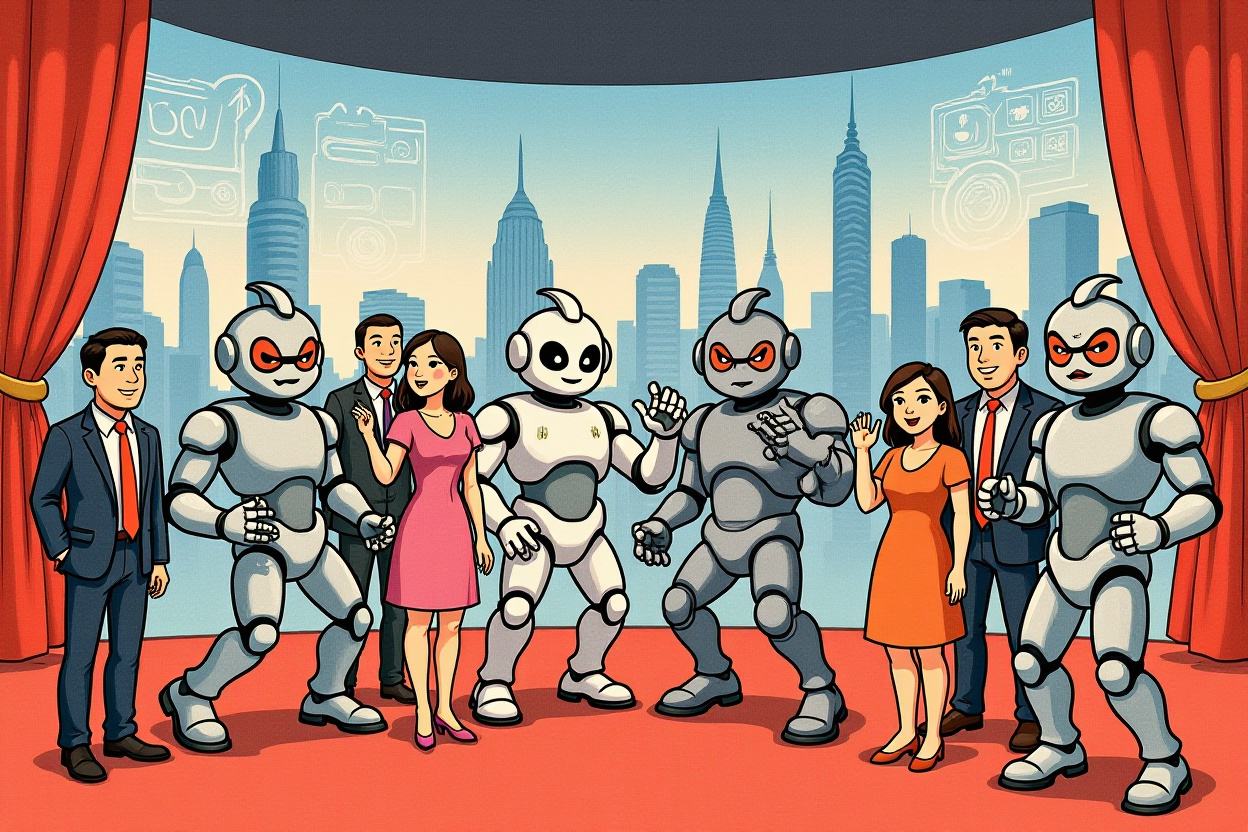
As the curtain rises on China’s technological ambitions, the 2026 CCTV Spring Festival Gala (央视春晚) served not just as entertainment but as the ultimate test ground for embodied intelligence. This annual spectacle, watched by over a billion viewers, transitioned from a display of potential to a rigorous examination of practicality, where humanoid robots from Magic Atom (魔法原子), Galaxy Universal (银河通用), Yushu Technology (宇树科技), and Songyan Power (松延动力) performed alongside celebrities. Their appearance marks a pivotal moment for an industry poised between laboratory innovation and real-world application, highlighting both the immense opportunities and daunting challenges ahead. For global investors and tech executives, understanding this shift is crucial to navigating China’s rapidly evolving robotics landscape.
Key Takeaways:
– The 2026 CCTV Spring Festival Gala featured four embodied AI companies in coordinated performances, signaling a move from fragmented tech demos to consolidated industry showcases on a national platform.
– Official titles at the gala, such as ‘春晚机器人合作伙伴’ for Yushu Technology versus ‘春晚指定具身大模型机器人’ for Galaxy Universal, reveal divergent technical strategies focusing on humanoid robotics, AI integration, and market positioning.
– Market research from IDC projects China’s embodied intelligent robot user spending to reach $770 billion by 2030, with a 94% CAGR, but growth depends on overcoming hurdles in industrial, commercial, and domestic environments.
– Post-gala, the industry faces three critical barriers: achieving reliability in factory settings, adaptability in dynamic commercial spaces, and safety in unstructured home environments, which will determine long-term viability.
– 2026 is emerging as a watershed year, shifting the competitive focus from capital investment and publicity to tangible customer orders, revenue scalability, and sustainable business models.
The CCTV Spring Festival Gala: An Ultimate Test Ground for Embodied Intelligence
For decades, the CCTV Spring Festival Gala has served as a cultural touchstone and a barometer for China’s technological trends. In 2026, it evolved into something far more consequential: the ultimate test ground for embodied intelligence. This transformation was evident as humanoid robots took center stage, not as novelties but as key performers in a high-stakes demonstration of China’s robotics prowess. The gala’s global audience provided an unprecedented platform for these companies to validate their technologies under intense scrutiny, bridging the gap between academic research and mainstream acceptance.
A Showcase of China’s Embodied AI Pioneers
The 2026 gala featured a ‘robot squad’ from four domestic firms, each bringing unique capabilities to the fore. Yushu Technology (宇树科技), building on its 2025 breakout performance, collaborated with the Henan Tagou Martial Arts School to present a kung fu routine titled ‘武 BOT,’ blending traditional Chinese culture with cutting-edge robotics. Songyan Power (松延动力) appeared earlier in a comedy sketch with veteran performer Cai Ming (蔡明) and Wang Tianfang (王天放), titled ‘Grandma’s Favorite,’ while Magic Atom (魔法原子) supported a song performance called ‘Intelligent Manufacturing Future.’ Galaxy Universal (银河通用) joined comedic duo Shen Teng (沈腾) and Ma Li (马丽) in a micro-film. This collective showcase underscored a strategic shift from isolated experiments to a coordinated industry push, aiming to cement embodied intelligence in the public consciousness.
Decoding the Titles: Strategic Positioning Revealed
A subtle yet telling detail from the gala was the variation in official partner titles. Yushu Technology was designated a ‘春晚机器人合作伙伴’ (Spring Festival Gala Robot Partner), Songyan Power a ‘春晚人形机器人合作伙伴’ (Humanoid Robot Partner), Magic Atom a ‘春晚智能机器人战略合作伙伴’ (Intelligent Robot Strategic Partner), and Galaxy Universal a ‘春晚指定具身大模型机器人’ (Designated Embodied Large Model Robot). These distinctions reflect deeper divergences in technical architecture and market focus. For instance, Galaxy Universal’s emphasis on ‘large model’ points to investments in AI-driven cognitive systems, whereas Yushu Technology’s broader ‘robot’ label may indicate a hardware-centric approach. Such nuances are critical for investors assessing competitive advantages in a crowded field, as they hint at each company’s roadmap for scalability and integration.
Beyond the Spotlight: The Commercial Imperative After the Ultimate Test Ground
While the gala offered a moment of glory, it also set the stage for a more formidable challenge: translating stage presence into market dominance. As the lights dimmed, the embodied intelligence sector confronted the harsh reality that performance art alone cannot sustain a business. The ultimate test ground for embodied intelligence is not the春晚 stage but the unforgiving environments of factories, warehouses, and homes. This shift demands a focus on durability, cost-efficiency, and user-centric design, moving beyond viral moments to solve tangible problems.
IDC Projections and the $770 Billion Opportunity
According to data from International Data Corporation (IDC), China’s embodied intelligent robot market is on a blistering growth trajectory, with user expenditure projected to hit $770 billion by 2030, representing a compound annual growth rate (CAGR) of 94%. This forecast, detailed in IDC’s recent reports on Asian robotics, highlights a sector expanding at nearly double each year, driven by labor shortages, automation trends, and government initiatives like ‘Made in China 2025.’ However, this potential hinges on the industry’s ability to deliver reliable solutions. The gala’s role was to accelerate public and corporate adoption by demonstrating feasibility, but sustained growth will require meeting rigorous performance metrics in real-world settings.
From Performance to Practical Application
The transition from gala performer to industrial workhorse is fraught with obstacles. In factory floors, robots must execute repetitive tasks like sorting, assembly, and loading with near-perfect accuracy, as even minor errors can lead to significant financial losses. Companies like Songyan Power (松延动力) are targeting this sector, but success depends on passing reliability tests in extreme conditions—something that stage performances cannot simulate. Similarly, commercial applications in retail or healthcare demand advanced perception and interaction skills, such as navigating crowded spaces or responding to verbal commands. The ultimate test ground for embodied intelligence thus extends into these environments, where systems must prove their worth beyond choreographed routines.
Navigating the Three Critical Hurdles for Embodied Intelligence
For China’s embodied AI firms, the post-gala era is defined by three sequential challenges that serve as the true ultimate test ground for embodied intelligence. Each hurdle represents a escalation in complexity, from controlled industrial settings to the chaotic intimacy of homes. Overcoming these barriers is essential for achieving the scalability envisioned by market optimists, and failure at any stage could relegate a company to niche status.
Conquering the Factory Floor
Industrial automation remains the most immediate and lucrative market for embodied intelligence. Factories offer structured environments where robots can replace human labor in tasks like material handling, quality inspection, and machine tending. However, the requirements are stringent: robots must operate with 99.9% uptime, withstand dust, temperature variations, and physical impacts, all while maintaining low operational costs. As noted in a report by the Ministry of Industry and Information Technology (MIIT, 工业和信息化部), Chinese manufacturers are increasingly adopting robotics to address rising wage pressures and demographic shifts. Companies that excel here, such as those with robust mechanical designs like Yushu Technology (宇树科技), will gain a foothold, but they must demonstrate that their systems can outperform traditional automation solutions in flexibility and ROI.
Navigating Complex Commercial Environments
Beyond factories, embodied intelligence faces a tougher trial in commercial spaces like shopping malls, hospitals, and logistics centers. These settings are semi-structured, with dynamic elements like moving people, unpredictable obstacles, and diverse task requirements. For example, a robot deployed in a warehouse must not only transport goods but also adapt to layout changes and interact with human workers. The gala performances, such as Magic Atom’s (魔法原子) coordinated movements, hinted at this capability, but real-world deployment demands more sophisticated sensor fusion and decision-making algorithms. Industry experts, including Dr. Li Fei-Fei (李飞飞), a prominent AI researcher, emphasize that success in this arena requires integrating computer vision, natural language processing, and motion planning—a holistic approach that remains a work in progress for many firms.
The Elusive Dream: Robots in Every Home
The final and most ambitious hurdle is the domestic sphere, where embodied intelligence must contend with highly unstructured environments. Homes are filled with variables: cluttered floors, pets, children, varying lighting, and ambiguous user commands. Achieving widespread adoption here necessitates breakthroughs in safety, affordability, and ease of use. While Galaxy Universal’s (银河通用) gala appearance showcased interactive potential, the leap to a consumer product involves massive reductions in cost—currently, advanced humanoid robots can exceed $100,000—and enhancements in AI to handle open-ended tasks. The ultimate test ground for embodied intelligence in homes is still years away, but early movers who invest in user-friendly interfaces and robust safety protocols, as seen in prototypes from companies like Sony and Boston Dynamics, may eventually lead this charge.
2026: A Watershed Year for China’s Embodied Intelligence Industry
The 2026 CCTV Spring Festival Gala has catalyzed a paradigm shift, marking the year when the embodied intelligence sector moves from hype to substance. This ultimate test ground for embodied intelligence has exposed the strengths and weaknesses of key players, setting the stage for a consolidation phase where commercial viability trumps technological spectacle. Investors and stakeholders must now evaluate companies based on concrete metrics rather than promotional flair, as the industry pivots toward sustainable growth.
Shifting from Capital to Customers
In previous years, success in China’s robotics scene was often measured by fundraising rounds and media attention. For instance, Yushu Technology (宇树科技) leveraged its 2025 gala fame to secure significant venture capital, but 2026 demands a new focus: customer acquisition and retention. The ultimate test ground for embodied intelligence is the sales ledger, where repeat orders from manufacturing clients or service contracts with commercial entities validate product-market fit. As Zhang Yong (张勇), former CEO of Alibaba Group (阿里巴巴集团), noted in a recent fintech conference, ‘Technology must serve business, not the other way around.’ This mantra is particularly relevant for embodied AI firms, which must now prove their solutions reduce costs or increase efficiency for end-users.
The Real Metrics of Success: Orders and Scalability
Key performance indicators are evolving from demo counts to deployment statistics. Companies must track metrics like mean time between failures (MTBF) in industrial settings, customer satisfaction scores in commercial applications, and cost-per-task in home environments. For example, if Songyan Power (松延动力) can demonstrate that its robots reduce labor costs by 30% in automotive assembly lines, it will gain a competitive edge. The ultimate test ground for embodied intelligence is thus a continuous evaluation across these dimensions, with early leaders likely to emerge from firms that partner with large enterprises for pilot programs, such as collaborations with Huawei (华为) or Tencent (腾讯) for AI integration.
Global Implications and Forward-Looking Strategies
China’s embodied intelligence push has reverberations beyond its borders, influencing global supply chains, investment flows, and technological standards. As Chinese firms like Magic Atom (魔法原子) and Galaxy Universal (银河通用) refine their offerings, they may challenge incumbents from Japan, the U.S., and Europe in robotics markets. The ultimate test ground for embodied intelligence in China could become a blueprint for international adoption, but it also raises questions about data privacy, ethical AI use, and regulatory harmonization.
Competitive Landscape and International Outlook
The global robotics market is increasingly interconnected, with Chinese companies leveraging domestic scale to export solutions. According to the International Federation of Robotics (IFR), China is already the world’s largest market for industrial robots, and embodied intelligence could extend this lead into service and consumer segments. However, success abroad requires navigating diverse regulatory environments, such as the EU’s AI Act or U.S. export controls. Firms that use the ultimate test ground for embodied intelligence in China to build resilient, compliant products will be better positioned for international expansion. For instance, incorporating ethical AI frameworks from the outset, as advocated by researchers like Pan Gongsheng (潘功胜) of the People’s Bank of China (中国人民银行), can enhance trust and adoption.
Regulatory and Ethical Considerations
As embodied intelligence permeates daily life, regulatory bodies like the Cyberspace Administration of China (CAC, 国家互联网信息办公室) are drafting guidelines for AI safety and data governance. Companies must anticipate these trends by embedding transparency and accountability into their designs. The ultimate test ground for embodied intelligence includes not only technical hurdles but also societal acceptance, which depends on addressing concerns about job displacement, privacy infringement, and algorithmic bias. Proactive engagement with policymakers and civil society, as seen in forums hosted by the World Economic Forum, can help shape a conducive environment for innovation.
The journey from the春晚 stage to global markets is a marathon, not a sprint. The 2026 CCTV Spring Festival Gala has illuminated the path forward, but the real work begins in the trenches of factories, shops, and living rooms. For embodied intelligence firms, the ultimate test ground for embodied intelligence is now everywhere—demanding relentless innovation, customer-centricity, and operational excellence. Investors and industry watchers should focus on companies that demonstrate tangible progress in order books and real-world deployments, rather than fleeting fame. As China’s robotics revolution accelerates, those who pass this ultimate test will not only dominate domestic markets but also redefine global technological leadership. Stay informed by following regulatory updates and market analyses, and consider engaging with pilot programs to gauge the practical impact of these transformative technologies.