



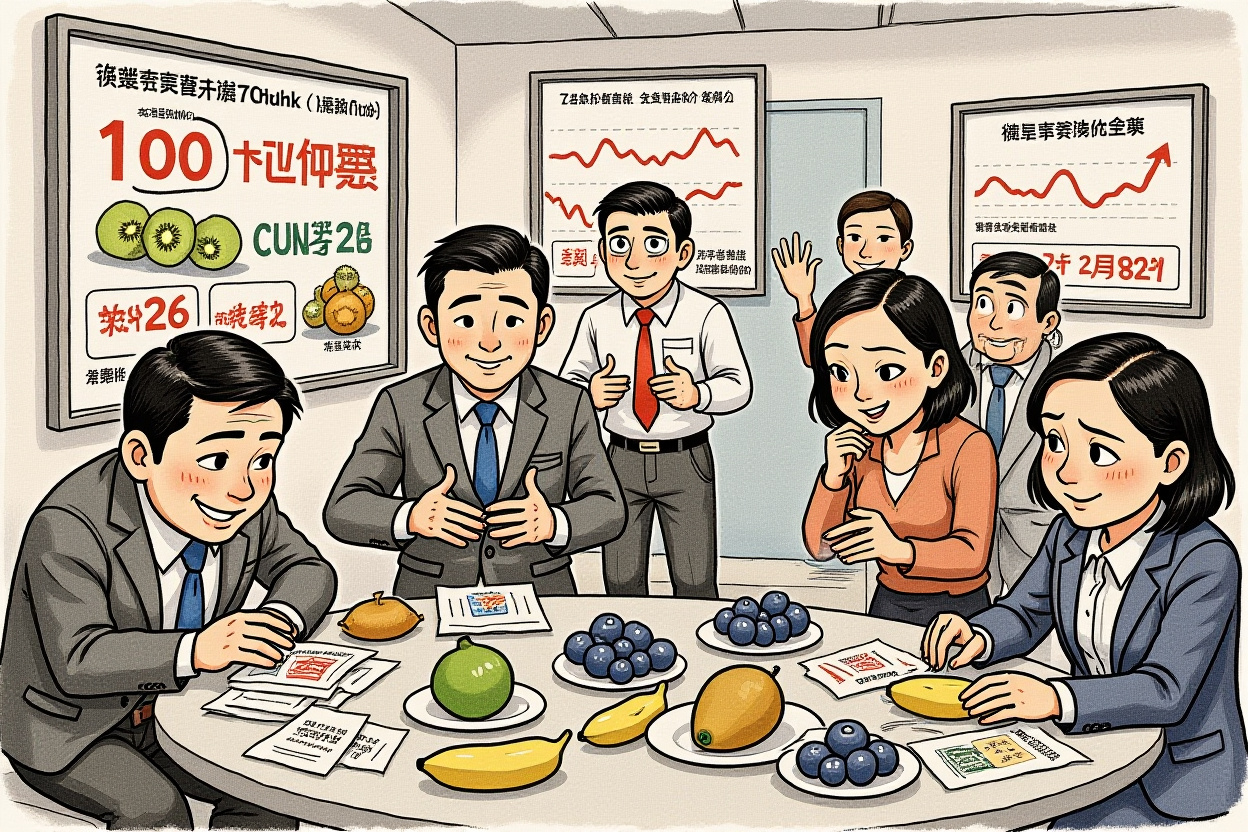
Key Takeaways: The Urgency Behind Xinrongmao’s IPO Push
– Legend Holdings (联想控股) is spearheading a $1.6 billion equity optimization to force Xinrongmao (鑫荣懋), China’s dominant fruit supply chain platform, toward a Hong Kong IPO with a strict deadline of December 31, 2027.
– A binding agreement mandates that if Xinrongmao fails to list by the deadline, management must repurchase Legend’s shares at a $5 billion valuation, turning this into a high-stakes gamble for all parties involved.
– With annual revenue nearing $20 billion, Xinrongmao controls a significant portion of China’s high-end imported fruit market, but faces industry-wide hurdles like razor-thin margins and supply chain volatility.
– The IPO is pivotal for Legend Holdings’ struggling agricultural portfolio, particularly as its other listed entity, Jiawo Food (佳沃食品), faces continuous losses and delisting risks.
– Success hinges on Xinrongmao navigating a competitive landscape where other fruit industry IPOs have faltered, setting a precedent for capital-intensive agri-business models in China.
The Billion-Dollar Bet on China’s Fruit King
Capital is finally taking the fruit business seriously. In a move that underscores the high stakes in China’s agri-business sector, Legend Holdings (联想控股) has placed a massive bet on the initial public offering of Xinrongmao (鑫荣懋), the country’s leading fruit supply chain giant. With a deadline of December 31, 2027, and a $1.6 billion equity restructuring, this IPO push is more than just a financial transaction—it’s a make-or-break moment for both the company and its backer. The focus on Xinrongmao’s high-stakes IPO encapsulates the urgency and risks involved, as a failure could unravel years of investment and strategic planning. For global investors monitoring Chinese equities, this development signals a critical juncture in the maturation of China’s consumer and agricultural markets, where scale meets capital intensity in an industry long considered fragmented and undervalued.
A Decade-Long IPO Dream Faced With Repeated Setbacks
In China’s fruit industry, Xinrongmao (鑫荣懋) is an indispensable name. Founded in 1998 in Shenzhen, the company started with traditional fruit trading and has grown into one of China’s largest fruit supply chain platforms. Despite its dominance—facilitating the import of staples like Zespri kiwifruit from New Zealand, Driscoll’s blueberries from the U.S., and Dole bananas from Chile—it has lacked a capital market identity for over a decade.
From Humble Beginnings to Supply Chain Dominance
Xinrongmao’s model revolves around upstream partnerships with global producers, midstream cold-chain logistics, and downstream channel and brand development. This sounds straightforward, but execution is notoriously difficult due to fruit’s perishability. Unlike alcohol that can be aged for years, fruit spoils within days, necessitating an extremely efficient supply chain. To achieve this, Xinrongmao spent over two decades building a cold-chain system with 30-plus logistics centers across China, connecting over 300 cities and distributing over 3,000 tons of fruit daily. However, scale brings capital demands: the fruit trade is characterized by low margins but high capital turnover for inventory, logistics, and channel expansion, making an IPO essential.
Previous Attempts and Regulatory Hurdles
The journey to list has been fraught with obstacles. As early as 2015, when Xinrongmao merged with Legend’s agricultural arm, Jiawo Group (佳沃集团), both sides expressed IPO ambitions. In 2019, Xinrongmao formally began A-share listing辅导, only to see plans stall due to shifting internal and external conditions. A subsequent pivot to Hong Kong was vetoed by dissenting shareholders, creating a僵局 where old investors sought exits while equity value remained unrealized. To break this deadlock, Legend orchestrated a bold $1.617 billion equity buyback, where Xinrongmao spent $1.086 billion to repurchase 14.13% of shares from entities like Junlian Shengyuan, Xiamen C&D, and Longmen Fund, effectively clearing dissenters from the cap table. This sets the stage for Xinrongmao’s high-stakes IPO, now backed by a unified shareholder base but under immense pressure.
Legend Holdings’ Agricultural Ambitions: Why the Rush?
Beyond its tech roots, Legend Holdings (联想控股) has long pursued long-term consumer sectors, with agriculture as a core focus. Established in 2012, Jiawo Group (佳沃集团) was its vehicle for agricultural investments, ranging from blueberry and kiwifruit cultivation to acquiring智利 salmon farmer Australis. However, results have been disappointing, and the urgency to push Xinrongmao’s high-stakes IPO stems from deeper portfolio anxieties.
The Struggles of Jiawo Food (佳沃食品)
As Legend’s only listed agricultural entity, ST Jiawo (佳沃食品) is in dire straits. Financial reports show that in the first half of 2025, Jiawo Food’s revenue plummeted 33.96% year-on-year to $1.245 billion, with a net loss of $419 million. Over six consecutive years since 2019, cumulative losses exceed $4.3 billion, and its资产负债率 once soared to 104.9%, teetering on delisting. To salvage this, Legend executed drastic measures like剥离 loss-making salmon assets and transferring subsidiaries for nominal fees, reducing资产负债率 from 104.92% to 12.56% but incurring over $1.1 billion in net losses over eight years. This context makes Xinrongmao’s high-stakes IPO not just desirable but necessary for Legend’s agricultural reboot.
The Strategic Imperative for a New Listing Platform
Xinrongmao represents a clean, high-performing asset to shoulder Legend’s agricultural capital化 ambitions. With 2023 net profit at $266 million, 2024 at $308 million, and $245 million in the first nine months of 2025, its revenue scale surpasses rivals like Pagoda (百果园) and Hongjiu Fruit (洪九果品). Yet, without a listing, valuation remains suppressed, and impatient shareholders loom. Legend, through Jiawo, holds about 39% of Xinrongmao, making this a cornerstone investment. The binding agreement requires Xinrongmao to file for a qualified Hong Kong listing by September 30, 2027, and list by December 31, 2027; otherwise, management must repurchase Legend’s shares at a $5 billion valuation. This赌协议 turns Xinrongmao’s high-stakes IPO into a non-negotiable deadline, reflecting Legend’s need to secure a viable exit and stabilize its agricultural narrative amid a cool investment climate for agri-businesses.
The Underestimated Economics of the Fruit Trade
China is the world’s largest fruit producer and consumer, with a market exceeding $1 trillion annually. While often dismissed as a simple brokerage, Xinrongmao’s operations involve global resource integration, linking over 40 countries and regions. It holds exclusive partnerships with brands like Zespri and Driscoll’s, and its subsidiaries—”Jiawo” for high-margin items like blueberries and durians, and “Happy Orchard” for younger demographics—cover the entire value chain. This dominance in premium imported fruit highlights the scale potential, but profitability remains elusive.
Scale vs. Profitability: The Industry Conundrum
Xinrongmao’s supply chain is formidable: 30-plus cold-chain logistics centers, over 300,000 square meters of warehouse space, and serving 20 million households. This infrastructure creates barriers to entry, as普通 retailers cannot match such capital intensity. However, the fruit industry is notorious for low net profits, often in the low single digits, due to factors like weather volatility, demand fluctuations, and currency risks. Even with Xinrongmao’s high-stakes IPO driving efficiency, maintaining revenue growth while balancing利润 is challenging, especially amid社区团购 price wars and declining supermarket traffic. This dichotomy underscores why, despite its size, Xinrongmao’s path to listing is fraught with skepticism from investors burned by previous fruit sector IPOs.
Lessons from Market Precedents
Capital markets have grown wary of fruit stocks. Hongjiu Fruit (洪九果品), once hailed as港股’s first fruit股, exited in disarray, while Pagoda (百果园) has seen volatile市值 swings post-listing. These cases reveal inherent industry issues: high perishability, non-standardization, and脆弱的护城河. For Xinrongmao’s high-stakes IPO to succeed, it must articulate a compelling narrative beyond scale, perhaps emphasizing technology integration or brand loyalty. Investors will scrutinize whether its supply chain mastery can translate into sustainable returns, a question that will define not just this listing but the broader appetite for agricultural investments in Chinese equities.
The High-Stakes Gamble: Terms and Implications of the IPO Push
The $1.6 billion equity optimization is more than a financial maneuver; it’s a strategic recalibration with clear winners and losers. By buying out dissenting shareholders, Xinrongmao and Legend have streamlined decision-making, but the accompanying赌协议 imposes severe penalties for failure, making Xinrongmao’s high-stakes IPO a binary outcome.
The Binding Deadline and Its Consequences
Under the agreement, if Xinrongmao misses the 2027 deadlines, Legend can demand a share repurchase at a $5 billion valuation, allowing它 to exit unscathed while management bears the burden. This creates a “背水一战” scenario, where the next two years are critical for operational execution and regulatory navigation. For context, $5 billion is a conservative valuation given Xinrongmao’s revenue, but it still represents a significant liability for management if the IPO falters. This structure aligns incentives but also heightens risk, as any market downturn or operational hiccup could derail the timeline.
Market Reactions and Strategic Positioning
Industry observers note that Xinrongmao’s high-stakes IPO could reshape China’s agricultural investment landscape. A successful listing would validate capital-intensive,整合 models in a fragmented sector, potentially attracting more institutional interest. Conversely, failure might deter future agri-business listings, reinforcing perceptions of the fruit trade as unsuitable for public markets. Key to watch will be Xinrongmao’s ability to leverage its供应链优势 while innovating in areas like direct-to-consumer channels or premium branding, as seen in its partnerships with retailers like Walmart, Sam’s Club,华润, and永辉. The company’s recent financials—with steady profit growth despite industry headwinds—suggest resilience, but the ultimate test will be investor confidence during the roadshow.
Future Prospects: What Success or Failure Means for Stakeholders
As Xinrongmao’s high-stakes IPO approaches, the implications extend beyond the company and Legend Holdings to the broader Chinese economy and global investors. For consumers, a listed Xinrongmao might drive efficiencies that lower prices for imported blueberries and cherries, but for markets, it represents a litmus test for agri-business viability.
Broader Impact on Chinese Agriculture and Consumption
A successful IPO could catalyze consolidation in China’s fruit industry, encouraging similar players to pursue public listings or partnerships. It would also bolster Legend’s agricultural portfolio, providing capital for expansion and potentially reviving interest in sectors like cold-chain logistics and food safety. However, challenges persist: the industry’s low-margin nature means that even with scale, profitability requires relentless innovation. Xinrongmao’s focus on high-end imports may shield it from some domestic competition, but it must also navigate geopolitical tensions affecting trade flows and currency risks.
Investment Takeaways and Forward Guidance
For institutional investors, Xinrongmao’s high-stakes IPO offers a unique exposure to China’s consumption upgrade and supply chain modernization. Key metrics to monitor include net profit margins, inventory turnover, and market share in premium segments. The赌协议 adds a layer of urgency, but it also signals Legend’s confidence in the asset. As one analyst put it, “This is not just an exit strategy; it’s a statement that agriculture can yield returns if managed with industrial discipline.”
Synthesizing the Stakes: A Pivotal Moment for Capital and Agriculture
The push for Xinrongmao’s high-stakes IPO encapsulates the convergence of capital, consumption, and agricultural transformation in China. With Legend Holdings’ $1.6 billion bet and a non-negotiable 2027 deadline, the company must overcome industry fragilities and market skepticism to succeed. Its journey—from a traditional trader to a supply chain behemoth—highlights both the potential and pitfalls of scaling agri-businesses. For global investors, this IPO serves as a critical case study in assessing Chinese equities beyond tech and real estate, into sectors that underpin daily life. As the clock ticks down, all eyes will be on whether Xinrongmao can turn its fruit empire into a lasting public enterprise, or if the pressures prove too great. To stay ahead in this dynamic market, professionals should track regulatory filings from the Hong Kong Stock Exchange and Legend Holdings’ disclosures, while evaluating how supply chain innovations might redefine investment theses in emerging economies.